Pre-Case Assessment: Test Your Baseline Knowledge
Answer these questions before reviewing the case to assess your starting knowledge
Which mnemonic is most useful for comprehensive hypercalcemia differential diagnosis?
Learning Point: VITAMINS TRAP is a comprehensive mnemonic covering all major causes of hypercalcemia: Vitamin D intoxication, Immobilization, Thiazides, Adenosine (vitamin A), Malignancy, Intoxications, Neoplasm (lymphomas), Sarcoidosis & granulomas, Thyrotoxicosis, Renal failure, Adrenal insufficiency, Primary hyperparathyroidism.
📚 Reference: Hypercalcemia VITAMINS TRAP Section
What is the most common cause of hypercalcemia in hospitalized patients?
Learning Point: Malignancy accounts for 80-90% of hypercalcemia cases in hospitalized patients, while primary hyperparathyroidism is the leading cause in outpatients. Calcium levels >13 mg/dL strongly suggest malignancy.
📚 Reference: Malignancy-Associated Hypercalcemia
Which laboratory pattern is characteristic of granulomatous disease-induced hypercalcemia?
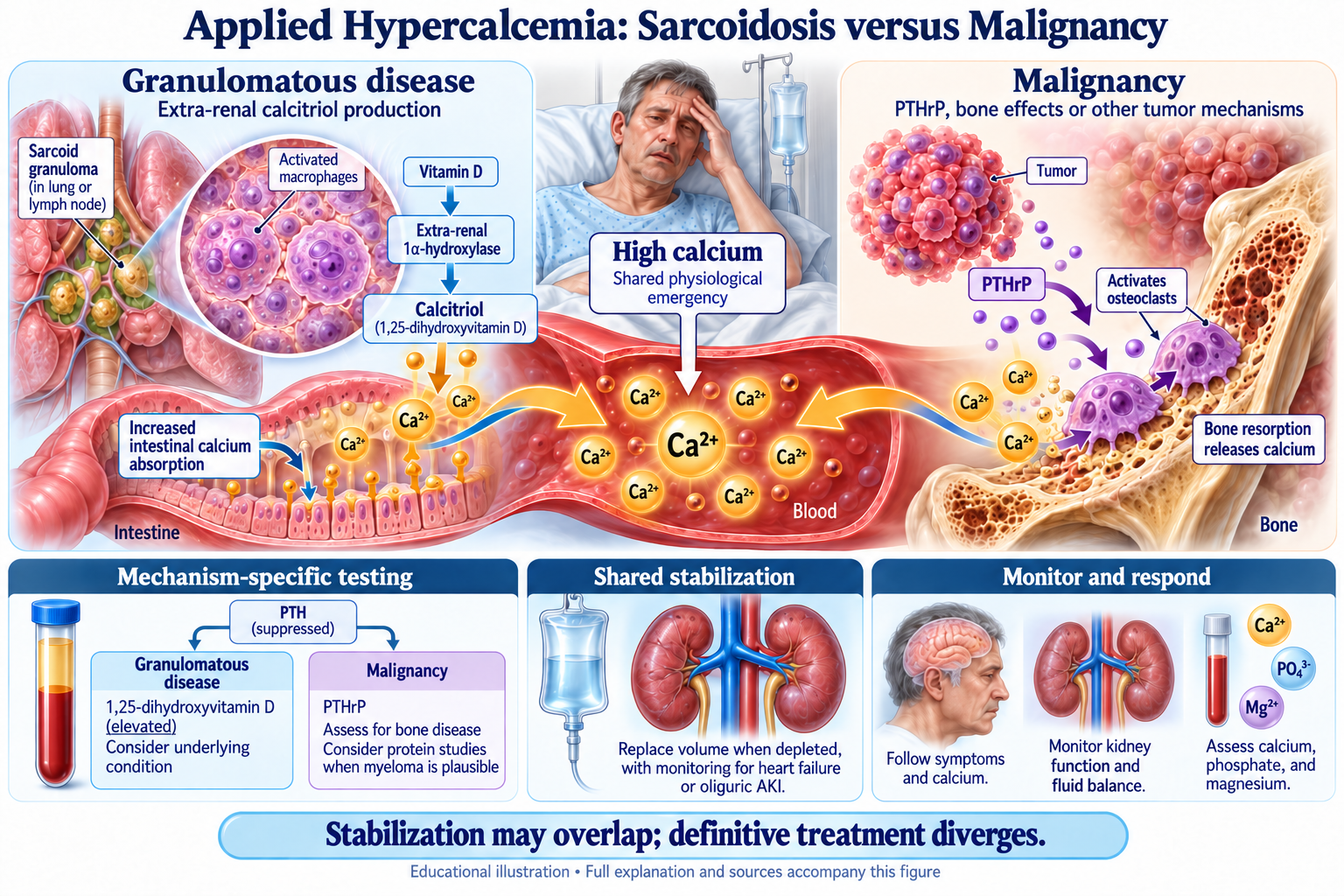
Learning Point: Granulomatous diseases (sarcoidosis, histoplasmosis, tuberculosis) cause hypercalcemia through extra-renal 1α-hydroxylase activity in activated macrophages, leading to excessive 1,25(OH)2D production. PTH is appropriately suppressed by the high calcium.
📚 Reference: Granulomatous Disease Section
Case Presentation
Patient: 45-year-old African American woman
Chief Complaint: "I've been so tired and confused lately, and I can't stop drinking water"
History: 3-month history of progressive fatigue, polyuria, polydipsia, depression, and cognitive difficulties. Reports drinking 4-5 liters of water daily and urinating frequently. Has lost 15 pounds over the past 2 months despite normal appetite. Denies fever, but notes occasional dry cough for 6 months.
Past Medical History: Hypertension (well-controlled on lisinopril), no known kidney disease
Medications: Lisinopril 10 mg daily, vitamin D3 2000 IU daily (started 4 months ago), multivitamin
Social History: Non-smoker, occasional alcohol, works as a nurse, recently returned from vacation in Arizona
Family History: Mother with "kidney stones," father with diabetes
🤔 Initial Clinical Reasoning Questions
Based on the constellation of symptoms (polyuria, polydipsia, fatigue, depression, weight loss), which condition should be high on your differential?
Clinical Reasoning: The classic presentation of hypercalcemia includes the "stones, bones, groans, and psychiatric moans." This patient has prominent psychiatric (depression, confusion) and renal symptoms (polyuria/polydipsia from nephrogenic diabetes insipidus). The combination of neuropsychiatric symptoms with nephrogenic DI is highly suggestive of hypercalcemia.
📚 Learn More: Hypercalcemia - Clinical Manifestations
What historical detail most strongly suggests a potential underlying cause of hypercalcemia?
Clinical Reasoning: Chronic dry cough in a middle-aged African American woman is a classic presentation of pulmonary sarcoidosis. African Americans have 3-4x higher incidence of sarcoidosis and are more likely to develop hypercalcemia. While vitamin D supplementation could contribute, 2000 IU daily is typically insufficient to cause toxicity alone.
📚 Learn More: Hypercalcemia - Sarcoidosis Section
Physical Examination & Vital Signs
Vital Signs
- Blood Pressure: 148/92 mmHg (normally 130/80)
- Heart Rate: 88 bpm, regular
- Temperature: 98.8°F (37.1°C)
- Respiratory Rate: 16/min
- Oxygen Saturation: 96% on room air
- Weight: 145 lbs (previous 160 lbs)
Physical Findings
- General: Alert but appears mildly lethargic
- HEENT: Dry mucous membranes, no lymphadenopathy
- Cardiovascular: Regular rate/rhythm, no murmurs
- Pulmonary: Occasional fine crackles at bilateral bases
- Extremities: No peripheral edema, no joint swelling
- Neurologic: Mild confusion, hyporeflexia
📊 Physical Exam Analysis
What physical finding supports your suspicion of pulmonary sarcoidosis?
Learning Point: Bilateral fine crackles at the lung bases, combined with chronic dry cough, are consistent with pulmonary sarcoidosis. The dry mucous membranes and hyporeflexia are likely consequences of hypercalcemia (volume depletion and neuromuscular effects).
📚 Reference: Sarcoidosis Clinical Features
Laboratory Data & Analysis
Initial Laboratory Values
| Parameter | Patient Value | Normal Range | Clinical Significance |
|---|---|---|---|
| Serum Calcium (total) | 12.8 mg/dL | 8.5-10.5 mg/dL | Significantly elevated |
| Serum Albumin | 3.2 g/dL | 3.5-5.0 g/dL | Low (corrected Ca ~13.4 mg/dL) |
| Ionized Calcium | 1.45 mmol/L | 1.15-1.30 mmol/L | Elevated (confirms hypercalcemia) |
| Serum Phosphorus | 4.1 mg/dL | 2.5-4.5 mg/dL | Upper normal |
| Serum Creatinine | 1.4 mg/dL | 0.6-1.2 mg/dL | Mild elevation (baseline 0.9) |
| BUN | 32 mg/dL | 7-20 mg/dL | Elevated (prerenal component) |
| PTH (intact) | 8 pg/mL | 15-65 pg/mL | Appropriately suppressed |
📊 Laboratory Analysis Questions
What is the corrected calcium level given the patient's low albumin?
Calculation: Corrected Ca = Measured Ca + 0.8 × (4.0 - Albumin)
Corrected Ca = 12.8 + 0.8 × (4.0 - 3.2) = 12.8 + 0.8 × 0.8 = 12.8 + 0.64 = 13.44 mg/dL ≈ 13.4 mg/dL
Clinical Significance: Corrected calcium >13 mg/dL significantly increases suspicion for malignancy, though granulomatous disease can also reach these levels.
📚 Reference: Full article: 🔺 Hypercalcemia
The suppressed PTH level indicates which type of hypercalcemia?
Learning Point: PTH <20 pg/mL indicates PTH-independent hypercalcemia. This eliminates primary hyperparathyroidism and narrows the differential to malignancy, granulomatous diseases, vitamin D disorders, and other non-parathyroid causes. The parathyroid glands are appropriately responding to high calcium by suppressing PTH production.
📚 Reference: PTH-Guided Diagnostic Algorithm
Advanced Laboratory Studies
Vitamin D Studies & Additional Tests
| Parameter | Patient Value | Normal Range | Interpretation |
|---|---|---|---|
| 25(OH) Vitamin D | 38 ng/mL | 30-100 ng/mL | Normal (rules out vitamin D intoxication) |
| 1,25(OH)2 Vitamin D | 89 pg/mL | 18-72 pg/mL | Elevated (suggests extra-renal production) |
| PTHrP | 1.2 pmol/L | <4.2 pmol/L | Normal (rules out PTHrP-mediated malignancy) |
| ACE Level | 68 U/L | 8-53 U/L | Elevated (supports sarcoidosis) |
| 24h Urine Calcium | 420 mg/24h | 100-250 mg/24h | Elevated hypercalciuria |
| Alkaline Phosphatase | 95 U/L | 44-147 U/L | Normal |
🎯 Sarcoidosis Laboratory Pattern Recognition
Classic Sarcoidosis Pattern
- ✅ PTH: Suppressed (<20 pg/mL)
- ✅ 1,25(OH)2D: Elevated (>72 pg/mL)
- ✅ 25(OH)D: Normal or low
- ✅ ACE: Elevated (>53 U/L)
- ✅ Hypercalciuria: Often prominent
- ✅ PTHrP: Normal
Mechanism Explanation
- Extra-renal 1α-hydroxylase: Activated macrophages in granulomas
- Substrate consumption: 25(OH)D → 1,25(OH)2D
- Increased absorption: Intestinal calcium uptake
- Seasonal variation: Worse in summer (sun exposure)
- Vitamin D sensitivity: Exaggerated response to supplements
🔬 Advanced Laboratory Interpretation
What is the most important laboratory finding that supports sarcoidosis as the cause of hypercalcemia?
Learning Point: Elevated 1,25(OH)2D with normal/low 25(OH)D is the pathognomonic laboratory pattern for granulomatous disease-induced hypercalcemia. This indicates extra-renal 1α-hydroxylase activity in granulomas. While elevated ACE supports sarcoidosis, it's not specific and can be elevated in other conditions.
📚 Reference: Granulomatous Disease Patterns
Hypercalcemia Laboratory Patterns by Etiology
Comprehensive diagnostic reference for pattern recognition
🎯 Our Patient's Pattern Match
Patient Values
- PTH: 8 pg/mL (↓)
- PTHrP: 1.2 pmol/L (Normal)
- 1,25(OH)2D: 89 pg/mL (↑)
- 25(OH)D: 38 ng/mL (Normal)
- ACE: 68 U/L (↑)
Perfect Match
SARCOIDOSIS pattern - identical to the highlighted row above. Could also match lymphoma, but clinical features (BHL, ACE elevation, African American woman) strongly favor sarcoidosis.
VITAMINS TRAP: Comprehensive Hypercalcemia Mnemonic
Master the complete differential diagnosis of hypercalcemia with this systematic approach
🆅 - VITAMIN D Intoxication
- Excessive supplementation (>50,000 IU daily)
- 25(OH)D >100 ng/mL diagnostic
- Mechanism: ↑ intestinal Ca absorption
- Treatment: Stop vitamin D, glucocorticoids
🅸 - IMMOBILIZATION
- Paget's disease + bedrest
- Spinal cord injury patients
- Mechanism: ↑ bone resorption
- Prevention: Early mobilization
🅣 - THIAZIDE Diuretics
- 8-10% of thiazide users
- Mechanism: ↑ distal Ca reabsorption
- May unmask hyperparathyroidism
- Usually reversible within weeks
🅰 - VITAMIN A Intoxication
- Chronic: >25,000 IU daily for months
- Acute: >300,000 IU single dose
- Mechanism: ↑ bone resorption
- Associated: Hepatotoxicity, bone pain
🅼 - MALIGNANCY
- PTHrP (80%): Squamous cell, lung, RCC
- Osteolytic (20%): Breast, myeloma
- Ca >13 mg/dL: 80-90% malignancy
- Poor prognosis: Median survival 2-3 months
🅸 - INTOXICATIONS
- Milk-alkali syndrome
- Excessive calcium supplements
- Lithium (affects calcium-sensing receptor)
- Theophylline overdose (rare)
🅽 - NEOPLASM (Lymphomas)
- 🎯 THIS CASE: Extra-renal 1α-hydroxylase
- Hodgkin & Non-Hodgkin lymphoma
- Adult T-cell leukemia/lymphoma (HTLV-1)
- Mechanism similar to sarcoidosis
🆂 - SARCOIDOSIS & Granulomas
- 🎯 THIS CASE: Primary focus
- Histoplasmosis, tuberculosis
- Coccidioidomycosis
- Treatment: Glucocorticoids first-line
🅣 - THYROTOXICOSIS
- 20% of hyperthyroid patients
- Mechanism: ↑ bone resorption
- Usually mild Ca <12 mg/dL
- Reversible with thyroid treatment
🆁 - RENAL FAILURE
- Tertiary hyperparathyroidism
- Post-transplant: 30-50% develop
- Aluminum toxicity (dialysis)
- Treatment: Cinacalcet, parathyroidectomy
🅰 - ADRENAL INSUFFICIENCY
- Addison's disease
- Mechanism: Volume depletion
- Associated: Hyperkalemia, hyponatremia
- Treatment: Glucocorticoid replacement
🅿 - PRIMARY HYPERPARATHYROIDISM
- Adenoma (85%), hyperplasia (15%)
- PTH elevated or inappropriately normal
- #1 cause in outpatients
- Treatment: Parathyroidectomy
📚 VITAMINS TRAP Application
Based on our patient's presentation and labs, which letters from VITAMINS TRAP are most relevant to consider?
Learning Point: With suppressed PTH, elevated 1,25(OH)2D, normal 25(OH)D, elevated ACE, and clinical features suggesting pulmonary sarcoidosis, both S (Sarcoidosis) and N (Neoplasm/lymphoma) from VITAMINS TRAP are the most relevant. Both can cause identical laboratory patterns through extra-renal 1α-hydroxylase activity.
📚 Learn More: VITAMINS TRAP Differential Diagnosis
Imaging Studies
Chest X-ray Findings
- Bilateral hilar lymphadenopathy
- Reticulonodular opacities in bilateral mid-lungs
- No pleural effusions
- Heart size normal
- Stage II pulmonary sarcoidosis pattern
Radiologist interpretation: "Findings consistent with Stage II pulmonary sarcoidosis. Bilateral hilar lymphadenopathy with parenchymal involvement."
CT Chest (High Resolution)
- Bilateral mediastinal and hilar lymphadenopathy
- Perilymphatic micronodules
- Upper lobe predominant distribution
- No honeycombing or traction bronchiectasis
- No evidence of malignancy
Radiologist interpretation: "Classic CT pattern for pulmonary sarcoidosis. No findings suggestive of lymphoma or other malignancy."
📷 Imaging Interpretation
What imaging finding most strongly supports the diagnosis of sarcoidosis?
Learning Point: Bilateral hilar lymphadenopathy (BHL) with parenchymal involvement defines Stage II pulmonary sarcoidosis and is the classic radiographic pattern. Stage I is BHL alone, Stage III is parenchymal disease without BHL, and Stage IV includes fibrosis. The perilymphatic distribution and upper lobe predominance are additional supportive features.
📚 Learn More: Sarcoidosis Imaging and Staging
Emergency Hypercalcemia Management: Challenges & Solutions
Critical analysis of treatment approaches, limitations, and evidence-based protocols
🚰 Saline Hydration: First-Line but Complex
✅ Benefits
- Restores volume depletion
- Increases calcium excretion
- Improves GFR and calcium clearance
- Safe and readily available
⚠️ Challenges
- Risk of volume overload in elderly/CKD
- May worsen heart failure
- Limited efficacy alone in severe cases
- Requires careful monitoring
💊 Furosemide: Powerful but Problematic
✅ Benefits
- Enhances calcium excretion
- Prevents/treats volume overload
- Rapid onset of action
- Useful in patients with heart failure
⚠️ Major Challenges
- Risk of severe volume depletion
- Can worsen kidney function
- Electrolyte disturbances (K+, Mg2+)
- ONLY use after volume restoration
🐟 Calcitonin: Rapid but Temporary
✅ Benefits
- Rapid onset (2-4 hours)
- Safe in kidney disease
- Bridges to bisphosphonate effect
- Can repeat dosing
⚠️ Major Limitation: Tachyphylaxis
- Effect diminishes after 48-72 hours
- Receptor downregulation
- Modest calcium reduction (1-2 mg/dL)
- Cannot be sole long-term therapy
💀 Bisphosphonates: Definitive but Delayed
✅ Benefits
- Most effective long-term therapy
- Duration: 2-4 weeks
- Zoledronic acid most potent
- Addresses bone resorption
⚠️ Challenges
- Delayed onset (24-48 hours)
- Contraindicated if CrCl <30
- Risk of osteonecrosis of jaw
- Requires pre-infusion dental evaluation
🎯 Key Clinical Pearl: Thiazide Paradox
🤔 The Paradox
Thiazides typically CAUSE hypercalcemia by increasing distal tubular calcium reabsorption. Yet patients on thiazides often have LOWER baseline calcium levels.
💡 The Explanation
Thiazides may unmask mild hyperparathyroidism rather than causing true hypercalcemia. The "normal" baseline calcium on thiazides may represent suppressed abnormal parathyroid function.
Treatment Planning & Protocol Questions
What is the FIRST-LINE treatment for sarcoidosis-induced hypercalcemia?
Treatment Rationale: Corticosteroids are first-line for sarcoidosis-induced hypercalcemia because they suppress the extra-renal 1α-hydroxylase activity in granulomas, directly addressing the underlying mechanism. Standard initial dosing is prednisone 20–40 mg/day (often 20–30 mg) per Sharma 1996 / WASOG sarcoidosis treatment guidance, with rapid response in 2–5 days. Unlike malignancy-associated hypercalcemia, steroids provide both symptom relief and treatment of the underlying disease process.
📚 Reference: Granulomatous Disease Treatment
When using furosemide in hypercalcemia treatment, what is the most important precaution?
Critical Safety Point: Furosemide should NEVER be used before volume restoration as it can cause severe volume depletion, worsening hypercalcemia and kidney function. The sequence is: 1) Aggressive saline hydration first, 2) Then furosemide if volume overload develops. This prevents the dangerous combination of dehydration and hypercalcemia.
📚 Learn More: Hypercalcemia Emergency Management
Why does calcitonin lose effectiveness after 48-72 hours?
Mechanism: Calcitonin causes tachyphylaxis through downregulation of calcitonin receptors on osteoclasts and kidney tubules. This is why calcitonin is useful for rapid initial control but cannot be relied upon for sustained therapy. Bisphosphonates must be started early to provide longer-term calcium control.
📚 Learn More: Hypercalcemia - Calcitonin and Bisphosphonate Therapy
Treatment Timeline & Patient Response
Day 1-2: Emergency Management
• Patient received 2 liters NS over 8 hours • No signs of volume overload • Urine output improved to 80 mL/hr
• Initiated 6 hours after admission • Calcium decreased from 12.8 to 11.9 mg/dL by 24 hours • No adverse effects
• Started after confirming sarcoidosis diagnosis • Patient counseled on steroid side effects • Blood glucose monitoring initiated
Day 3-7: Response to Treatment
| Day | Calcium (mg/dL) | Creatinine (mg/dL) | Symptoms | Treatment |
|---|---|---|---|---|
| Day 1 | 12.8 | 1.4 | Confused, lethargic | NS + Calcitonin started |
| Day 2 | 11.9 | 1.2 | More alert, less polyuria | Prednisone added |
| Day 4 | 11.1 | 1.0 | Significantly improved | Calcitonin discontinued |
| Day 7 | 10.2 | 0.9 | Back to baseline | Prednisone taper planned |
📈 Treatment Response Analysis
Why was calcitonin discontinued on day 4 despite continued mild hypercalcemia?
Clinical Decision: Calcitonin loses effectiveness due to receptor downregulation after 48-72 hours. By day 4, the prednisone was taking effect (note the continuing calcium decline), making calcitonin unnecessary. Continuing ineffective calcitonin would provide no benefit and incur unnecessary cost.
📚 Learn More: Granulomatous Hypercalcemia Treatment
Learning Objectives Assessment
Evaluate your mastery of the key learning objectives from this case
🎯 Learning Objective 1: Master VITAMINS TRAP Mnemonic Application
Objective: Systematically apply the VITAMINS TRAP mnemonic to evaluate hypercalcemia patients and identify the most likely etiology based on clinical and laboratory patterns.
A 35-year-old white male presents with Ca 13.2 mg/dL, PTH 6 pg/mL, 25(OH)D 165 ng/mL, 1,25(OH)2D 45 pg/mL. Which VITAMINS TRAP letter is most likely?
Competency Demonstration: Markedly elevated 25(OH)D (greater than 150 ng/mL is the toxicity threshold per Holick 2007 NEJM) with suppressed PTH and normal/low 1,25(OH)2D indicates vitamin D intoxication. Unlike sarcoidosis (where 1,25(OH)2D is the elevated metabolite from extra-renal 1-alpha-hydroxylase activity), vitamin D intoxication accumulates the substrate 25(OH)D from excessive supplementation. The 25-100 ng/mL range is "sufficient"; toxicity requires greater than 150 ng/mL with hypercalcemia.
📚 Master This: Complete VITAMINS TRAP Guide
🎯 Learning Objective 2: Recognize Granulomatous Disease Patterns
Objective: Identify the characteristic laboratory pattern of extra-renal 1α-hydroxylase activity and understand its clinical implications for diagnosis and treatment.
What laboratory pattern is pathognomonic for granulomatous disease-induced hypercalcemia?
Competency Demonstration: This triad (↓PTH, ↑1,25(OH)2D, normal/low 25(OH)D) indicates extra-renal 1α-hydroxylase activity converting substrate to active hormone outside normal kidney regulation.
📚 Learn More: Granulomatous Disease Lab Patterns
🎯 Learning Objective 3: Understand Treatment Challenges and Sequencing
Objective: Master the complexities of hypercalcemia treatment including proper sequencing, recognition of limitations, and cause-specific approaches.
What is the correct sequence for emergency hypercalcemia management?
Competency Demonstration: Proper sequencing prevents complications: saline first restores volume and improves calcium excretion, calcitonin provides rapid temporary control, furosemide only if volume overloaded, and bisphosphonates for definitive long-term control.
📚 Learn More: Hypercalcemia Treatment Sequencing
Case Reflection & Multi-Module Integration
⚡ Hypercalcemia Module Integration
- VITAMINS TRAP systematic approach
- PTH-dependent vs PTH-independent classification
- Emergency management protocols and sequencing
- Laboratory pattern recognition and interpretation
🫁 Granulomatous Disease Integration
- Extra-renal 1α-hydroxylase physiology
- Sarcoidosis epidemiology and risk factors
- Radiographic patterns and staging
- Corticosteroid therapy principles
🚨 Emergency Management Integration
- Fluid therapy principles and monitoring
- Calcitonin pharmacology and limitations
- Bisphosphonate selection and contraindications
- Multi-organ system effects assessment
💊 Drug Effects Integration
- Thiazide paradox understanding
- Vitamin D supplementation risks
- Drug-induced hypercalcemia mechanisms
- Medication history importance
🎯 Key Integration Concepts
This case demonstrates the critical importance of systematic evaluation using mnemonics like VITAMINS TRAP, understanding disease-specific pathophysiology (extra-renal 1α-hydroxylase), recognizing treatment limitations and sequencing requirements, and integrating knowledge across electrolyte disorders, emergency medicine, pulmonary medicine, and pharmacology. The case highlights how a systematic approach leads to accurate diagnosis and appropriate management even in complex presentations.
Advanced Integration Challenge
A 42-year-old man with known sarcoidosis (on chronic prednisone) develops recurrent hypercalcemia despite steroid therapy. What is the most appropriate next step?
Advanced Clinical Reasoning: Sarcoidosis patients are at increased risk for lymphoma development. When hypercalcemia becomes refractory to corticosteroids that previously controlled it, suspect malignancy (especially lymphoma) or other complications. Both sarcoidosis and lymphoma can cause identical laboratory patterns through extra-renal 1α-hydroxylase activity.
🔗 Integration Point: This demonstrates how VITAMINS TRAP letters S (Sarcoidosis) and N (Neoplasm) can coexist or transform.
Why might this patient's hypercalcemia worsen during summer months despite stable sarcoidosis therapy?
Advanced Pathophysiology: Sarcoidosis patients have seasonal variation in hypercalcemia because sun exposure increases vitamin D production, providing more 25(OH)D substrate for conversion to 1,25(OH)2D by granulomatous 1α-hydroxylase. This is why patients should avoid sun exposure and vitamin D supplements.
🔗 Integration Point: Links vitamin D metabolism, seasonal factors, and disease management strategies.
📝 Case Summary & Clinical Pearls
This case demonstrates a classic presentation of sarcoidosis-induced hypercalcemia in a high-risk patient (African American woman) with typical features including bilateral hilar lymphadenopathy, elevated 1,25(OH)2D with normal 25(OH)D, and excellent response to corticosteroid therapy. The case emphasizes the systematic use of VITAMINS TRAP for differential diagnosis and highlights the importance of understanding treatment limitations and proper sequencing.
🔑 Key Clinical Pearls from This Case:
- VITAMINS TRAP Mastery: Systematic approach prevents missed diagnoses and guides appropriate workup
- Granulomatous Pattern Recognition: ↓PTH + ↑1,25(OH)2D + normal 25(OH)D = extra-renal 1α-hydroxylase
- Treatment Sequencing: Saline → Calcitonin → Furosemide (if needed) → Bisphosphonates; corticosteroids first-line for granulomatous disease
- Calcitonin Limitations: Tachyphylaxis after 48-72 hours limits utility to bridging therapy only
- Thiazide Paradox: Usually cause hypercalcemia but may have lower baseline calcium levels
- Seasonal Awareness: Sarcoidosis hypercalcemia worsens with sun exposure due to increased vitamin D substrate