Pre-Case Assessment: Emergency Hyperkalemia Knowledge
Test your baseline knowledge of hyperkalemia emergencies before reviewing this case
Which ECG finding is MOST concerning and requires immediate intervention in hyperkalemia?
Critical Teaching: Absent P waves + wide QRS indicates severe hyperkalemia with imminent risk of ventricular fibrillation or asystole. This represents atrial paralysis and requires immediate calcium gluconate.
📚 Reference: Progressive ECG Changes in Hyperkalemia
What is the mechanism of action for calcium gluconate in hyperkalemia treatment?
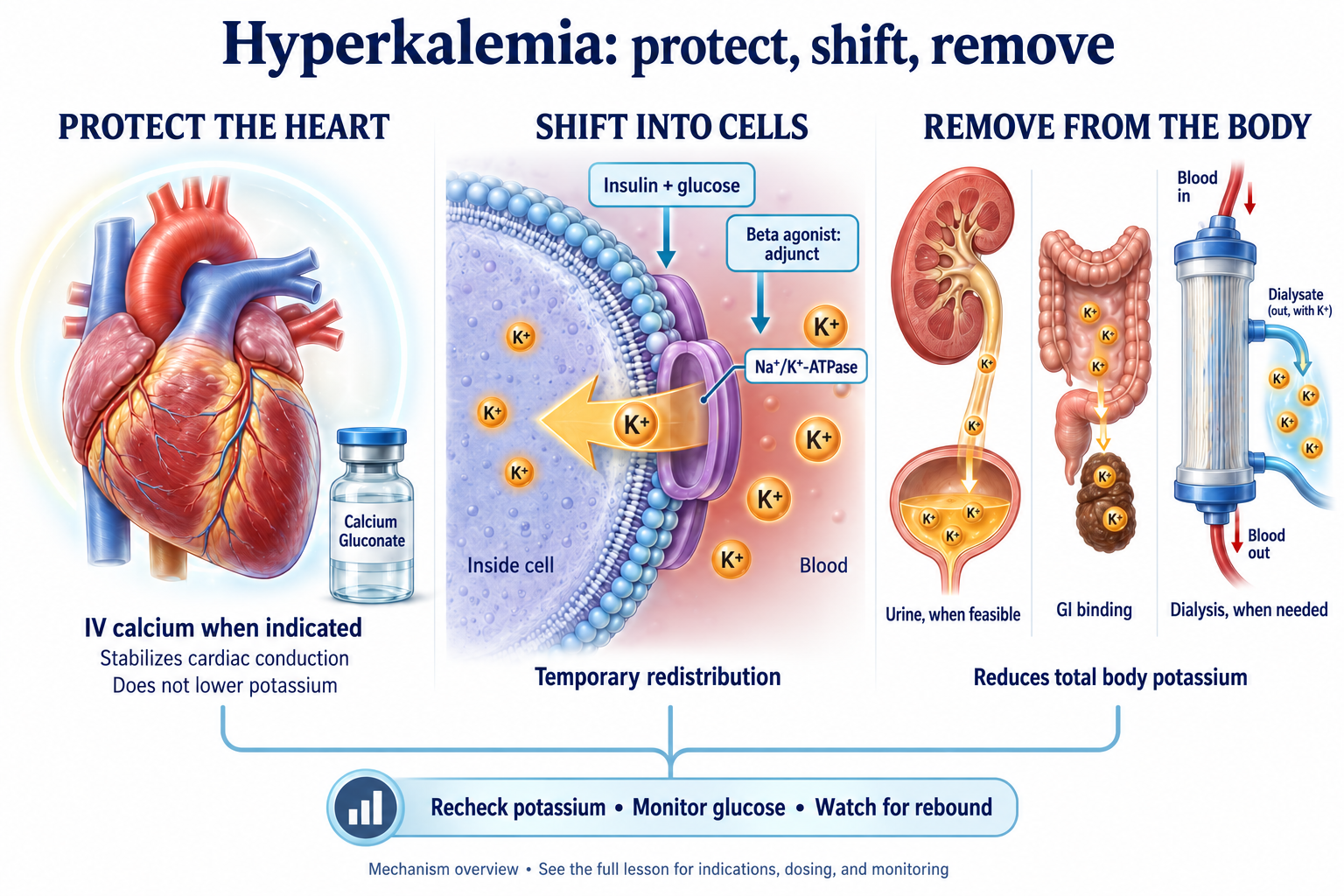
Key Mechanism: Calcium stabilizes cardiac membranes by restoring normal action potential without affecting serum K+ levels. This is why it provides immediate cardioprotection but doesn't treat the underlying hyperkalemia.
📚 Reference: Calcium Membrane Stabilization
In a CKD patient with hyperkalemia, which medication change provides the GREATEST long-term benefit while minimizing hyperkalemia risk?
Clinical Strategy: RAAS inhibitors provide critical cardio-renal protection in CKD. K+ binders allow continuation of these beneficial medications while managing hyperkalemia risk.
📚 Reference: CKD Hyperkalemia Management
What is the expected timeline for emergency dialysis to effectively lower serum potassium in life-threatening hyperkalemia?
Dialysis Timeline: Emergency hemodialysis typically requires 2-4 hours to safely reduce K+ from dangerous levels (>7.0) to target levels (<5.5 mEq/L). Too rapid correction can cause rebound hyperkalemia.
📚 Reference: Emergency Dialysis Protocols
Emergency Presentation
Patient: 52-year-old man with diabetic nephropathy
Chief Complaint: Palpitations, weakness, and "feeling like my heart is skipping"
History: 3-day history of worsening fatigue and palpitations. Recently started on spironolactone for heart failure. Family brought him to ED when he became confused and complained of chest tightness.
Past Medical History: Type 2 diabetes (15 years), stage 4 CKD (eGFR 25), systolic heart failure (EF 35%), hypertension
Medications: Lisinopril 20mg daily, metoprolol 50mg BID, spironolactone 25mg daily (started 1 week ago), furosemide 40mg daily, insulin, atorvastatin
🤔 Initial Clinical Reasoning
Given this patient's medication regimen and CKD stage, what is the MOST likely cause of his acute presentation?
Clinical Reasoning: Triple combination of ACE inhibitor + K+-sparing diuretic + advanced CKD creates extremely high risk for life-threatening hyperkalemia. The 1-week timeline fits perfectly.
📚 Learn More: Hyperkalemia Causes & Risk Factors
What is the pathophysiologic mechanism by which spironolactone causes hyperkalemia in this patient?
Mechanism: Spironolactone blocks aldosterone receptors in the collecting duct, preventing Na+ reabsorption and K+ secretion. In CKD with already reduced nephron mass, this effect is magnified.
📚 Learn More: Hyperkalemia Pathophysiology
Why is the combination of ACE inhibitor + spironolactone particularly dangerous in stage 4 CKD?
Synergistic Effect: ACE inhibitors reduce aldosterone production, spironolactone blocks aldosterone action. With ~75% nephron loss in stage 4 CKD, remaining nephrons cannot compensate for this dual K+ retention.
📚 Learn More: Drug-Induced Hyperkalemia
Critical Assessment & ECG Analysis
Laboratory Values
| Parameter | Current Value | 1 Month Ago | Normal Range | Clinical Significance |
|---|---|---|---|---|
| Potassium | 7.8 mEq/L | 5.2 mEq/L | 3.5-5.0 mEq/L | LIFE-THREATENING |
| Sodium | 134 mEq/L | 138 mEq/L | 136-145 mEq/L | Mild hyponatremia |
| Creatinine | 3.2 mg/dL | 2.8 mg/dL | 0.6-1.2 mg/dL | Progressive CKD |
| eGFR | 20 mL/min/1.73m² | 25 mL/min/1.73m² | >60 mL/min/1.73m² | Stage 4 → approaching 5 |
📊 Laboratory Analysis Questions
The increase in potassium from 5.2 to 7.8 mEq/L represents a:
Critical Concept: Cardiac toxicity increases exponentially, not linearly. The jump from 5.2 to 7.8 mEq/L represents a massive increase in arrhythmia risk despite being "only" a 50% numerical increase.
📚 Learn More: Hyperkalemia Cardiac Toxicity
What is the significance of the concurrent creatinine rise from 2.8 to 3.2 mg/dL?
Pathophysiology: The creatinine rise reflects ongoing CKD progression, reducing K+ excretory capacity. Combined with spironolactone, this creates a "perfect storm" for life-threatening hyperkalemia.
📚 Learn More: CKD Progression & Electrolyte Complications
Interactive ECG Analysis Timeline
Click through each ECG stage to understand the progressive cardiac toxicity
⚡ K+ 5.5-6.5 mEq/L: Early ECG Changes
What would you expect to see at this stage, and why is it often missed?
Early ECG Findings:
- Tall, peaked T waves: >5mm in limb leads, narrow base
- Shortened QT interval: Due to rapid repolarization
- Normal QRS width: Conduction still intact
- Usually asymptomatic: Patients feel normal
⚠️ Clinical Pearl: Often missed because patients are asymptomatic and T-wave changes can be subtle. Always calculate QT interval!
⚡ K+ 6.5-7.5 mEq/L: Progressive Changes
As potassium continues rising, what additional ECG changes develop?
Progressive ECG Findings:
- Flattened/absent P waves: Atrial conduction impairment
- Prolonged PR interval: First-degree AV block
- QRS widening begins: Ventricular conduction delay
- Very peaked T waves: More pronounced, "tent-shaped"
🎯 Key Teaching: P wave flattening is an ominous sign - indicates atrial myocardium is becoming inexcitable.
🚨 K+ >7.5 mEq/L: CRITICAL Changes (This Patient)
At K+ 7.8 mEq/L, what life-threatening ECG pattern is developing?
CRITICAL ECG Findings (K+ 7.8 mEq/L):
- ❗ Absent P waves: Complete atrial paralysis
- ❗ Wide QRS (134ms): Severely prolonged conduction
- ❗ Sine wave pattern: QRS merging with T wave
- ❗ Junctional rhythm: Escape rhythm at 58 bpm
- ❗ Risk of VF/asystole: Minutes away from cardiac arrest
🚨 EMERGENCY: This ECG pattern requires immediate calcium gluconate - do not delay for lab confirmation!
🎯 ECG-Based Treatment Decisions
How should ECG findings guide your emergency treatment approach?
ECG-Guided Treatment Protocol:
- Normal ECG + K+ 5.5-6.0: Monitor, oral therapy possible
- Peaked T waves + K+ 6.0-6.5: IV therapy, close monitoring
- QRS widening + K+ >6.5: Immediate calcium, insulin/glucose
- Absent P waves + wide QRS: EMERGENCY protocol, prepare dialysis
🔑 Clinical Pearl: ECG changes are more predictive of cardiac risk than absolute K+ levels!
Emergency Management Decision Points
After initial stabilization, the potassium remains 6.3 mEq/L with improving ECG. What's the best next step?
Shift therapies are temporary; initiate removal via binders, diuretics (if making urine), or dialysis (if refractory/unstable).
📚 Reference: Hyperkalemia Emergency Protocol · Removal Therapies
Which ECG change most strongly indicates immediate calcium therapy?
Calcium stabilizes the myocardium and is indicated for life‑threatening ECG changes (e.g., QRS widening, sine wave).
📚 Reference: ECG Changes by Severity · Membrane Stabilization
For intracellular shift, which is the most rapid and reliable regimen in the ED?
Insulin/glucose reliably shifts K+ intracellularly within 15–30 minutes; pair with albuterol ± bicarbonate if acidotic.
📚 Reference: Shift Therapies · Stepwise Emergency Protocol
Which of the following is NOT a potassium removal strategy?
Albuterol is a shift therapy; it does not remove total body potassium.
📚 Reference: Removal vs Shift Therapies
When is urgent dialysis indicated for hyperkalemia?
Dialysis is for refractory or life‑threatening hyperkalemia, especially with ECG changes or anuric AKI.
📚 Reference: Emergency Dialysis Protocols
Advanced CKD Management Integration
📉 CKD Progression Analysis
Current status: Stage 4 CKD progressing to stage 5 (eGFR 20 mL/min/1.73m²)
Underlying etiology: Diabetic nephropathy with 15-year diabetes history
Accelerating factors: Poorly controlled hypertension, recent medication changes
🎯 Advanced CKD Management Questions
Which order of operations best reflects emergency hyperkalemia management?
Stabilize membrane first, then shift K+, then remove K+; reassess frequently.
📚 Reference: Emergency Protocol
In a non-dialysis patient with persistent K+ 6.0 mEq/L after shift therapy, which binder strategy is preferred acutely?
SZC has a relatively rapid onset among binders and is suitable as the first removal step post‑shift in hemodynamically stable patients.
📚 Reference: Potassium Binders · Removal Therapies
For chronic hyperkalemia in CKD on RAAS inhibitors, the preferred outpatient strategy is:
Preserving RAASi benefits is desirable; combine dietary measures, diuretics if euvolemic/hypervolemic, and binders to control K+.
📚 Reference: Chronic Hyperkalemia Management
Emergency Dialysis & Transition Planning
🔄 Emergency Dialysis Indications Analysis
Absolute Indications (Present)
- ✓ Life-threatening hyperkalemia (K+ 7.8)
- ✓ ECG changes (wide QRS, absent P waves)
- ✓ Failed medical management
- ✓ Limited endogenous clearance (eGFR 20)
Supporting Indications
- ✓ Metabolic acidosis (CO2 18)
- ✓ Volume overload (mild)
- ✓ Advanced CKD approaching ESRD
- ⚠️ Uremic symptoms developing
🔄 Dialysis Planning Questions
For urgent hemodialysis due to refractory hyperkalemia, which initial dialysate potassium bath do you select?
Very low K baths (e.g., 1 K) are associated with higher arrhythmic/CV risk; 2 K bath is preferred initially for safety and efficacy.
📚 Reference: Dialysis as Removal Therapy
Which factor most increases risk of rebound hyperkalemia after insulin/dextrose?
Intracellular shift is temporary; without removal, K+ will re-equilibrate to plasma.
📚 Reference: Protocol: Shift then Remove
Learning Objectives Mastery Assessment
Demonstrate mastery of integrated concepts across multiple modules
🎯 Learning Objective 1: Emergency Hyperkalemia Recognition & Management
Objective: Integrate ECG interpretation, emergency protocols, and clinical decision-making for life-threatening hyperkalemia.
Stable ED patient, K+ 6.1 mEq/L after calcium + insulin/D50; next best removal step?
SZC has a quicker onset among binders and is preferred first for acute removal in stable patients post‑shift; reassess K+ in 2–4 hours.
📚 Reference: Potassium Binders · Removal Therapies
🎯 Learning Objective 2: CKD-Hyperkalemia Management Integration
Objective: Balance cardio-renal protection with hyperkalemia prevention in advanced CKD.
Which dietary advice best supports long-term K+ control in CKD?
Education on potassium sources and cooking techniques reduces dietary K+ load without malnutrition.
📚 Reference: Chronic Management
🎯 Learning Objective 3: Emergency Dialysis Decision-Making
Objective: Apply evidence-based criteria for emergency dialysis and understand transition to chronic therapy.
CLINICAL DECISION QUESTION: When should emergency dialysis be initiated for hyperkalemia?
Evidence-Based Criteria: Emergency dialysis indicated for: (1) Life-threatening ECG changes, (2) Failed medical management, (3) Very high levels with symptoms. Absolute K+ levels alone are insufficient criteria.
📚 Master This: Emergency Dialysis Protocols
🏆 Final Integration Challenge
COMPREHENSIVE CHALLENGE: Design an optimal long-term management plan for this patient after recovery, considering all systems involved:
52-year-old man, diabetic nephropathy, eGFR now stable at 22 mL/min/1.73m², EF 35%, recent life-threatening hyperkalemia episode
🎯 Comprehensive Integration: Advanced CKD requires balancing multiple competing priorities:
- Hyperkalemia Prevention: K+ binder, dietary modification, medication adjustment
- Cardio-Renal Protection: Continued but reduced RAAS inhibition
- CKD-MBD Management: Phosphate binders, vitamin D, PTH monitoring
- Diabetes Optimization: Moderate targets, avoid hypoglycemia
- Dialysis Preparation: Access planning, modality education
🏆 Mastery Demonstrated: This approach integrates learning from hyperkalemia emergencies, CKD management, dialysis planning, and cardiorenal disease into evidence-based comprehensive care.
📚 Learn More: Comprehensive CKD Management
Multi-Module Integration & Clinical Synthesis
⚡ Electrolyte Emergency Module
- Progressive ECG changes and cardiac risk stratification
- Three-phase emergency protocol: Stabilize-Shift-Eliminate
- K+ level vs ECG correlation for treatment decisions
- Calcium mechanism and timing of administration
- Combination therapy for maximal K+ shifting
📉 Advanced CKD Management
- Stage 4-5 CKD complications and medication challenges
- Balancing cardio-renal protection with safety
- CKD-MBD evaluation and management priorities
- K+ binder integration for RAAS continuation
- Diabetes management in advanced kidney disease
🔄 Emergency Dialysis Integration
- Emergency dialysis indications and contraindications
- K+ bath selection and correction strategies
- Temporary vascular access considerations
- Transition from emergency to chronic dialysis
- Modality selection in urgent-start situations
💔 Cardiorenal Emergency
- Cardiac electrophysiology and K+ toxicity
- Heart failure medication challenges in CKD
- Volume management in cardiorenal syndrome
- Risk stratification for future episodes
- Coordinated cardiology-nephrology care
🎯 Integrated Clinical Mastery
This case exemplifies the complexity of advanced kidney disease management, where emergency presentations intersect with chronic disease progression and multi-system complications. Mastery requires understanding how hyperkalemia pathophysiology, ECG interpretation, emergency protocols, CKD management strategies, and dialysis planning integrate into comprehensive patient care. The case emphasizes that effective nephrology practice demands rapid emergency response capabilities combined with long-term strategic thinking and multi-disciplinary coordination.
🚨 Emergency Excellence
Rapid recognition, evidence-based protocols, and systematic approach to life-threatening presentations
🧠 Systems Integration
Understanding complex interactions between kidney disease, cardiac function, and medication effects
🎯 Strategic Planning
Balancing immediate stabilization with long-term management goals and quality of life
Treatment Response & Recovery Timeline
T=0-10 minutes: Emergency Stabilization
Calcium gluconate 2g IV: QRS narrowed from 134ms to 118ms within 5 minutes
Insulin/glucose: 10 units insulin + 25g glucose IV push
Clinical improvement: Reduced palpitations, improved alertness
T=10-30 minutes: K+ Shifting
Albuterol 20mg nebulizer: High-dose treatment completed
K+ response: 7.8 → 6.9 mEq/L (0.9 mEq/L reduction)
ECG improvement: QRS 118ms, P waves beginning to appear
T=30-120 minutes: Dialysis Preparation
Nephrology consultation: Emergency dialysis indicated
Vascular access: Right IJ temporary catheter placed
Further improvement: K+ 6.2 mEq/L, QRS 108ms
T=2-6 hours: Emergency Hemodialysis
Dialysis parameters: 2 K+ bath (2 mEq/L) for initial 4-hour session — preferred over a 1 K bath to reduce arrhythmic risk per Pun 2007 and Karaboyas 2017 (consistent with this case's Q16 teaching)
Final K+ level: 4.8 mEq/L (controlled reduction)
ECG normalization: QRS 92ms, normal P waves and T waves
Clinical recovery: Complete symptom resolution
📝 Case Summary & Clinical Excellence
This enhanced case demonstrates life-threatening hyperkalemia requiring integration of emergency medicine, cardiology, nephrology, and critical care principles. The systematic approach from ECG recognition through emergency stabilization to long-term management planning exemplifies the complexity and reward of advanced nephrology practice. Key mastery concepts include ECG-guided treatment decisions, the balance between emergency intervention and definitive therapy, and the integration of acute crisis management with chronic disease progression.
🔑 Master Clinician Pearls:
- ECG Over Labs: Absent P waves + wide QRS = immediate calcium, regardless of K+ level
- Triple Threat Recognition: ACE inhibitor + spironolactone + advanced CKD = hyperkalemia emergency
- Three-Phase Protocol: Stabilize (calcium) → Shift (insulin/albuterol) → Eliminate (dialysis)
- Recovery Planning: Emergency episodes often precipitate chronic dialysis transition
- System Integration: Advanced CKD requires balancing competing priorities across multiple organ systems
- Prevention Focus: K+ binders enable continued cardio-renal protection while preventing recurrence