GLP-1 Receptor Agonists — PT Edition
Level: DPT Student · Duration: 20–30 minutes · Version: 2026-04-18
What this handout gets you
- A defensible answer when your cardiac-rehab patient says "My weight is dropping fast — should I cut back on training?"
- The counter-intuitive clinical finding driving today's obesity/cardiology/nephrology revolution — and the landmark trials behind it.
- The sarcopenia risk embedded in rapid GLP-1–driven weight loss and why resistance training is not optional.
- Peri-operative holds: why your ortho patient may be told to skip semaglutide the week before surgery.
- Red flags that mean pause the session and call the prescribing clinician.
Visual reference
Browse the visual reference library · Download lesson Markdown
1. Why This Matters to You as a PT
GLP-1 receptor agonists — semaglutide (Ozempic, Wegovy, Rybelsus), liraglutide (Victoza, Saxenda), dulaglutide (Trulicity), and the dual GIP/GLP-1 agonist tirzepatide (Mounjaro, Zepbound) — have moved from "niche diabetes drug" to arguably the biggest prescribing story of the decade. Your clinic panel is saturated with patients on them. A cardiac-rehab patient on semaglutide for T2DM and heart failure. An orthopedic patient three months before a total knee, losing 1 kg per week on tirzepatide. An older adult on liraglutide with a fall last month. A post-op patient who kept taking semaglutide the day before surgery and aspirated.
Three realities drive what PT needs to own:
- Rapid weight loss comes with disproportionate lean-mass loss unless resistance training and adequate protein protect against it. PT is the primary intervention that protects muscle during a GLP-1 course.
- Peri-procedural aspiration risk from delayed gastric emptying has changed pre-op hold windows. PTs who coordinate pre-habilitation or see patients near surgery need to know the rules.
- Volume/BP/orthostatic shifts during early titration change exercise tolerance. Session intensity needs to flex, especially in the first 4–8 weeks.
The PT's three jobs on GLP-1 RAs
- Prescribe resistance training from day one — 2–3 sessions/week covering all major muscle groups at moderate-to-high intensity. Count this as a non-negotiable, not a preference.
- Counsel protein intake (1.2–1.6 g/kg/day, distributed across meals) and coordinate with the dietitian or prescribing clinician.
- Recognize the peri-op, orthostatic, and hypoglycemia windows that mean modify or pause — and know the red flags that mean escalate.
2. What GLP-1 RAs Actually Do (Mechanism, Minimal)
The Incretin Effect in One Paragraph
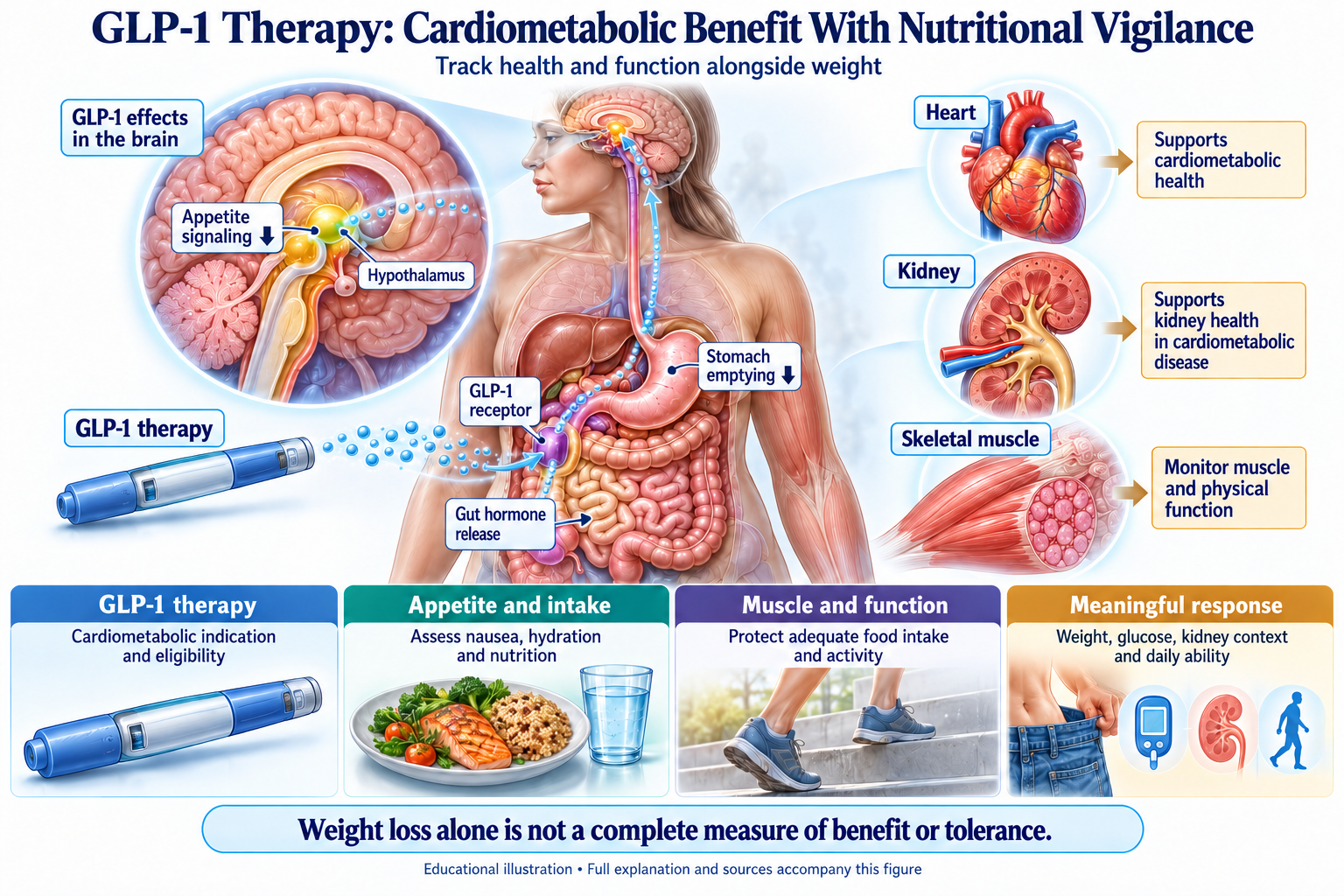
GLP-1 (glucagon-like peptide-1) is a gut hormone released after meals. It does four things that matter clinically: potentiates glucose-dependent insulin secretion, suppresses glucagon, slows gastric emptying, and acts centrally to reduce appetite. GLP-1 receptor agonists are long-acting analogs that exploit all four effects. Tirzepatide adds a GIP receptor agonist component, which amplifies the weight-loss signal. The slowed gastric emptying is what drives both the GI side-effect burden and the peri-op aspiration concern.
Who Gets These Drugs — and Why
| Indication | Landmark trial | Bottom line |
|---|---|---|
| Type 2 diabetes + CV risk | LEADER (liraglutide)[1] | Lower rate of CV death, MI, or stroke vs placebo in high-CV-risk T2DM. |
| Obesity + established CV disease, no diabetes | SELECT (semaglutide 2.4 mg)[2] | 17,604 patients. Primary CV composite 6.5% semaglutide vs 8.0% placebo; hazard ratio 0.80 (95% CI 0.72–0.90, P<0.001). |
| HFpEF + obesity | STEP-HFpEF (semaglutide 2.4 mg)[3] | Improved KCCQ symptom scores and 6-minute walk distance; meaningful weight loss. |
| Type 2 diabetes + CKD | FLOW (semaglutide 1.0 mg)[4] | 3,533 patients. 24% lower risk of major kidney disease events (hazard ratio 0.76, 95% CI 0.66–0.88, P=0.0003). Also reduced CV death and all-cause mortality. |
| Chronic weight management | STEP program (semaglutide), SURMOUNT program (tirzepatide) | 15–22% body-weight reductions at 68 weeks, dose-dependent. |
Your patients are on these drugs because they work — the weight, glucose, CV, and renal signals are real. The PT's job is not to second-guess the prescription; it is to manage the tradeoffs while the patient benefits.
Renal and Cardiovascular Signals — What to Expect, Not What to Fear
- Mild eGFR dip on initiation is expected and not harmful — similar to SGLT2i and RAAS blockers.
- Improved long-term kidney outcomes (FLOW).
- Reduced major adverse CV events across LEADER, SELECT, and other CV outcomes trials.
- Heart-failure benefit in HFpEF + obesity specifically (STEP-HFpEF) — symptomatic and functional.
None of these benefits require anything specific from PT — they accrue as long as the patient stays on therapy and avoids the pitfalls below.
3. What You Will See in Clinic
The Sarcopenia Signal — the Most PT-Relevant Concern
Weight loss on GLP-1 RAs is not proportional across compartments. Body-composition sub-studies of semaglutide and tirzepatide show that approximately 25–40% of total weight loss comes from lean mass rather than fat, depending on the drug, dose, and whether the patient resistance-trains. This is similar to lean-mass loss in any calorie-deficit weight-loss program, but the speed of GLP-1–driven weight loss amplifies it. For older adults, sarcopenic-obesity patients, and anyone with pre-existing functional limitations, this matters a lot — lost lean mass predicts falls, sarcopenia, and loss of independence.
Resistance training protects lean mass during GLP-1 therapy. The exact quantitative benefit varies by study, but the direction of effect is consistent: patients who resistance-train during weight loss preserve more lean mass and come out of the weight-loss course stronger, not weaker. PT is the intervention.
GI Side Effects — the #1 Reason Patients Stop
- Nausea, vomiting, diarrhea, constipation, abdominal discomfort — worst during titration, usually diminishes over 4–8 weeks.
- Severe enough in some patients to impair food intake (protein intake in particular) and reduce exercise tolerance.
- Rare: pancreatitis (stop drug, seek care); gastroparesis worsening in diabetic patients.
The SELECT trial had 16.6% discontinuation for adverse events in the semaglutide arm vs 8.2% placebo[2] — so roughly 1 in 6 patients will stop because of GI burden. Expect this.
The High-Risk Patient Profile
- Older adults — sarcopenia risk amplified; falls; frailty.
- Patients on insulin or sulfonylureas — hypoglycemia risk when combined with GLP-1 RA, especially with missed meals.
- Patients in the first 4–8 weeks of titration — GI symptoms, volume shifts, early orthostatic changes.
- Patients heading to surgery within the next 1–2 weeks — aspiration risk.
- Patients with a history of diabetic gastroparesis — may be exacerbated.
- Patients with rapid weight loss (>1 kg/week sustained) — higher lean-mass loss, more orthostasis.
Red Flags — What to Watch For During PT
🚩 If any of these appear, stop and escalate
| Finding | What it may signal |
|---|---|
| Severe or persistent abdominal pain radiating to back | Pancreatitis — urgent care/ED |
| Persistent vomiting / inability to keep food or fluids down | Severe GI side effects, dehydration, hypokalemia — escalate |
| New orthostatic hypotension (drop >20 mmHg SBP with symptoms) | Volume depletion from GI losses or rapid weight loss |
| Hypoglycemia (in a patient on insulin or sulfonylurea) | Combined-agent hypoglycemia — treat immediately, notify clinician |
| Unintentional weight loss accelerating (>1 kg/week persistently) | Inadequate intake; nutritional deficiency; sarcopenia risk |
| New weakness out of proportion to training stress | Lean-mass loss or undernutrition |
| Fall or near-fall since last visit | Orthostasis + sarcopenia + deconditioning — escalate, reassess |
| Patient heading to surgery and still taking the weekly injection | Peri-op aspiration risk — flag to surgical team immediately |
4. What to Do — The PT Decision Algorithm
Decision Algorithm
Patient on a GLP-1 RA (or GIP/GLP-1) arrives to PT
        ↓
Surgery in the next 1–2 weeks?
        ├── YES → Verify surgical team knows the hold plan per current
        │         ASA/ADA guidance. Do NOT tell patient to hold the
        │         drug on your own — coordinate with prescriber.
        │
        └── NO  → Continue below.
        ↓
In the first 4–8 weeks of titration?
        ├── YES → Expect GI symptoms, orthostasis. Modify intensity;
        │         shorter sessions; check orthostatic vitals.
        │
        └── NO  → Likely at steady state; proceed with normal progression.
        ↓
Is the patient losing weight rapidly (>1 kg/week) or already 10%+ down?
        ├── YES → Resistance training is the priority. Add protein
        │         counseling. Screen for sarcopenia markers.
        │
        └── NO  → Proceed with normal PT plan; still emphasize resistance
                  training as part of the program.
        ↓
Red flag present?
        ├── YES → Pause session. Escalate to prescribing clinician or
        │         urgent care/ED per severity.
        │
        └── NO  → Proceed, reinforce teaching, document.
4b. Resistance Training Prescription (the Non-Negotiable)
- Frequency: 2–3 sessions/week, non-consecutive days.
- Volume: cover all major muscle groups — legs, hips, back, chest, shoulders, arms, core. Include compound lifts when possible.
- Intensity: moderate-to-high — 60–80% 1RM or RPE 6–8 on a 10-point scale. Light-weight "toning" does not protect lean mass adequately.
- Sets/reps: 2–3 sets of 8–12 reps per exercise is a reasonable starting point; progress load as tolerated.
- Supervision: higher in early weeks when orthostasis + GI fatigue are worst.
- Aerobic training: add it, but do not substitute for resistance training. Aerobic alone does not adequately protect lean mass during rapid weight loss.
4c. Planning for Anesthesia
GLP-1 medicines delay gastric emptying and can increase aspiration risk during anesthesia. The 2024 multisociety guidance recommends individualized planning: many patients can continue therapy, while dose escalation, significant gastrointestinal symptoms, high doses, or other causes of delayed emptying may require additional precautions[5]. The prescribing and anesthesia teams balance aspiration risk against hyperglycemia and disruption of treatment.
- Assess risk: report nausea, vomiting, abdominal symptoms, recent dose increases, and other conditions that delay gastric emptying.
- Higher-risk patients: the anesthesia team may recommend a liquid-only diet for 24 hours, gastric ultrasound, changes to the anesthetic plan, or postponement.
- Medication interruption: follow an individualized instruction from the prescribing and procedural teams; do not apply a universal daily-versus-weekly hold rule.
PT's role: in pre-habilitation or pre-op PT visits, ask about the perioperative plan and confirm the surgical team has addressed it. Do NOT tell the patient to hold the medication on your own authority — that is a prescribing decision. Escalate if the patient seems unaware of the plan.
4d. Protein Counseling (quick version — full module later in this series)
- Target 1.2–1.6 g/kg/day in most adults during GLP-1 therapy — higher than the sedentary baseline (0.8 g/kg/day) to offset calorie deficit.
- Distribute across 3–4 meals (target approximately 25–40 g protein per meal — leucine threshold).
- If GI side effects are limiting food intake, protein-first eating (eat the protein portion of the meal first) helps.
- Coordinate with a dietitian or prescribing clinician; do not improvise a CKD patient's protein dose — the rules change in kidney disease (covered in the Protein PT handout later in this series).
4e. Hypoglycemia — When GLP-1 Is Combined With Insulin or Sulfonylurea
- GLP-1 RAs alone rarely cause hypoglycemia — insulin secretion is glucose-dependent.
- Combined with insulin or sulfonylurea, hypoglycemia risk rises substantially, especially if food intake drops due to GI symptoms.
- PT action: if the patient reports tremor, sweating, lightheadedness, confusion — check glucose if able. Treat with 15 g fast carbohydrate, recheck in 15 minutes. Notify prescribing clinician.
5. What to Teach the Patient
Scripts You Can Use Today
The "why lifting matters more now" script
"The weight coming off is a mix of fat and muscle. Your body doesn't know which one you'd rather lose — you have to tell it. Lifting weights two or three times a week is how you tell it. If you skip the lifting, you'll still be lighter, but you'll also be weaker, and that shows up years later as falls and trouble with stairs. If you lift, the weight that comes off is mostly fat and you come out of this stronger than you went in."
The "protein first" script
"The medicine kills your appetite, which is the point. But it also makes it harder to eat enough protein. Three things help. One — when food does taste good, eat the protein on your plate first. Two — target about 25 to 40 grams of protein at each meal, three or four times a day. Three — if nothing else, drink a protein shake on bad GI days. Your prescriber or a dietitian can fine-tune the numbers."
The "surgery coming up" script
"This medicine can slow stomach emptying. Tell your surgical and anesthesia teams that you take it, especially if your dose recently changed or you have nausea or vomiting. Many people can continue treatment, but your teams may recommend special precautions. Do not change your dose on your own."
The "early weeks are the roughest" script
"The first month or two is the hardest — nausea, sometimes vomiting, and less energy. Session intensity needs to flex during that period. Expect that. Once you acclimate, most people tolerate the medication well and can train normally again."
The "low glucose" script for patients on insulin or sulfonylureas
"If you're also on insulin or a pill like glipizide or glyburide, the combination with this medicine can drop your blood sugar — especially if your appetite is down. If you feel shaky, sweaty, or lightheaded, check your glucose if you can, eat or drink 15 grams of fast carbohydrate — juice, glucose tab, three or four hard candies — and tell your prescriber. Don't skip meals."
When to Call — Give the Patient the List
- Severe, persistent abdominal pain — especially to back.
- Vomiting for more than a day, or inability to keep fluids down.
- New lightheadedness standing up, or falls.
- Weight loss faster than about 2 lb per week, for more than two weeks.
- Low blood sugar symptoms (if on insulin or sulfonylurea).
- Surgery scheduled and no plan to hold the medication has been discussed.
- Signs of dehydration — dry mouth, reduced urine, dark urine, weakness.
6. Quick-Reference Card (One Page, Printable)
GLP-1 RAs & PT — At a Glance
THE DRUGS: semaglutide (Ozempic/Wegovy/Rybelsus), liraglutide (Victoza/Saxenda), dulaglutide (Trulicity), tirzepatide (Mounjaro/Zepbound — dual GIP/GLP-1).
WHY YOUR PATIENTS ARE ON THEM: T2DM + CV risk [LEADER], obesity + established CVD [SELECT: HR 0.80 CV composite], HFpEF + obesity [STEP-HFpEF], T2DM + CKD [FLOW: HR 0.76 kidney events], chronic weight management.
THE PT-OWNED INTERVENTIONS:
- Resistance training — 2–3×/week, all major muscle groups, moderate-to-high intensity. Non-negotiable.
- Protein counseling — 1.2–1.6 g/kg/day, distributed. Protein-first at meals.
- Early-titration modification — shorter sessions, lower intensity, orthostatic checks during weeks 4–8.
Before anesthesia: Follow the anesthesia/prescribing team’s individualized plan. The 2024 multisociety guidance allows continuation for many patients while assessing GI symptoms, dose escalation, delayed gastric emptying, and aspiration risk.
- Report gastrointestinal symptoms and recent dose changes to the anesthesia team.
- Many patients continue treatment; higher-risk patients need individualized precautions.
- PT's role: confirm the plan exists. Escalate if it doesn't. Do NOT instruct patient to hold on your own.
RED FLAGS — STOP SESSION, ESCALATE: severe abdominal pain · persistent vomiting · orthostatic drop with symptoms · hypoglycemia (on insulin/SU) · weight loss >1 kg/wk persistently · fall since last visit · surgery imminent without a perioperative plan.
SICK-DAY / DEHYDRATION RULE: coordinate with prescriber — GLP-1 RAs may need to hold during acute illness with poor PO intake. See the Hydration PT handout and the NSAIDs PT handout for overlapping sick-day rules (hold NSAIDs too).
7. On the Horizon — Student Q&A
"What do you think about GLP-3?"
Short answer: there is no GLP-3. The name gets used loosely, but it is not a real drug class. Incretin pharmacology only has GLP-1 and GIP — no GLP-2, no GLP-3 as a therapeutic target.
What students (and a lot of the lay press) actually mean by "GLP-3" is the next step up from single-receptor GLP-1 agonists:
- Single agonist (GLP-1 only): semaglutide, liraglutide, dulaglutide. This is the current standard of care for the indications in Section 1.
- Dual agonist (GIP + GLP-1): tirzepatide (Mounjaro/Zepbound). Already FDA-approved for T2DM, obesity, and OSA with obesity. Deeper weight loss than GLP-1 alone.
- Triple agonist (GLP-1 + GIP + glucagon [GCG]): retatrutide is the lead investigational agent. Phase-2 data show >24% weight loss at 48 weeks — larger than anything previously reported. Still investigational; CV and kidney outcome trials are ongoing.
Why the "GLP-3" label is wrong but sticky: people see "1 receptor → 2 receptors → 3 receptors" and mentally name the third drug "GLP-3." The third receptor in question is glucagon, not a third GLP. Call it a triple agonist or name the drug (retatrutide) to stay correct.
The honest clinical take: more data is needed before triple agonists replace GLP-1s or tirzepatide in routine practice. We do not yet have the CV outcome data (SELECT equivalent), the kidney outcome data (FLOW equivalent), or the HFpEF data (STEP-HFpEF equivalent) that moved the current GLP-1 agents from diabetes drugs to cardiorenal drugs. Until those trials read out, the triple agonists are weight-loss agents with phase-2 metabolic signals — not yet cardiorenal agents.
Why PT should care (today, not later)
If patients on tirzepatide already lose >20% of body weight, and retatrutide pushes that further, then the sarcopenia risk covered in Section 3 is amplified, not replaced. The deeper the weight loss, the more lean mass is on the line, and the more non-negotiable resistance training becomes. The PT intervention doesn't change. The stakes do.
References
- Marso SP, Daniels GH, Brown-Frandsen K, et al. (LEADER Steering Committee and Investigators) Liraglutide and Cardiovascular Outcomes in Type 2 Diabetes. N Engl J Med 2016;375(4):311–322. PMID: 27295427. PubMed
- Lincoff AM, Brown-Frandsen K, Colhoun HM, Deanfield J, Emerson SS, Esbjerg S, Hardt-Lindberg S, Hovingh GK, Kahn SE, Kushner RF, Lingvay I, Oral TK, Michelsen MM, Plutzky J, Tornøe CW, Ryan DH; SELECT Trial Investigators. Semaglutide and Cardiovascular Outcomes in Obesity without Diabetes. N Engl J Med 2023;389(24):2221–2232. PMID: 37952131. PubMed
- Kosiborod MN, Abildstrøm SZ, Borlaug BA, et al. (STEP-HFpEF Trial Committees and Investigators) Semaglutide in Patients with Heart Failure with Preserved Ejection Fraction and Obesity. N Engl J Med 2023;389(12):1069–1084. PMID: 37622681. PubMed
- Perkovic V, Tuttle KR, Rossing P, Mahaffey KW, Mann JFE, Bakris G, Baeres FMM, Idorn T, Bosch-Traberg H, Lausvig NL, Pratley R; FLOW Trial Committees and Investigators. Effects of Semaglutide on Chronic Kidney Disease in Patients with Type 2 Diabetes. N Engl J Med 2024;391(2):109–121. PMID: 38785209. PubMed
- Kindel TL, Wang AY, Wadhwa A, et al. Multisociety clinical practice guidance for the safe use of glucagon-like peptide-1 receptor agonists in the perioperative period. Surg Obes Relat Dis. 2024;20(12):1183. PubMed
Also on this topic
The same subject at other levels of depth.
- Clinical Mastery deep dive: GLP-1 Receptor Agonists