💧 Hydration & the "Pushing Water" Question
When more water helps. When more water harms. And why DPT students need to know the difference.
Visual reference
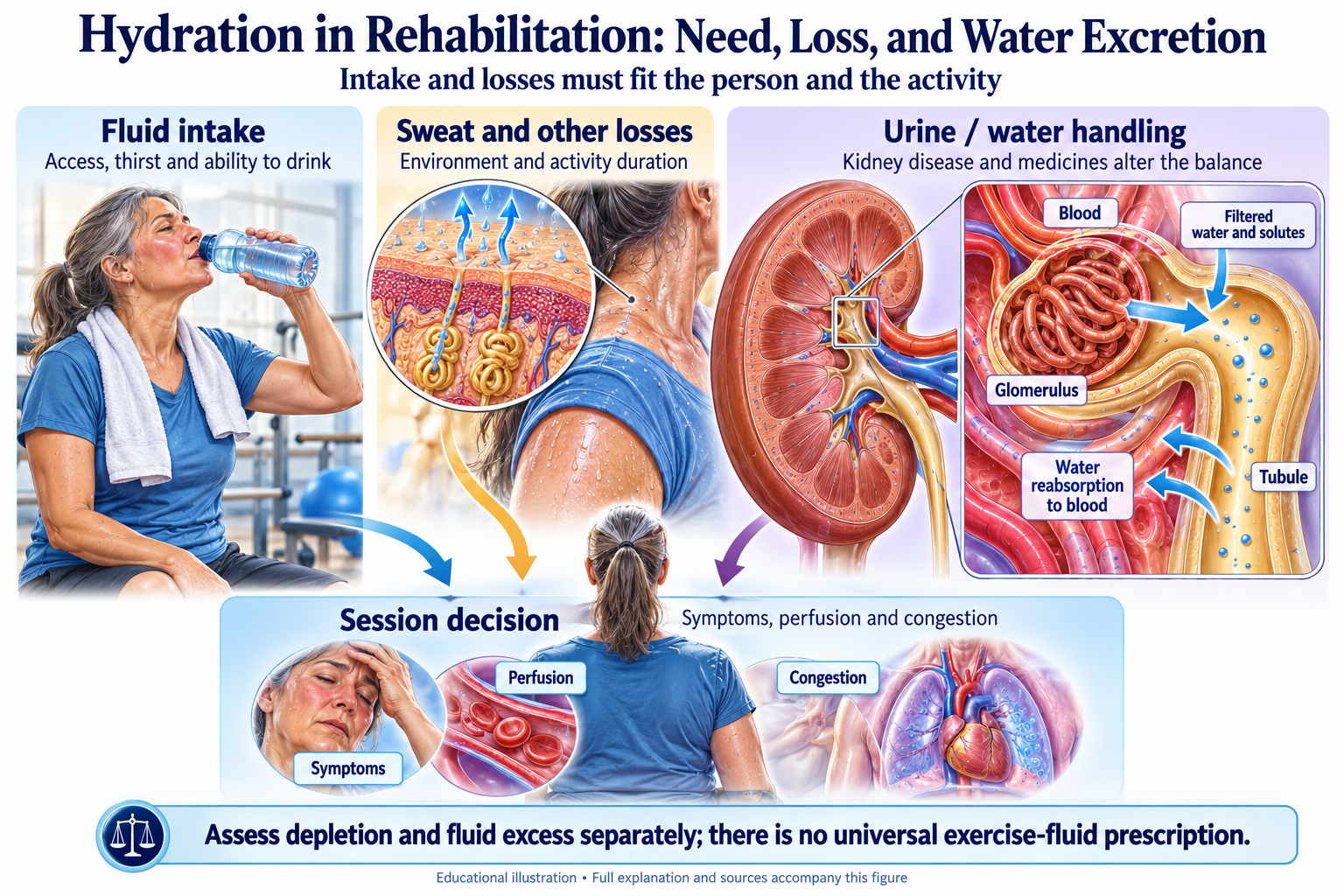
Browse the visual reference library · Download lesson Markdown
🎯 Learning Objectives
By the end of this lecture, you will be able to:
1. Why Hydration Matters in Physical Therapy and PA Practice
"Drink more water" is the most reflexive advice in clinical medicine. It is also wrong for millions of Americans. The woman with heart failure who gains four pounds overnight got worse, not better, because she drank what her cardiac-rehab group leader suggested. The endurance athlete who collapsed at mile 23 was not dehydrated — she had drunk herself to death. The dialysis patient on a 1.2-liter daily fluid restriction is handed bottled water by family at every visit.
These are patients physical therapy and PA clinicians see. You are often the person who sees them weekly — more often than their cardiologist, nephrologist, or primary care. That proximity makes you a high-leverage point for recognizing decompensation early.
💡 The DPT/PA Clinician's Three Jobs on Hydration
- Recognize the populations where "drink more" is unsafe — CHF, SIADH, advanced CKD, dialysis, cirrhosis, polydipsia, and endurance athletes drinking by schedule.
- Teach the right drinking strategy — drink-to-thirst for athletes, weight-based restriction for CHF/CKD, sick-day rules for everyone.
- Escalate the red flags — rapid weight gain, new edema, confusion, nausea-plus-headache in a runner — before they become hospitalizations.
2. The Two-Axis Framework — Tonicity vs Volume
About 60% of an adult man and 50% of an adult woman is water. Roughly two-thirds sits inside cells (ICF); one-third sits outside (ECF), split between plasma and interstitium. Membranes are freely permeable to water but not to solutes. That single fact is why tonicity matters — it determines which direction water moves.
(% body weight)
(mmol/L)
The Two Axes Everyone Conflates
Clinicians use "dehydration" to mean both "low volume" and "high sodium." They are not the same, and treating one when the patient has the other makes things worse.
| Axis | What it measures | What it tells you | What treats it |
|---|---|---|---|
| Tonicity | Serum sodium concentration | Whether cells are shrinking (hypernatremia), normal, or swelling (hyponatremia) | Free water (hyper); free-water restriction or hypertonic saline (hypo) |
| Volume | Total extracellular fluid | Volume-depleted, euvolemic, or volume-overloaded | Isotonic saline (depleted); diuretics + fluid restriction (overloaded) |
💡 The Canonical Four-Box
Patients live somewhere in a 2×2 grid of tonicity (normal/high Na vs low Na) and volume (low/normal vs high). A patient can be volume-overloaded AND hyponatremic at the same time — that is classic CHF. Giving them more water makes both worse. Giving them salty Gatorade is also wrong.
3. When "More Water" IS Right
Healthy ambulatory adults
Hot weather, moderate exercise, acute gastroenteritis. Drink to thirst plus a small margin is fine.
Nephrolithiasis
Nurses' Health Study: highest fluid-intake quintile had 38% lower stone risk vs lowest (RR 0.62, 95% CI 0.48–0.80).[4]
Heat stress / heavy sweat losses
ACSM position stand: customized replacement by individual sweat rate, target <2% body-weight loss.[5]
Recurrent UTI in women
Additional water (approximately 1.5 L/day above baseline) reduces UTI recurrence in small RCTs.
🚩 4. When "More Water" Is WRONG — The Seven High-Risk Populations
Do NOT push fluids in any of these:
| Population | Why extra water hurts | PT/PA action |
|---|---|---|
| CHF (any EF) | Failing heart cannot offload a volume challenge | Follow cardiology's target (typically 1.5–2 L/day); reinforce daily weights |
| SIADH | Body retains free water inappropriately | Reinforce restriction (often 800–1000 mL/day)[3] |
| Advanced CKD (stage 4–5) | Cannot excrete free water or sodium load | Defer to nephrology's prescription |
| Dialysis (HD/PD) | Oliguric/anuric — cannot offload between sessions | Reinforce 1–1.5 L/day limit; weigh every visit |
| Slow endurance athletes drinking by schedule | Overdrink → EAH | Teach drink-to-thirst[1] |
| Cirrhosis with ascites | TBW already expanded; worsens dilutional hyponatremia | Reinforce hepatology's fluid/Na restriction |
| Psychogenic polydipsia | Intake exceeds renal free-water ceiling | Behavioral; coordinate with psychiatry |
5. Exercise-Associated Hyponatremia (EAH)
Overdrinking during endurance exercise kills people. Since the mid-1980s there have been well-documented fatalities, most famously Cynthia Lucero at the 2002 Boston Marathon, whose death prompted the definitive cohort study.
The Almond 2002 Boston Marathon Cohort
Almond et al. studied 488 runners with finish-line blood samples.[2]
(Na ≤ 135 mmol/L)
(95% CI 2.2–8.2)
(95% CI 2.9–23.1)
The two dominant risk factors: weight gain during the race and racing time over 4 hours. Slow, longer-duration runners have time to overdrink — weekend-warrior marathoners are precisely the clients most at risk.
The 2015 Consensus — "Drink to Thirst"
The 3rd International EAH Consensus (Hew-Butler et al. 2015) replaced "stay ahead of thirst" with "drink to thirst".[1] In a 2021 survey of 210 marathon runners, <5% could name "drink to thirst" as a prevention strategy and only 32% could list an EAH symptom despite 84% claiming awareness.[6]
🚩 EAH Red Flags in a Runner
- Nausea + headache, often with vomiting
- Confusion or unusual behavior
- Puffy hands or face; tight rings; weight gain during the event
- Late-race or post-race seizure — neuro-emergent, transport
Do NOT give plain water. If alert and able to swallow, salty broth or a hypertonic snack. Any altered mental status, vomiting, or seizure → EMS. Hyponatremia severe enough for seizure is treated with hypertonic saline in hospital, not "fluids."
6. Tonicity-Decoupling Framework
Sports drinks lock tonicity at a fixed, hypotonic ratio (approximately 18–35 mmol/L Na vs plasma 140). For moderate exertion in a Na-normal patient, fine. For most other scenarios — thiazide or SSRI patient, POTS, post-op older adult, cardiac-rehab on hot day — the pre-mixed ratio is wrong.
How the ICU Actually Replaces Volume
An intensivist does not reach for Gatorade. They pick sodium and water separately, titrating each based on the serum sodium and volume status. Translated to outpatient PT/PA:
| Option | Na content | When it fits |
|---|---|---|
| Plain water | 0 mmol/L | Short exercise <90 min; healthy patient |
| Sports drink | 18–35 mmol/L (hypotonic) | Moderate exertion in Na-normal patient; poor for Na-vulnerable |
| Pedialyte | approximately 45 mmol/L | Acute diarrheal illness; adult sick-day |
| WHO ORS / LMNT / salt tabs + water | 75–90+ mmol/L | Heavy sweat losses, EAH prevention, thiazide recovery |
| Broth / bouillon + water | 800+ mg Na/cup, adjustable | Sick-day; decouples Na from free water; ICU approach at home |
| Pickle juice + water | Very high (hypertonic) | Muscle cramps, alert EAH |
| Pretzels / canned soup + water | 200–1,200 mg Na/serving | Practical ambulatory salt bolus |
💡 The Principle
Separate sodium from water. For the thiazide patient playing tennis on a hot day, the sports drink is worse than plain water plus a pretzel — the sports drink dilutes already-low serum sodium. Pretzel plus water gives a discrete sodium bolus and a discrete water bolus; the kidney sorts out tonicity. Module 2 covers this framework in depth.
7. Sick-Day Rules
Otherwise-healthy adult with vomiting, diarrhea, or fever
- Small, frequent sips of ORS or water-plus-salt
- Watch for dry mouth, reduced urine, orthostatic lightheadedness
- Avoid plain water alone for severe diarrhea — sodium loss outpaces intake
CHF / CKD / dialysis patient — the playbook REVERSES
- Hold diuretics — continuing during volume depletion drives hypotensive AKI
- Hold SGLT2 inhibitors — euglycemic DKA and AKI risk
- Hold ACEi / ARB — GFR drops sharply when volume-depleted
- Call the prescribing clinician early
8. The Point-of-Care Decision Algorithm
Patient presents (or asks) about hydration
        │
        ▼
Is the patient in a high-risk-for-overload group?
(CHF, SIADH, advanced CKD, dialysis, cirrhosis with ascites)
        │
        ├── YES → Defer to clinician's prescribed fluid target.
        │         Do NOT recommend "drink more water" on your own.
        │         Reinforce daily weights + sodium education.
        │
        └── NO  → Continue below.
        │
        ▼
Endurance athlete, long event, or prolonged heat?
        │
        ├── YES → Teach drink-to-thirst. Discourage scheduled drinking.
        │         Include sodium for events > 2 hours. Warn about EAH.
        │
        └── NO  → Drink to thirst plus small margin. Extra fluid for
                  recurrent stone prevention only if cardiac/renal allow.
        │
        ▼
Red flag now?
        │
        ├── YES → Stop session. Contact prescriber or route to ED.
        │
        └── NO  → Proceed, reinforce teaching, document.
9. Five Patient-Teaching Scripts
💬 Drink-to-thirst (athletes)
"Your body has a built-in fluid gauge. It is called thirst. For events under 90 minutes, plain water when you are thirsty is almost always enough. For longer events, keep drinking to thirst — but include some sodium, either in a sports drink or a salty snack. Slow runners who drink at every aid station on schedule end up in the medical tent with low sodium, not saved from dehydration."
💬 Daily weight (CHF / CKD / dialysis)
"Weigh yourself every morning, same time, same scale, right after you empty your bladder and before you eat. Write it down. Call your doctor if you go up more than two pounds overnight or more than five pounds in a week. That is fluid, not fat, and your heart and kidneys notice it long before you feel it."
💬 Fluid restriction is not punishment
"Fluid restriction feels harsh, especially in hot weather. The reason we do it is that your heart (or kidneys) cannot move the water out the way a healthy body does, so extra water fills your lungs and legs instead. Sipping slowly, ice chips, and hard candy for dry mouth all help. Write down every drink for a day so you can see how fast it adds up."
💬 Kidney-stone prevention
"For kidney stones, the single most effective thing is to drink enough that your urine stays pale yellow all day. Most people need 2.5 to 3 liters total — water, coffee, tea all count. Lemonade counts (citrate helps). Grapefruit juice is the one to skip. Space it through the day, not all at once."
💬 Urine-color check
"Look at your urine after you have been up a few hours. Pale yellow like lemonade is the target. Dark yellow like apple juice means drink more. Clear as water all day means you may be drinking too much. Middle of the road."
🩺 10. Case Vignettes — Four Clinical Scenarios
Case 1 · Cardiac Rehab on a Hot Day
Setting: Cardiac-rehab session in July. Mrs. Delgado, 72, HFpEF (EF 55%), on furosemide 40 mg BID and metoprolol. Cardiologist has her on a 2 L/day fluid target.
Presentation: Arrives 20 minutes late — "stopped at Culver's for a root beer because it was so hot." Brings a 32-oz water bottle. Mentions ankles felt tight this morning; woke up twice last night coughing. BP 128/78, HR 74. 1+ bilateral LE edema (was trace). JVP elevated compared to baseline.
What axis?
Volume axis. HFpEF with a prescribed 2 L/day cap, already blown past (32-oz root beer ≈ 950 mL + 32-oz water bottle = 1,900 mL before rehab). New orthopnea and worsening edema = early decompensation, not dehydration.
What should the clinician do?
- Do not tell her to "drink more water" during rehab — she is already over her cap.
- Modify the session — conservative today, longer cool-down.
- Contact cardiology — report weight trajectory, new orthopnea, worsening edema, fluid-cap violation.
- Reinforce fluid-cap teaching — hot weather makes the cap more important, not less.
- Set up daily weight reporting.
Learning points
- CHF patients on fluid restriction are not exempt because it's hot — hot weather amplifies overshoot risk.
- New orthopnea + worsening edema = volume overload, not dehydration.
- Weekly PT/PA visit is the early-warning system.
Case 2 · Marathon Medical Tent, Mile 23
Setting: Volunteer at marathon medical tent. 41-year-old recreational runner, projected 5-hour finish.
Presentation: Nausea, frontal headache last 4 miles. Rings tight — feels "puffy." Has been drinking one cup at every aid station "to stay ahead of thirst." Alert, oriented. BP 118/72, HR 88. Mild periorbital puffiness. Pre-race weight 142 lb; tent weight 145 lb.
What axis?
Tonicity axis — classic EAH. Slow event > 4 hours + weight gain during event (+3 lb) + nausea/headache/puffy hands + scheduled drinking. Matches both dominant Almond 2002 risk factors.[2]
What should the clinician do?
- Do NOT give plain water — more free water deepens the hyponatremia.
- Do NOT give a standard sports drink — at 18 mmol/L Na it is hypotonic to her already-low serum sodium.
- Give salty broth, pickle juice, or salt-tab-plus-small-water if alert and able to swallow.
- Escalate to tent physician / EMS — she needs bloodwork and potentially hypertonic saline.
- Watch for seizure — transport immediately if altered mentation.
Counseling for next time
"You did everything your training program told you to do. The advice was wrong. Next race, drink to thirst, include sodium for anything over 90 minutes, and never weigh more at the finish than the start."
Case 3 · Thiazide-Induced Hyponatremia in Outpatient Rehab
Setting: Post-op knee replacement rehab. Mrs. Chen, 68, on HCTZ 25 mg daily and sertraline 50 mg daily. Otherwise healthy.
Presentation: Week 2 into rehab. Reports "foggy" last 3 days. Morning nausea. Yesterday nearly fell getting out of shower — legs "rubbery." Drinking 3–4 L/day of plain water because a family member told her "hydration helps arthritis." BP 132/82 sitting, 118/72 standing. No edema. Slow to process instructions today.
What axis?
Tonicity axis — thiazide-plus-SSRI hyponatremia worsened by high free-water intake. Thiazides impair renal free-water excretion; SSRIs can trigger SIADH; add 3–4 L/day of plain water and you have symptomatic hyponatremia: fogginess, nausea, near-fall.
What should the clinician do?
- Do not dismiss "foggy" — in an older adult on Na-vulnerable meds, cognitive change with nausea is sodium until proven otherwise.
- Stop the session. Fall risk is real.
- Call PCP — basic metabolic panel today. Recommend pausing thiazide pending evaluation.
- Counsel against 3–4 L "hydration" — plain water on a thiazide makes sodium worse, not better.
- Document the call, the recommendation, observations.
Case 4 · Dialysis Interdialytic Overload
Setting: Inpatient PT for deconditioning. Mr. Bauer, 58, hemodialysis 3×/week (M/W/F), anuric, target dry weight 78 kg, prescribed fluid cap 1 L/day.
Presentation: Monday morning. "Tired and short of breath walking to the bathroom." Daughter brought a 64-oz sweet tea on Saturday ("hospital food is so dry"). A few cans of pop Sunday. Weight 84 kg (target 78). Crackles at bases. 2+ pitting edema. BP 168/92.
What axis?
Volume axis — massive interdialytic fluid overload. 6 kg over 48 hours is well above the < 5% interdialytic weight gain ceiling (approximately 3.9 kg for a 78-kg target). Symptomatic: dyspnea, crackles, hypertension, pitting edema.
What should the clinician do?
- Stop the PT session. Dyspnea + crackles in a dialysis patient = pulmonary edema until proven otherwise.
- Call the nephrology team — likely needs earlier or UF-focused dialysis run.
- Educate on the arithmetic — 64-oz sweet tea is 1.9 L; cleared his entire weekend budget in one drink.
- Coordinate with renal dietician — family members bringing outside drinks are common and correctable.
✍️ 11. Check Your Understanding
Ten MCQs. Click "Reveal answer" after you commit.
Q1. Which patient is MOST likely to be harmed by "drink more water"?
- 34yo runner with recurrent calcium-oxalate kidney stones
- 72yo woman with HFpEF and a 2 L/day fluid restriction
- 24yo healthy woman in Phoenix in August
- 48yo woman with recurrent UTIs
Q2. A recreational marathoner finishes in 4:52 with nausea, frontal headache, rings too tight. Pre-race 138 lb, post-race 141 lb. What should you NOT give?
- Salty broth
- Pickle juice
- A sports drink (Gatorade)
- Nothing orally; transport to hospital
Q3. Which is the single most useful marker of interdialytic fluid gain?
- Blood pressure
- Daily weight
- Peripheral edema
- JVP
Q4. 70yo on HCTZ and sertraline, 3 days of fogginess and nausea. FIRST action?
- Reassure and continue
- Recommend more water
- Stop session, contact PCP for BMP today
- Add electrolyte tablets to water bottle
Q5. Best summary of the Almond 2002 Boston Marathon finding?
- 13% had critical hyponatremia
- Strongest risk factors were weight gain during the race and race > 4 hours
- Sports drinks prevented hyponatremia better than plain water
- Elite runners had higher EAH rates than slower finishers
Q6. CHF patient held her furosemide this morning due to 24 hours of diarrhea. What do you say?
- "Always take your diuretic no matter what"
- "Good call. Keep holding until you can keep food/fluid down and your clinician confirms. Also hold ACEi or SGLT2i. Call today."
- "Drink extra Gatorade and keep taking furosemide"
- "Start lots of plain water"
Q7. Most accurate about the tonicity-decoupling framework?
- Sports drinks are isotonic with serum
- Salt tabs + water let clinician and patient control tonicity; sports drinks lock a hypotonic ratio
- Plain water + salty snack is always worse than pre-mixed sports drink
- The framework applies only to ICU patients
Q8. Dialysis patient gains 6 kg over a weekend (target 78 kg). Which is NOT an appropriate action?
- Stop the session and escalate to nephrology
- Review fluid-cap teaching with patient and family
- Encourage Gatorade during exercise to "replenish electrolytes"
- Document new dyspnea and crackles
Q9. Which patient is in the "more water is right" column?
- Cirrhosis patient with new ascites
- Psychogenic polydipsia patient drinking 8 L/day
- Recurrent calcium-oxalate stone former
- SIADH patient on 900 mL/day restriction
Q10. CHF patient gains 2.4 lb overnight with new ankle puffiness. BEST initial action?
- Proceed with the session as planned
- Cancel the session; send her to the ED
- Modify session (lighter intensity), notify cardiologist today, reinforce daily weights
- Tell her to skip her furosemide so she "doesn't lose more fluid"
📌 Take-Home Points
- Two axes, not one. Tonicity and volume are independent. Volume-overloaded AND hyponatremic at once is classic CHF.
- Seven high-risk populations flip the rule: CHF, SIADH, advanced CKD, dialysis, cirrhosis with ascites, psychogenic polydipsia, slow endurance athletes drinking by schedule.
- Drink to thirst replaces "stay ahead of thirst." Weight gain during event is pathognomonic for EAH.
- Sports drinks are hypotonic. Separate sodium from water for thiazide / SSRI / POTS / post-op older adult patients.
- Sick-day rules reverse. Healthy adult → ORS + sips. CHF/CKD/dialysis → hold diuretics/SGLT2i/ACEi-ARB, call early.
- Volume-overload red flags: > 2 lb overnight, > 5 lb/week, new edema, new orthopnea.
- EAH red flags: nausea + headache + puffy hands + weight gain during event. No plain water. Altered mentation → EMS.
📚 References
- Hew-Butler T, Rosner MH, Fowkes-Godek S, et al. Statement of the 3rd International Exercise-Associated Hyponatremia Consensus Development Conference, Carlsbad, California, 2015. Br J Sports Med 2015;49(22):1432–46. PMID: 26227507. PubMed
- Almond CSD, Shin AY, Fortescue EB, et al. Hyponatremia among runners in the Boston Marathon. N Engl J Med 2005;352(15):1550–6. PMID: 15829535. PubMed
- Verbalis JG, Goldsmith SR, Greenberg A, et al. Diagnosis, evaluation, and treatment of hyponatremia: expert panel recommendations. Am J Med 2013;126(10 Suppl 1):S1–42. PMID: 24074529. PubMed
- Curhan GC, Willett WC, Speizer FE, Stampfer MJ. Beverage use and risk for kidney stones in women. Ann Intern Med 1998;128(7):534–40. PMID: 9518397. PubMed
- Sawka MN, Burke LM, Eichner ER, et al. ACSM position stand. Exercise and fluid replacement. Med Sci Sports Exerc 2007;39(2):377–90. PMID: 17277604. PubMed
- Namineni N, Potok OA, Ix JH, et al. Marathon Runners' Knowledge and Strategies for Hydration. Clin J Sport Med 2022;32(5):517–522. PMID: 34723866. PubMed
🔗 Related Content
📖 Module 2 · High-Salt Foods & Tonicity Decoupling
The decoupling framework in depth: master replacement table, sports-drink critique, less-salt overrides.
🖨️ Hydration Printable Handout
20-minute quick-reference version of this lecture.
🔬 Sodium Disorders Deep-Dive
PA-program-depth reference — hyponatremia, hypernatremia, SIADH.
💧 Edema & Fluid Overload
Circulation-cycle pathophysiology for CHF/CKD rehab patients.