Visual summary
ADH changes the collecting duct’s permeability to water. Its principal renal effect is water conservation, so connect the hormone to tonicity and urine concentration.
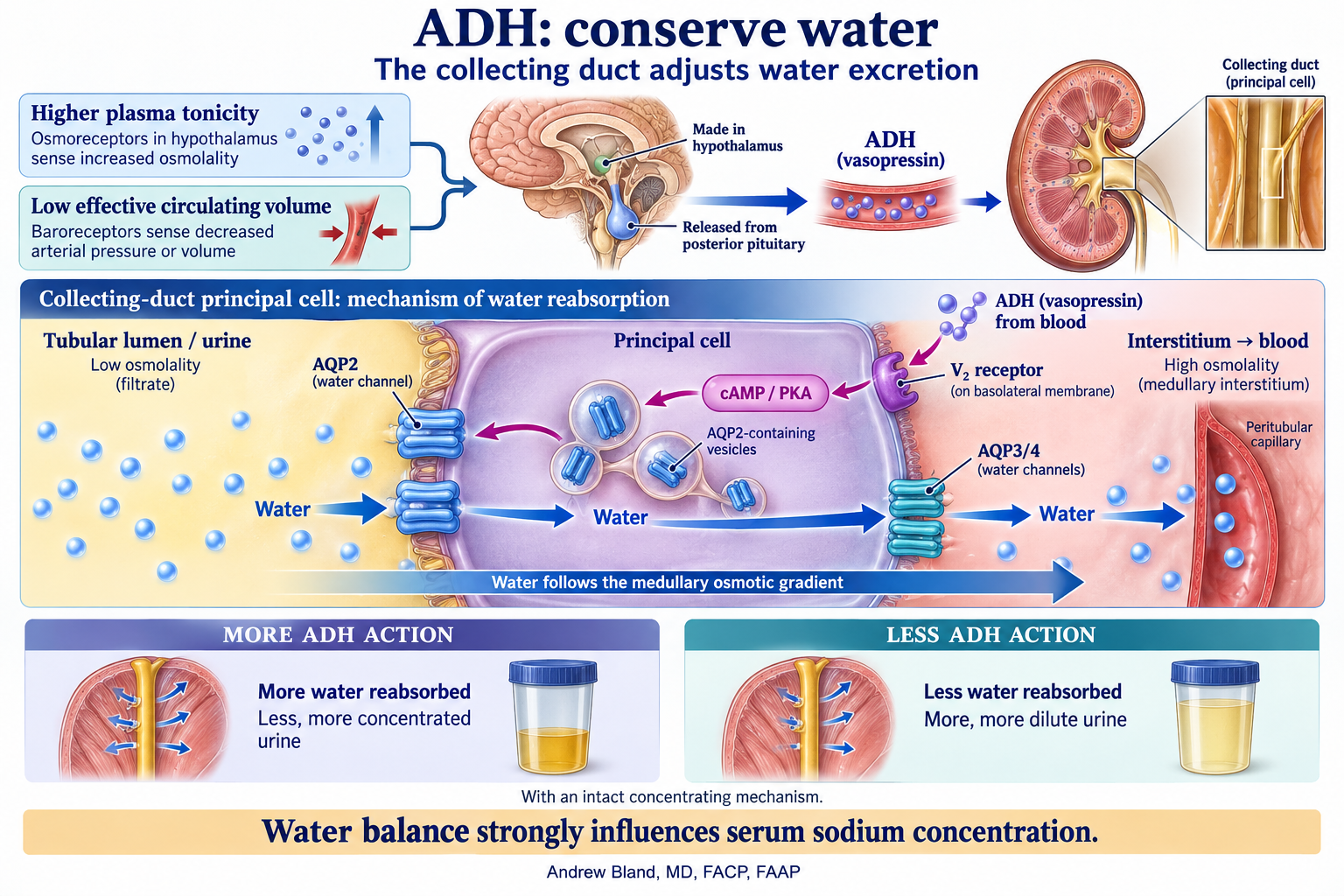
Illustration updated October 19, 2026. Educational schematic. Full teaching text and sources follow.
Diagram description
The diagram traces hypothalamic synthesis and posterior-pituitary release of ADH to a collecting-duct principal cell. Basolateral V2 signaling through cAMP and PKA inserts apical AQP2; water moves from tubular lumen through the cell and exits through basolateral AQP3/4 toward blood.
Text version
What triggers ADH?
Rising plasma tonicity is a major stimulus. Low effective circulating volume can also drive ADH release, even when serum sodium is already low.
Where does it come from?
ADH, also called vasopressin, is synthesized in the hypothalamus and released from the posterior pituitary.
Follow the collecting-duct mechanism
ADH binds basolateral V2 receptors on principal cells. The cAMP/PKA pathway increases insertion of aquaporin-2 in the apical membrane; water exits through basolateral aquaporin-3 and aquaporin-4.
The gradient makes water movement possible
Water moves down an osmotic gradient toward the medullary interstitium and blood. ADH supplies permeability; a functioning medullary concentration gradient is also needed.
Connect urine and blood
More ADH generally means less water excretion and more concentrated urine. Reduced ADH allows more dilute urine when the kidney can dilute normally. ADH is not simply a sodium-retaining hormone: interpret serum sodium as a water-balance clue and assess volume separately.