Visual summary
RAAS links a signal of low effective circulation to vascular tone, sodium retention, and aldosterone-mediated potassium and hydrogen-ion secretion.
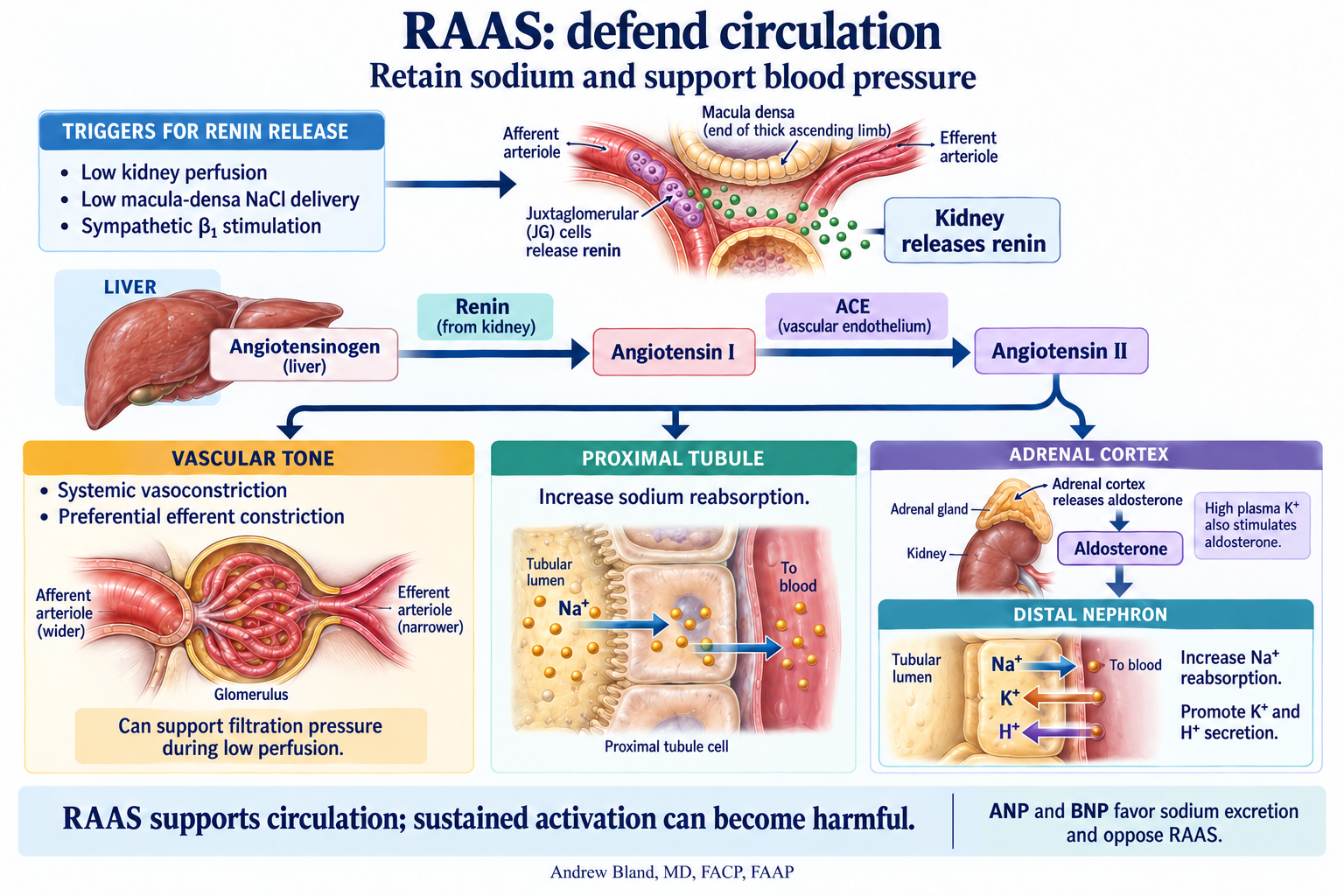
Illustration updated October 19, 2026. Educational schematic. Full teaching text and sources follow.
Diagram description
Renin is released by juxtaglomerular cells in the afferent arteriolar wall. A liver-to-angiotensin pathway leads to angiotensin II, with arrows to vascular and proximal-tubule effects and to adrenal aldosterone. A distal-nephron panel shows sodium reabsorption with potassium and hydrogen-ion secretion.
Text version
What starts the signal?
Reduced renal perfusion pressure, reduced macula-densa sodium chloride delivery, and sympathetic beta-1 stimulation can promote renin release from juxtaglomerular cells.
Follow the pathway
Liver-derived angiotensinogen is cleaved by renin to angiotensin I; ACE converts angiotensin I to angiotensin II. Angiotensin II stimulates adrenal aldosterone secretion.
Angiotensin II acts before the distal nephron
Angiotensin II promotes proximal sodium reabsorption and vasoconstriction. Preferential efferent constriction can help preserve glomerular pressure during reduced perfusion; strong activation can also reduce renal blood flow and GFR.
Aldosterone changes distal handling
Aldosterone promotes distal sodium reabsorption, potassium secretion, and hydrogen-ion secretion. Elevated potassium can directly stimulate aldosterone independently of renin.
Apply it to edema and filtration
A patient can have excess total-body fluid yet low effective arterial circulation. Connect this to sodium retention and ADH, then use the GFR model to discuss why ACE inhibitors or ARBs can alter glomerular pressure.