Visual summary
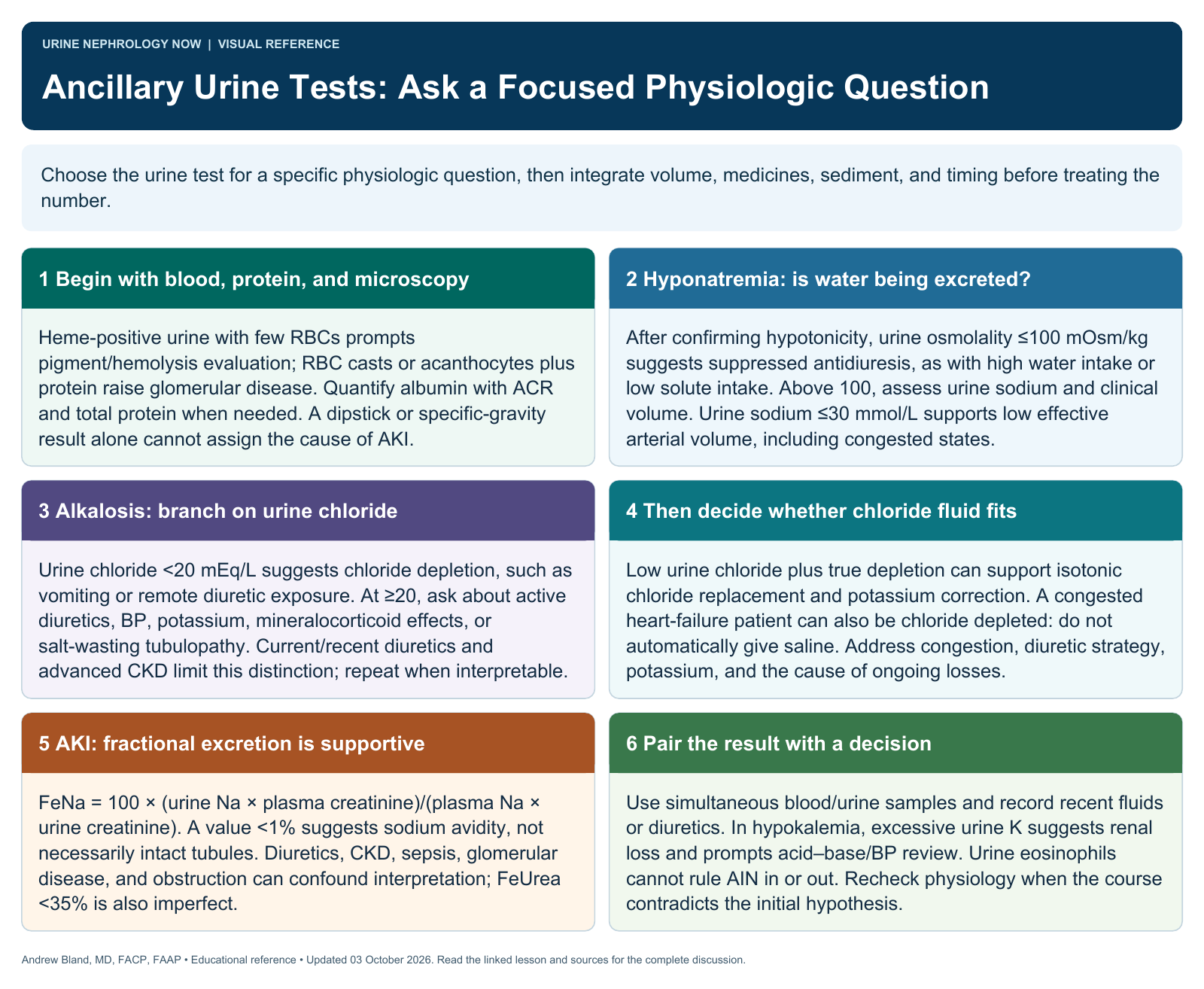
Order a urine test because it answers a question, and interpret the answer within the conditions under which it was measured.
Text version
Excretion reflects current physiology
Urinary electrolytes and fractional excretion calculations describe how the kidney is handling solutes at a moment in time. They do not directly measure the histologic cause of AKI or eliminate the need for clinical assessment.
Recognize when a result may mislead
Diuretics, CKD, sepsis, recent fluid therapy, glycosuria, and particular renal diseases can alter textbook patterns. Timing and simultaneous blood sampling matter when calculating fractional excretion indices.
Use tests for a defined question
Interpret urine sodium and fractional excretion measures alongside perfusion, congestion, medication exposure, urine sediment, and renal trajectory. Urine osmolality, protein quantification, and targeted studies may answer a different and more useful question.
Choose confirmation rather than ritual
Do not order urine eosinophils as a reliable rule-in or rule-out test for interstitial nephritis. Review the medication history and consider biopsy when diagnostic uncertainty would change treatment.
Add specialized microscopy selectively
Phase contrast, polarized light, or specific stains can clarify red cell morphology, crystals, or other structures. These techniques require appropriate collection and expertise, and should be linked to a plausible differential diagnosis.
Communicate the limitation
Explain what the test suggests, what can confound it, and which subsequent observation will increase confidence. When a result conflicts with the patient’s course, revisit the question rather than forcing the diagnosis to match the calculated number.
Continue learning
This graphic summarizes a topic. The full educational pages provide the broader discussion and references.