Visual summary
Choose the urine test for a specific physiologic question, then integrate volume, medicines, sediment, and timing before treating the number.
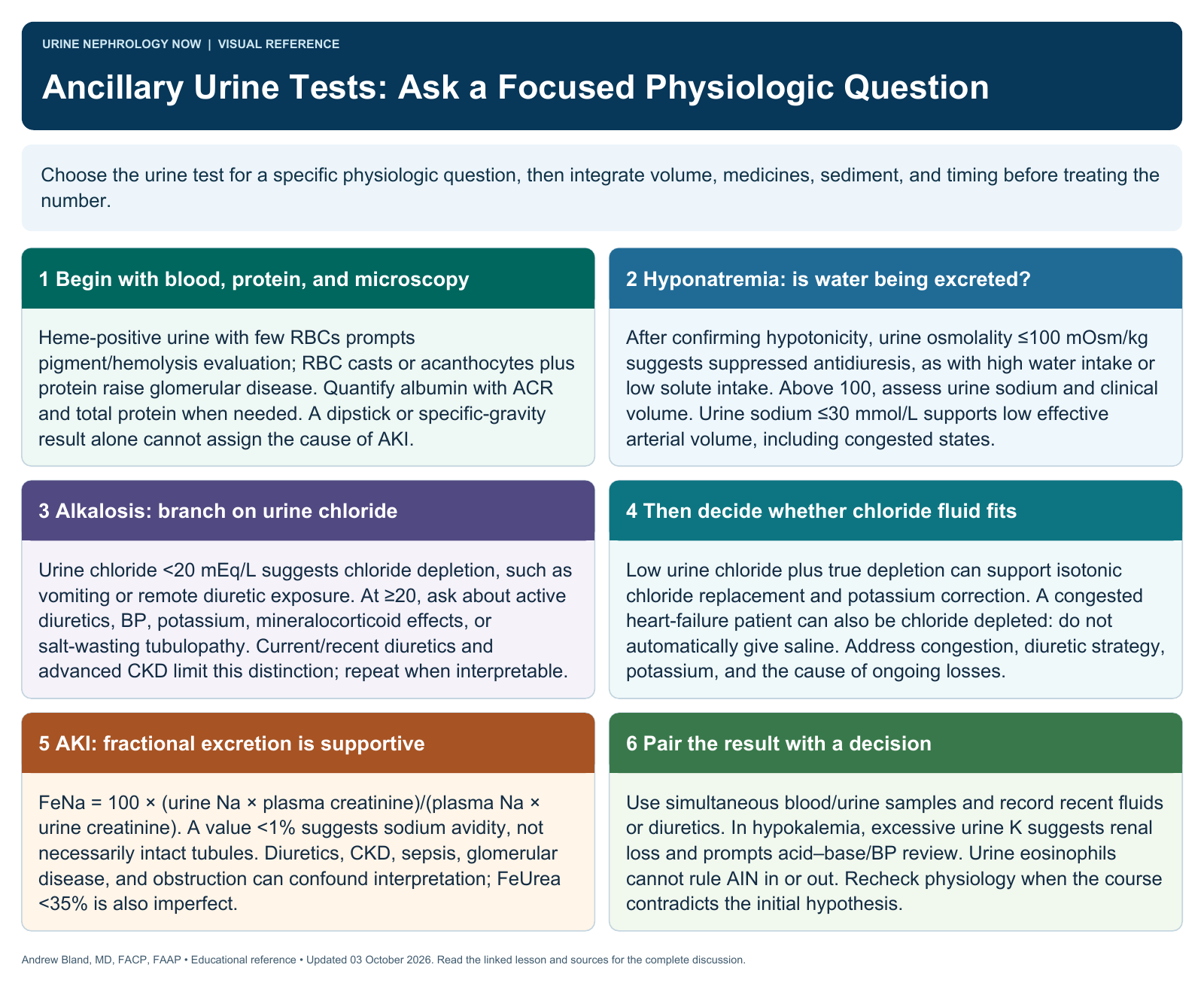
Text version
Begin with blood, protein, and microscopy
Heme-positive urine with few RBCs prompts pigment/hemolysis evaluation; RBC casts or acanthocytes plus protein raise glomerular disease. Quantify albumin with ACR and total protein when needed. A dipstick or specific-gravity result alone cannot assign the cause of AKI.
Hyponatremia: is water being excreted?
After confirming hypotonicity, urine osmolality ≤100 mOsm/kg suggests suppressed antidiuresis, as with high water intake or low solute intake. Above 100, assess urine sodium and clinical volume. Urine sodium ≤30 mmol/L supports low effective arterial volume, including congested states.
Alkalosis: branch on urine chloride
Urine chloride <20 mEq/L suggests chloride depletion, such as vomiting or remote diuretic exposure. At ≥20, ask about active diuretics, BP, potassium, mineralocorticoid effects, or salt-wasting tubulopathy. Current/recent diuretics and advanced CKD limit this distinction; repeat when interpretable.
Then decide whether chloride fluid fits
Low urine chloride plus true depletion can support isotonic chloride replacement and potassium correction. A congested heart-failure patient can also be chloride depleted: do not automatically give saline. Address congestion, diuretic strategy, potassium, and the cause of ongoing losses.
AKI: fractional excretion is supportive
FeNa = 100 × (urine Na × plasma creatinine)/(plasma Na × urine creatinine). A value <1% suggests sodium avidity, not necessarily intact tubules. Diuretics, CKD, sepsis, glomerular disease, and obstruction can confound interpretation; FeUrea <35% is also imperfect.
Pair the result with a decision
Use simultaneous blood/urine samples and record recent fluids or diuretics. In hypokalemia, excessive urine K suggests renal loss and prompts acid–base/BP review. Urine eosinophils cannot rule AIN in or out. Recheck physiology when the course contradicts the initial hypothesis.