Visual summary
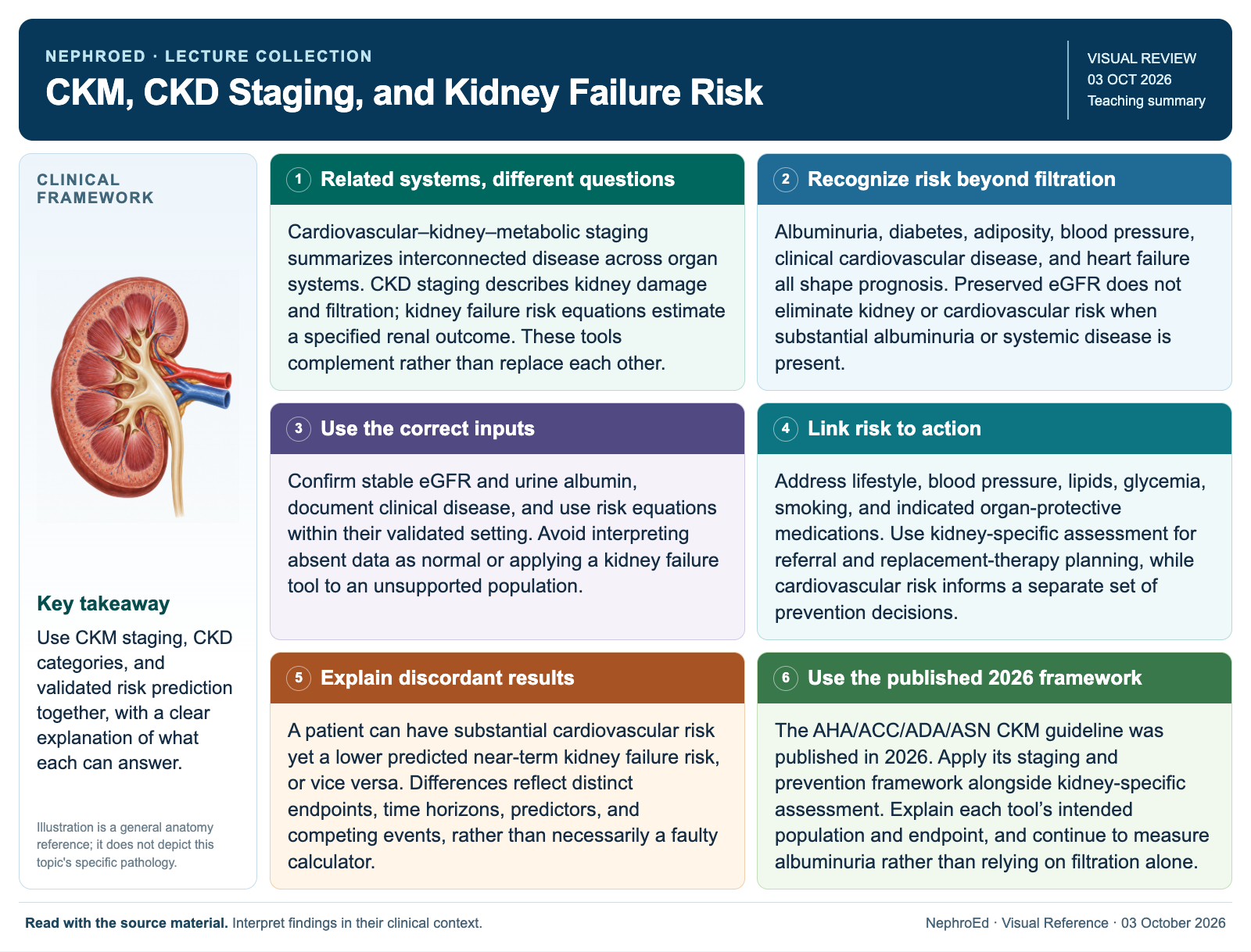
Use CKM staging, CKD categories, and validated risk prediction together, with a clear explanation of what each can answer.
Text version
Related systems, different questions
Cardiovascular–kidney–metabolic staging summarizes interconnected disease across organ systems. CKD staging describes kidney damage and filtration; kidney failure risk equations estimate a specified renal outcome. These tools complement rather than replace each other.
Recognize risk beyond filtration
Albuminuria, diabetes, adiposity, blood pressure, clinical cardiovascular disease, and heart failure all shape prognosis. Preserved eGFR does not eliminate kidney or cardiovascular risk when substantial albuminuria or systemic disease is present.
Use the correct inputs
Confirm stable eGFR and urine albumin, document clinical disease, and use risk equations within their validated setting. Avoid interpreting absent data as normal or applying a kidney failure tool to an unsupported population.
Link risk to action
Address lifestyle, blood pressure, lipids, glycemia, smoking, and indicated organ-protective medications. Use kidney-specific assessment for referral and replacement-therapy planning, while cardiovascular risk informs a separate set of prevention decisions.
Explain discordant results
A patient can have substantial cardiovascular risk yet a lower predicted near-term kidney failure risk, or vice versa. Differences reflect distinct endpoints, time horizons, predictors, and competing events, rather than necessarily a faulty calculator.
Use the published 2026 framework
The AHA/ACC/ADA/ASN CKM guideline was published in 2026. Apply its staging and prevention framework alongside kidney-specific assessment. Explain each tool’s intended population and endpoint, and continue to measure albuminuria rather than relying on filtration alone.
Continue learning
This graphic summarizes a topic. The full educational pages provide the broader discussion and references.