Visual summary
Staging describes disease; prediction estimates a specified future outcome. State the population, endpoint, and action every time you use a score.
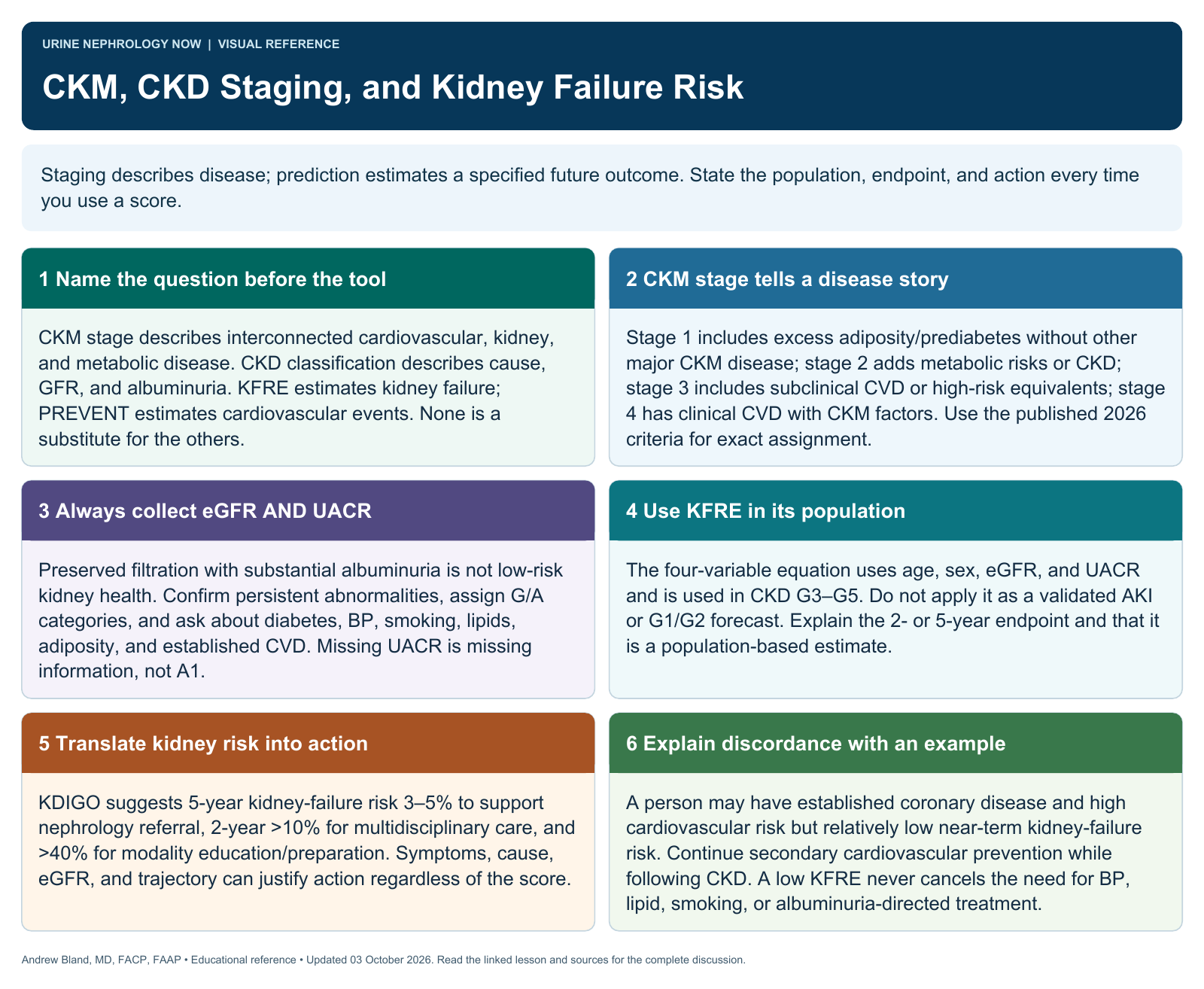
Text version
Name the question before the tool
CKM stage describes interconnected cardiovascular, kidney, and metabolic disease. CKD classification describes cause, GFR, and albuminuria. KFRE estimates kidney failure; PREVENT estimates cardiovascular events. None is a substitute for the others.
CKM stage tells a disease story
Stage 1 includes excess adiposity/prediabetes without other major CKM disease; stage 2 adds metabolic risks or CKD; stage 3 includes subclinical CVD or high-risk equivalents; stage 4 has clinical CVD with CKM factors. Use the published 2026 criteria for exact assignment.
Always collect eGFR AND UACR
Preserved filtration with substantial albuminuria is not low-risk kidney health. Confirm persistent abnormalities, assign G/A categories, and ask about diabetes, BP, smoking, lipids, adiposity, and established CVD. Missing UACR is missing information, not A1.
Use KFRE in its population
The four-variable equation uses age, sex, eGFR, and UACR and is used in CKD G3–G5. Do not apply it as a validated AKI or G1/G2 forecast. Explain the 2- or 5-year endpoint and that it is a population-based estimate.
Translate kidney risk into action
KDIGO suggests 5-year kidney-failure risk 3–5% to support nephrology referral, 2-year >10% for multidisciplinary care, and >40% for modality education/preparation. Symptoms, cause, eGFR, and trajectory can justify action regardless of the score.
Explain discordance with an example
A person may have established coronary disease and high cardiovascular risk but relatively low near-term kidney-failure risk. Continue secondary cardiovascular prevention while following CKD. A low KFRE never cancels the need for BP, lipid, smoking, or albuminuria-directed treatment.