Visual summary
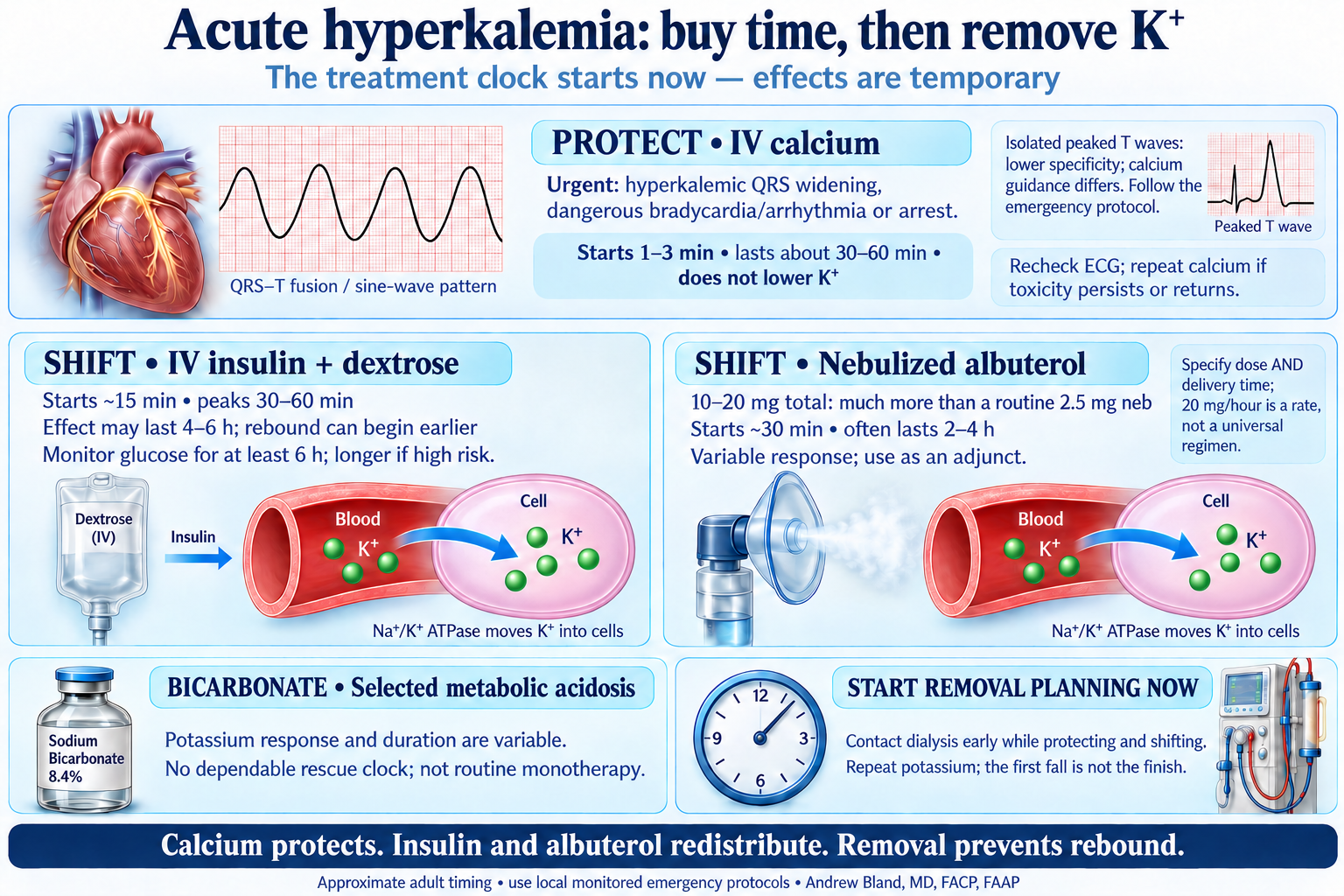
Calcium protection and intracellular shifts have different clocks; start removal planning immediately.
Teaching text
Calcium: prioritize conduction toxicity
Hyperkalemia-associated QRS widening, a sine-wave pattern, dangerous bradycardia or ventricular arrhythmia, and suspected hyperkalemic arrest are urgent reasons for IV calcium. Isolated peaked T waves are less specific and were not associated with short-term adverse events in one observational study; they are not equivalent to QRS widening. However, calcium guidance differs: UKKA includes isolated hyperkalemic peaked T waves. Teach the distinction without a blanket rule to withhold calcium. Use the emergency protocol and the whole clinical picture.
Calcium buys a short interval
The ECG effect begins in about 1–3 minutes and lasts roughly 30–60 minutes. Reassess promptly; persistent or recurrent toxicity may require repeat calcium while shifting and removal proceed. Calcium does not reduce serum or total-body potassium. Formulations are not dose-equivalent: calcium chloride contains about three times the elemental calcium per equal volume of a 10% solution. Follow the local formulation, dose, route and repeat-dose protocol.
Insulin plus dextrose: an early shift with a later glucose risk
IV regular insulin begins lowering potassium in about 15 minutes, with peak effect around 30–60 minutes. The shift may persist for 4–6 hours, but potassium can begin rebounding earlier. Dextrose supports blood glucose; it does not make the insulin effect harmless or guarantee six hours of protection. Check glucose before treatment and frequently for at least six hours afterward, extending monitoring after repeat doses or in high-risk patients. Kidney failure increases delayed hypoglycemia risk.
Albuterol: a hyperkalemia dose, not an ordinary bronchodilator treatment
The studied adult nebulized dose is 10–20 mg total, substantially more than a routine 2.5 mg nebulizer treatment. Specify total dose and delivery time with respiratory therapy under the local protocol. A rate such as 20 mg/hour is not interchangeable with a total 20 mg dose and should not be taught as an indefinite standard infusion. Potassium lowering generally begins by about 30 minutes and lasts at least two hours, commonly about 2–4 hours; some responses last longer. Response varies, so use it as an adjunct, not sole therapy for severe hyperkalemia. Watch for tachycardia, tremor and ischemic symptoms.
Bicarbonate: do not assign it a dependable potassium clock
IV bicarbonate is not routinely effective as acute hyperkalemia monotherapy. It may be useful when clinically important metabolic acidosis supplies a separate indication, with attention to sodium, volume and ventilation. The magnitude, onset and duration of potassium lowering are inconsistent; a fixed two-hour or six-hour rescue window would be misleading. In a small crossover study of hemodialysis patients, bicarbonate alone did not lower potassium during the first hour.
Recheck the patient, not just the first improved number
Continue ECG monitoring when indicated, repeat potassium early after treatment and again as the shift wears off, and track glucose separately. A useful monitored framework checks potassium around one and two hours, then four and six hours, with earlier or additional testing for instability or a changing trajectory. Calcium can wear off before dialysis starts; shifted potassium remains in the body. Reassess and bridge until actual removal provides sustained control.
Continue learning
Supporting evidence
- UK Kidney Association hyperkalemia guidance, July 2026
- Durfey et al.: ECG findings and short-term adverse events
- KDIGO conference summary: acute hyperkalemia
- Allon et al.: nebulized albuterol 10 versus 20 mg
- Montoliu et al.: time course after nebulized salbutamol
- Allon and Shanklin: bicarbonate, insulin and albuterol crossover study
- ILCOR 2025 consensus: acute hyperkalemia therapies