Visual summary
Low magnesium can permit ongoing renal potassium loss
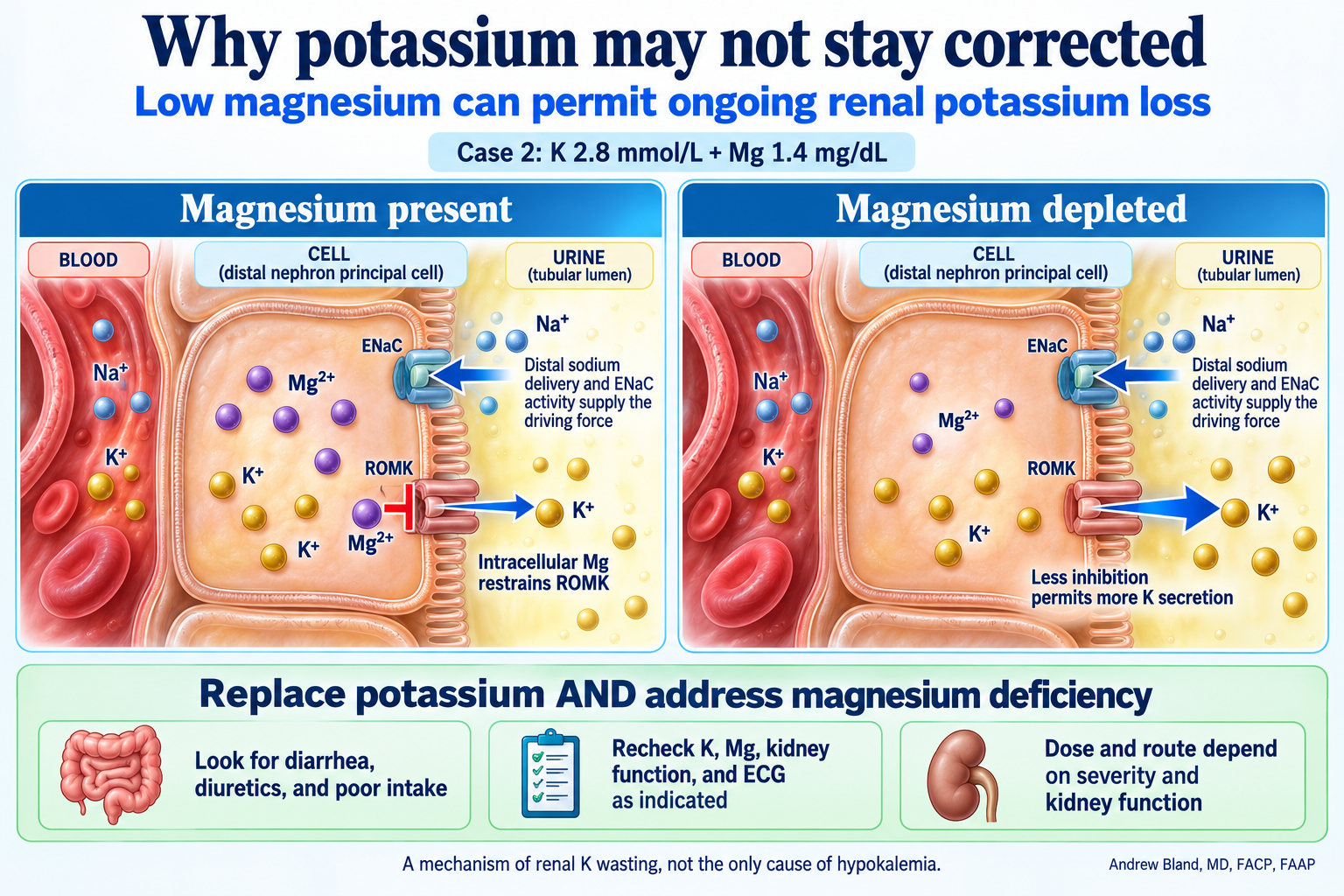
Low magnesium can permit ongoing renal potassium loss
Text version
Connect magnesium to renal potassium loss
Intracellular magnesium inhibits ROMK on the urine-facing membrane of distal-nephron cells. Lower intracellular magnesium reduces this restraint. Distal sodium delivery and ENaC activity help provide the electrical driving force for potassium secretion from cell to urine.
Apply the paired abnormalities
Case 2 begins with K 2.8 mEq/L and Mg 1.4 mg/dL. Thiazide exposure, poor intake and other losses can contribute to both deficits. Replacing potassium without addressing magnesium deficiency may leave an ongoing renal loss mechanism in place.
Replace and reassess
Address magnesium alongside potassium; do not delay urgent potassium replacement while waiting for magnesium to finish. Route, dose and monitoring depend on severity, symptoms and kidney function. Recheck both electrolytes and remember that potassium replacement contributes to sodium correction in this hyponatremic patient.
Does correcting magnesium alone guarantee that potassium will normalize?
No. It addresses one mechanism of renal potassium loss. The potassium deficit and other ongoing losses still need treatment and reassessment.
Cases and related lectures
The linked case and lecture content provide the teaching sequence and patient data.