Visual summary
Impaired dilution, potassium loss, and the patient's intake interact
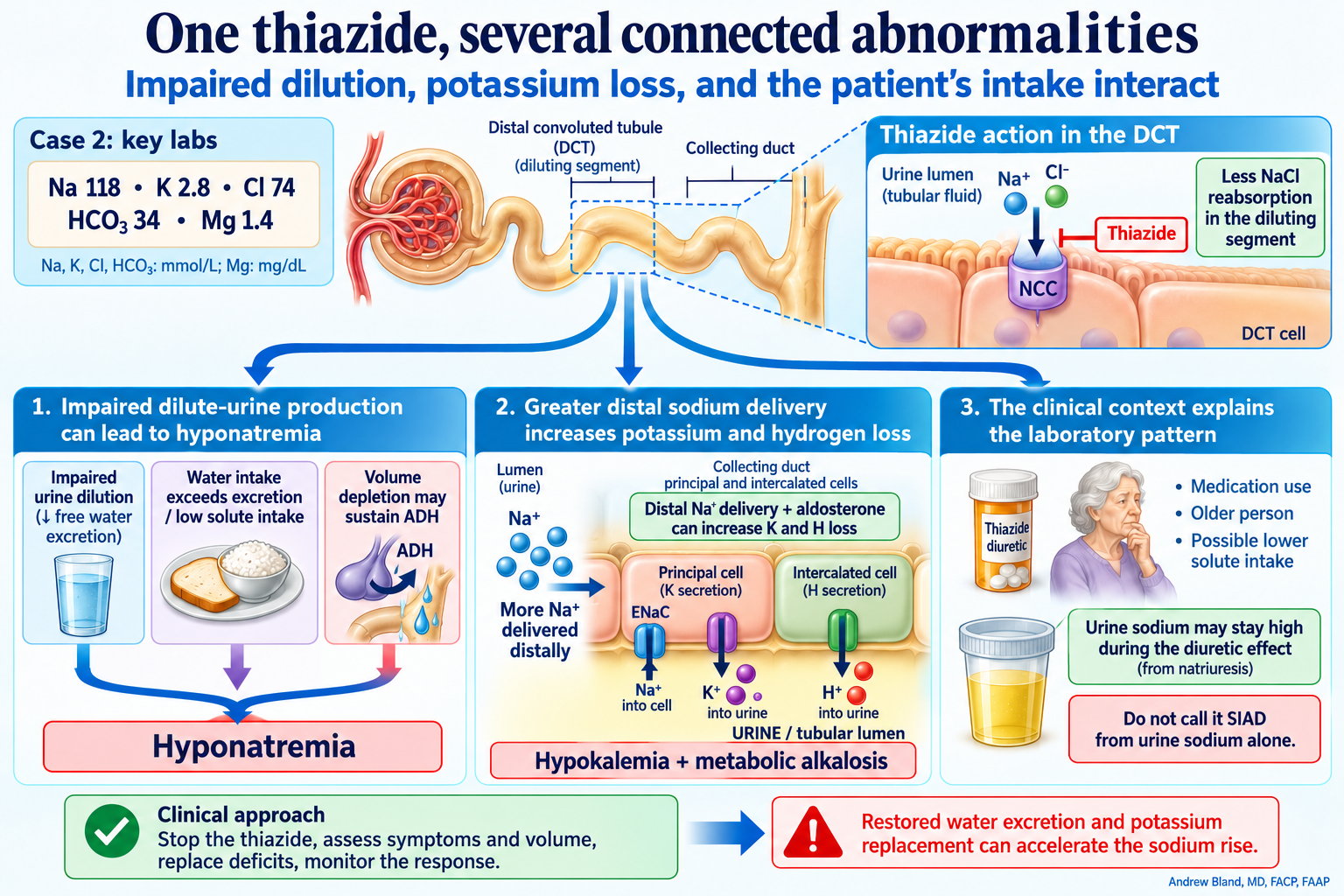
Impaired dilution, potassium loss, and the patient's intake interact
Text version
Start in the diluting segment
Thiazides inhibit NCC-mediated NaCl reabsorption in the distal convoluted tubule. Impaired dilution, excess water relative to excretion and low dietary solute can converge on hyponatremia. Volume depletion can sustain nonosmotic ADH activity; it is a parallel contributor, not a consequence of excess water intake.
Read the whole chemistry panel
Case 2 begins with Na 118, K 2.8, Cl 74 and bicarbonate 34 mEq/L, with Mg 1.4 mg/dL. Distal sodium delivery and aldosterone can promote K and H secretion. Magnesium depletion can perpetuate renal potassium loss. The low sodium, hypokalemia, alkalosis and low magnesium belong in one mechanism-based explanation.
Interpret the urine in context
A diuretic can keep urine sodium and chloride high despite volume depletion. Those results do not independently prove SIAD or chloride-resistant alkalosis. Stop the thiazide, assess symptoms and volume, replace deficits and follow the response. Restored water excretion and potassium replacement can accelerate sodium correction.
Why does urine sodium 55 not erase the evidence of volume depletion?
The thiazide itself alters sodium handling. Integrate the drug timeline, orthostatic findings, weight loss, dietary intake and subsequent course rather than using one urine threshold as a diagnosis.
Cases and related lectures
The linked case and lecture content provide the teaching sequence and patient data.