Visual summary
Read the cast, then test the clinical story and specimen quality.
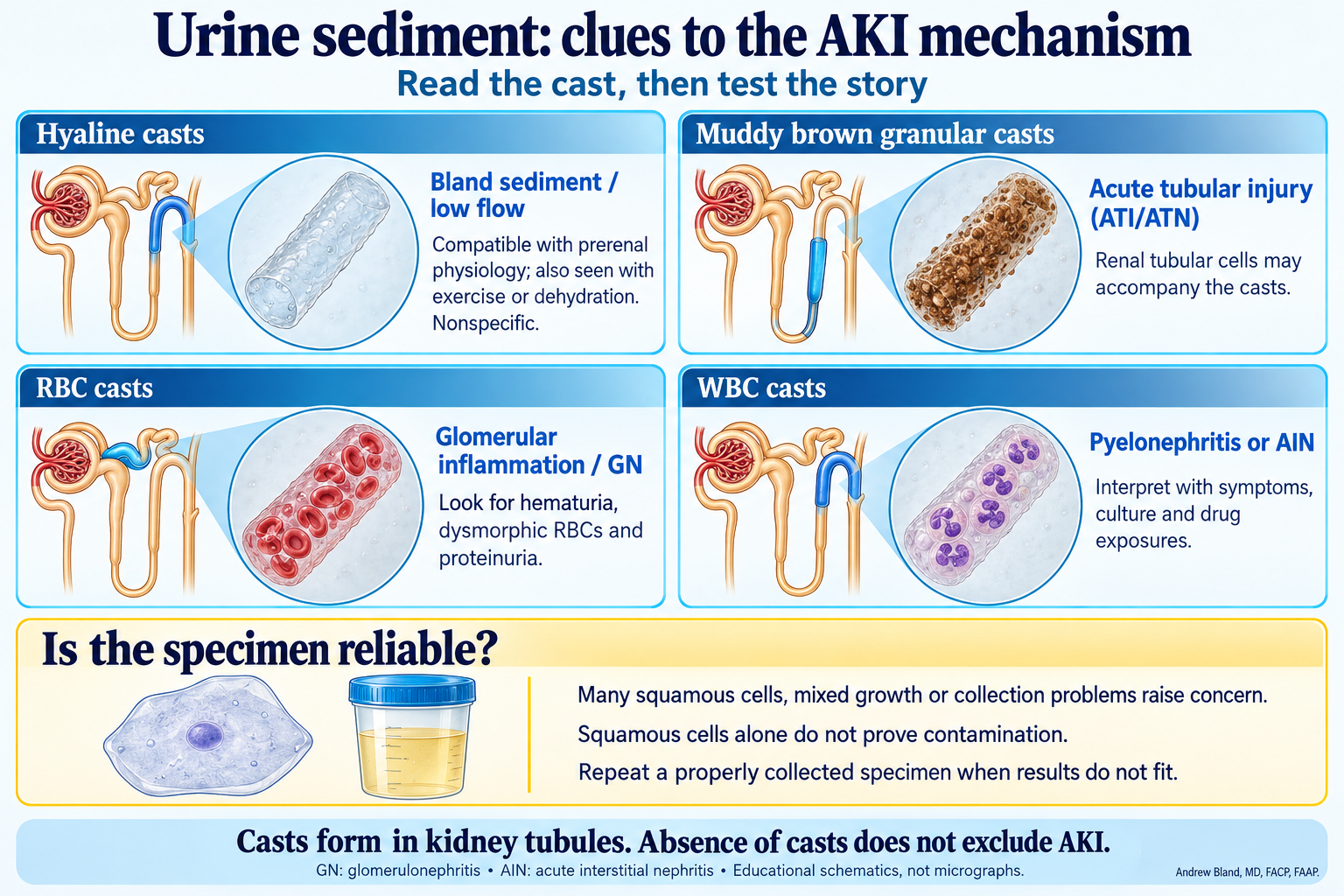
Read the cast, then test the clinical story and specimen quality.
Teaching text
Hyaline and muddy brown casts
A bland sediment with occasional hyaline casts is compatible with low-flow or prerenal physiology. Hyaline casts are nonspecific and also occur with dehydration or exercise without AKI. Muddy brown granular casts and renal tubular epithelial cells strongly support acute tubular injury, often termed ATN in teaching; they do not identify its cause by themselves.
Red-cell and white-cell casts
RBC casts strongly suggest glomerular inflammation, especially with dysmorphic red cells and proteinuria, and warrant prompt evaluation. WBC casts suggest inflammation within the kidney, including pyelonephritis or acute interstitial nephritis. Fever, flank symptoms and culture support infection; medication timing and other findings may suggest AIN. Neither cast is perfectly sensitive or exclusive to one diagnosis.
Check specimen quality before interpreting infection
Numerous squamous epithelial cells, mixed organisms on culture, vaginal secretions or menstrual blood, poor collection, or delayed processing raise concern for contamination. Squamous cells alone do not prove it, and bacteriuria or pyuria alone does not establish symptomatic UTI. When results conflict with the presentation, repeat a fresh properly collected midstream sample; use catheter sampling when clinically indicated.
Know what contamination does not explain
True cellular casts form within kidney tubules. Do not dismiss RBC or WBC casts as lower-tract contamination simply because squamous cells are also present. Absence of casts does not exclude intrinsic disease, and a bland urinalysis does not exclude obstruction.