Visual summary
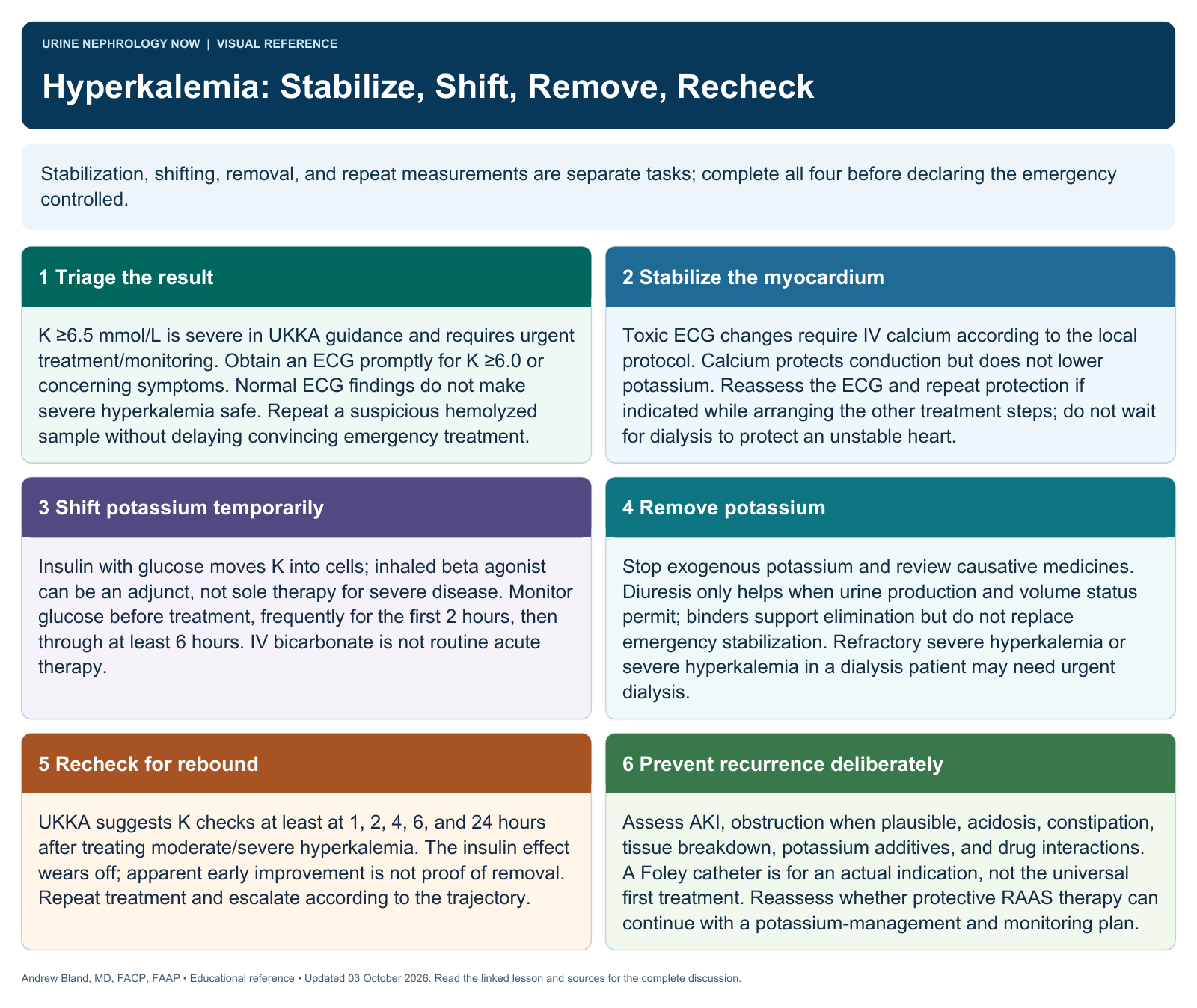
Stabilization, shifting, removal, and repeat measurements are separate tasks; complete all four before declaring the emergency controlled.
Text version
Triage the result
K ≥6.5 mmol/L is severe in UKKA guidance and requires urgent treatment/monitoring. Obtain an ECG promptly for K ≥6.0 or concerning symptoms. Normal ECG findings do not make severe hyperkalemia safe. Repeat a suspicious hemolyzed sample without delaying convincing emergency treatment.
Stabilize the myocardium
Toxic ECG changes require IV calcium according to the local protocol. Calcium protects conduction but does not lower potassium. Reassess the ECG and repeat protection if indicated while arranging the other treatment steps; do not wait for dialysis to protect an unstable heart.
Shift potassium temporarily
Insulin with glucose moves K into cells; inhaled beta agonist can be an adjunct, not sole therapy for severe disease. Monitor glucose before treatment, frequently for the first 2 hours, then through at least 6 hours. IV bicarbonate is not routine acute therapy.
Remove potassium
Stop exogenous potassium and review causative medicines. Diuresis only helps when urine production and volume status permit; binders support elimination but do not replace emergency stabilization. Refractory severe hyperkalemia or severe hyperkalemia in a dialysis patient may need urgent dialysis.
Recheck for rebound
UKKA suggests K checks at least at 1, 2, 4, 6, and 24 hours after treating moderate/severe hyperkalemia. The insulin effect wears off; apparent early improvement is not proof of removal. Repeat treatment and escalate according to the trajectory.
Prevent recurrence deliberately
Assess AKI, obstruction when plausible, acidosis, constipation, tissue breakdown, potassium additives, and drug interactions. A Foley catheter is for an actual indication, not the universal first treatment. Reassess whether protective RAAS therapy can continue with a potassium-management and monitoring plan.