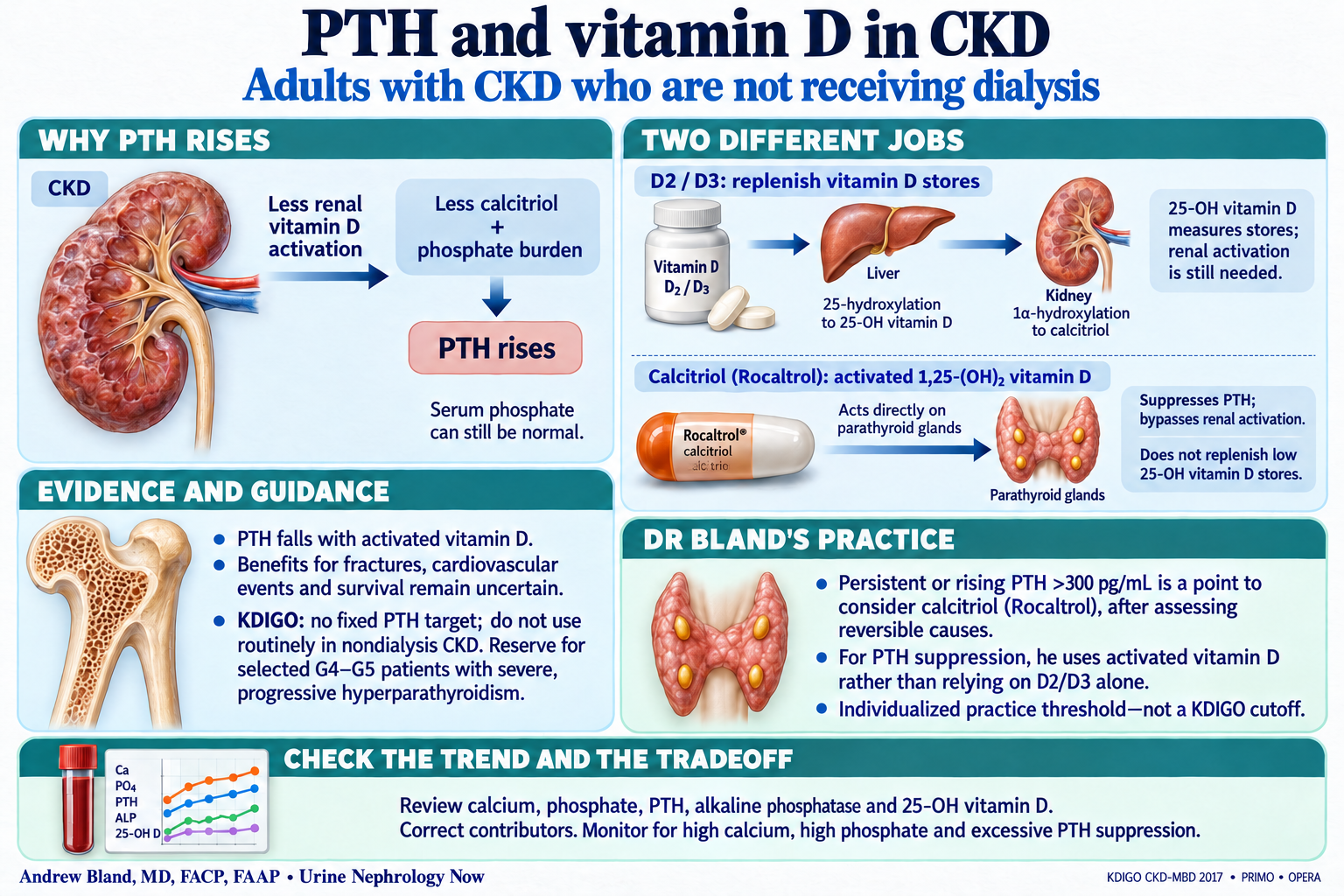
Nondialysis CKD: distinguish nutritional vitamin D repletion, activated vitamin D for PTH suppression, the clinical-outcome evidence gap and Dr Bland’s individualized practice threshold.
Teaching text and evidence
Why PTH rises
Reduced renal vitamin D activation, phosphate burden and altered calcium balance can stimulate secondary hyperparathyroidism as CKD progresses. PTH can rise while serum phosphate remains within the reference range. Interpret calcium, phosphate, alkaline phosphatase, 25-OH vitamin D and PTH together and as serial trends.
Two forms, two purposes
Ergocalciferol (D2) and cholecalciferol (D3) replenish nutritional vitamin D stores, assessed with 25-OH vitamin D. Their conversion to the active hormone includes renal 1α-hydroxylation. Calcitriol (Rocaltrol), activated 1,25-(OH)2 vitamin D3, bypasses that step and suppresses PTH. Calcitriol does not replace correction of low 25-OH vitamin D stores.
What is established, and what remains uncertain
Activated vitamin D lowers PTH. Evidence that treating secondary hyperparathyroidism this way improves fractures, cardiovascular events or survival in nondialysis CKD remains insufficient. PRIMO and OPERA tested paricalcitol, not calcitriol: PTH suppression did not improve their primary cardiac structural endpoints, and hypercalcemia was more frequent. Those results do not establish that selected patients with severe progressive disease can never benefit.
Guideline frame
KDIGO does not define an optimal PTH target for adults with nondialysis CKD. Evaluate reversible contributors when PTH is persistently elevated or rising. Calcitriol and vitamin D analogs are not recommended routinely in G3a–G5; selective use may be reasonable in G4–G5 with severe progressive secondary hyperparathyroidism. The guideline does not specify 300 pg/mL as a treatment cutoff.
Dr Bland’s practice
Dr Bland uses persistently elevated or rising PTH above about 300 pg/mL as a point to consider calcitriol (Rocaltrol), after evaluating reversible contributors. For PTH suppression he prefers activated vitamin D rather than relying on nutritional D2/D3 alone. This is an individualized faculty practice threshold, not a proven clinical-outcome threshold or a KDIGO target. Deficiency in 25-OH vitamin D still requires attention.
Return to Case 4 and monitor
Carol’s G3b CKD, PTH 260→400, normal calcium/phosphate and 25-OH vitamin D of 17 call for correcting deficiency and reviewing the trend and other contributors first. A single PTH of 400 does not make calcitriol automatic. If selected, monitor calcium, phosphate and PTH; excessive suppression can promote low bone turnover. High calcium or phosphate should prompt reassessment.