1 · Approach
Use the opening diagram and short lessons before the patient.
CKD, complications and cardiorenal care
Andrew Bland, MD, FACP, FAAP · October 21, 2026
3 cases now use the same sequence, with 24 short lessons and opening, interpretation and treatment figures.
Open the collected self-study teaching ↓ · Browse the self-study case guide
Opening frameworks, 35 Learn first sections, stage-specific infographics and direct lecture links for the three classroom cases. Use the short lesson before its question, then return to the case to commit, discuss and reveal.
Session plan and self-study cases · Shared opening lecture · Day 2 figures in the visual library
Look for hyperkalemic cardiac toxicity, hypoxemic pulmonary edema and uremic complications. A stable CKD stage or an isolated office BP value calls for context and follow-up, not reflex emergency treatment.
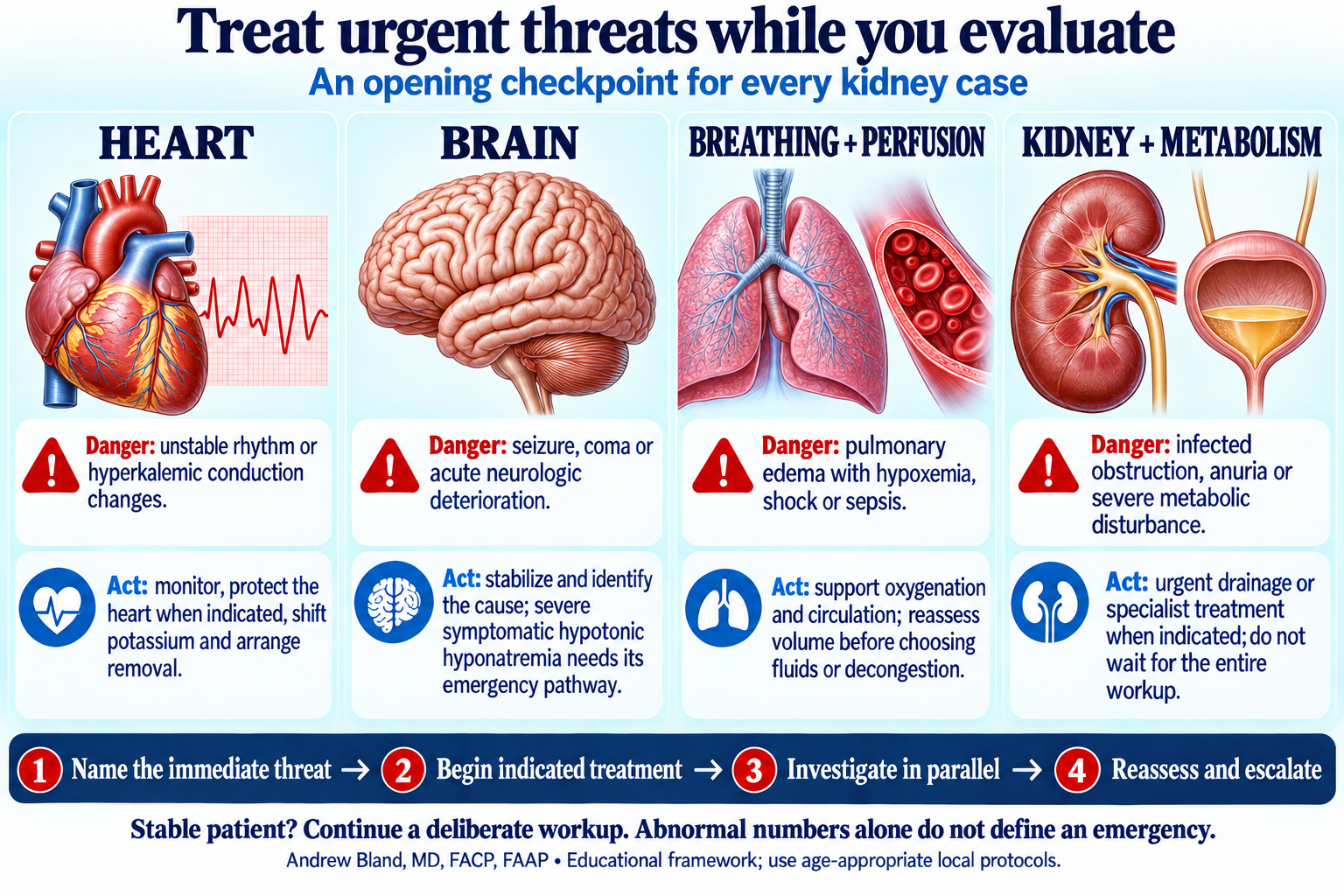
Name the threat, begin indicated treatment, investigate in parallel, then reassess.
Confirm chronicity and measurement, place filtration beside albuminuria, then separate CKD complications from other causes of fatigue.
Use the opening diagram and short lessons before the patient.
Revisit urgency as history, examination and initial data arrive.
Use the urine, blood or imaging guide at the relevant decision.
Connect the management plan with response, monitoring and follow-up.
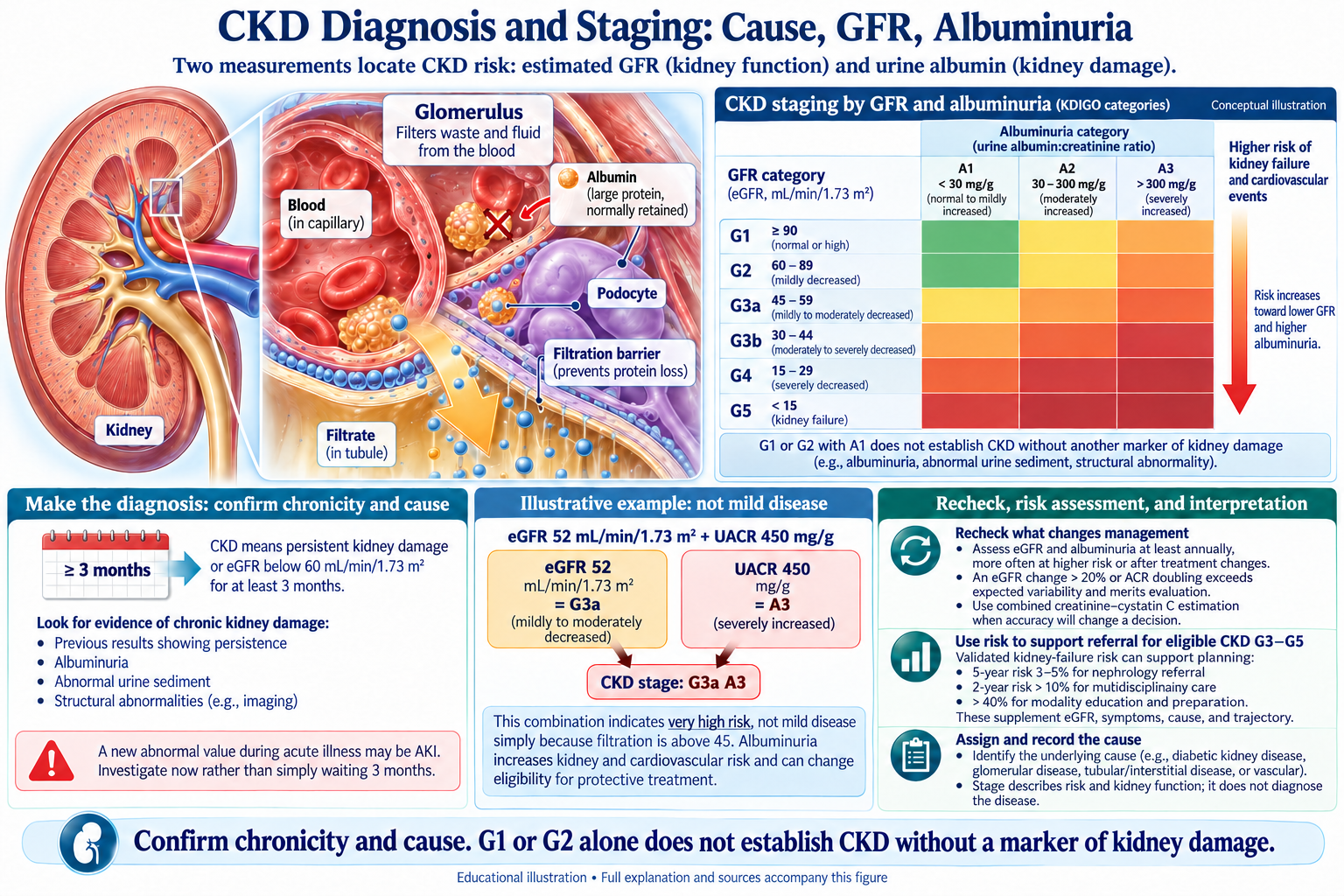
Use the diagram with the teaching text, then apply it to the case findings.
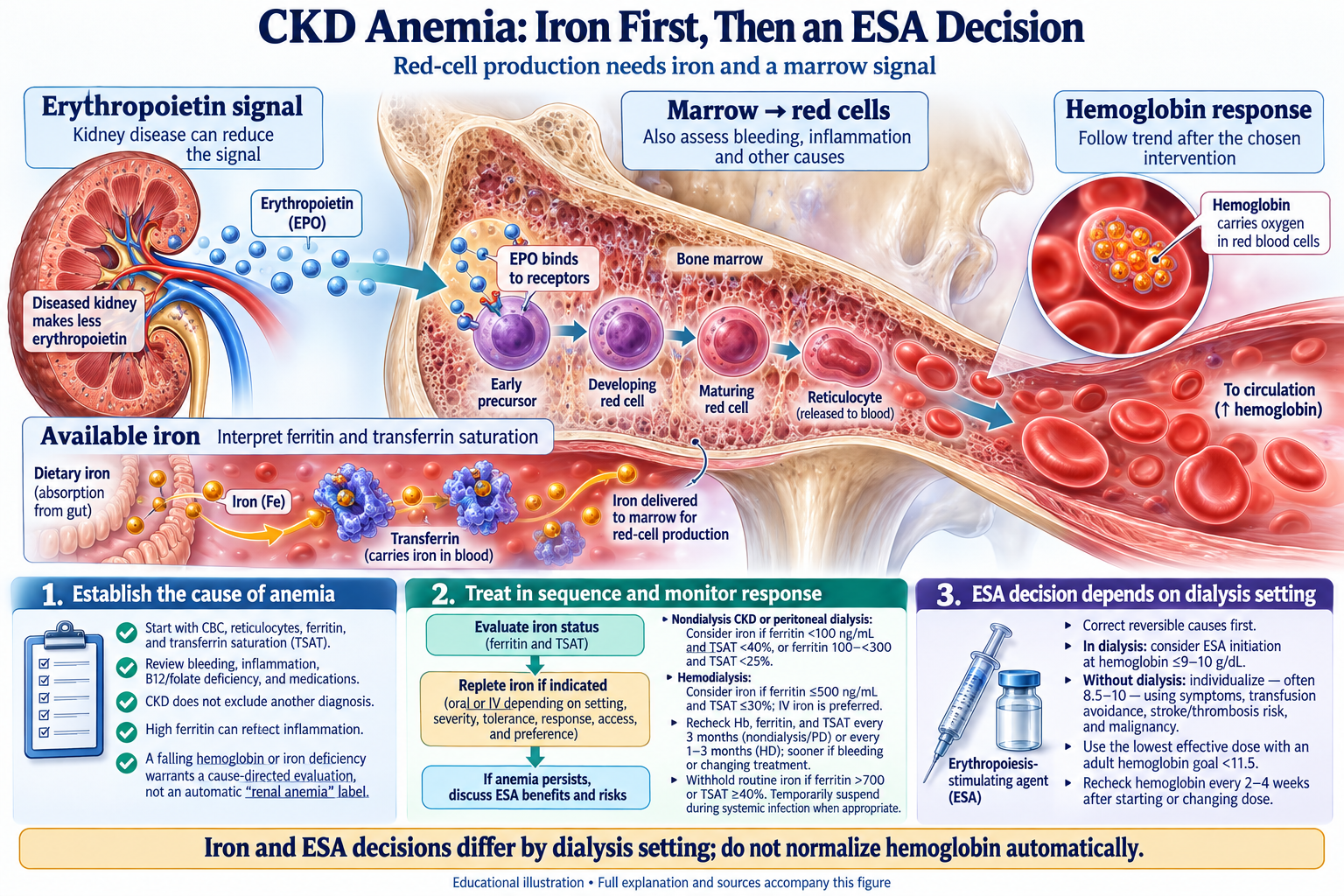
Use the diagram with the teaching text, then apply it to the case findings.
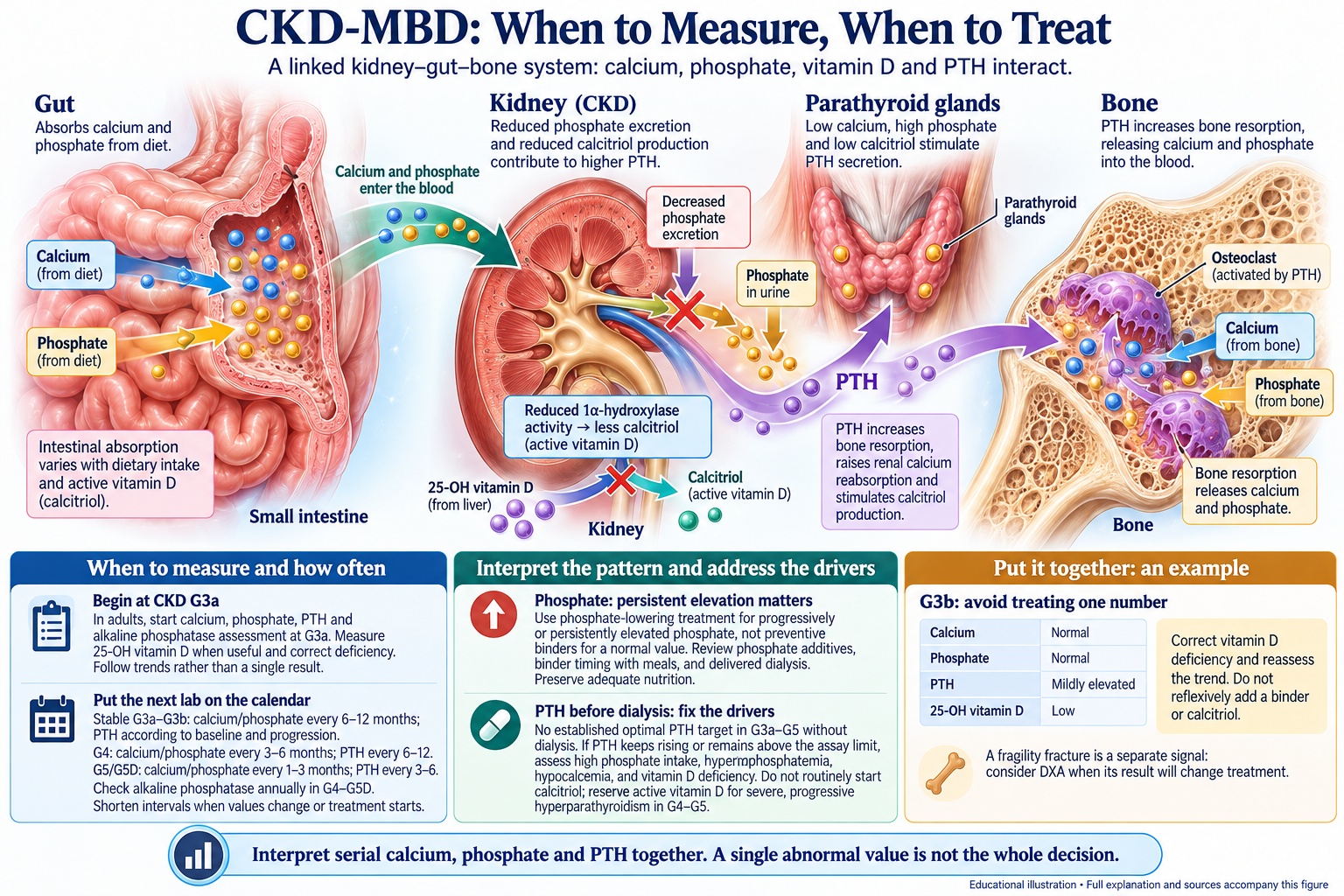
Use the diagram with the teaching text, then apply it to the case findings.
Assigned reading: the explanations in this case and the question-linked course evidence guide. The objective map distinguishes tested decisions from concepts taught in explanations.
Concepts: ckd-01, ckd-02, ckd-03, ckd-04, ckd-05, ckd-07, ckd-10, ckd-14, ckd-15, ckd-16, ckd-19, ckd-21, ckd-26, htn-cardiorenal-01, htn-cardiorenal-02, htn-cardiorenal-04, htn-cardiorenal-06, htn-cardiorenal-10, htn-cardiorenal-16, structural-20.
CKD staging handout (site) — UACR & 24-Hour Urine Protein Interpretation
Creatinine & GFR lecture — Limitations of eGFR / Evolution of eGFR Equations
CKD overview handout (site) — Identifying the True Cause of CKD
CKD overview handout (site) — The Challenge: "Hypertensive Nephropathy"
CKD management pathways (site) — Part 3: Blood Pressure Management in CKD
CKD-MBD handout (site) — Diagnostic Approach: CKD-MBD Screening
Renal pharmacology lecture — Nephrotoxic Medication Avoidance / NSAID Alternatives
BP measurement handout (site) — Sources of Measurement Error
Home BP monitoring lecture — Critical HBPM Implementation Points
BP targets lecture — Population-Specific Target Recommendations
Lifestyle interventions lecture — Quantified BP Reduction Summary
Diuretic selection lecture — Thiazide vs Thiazide-Like Diuretics
Resistant HTN lecture — Definition / Systematic Evaluation / Spironolactone
Hypertensive nephropathy student handout (site) — Clinical Approach and BP Management
NSAID-induced nephrotoxicity lecture — Risk Factors for NSAID-Induced Kidney Injury
Stage diabetic kidney disease, identify protective-treatment opportunities, and connect each drug to potassium, volume and follow-up.
Use the opening diagram and short lessons before the patient.
Revisit urgency as history, examination and initial data arrive.
Use the urine, blood or imaging guide at the relevant decision.
Connect the management plan with response, monitoring and follow-up.
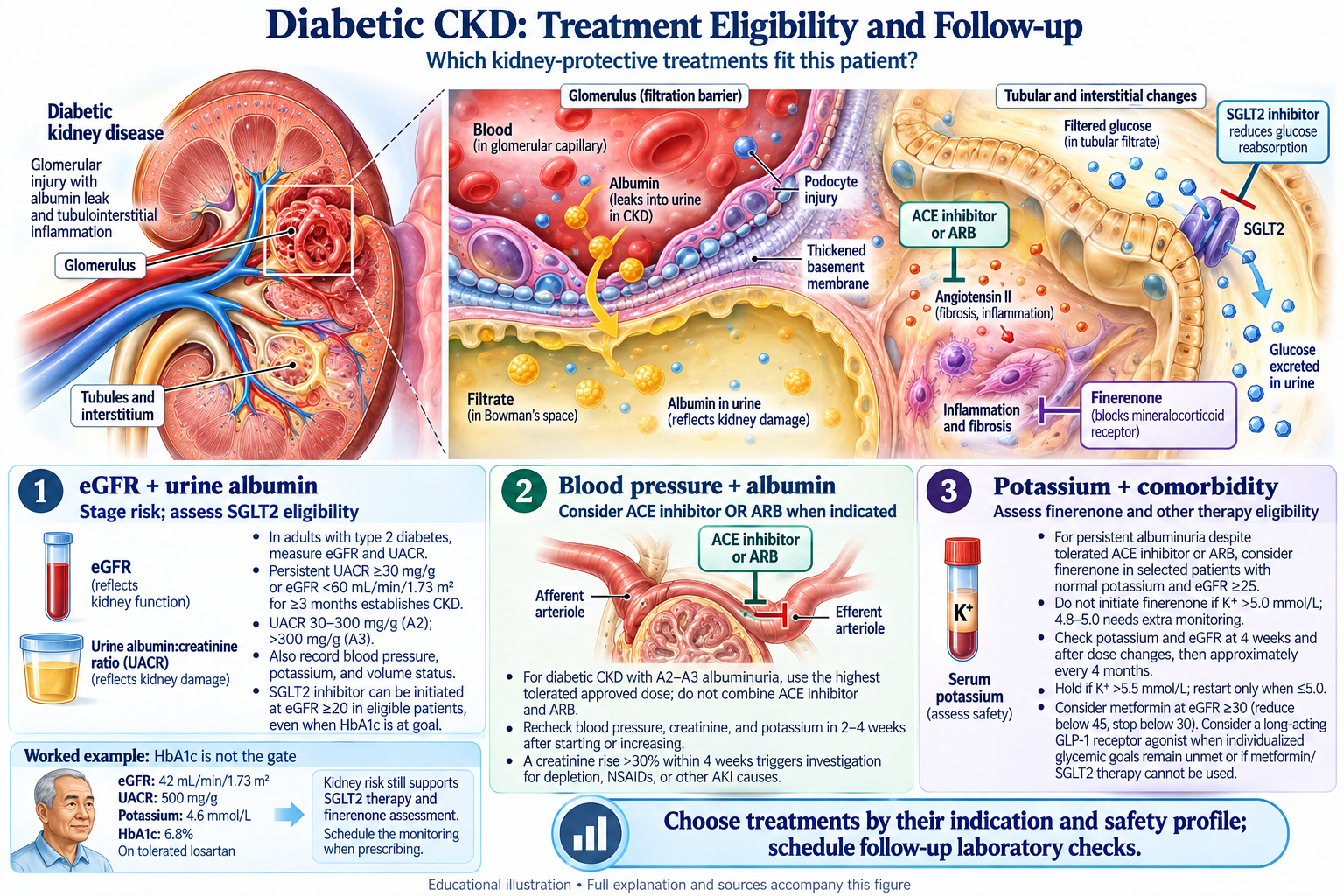
Use the diagram with the teaching text, then apply it to the case findings.
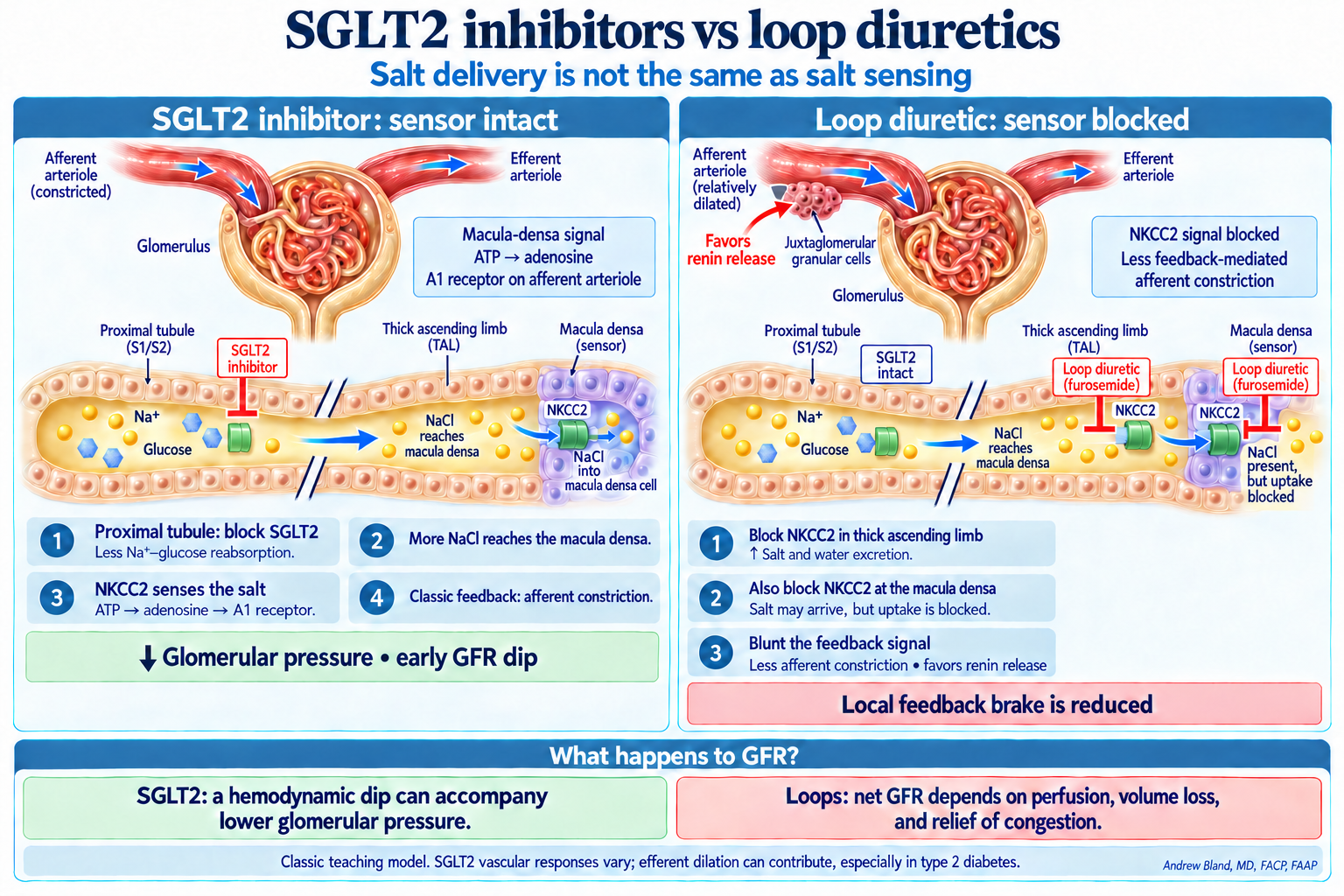
Use the diagram with the teaching text, then apply it to the case findings.
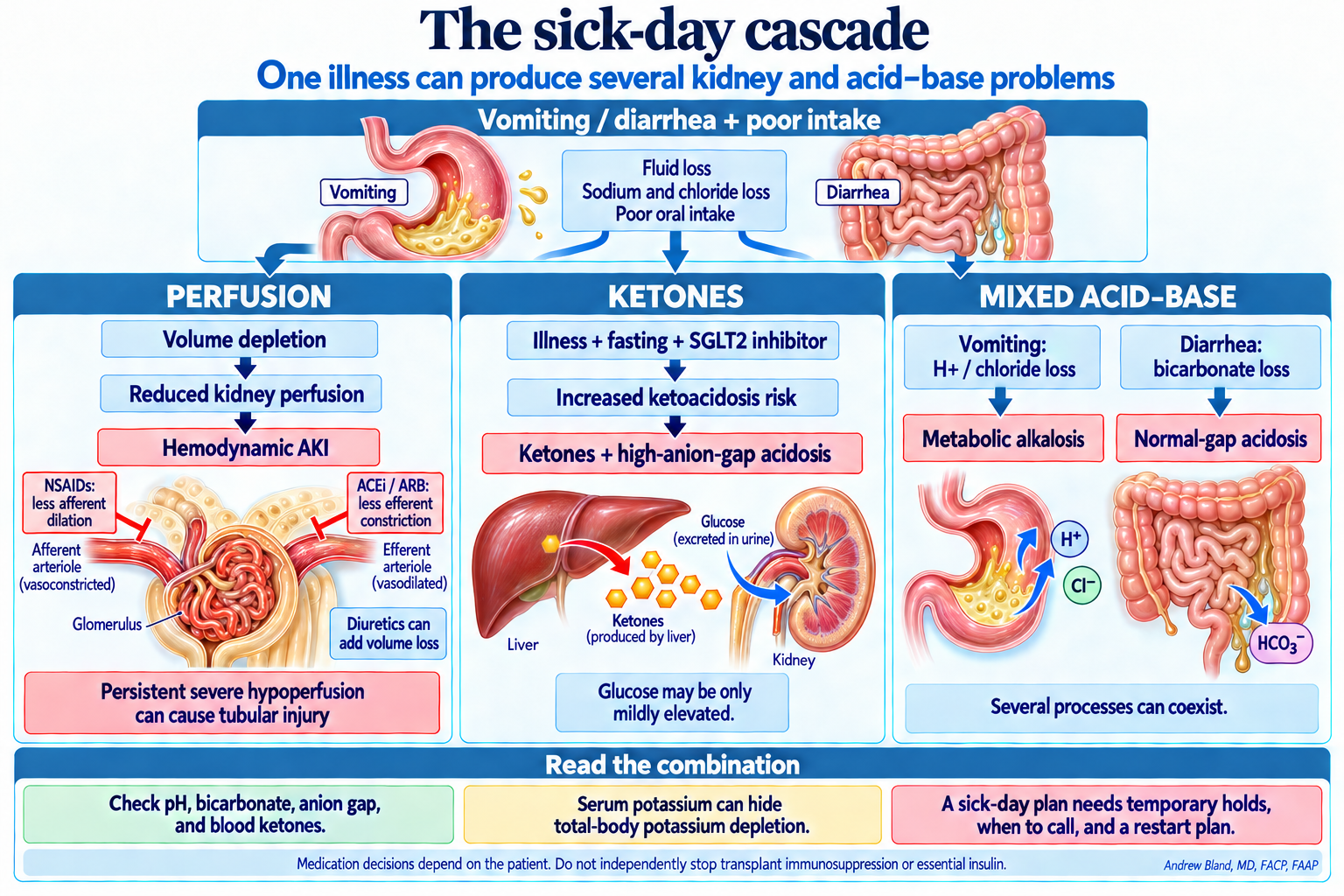
Use the diagram with the teaching text, then apply it to the case findings.
Assigned reading: the explanations in this case and the question-linked course evidence guide. The objective map distinguishes tested decisions from concepts taught in explanations.
Concepts: aki-14, aki-15, aki-27, ckd-02, ckd-06, ckd-11, ckd-12, ckd-13, ckd-17, ckd-20, htn-cardiorenal-07, htn-cardiorenal-09, htn-cardiorenal-24, htn-cardiorenal-25, lytes-14, structural-23, structural-24.
Hyperkalemia lecture — Find the mechanism and reversible contributors
Drug-induced AKI handout — Function/Damage 2x2 grid (the KDIGO 2026 draft figure)
Renal pharmacology lecture — 2. Nephrotoxic Medication Avoidance
Hyperkalemia lecture — Find the mechanism and reversible contributors
Comorbidity management lecture — Paradigm Shift: CKM Syndrome
Drug dosing quick reference — Part 5: Antidiabetic Medications
Assess congestion and perfusion together, judge the response to diuretics, then preserve disease-modifying treatment when it remains appropriate.
Use the opening diagram and short lessons before the patient.
Revisit urgency as history, examination and initial data arrive.
Use the urine, blood or imaging guide at the relevant decision.
Connect the management plan with response, monitoring and follow-up.
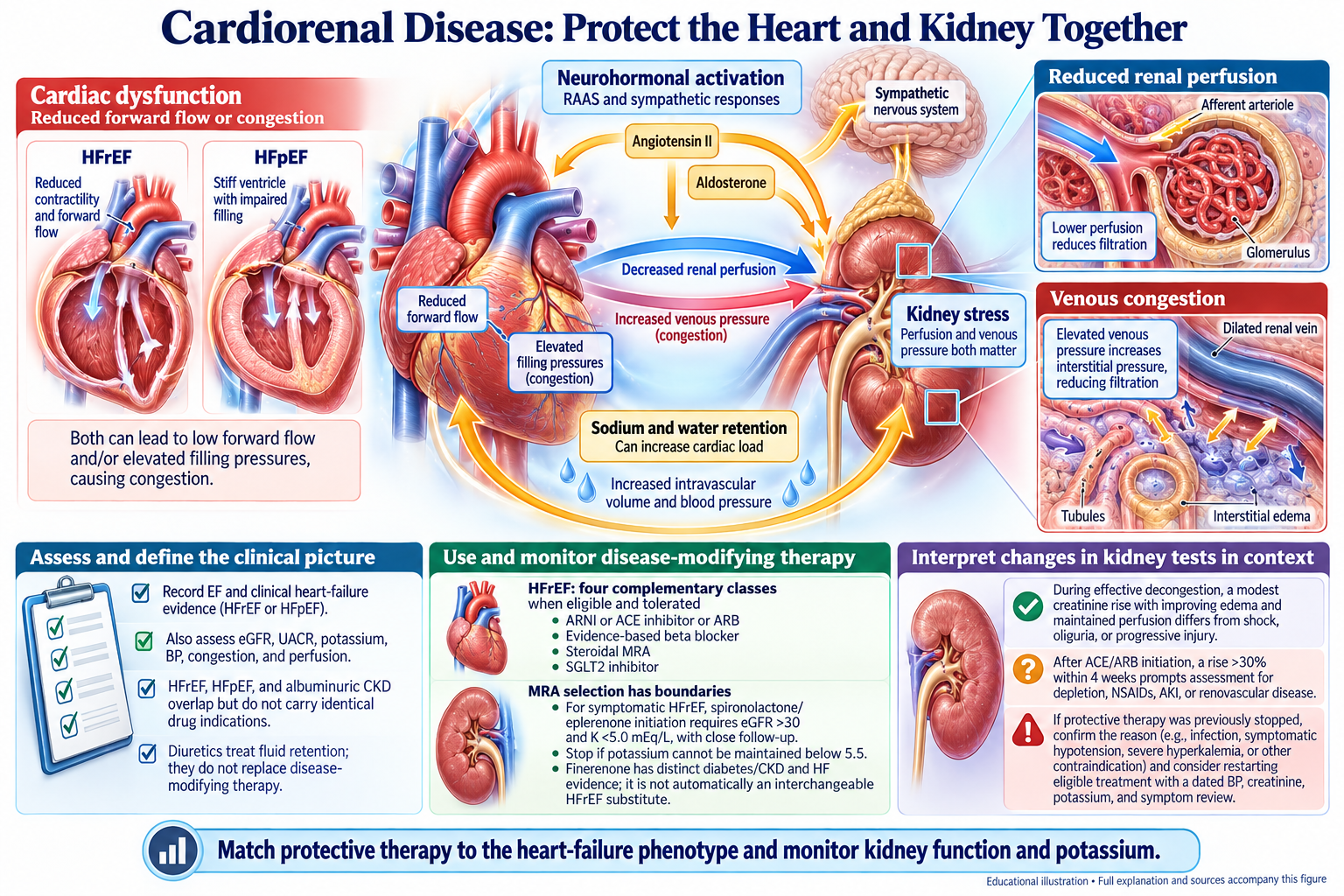
Use the diagram with the teaching text, then apply it to the case findings.
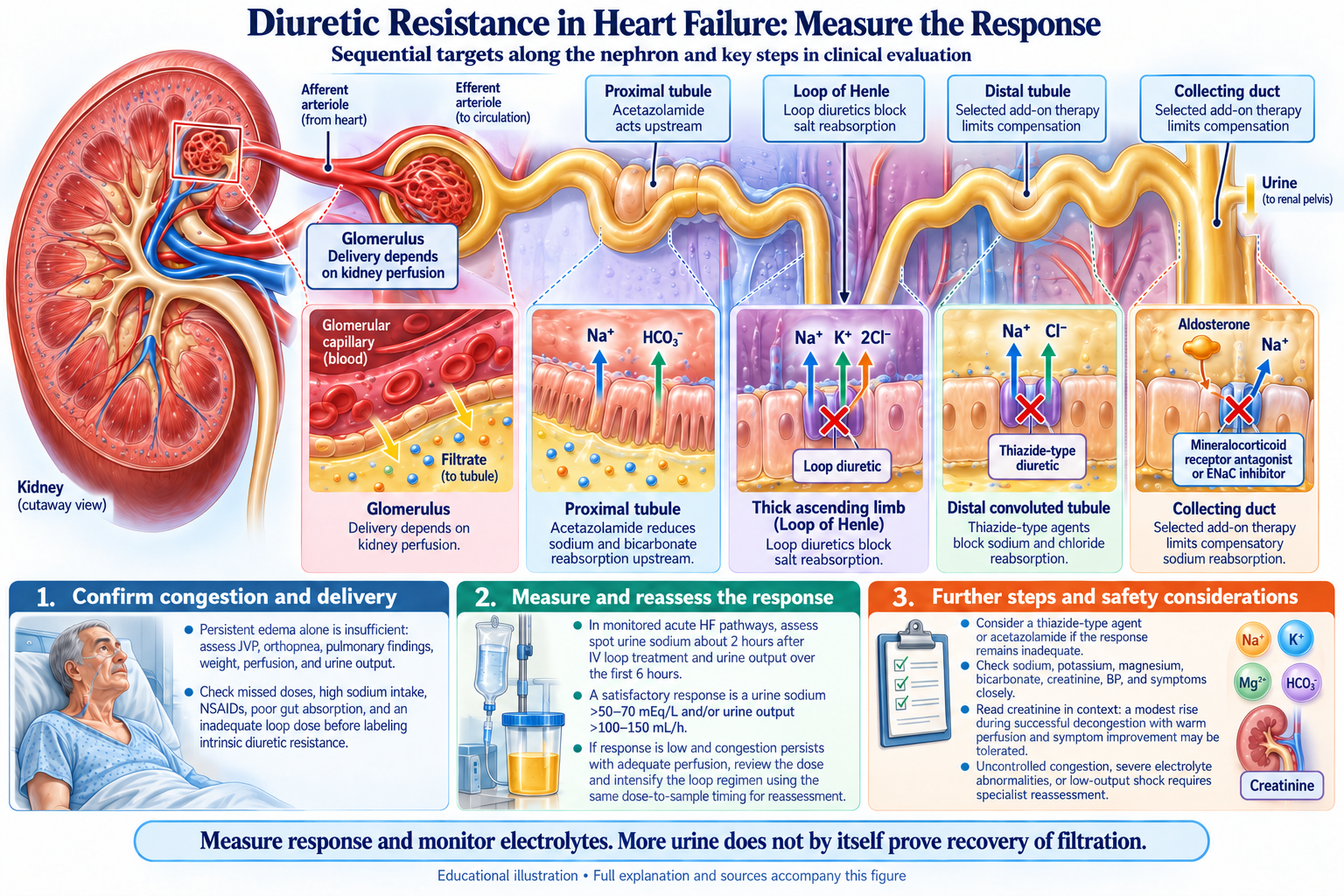
Use the diagram with the teaching text, then apply it to the case findings.
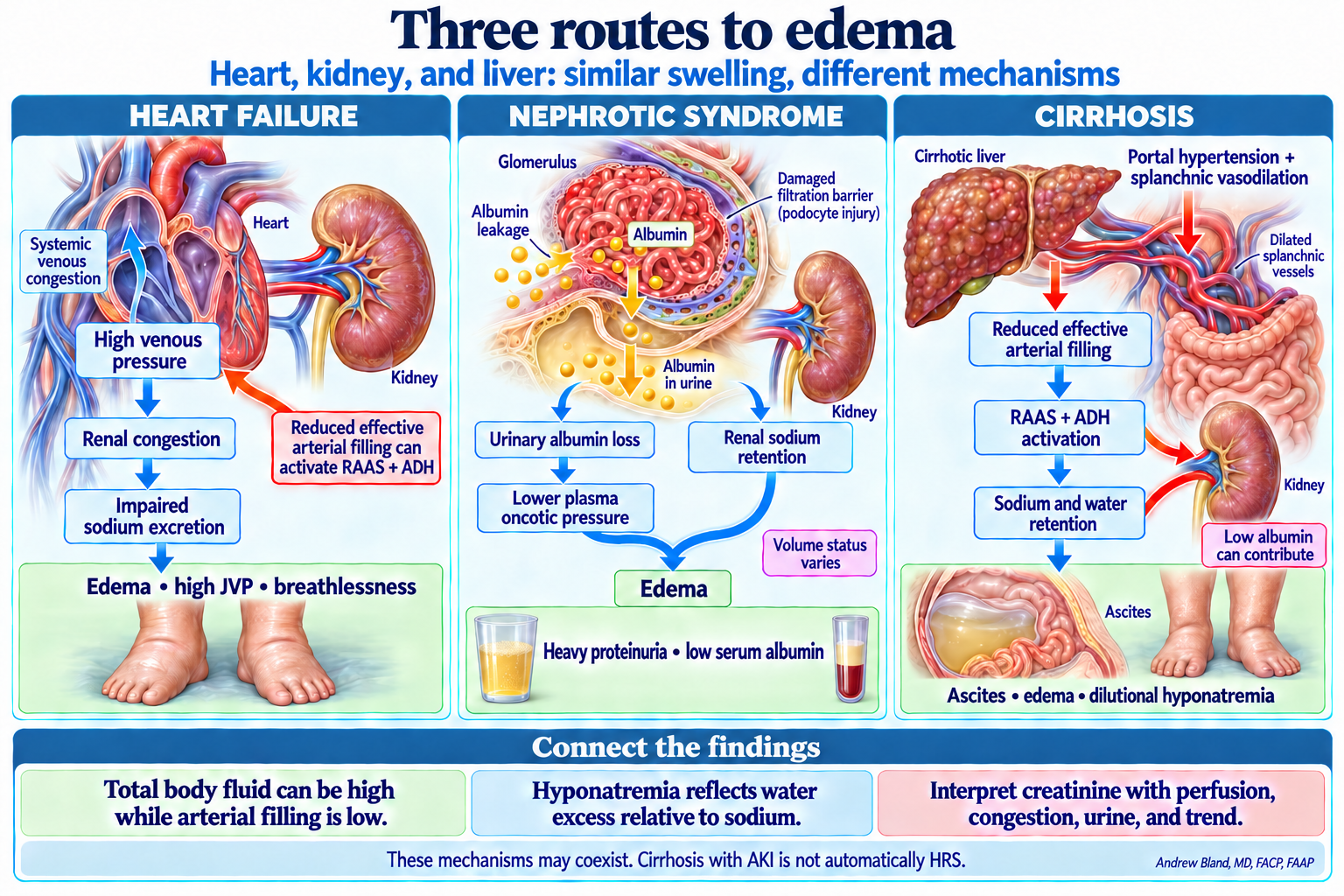
Use the diagram with the teaching text, then apply it to the case findings.
Assigned reading: the explanations in this case and the question-linked course evidence guide. The objective map distinguishes tested decisions from concepts taught in explanations.
Concepts: aki-19, ckd-17, ckd-26, htn-cardiorenal-09, htn-cardiorenal-19, htn-cardiorenal-20, htn-cardiorenal-21, htn-cardiorenal-22, htn-cardiorenal-23, lytes-01, lytes-07, lytes-27, structural-20.
ACE Inhibitors vs ARBs — Renal Effects ("Acceptable rise: 30 % creatinine")
HF, Diuretic Resistance and Volume Management — Cardiorenal Syndrome: Classification
HF lecture — Guideline-Directed Medical Therapy in Cardiorenal Disease
Diuretic Selection and Optimization — Structured Monitoring and Risk Mitigation
Hyperkalemia — Find the mechanism and reversible contributors · Potassium and Your Kidneys — binders
CKD Comprehensive Management Pathways — Part 5: Progression Prevention Checklist
NSAID-Induced Nephrotoxicity — Risk Factors · Renal Pharmacology — 6. NSAID Alternatives; 7. Sick Day Rules
Bring the lecture to the bedside · Course evidence guide · Integrated case summaries
Open a case below for its teaching, diagrams and lecture links. Use the staged case to answer the questions and reveal explanations.
Separate an urgent dialysis indication from long-term preparation. Combine filtration, albuminuria, trajectory and risk with the patient’s goals.
Read the opening framework and urgent-threat checkpoint.
Build the pattern as the history, examination and results arrive.
Use the mechanism to explain the blood, urine or imaging findings.
Connect the treatment with the response, risks and follow-up.
Review the shared urgent-threat framework →
Use the visual framework with the case findings and the linked lecture.
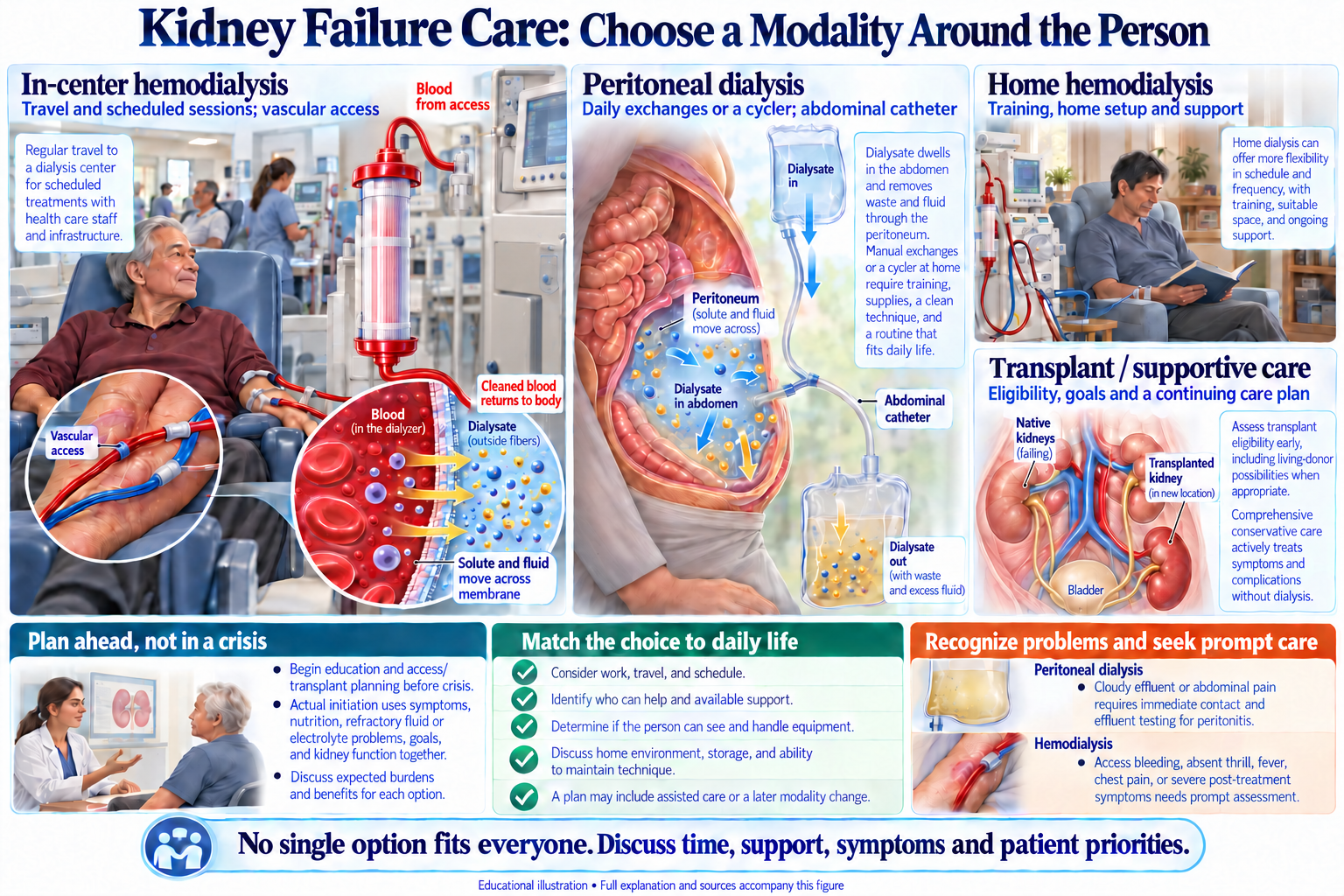
Use the visual framework with the case findings and the linked lecture.
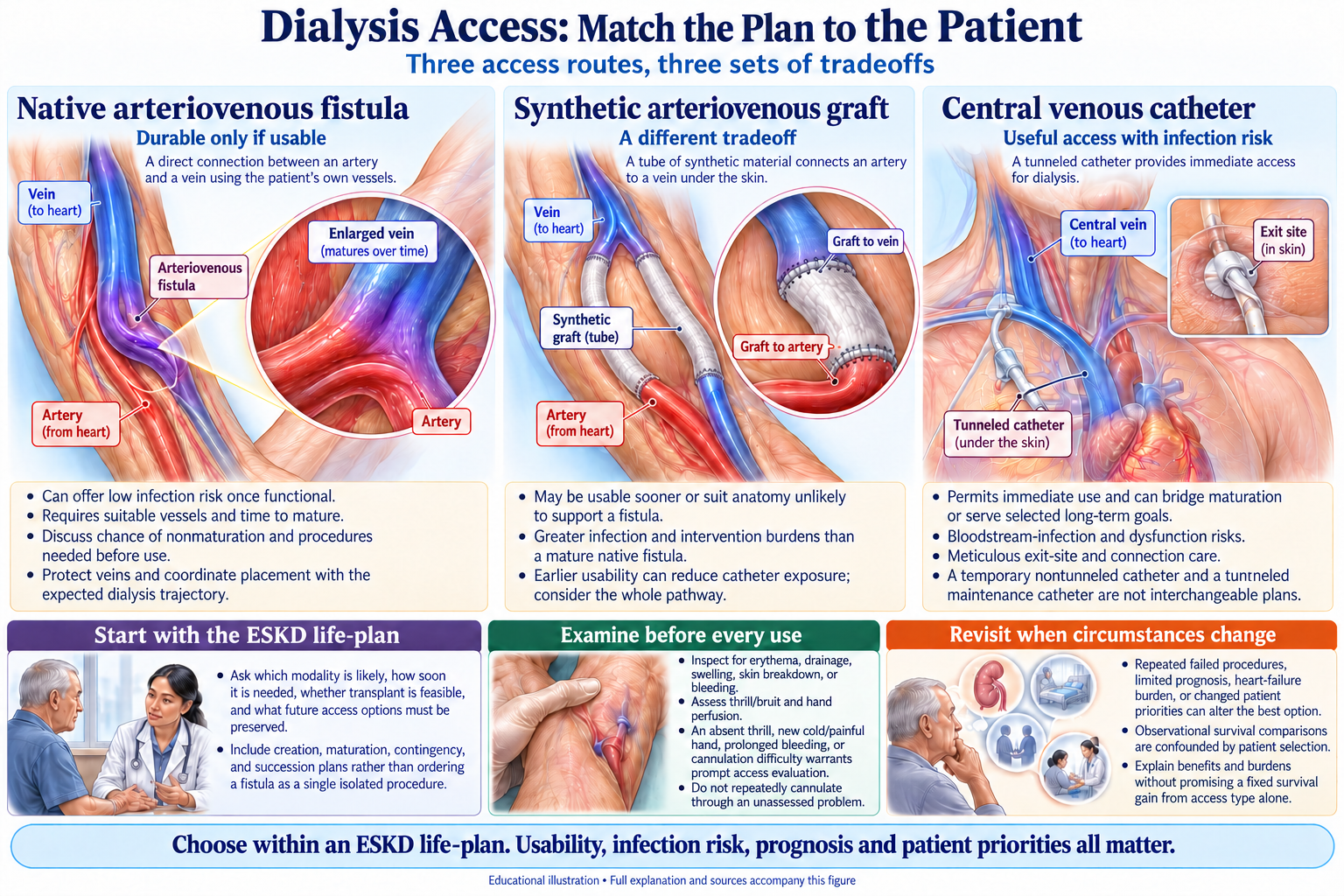
Use the visual framework with the case findings and the linked lecture.
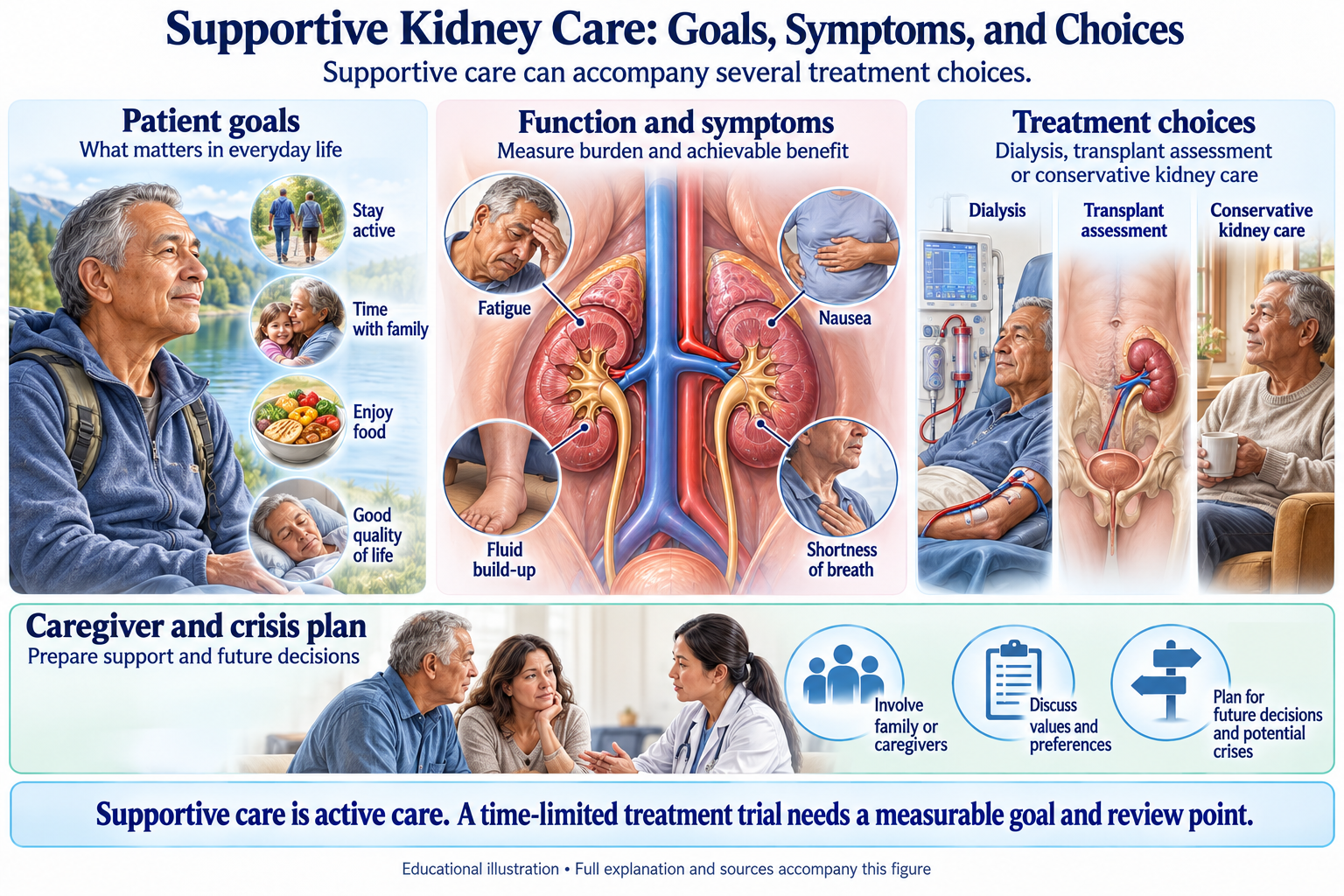
Use the visual framework with the case findings and the linked lecture.
What would make dialysis necessary today, and what preparation should continue even if it is not needed today?
Assigned reading: the explanations in this case and the question-linked course evidence guide. The objective map distinguishes tested decisions from concepts taught in explanations.
Concepts: aki-22, ckd-09, ckd-16, ckd-21, ckd-22, ckd-23, ckd-24, ckd-25, ckd-27, structural-25, structural-26.
CKM vs KFRE lecture — Different questions: KDIGO action thresholds
CKD staging handout — Referral Criteria Summary (Handy Chart)
Dialysis initiation handout — Modality Choice: HD vs PD vs Conservative
Access complications handout — Section 3: PICC Lines in Dialysis Patients
Kidney transplant fundamentals — Part 1: Transplant Evaluation Framework
Dialysis prescription lecture — Urgent Dialysis Indications: AEIOU
CKD nutrition handout — Practical Implementation · Phosphorus patient handout — The hidden phosphorus
Nephrology textbook — Chapter 6 AKI, Indications for Urgent Dialysis (AEIOU)
Geriatric nephrology handout — IV. Frailty Assessment in CKD Patients
Palliative nephrology handout — I. Conservative (Non-Dialysis) Kidney Management
Verify pressure and chronicity before labeling disease. Use medication and electrolyte clues to guide secondary-cause testing and a coordinated prevention plan.
Read the opening framework and urgent-threat checkpoint.
Build the pattern as the history, examination and results arrive.
Use the mechanism to explain the blood, urine or imaging findings.
Connect the treatment with the response, risks and follow-up.
Review the shared urgent-threat framework →
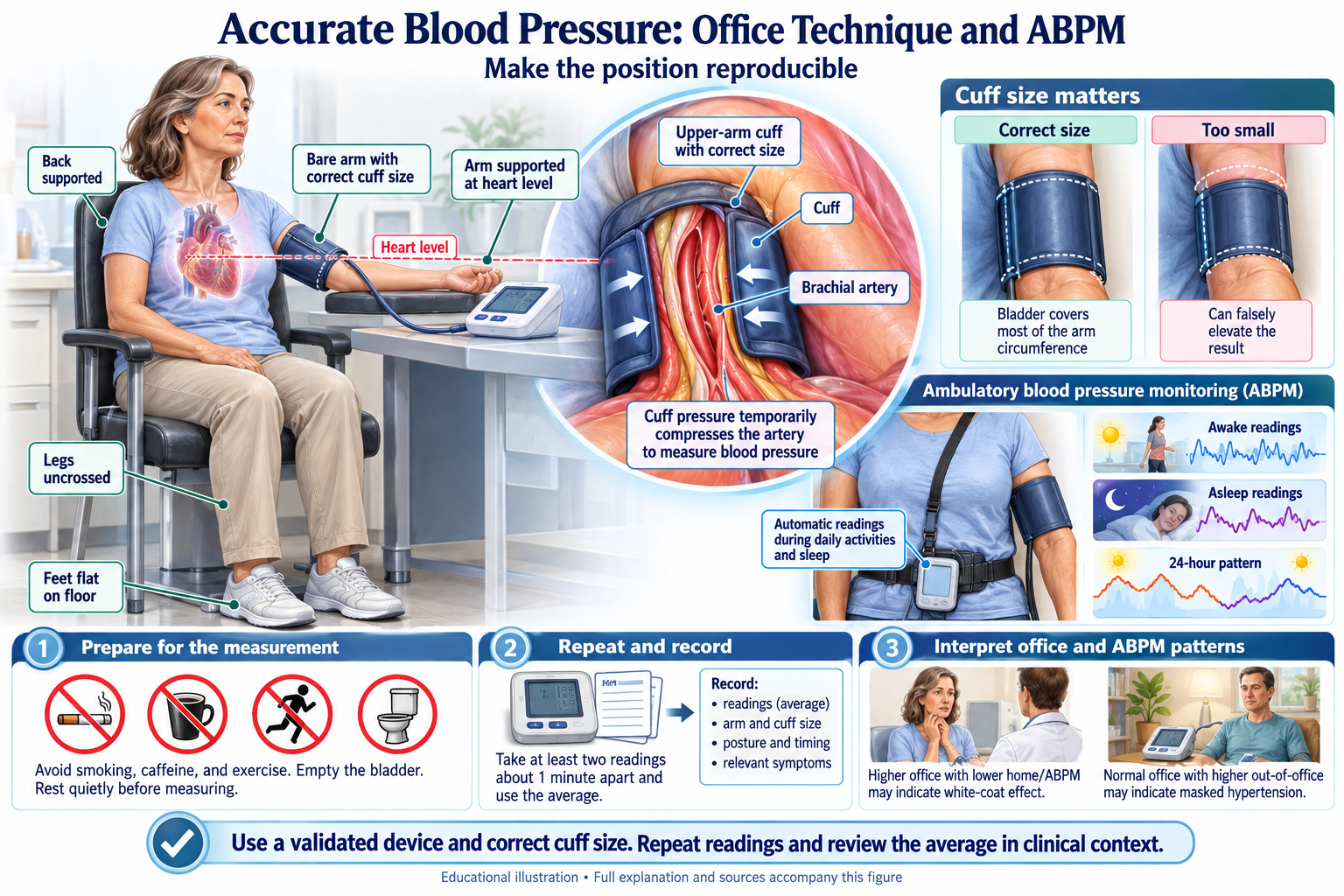
Use the visual framework with the case findings and the linked lecture.
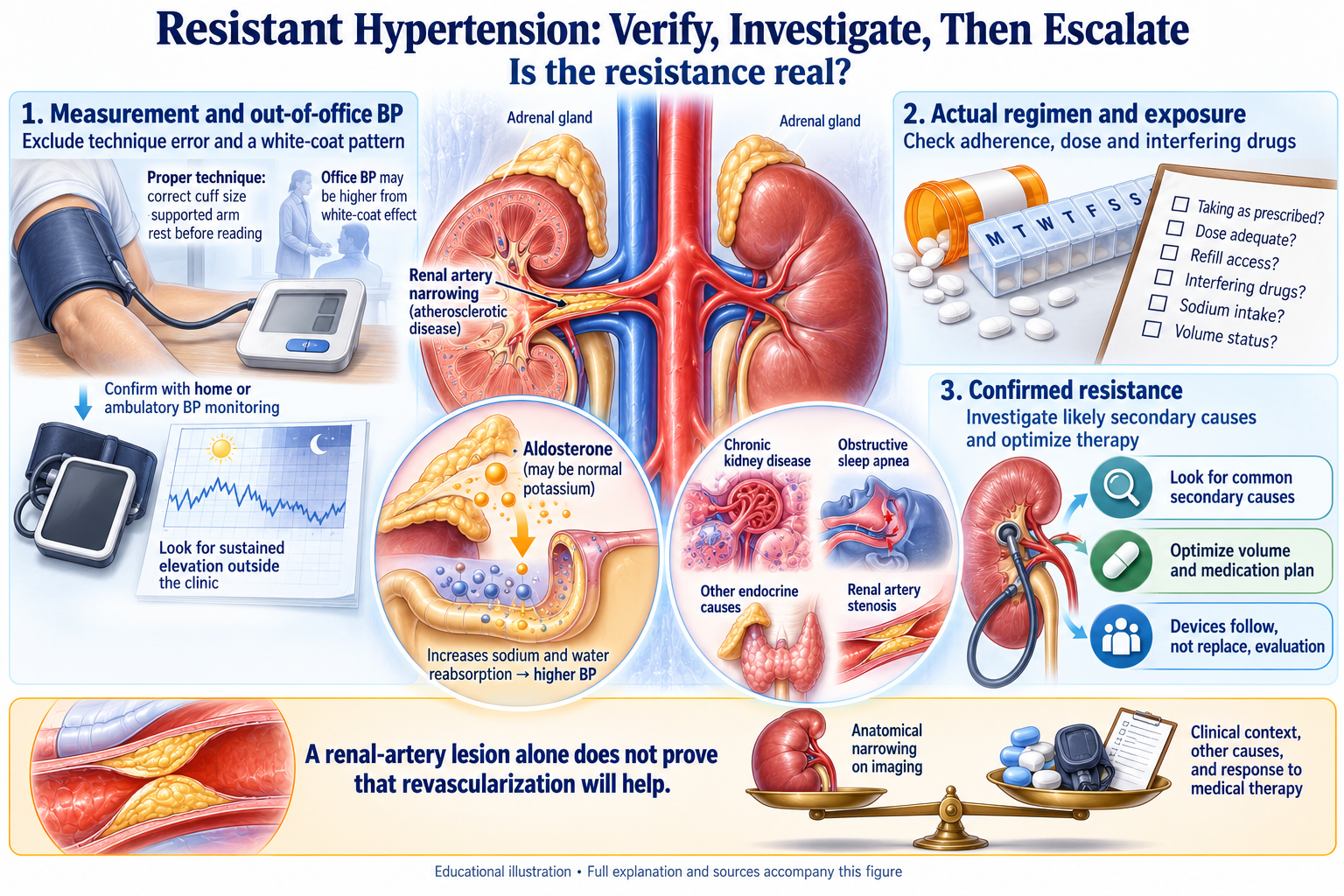
Use the visual framework with the case findings and the linked lecture.
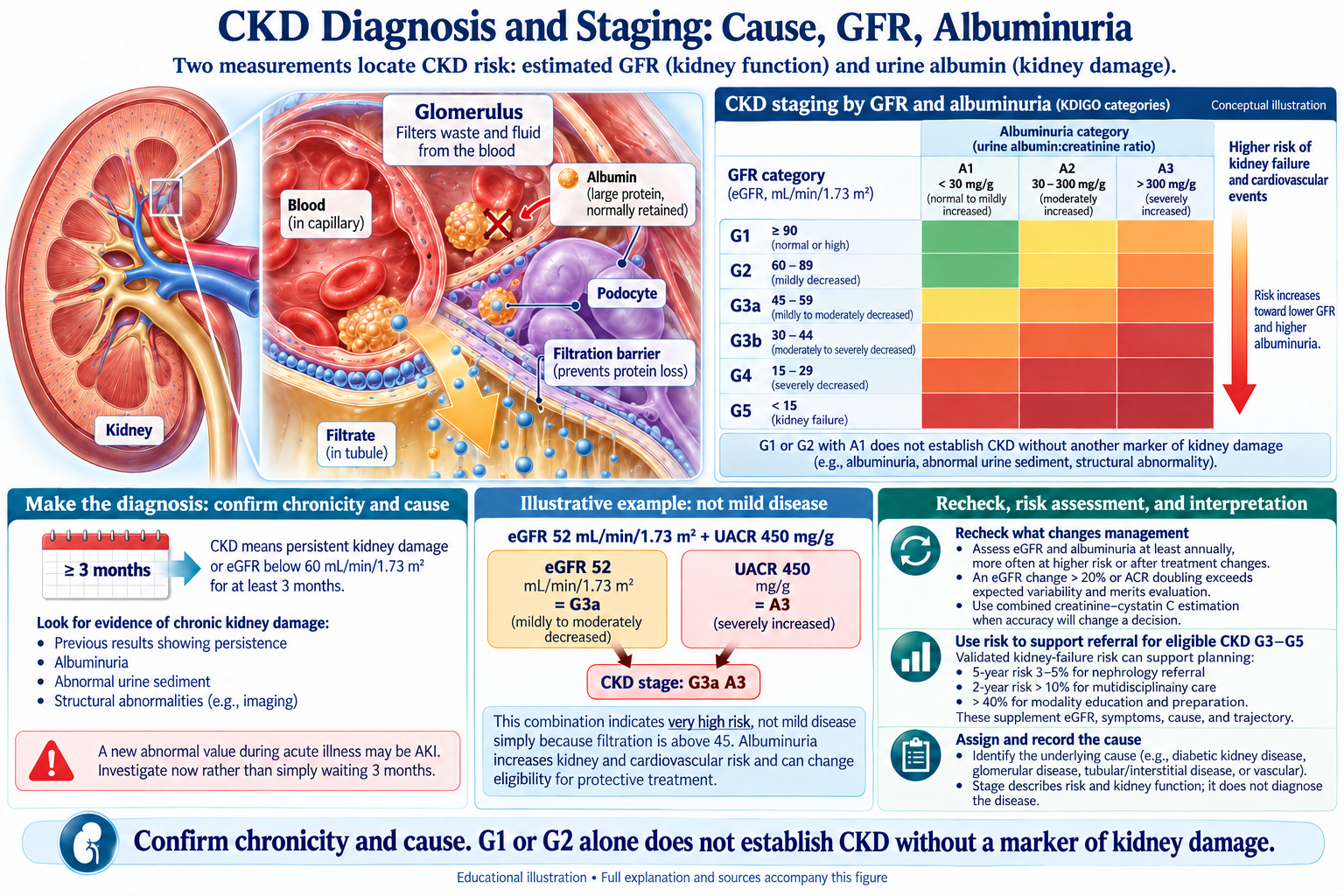
Use the visual framework with the case findings and the linked lecture.
Which findings establish chronic kidney damage, and which findings reopen the cause of hypertension?
Assigned reading: the explanations in this case and the question-linked course evidence guide. The objective map distinguishes tested decisions from concepts taught in explanations.
Concepts: ckd-01, ckd-02, ckd-03, ckd-11, ckd-26, htn-cardiorenal-01, htn-cardiorenal-02, htn-cardiorenal-03, htn-cardiorenal-05, htn-cardiorenal-06, htn-cardiorenal-07, htn-cardiorenal-11, htn-cardiorenal-14, htn-cardiorenal-27, lytes-27.
BP measurement lecture — Office Blood Pressure Measurement Protocol
Home BP monitoring lecture — Critical HBPM Implementation Points
Medical management lecture — Treatment Thresholds Using PREVENT
Lifestyle interventions lecture — Quantified BP Reduction Summary
Diuretic selection lecture — Thiazide vs Thiazide-Like Diuretics
Secondary HTN screening lecture — Additional Secondary Causes
CKD staging handout (site) — UACR & 24-Hour Urine Protein Interpretation
Diuretic selection lecture — Structured Monitoring and Risk Mitigation
Review each medicine by indication, clearance, dose and exposure. Look for accumulated toxicity, interacting drugs and procedure-related risks.
Read the opening framework and urgent-threat checkpoint.
Build the pattern as the history, examination and results arrive.
Use the mechanism to explain the blood, urine or imaging findings.
Connect the treatment with the response, risks and follow-up.
Review the shared urgent-threat framework →
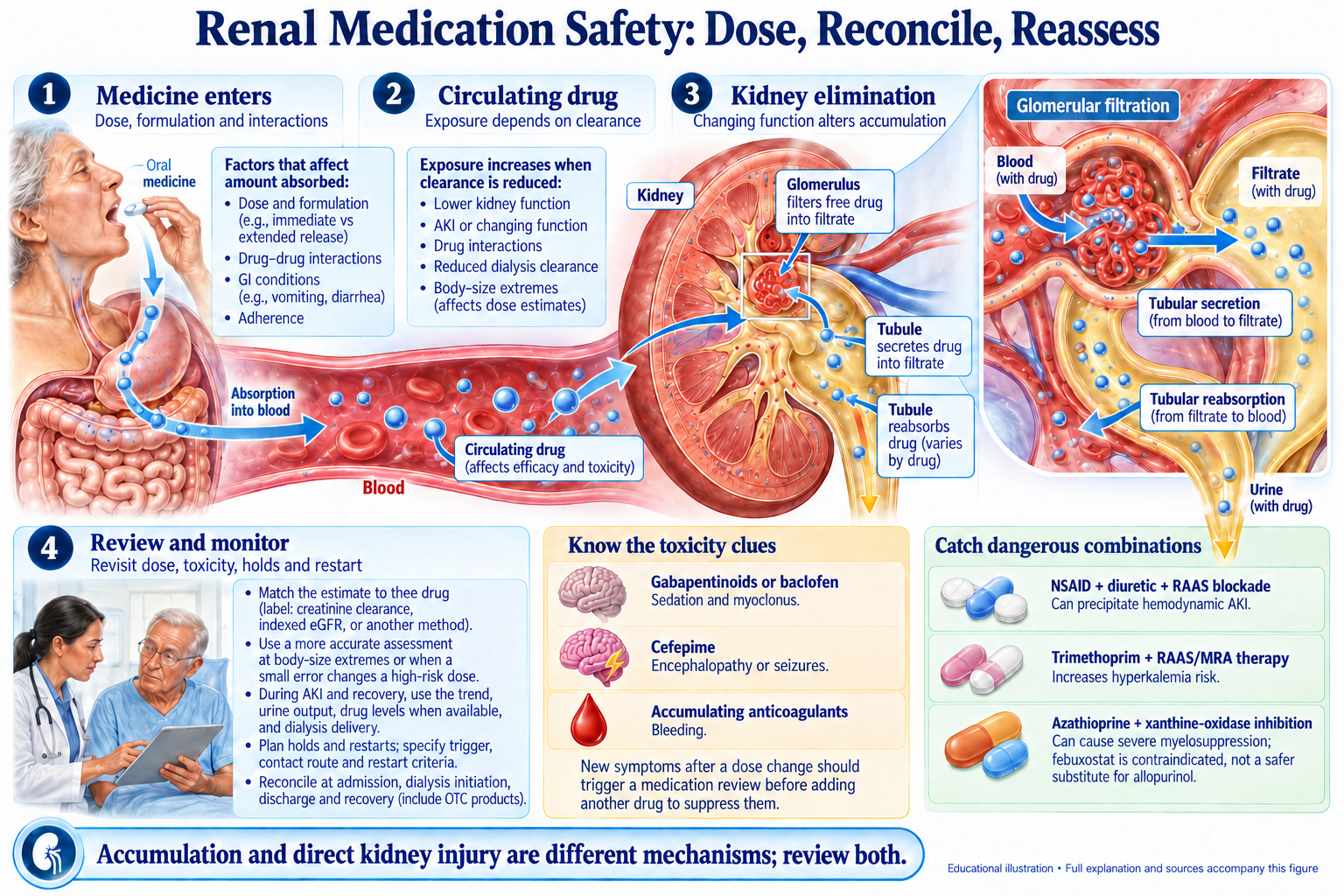
Use the visual framework with the case findings and the linked lecture.
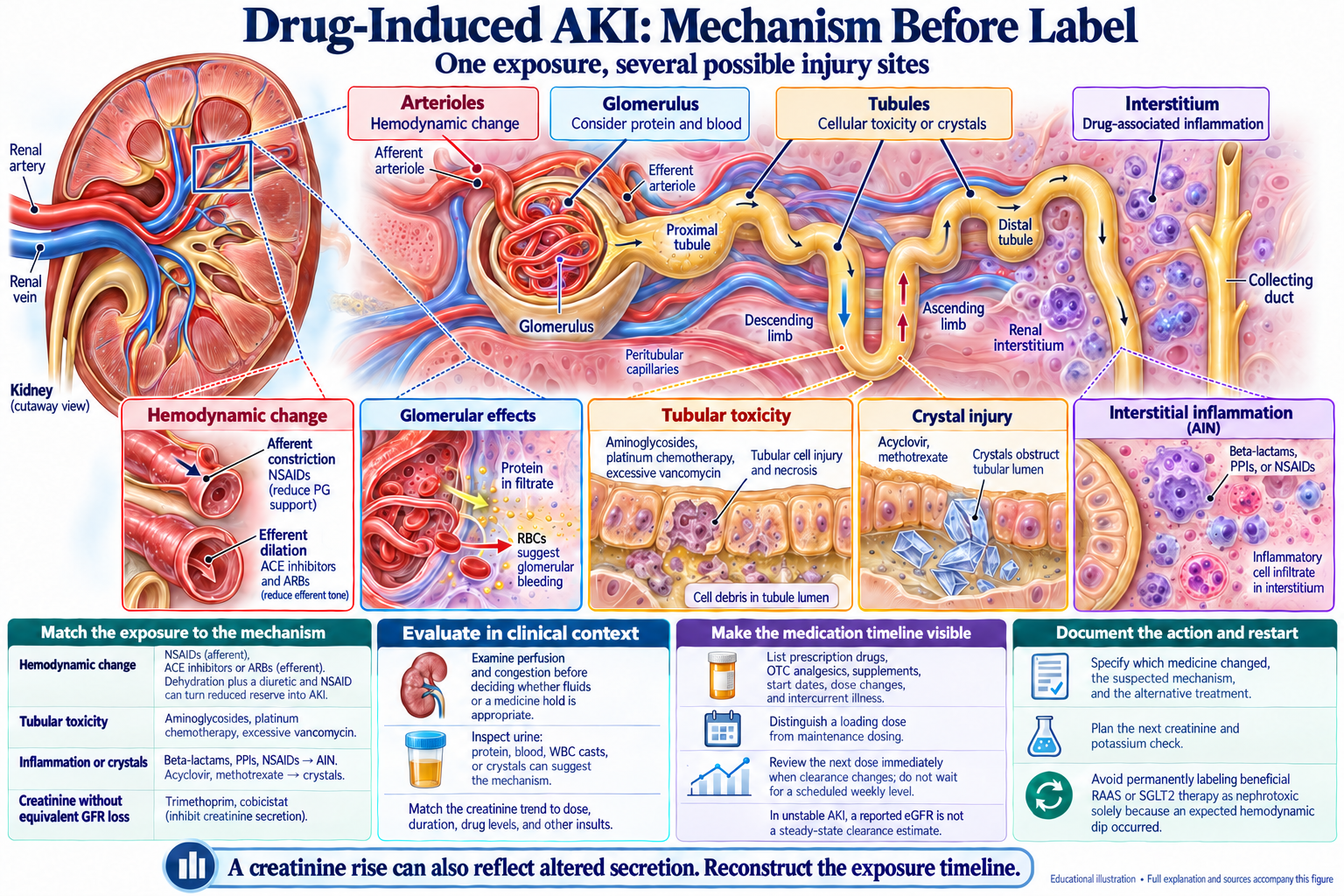
Use the visual framework with the case findings and the linked lecture.
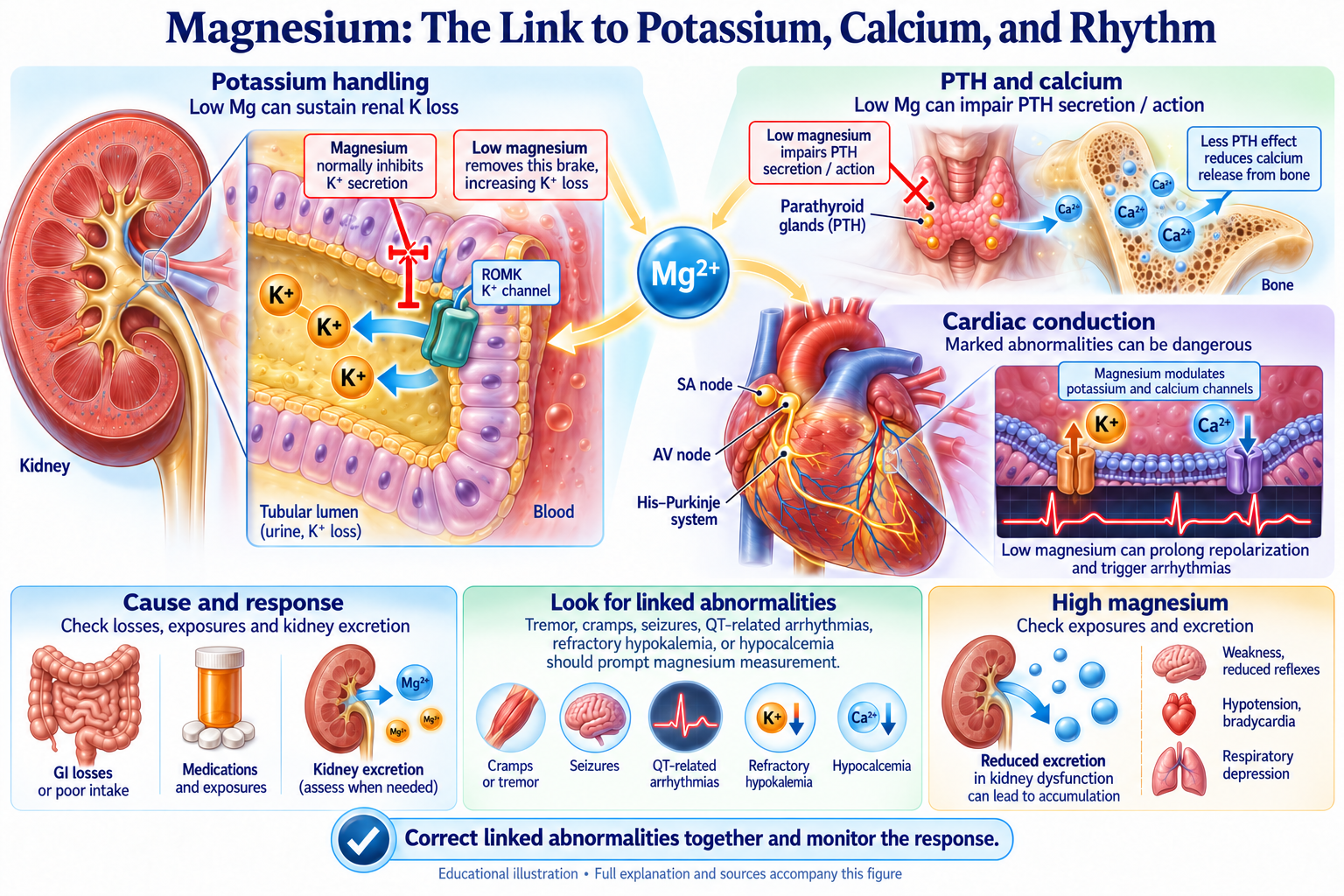
Use the visual framework with the case findings and the linked lecture.
Which drug decisions use a product-specific renal rule, and what monitoring and restart plan makes them safe?
Assigned reading: the explanations in this case and the question-linked course evidence guide. The objective map distinguishes tested decisions from concepts taught in explanations.
Concepts: aki-13, aki-15, aki-22, ckd-18, ckd-19, ckd-20, htn-cardiorenal-25, lytes-18, structural-15, structural-18, structural-19, structural-20, structural-23.
Drug dosing quick reference (site) — Part 1: Principles of Drug Dosing in CKD
Renal pharmacology lecture — 2. Nephrotoxic Medication Avoidance
Renal pharmacology lecture — 1. Drug Dosing in CKD: Principles of Renal Clearance
Drug dosing quick reference (site) — Part 5: Antidiabetic Medications