Visual summary
Both drugs can increase urinary salt loss, but they act at different sites. The distinction is between salt reaching the macula densa and salt entering its NKCC2 sensor. That difference changes the local feedback to the glomerulus.
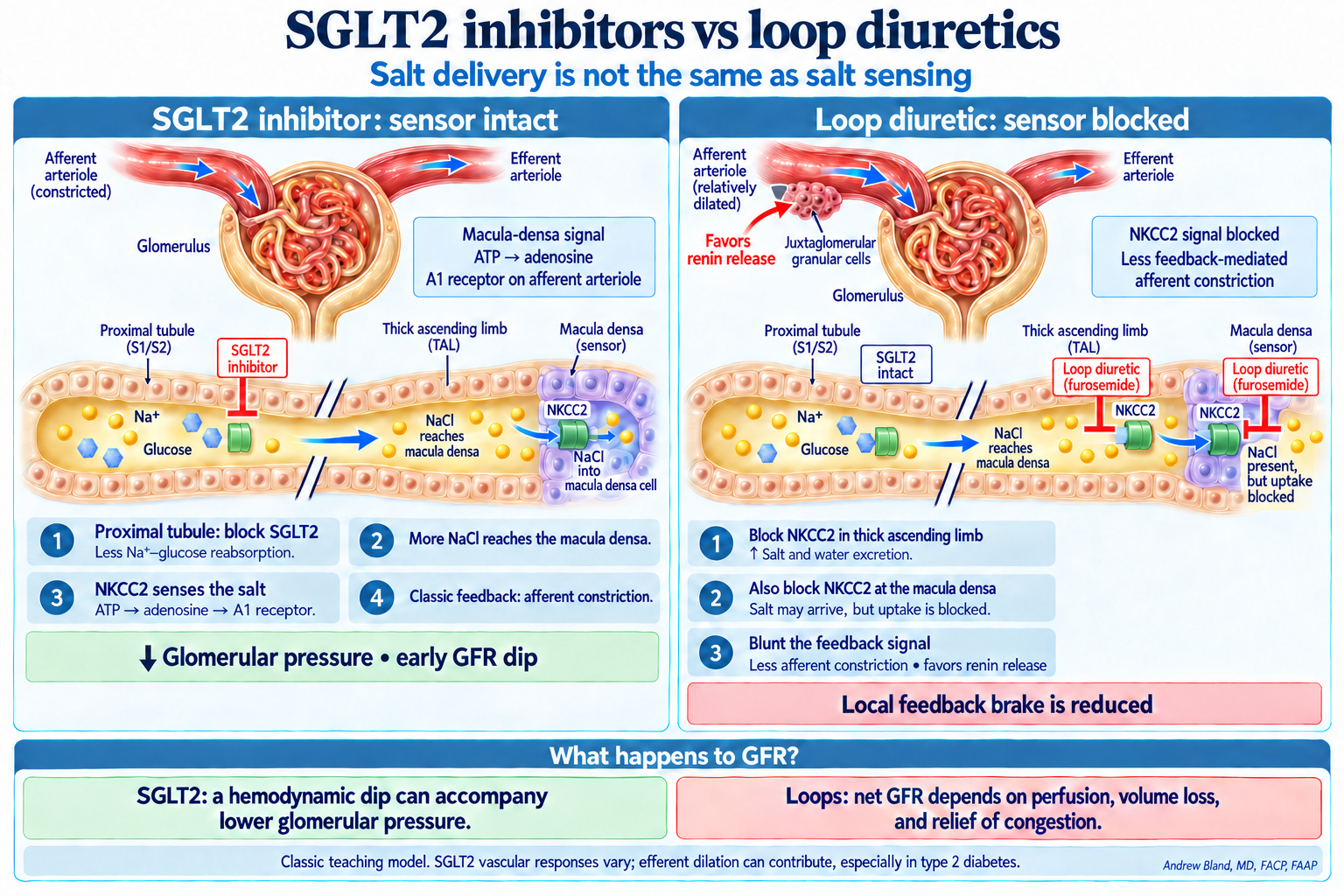
Illustration updated October 19, 2026. Educational schematic. Full teaching text and sources follow.
Diagram description
Side-by-side comparison: SGLT2 inhibition reduces proximal sodium–glucose reabsorption and increases NaCl delivery to an intact macula-densa NKCC2 sensor. ATP and adenosine signaling can constrict the afferent arteriole and lower glomerular pressure. Loop diuretics block NKCC2 in the thick ascending limb and at the sensor, blunting this feedback and favoring renin release. Net GFR also depends on perfusion, volume, and congestion.
Text version
SGLT2 inhibitor: delivery increases; sensing remains intact
Less proximal sodium–glucose reabsorption increases NaCl delivery downstream. NKCC2 in the macula densa can sense it. In the classic model, ATP/adenosine signaling through A1 receptors increases afferent arteriolar tone, reducing glomerular pressure and hyperfiltration. An early hemodynamic GFR dip can occur.
Loop diuretic: block transport and the sensor
Loop diuretics inhibit NKCC2 in both the thick ascending limb and the macula densa. Salt can reach the sensor while uptake is blocked. The resulting feedback-mediated afferent constriction is blunted and renin release from juxtaglomerular granular cells is favored.
Local feedback is only part of the GFR response
A loop diuretic does not invariably increase GFR: perfusion, volume loss, and relief of congestion affect the net response. SGLT2 vascular responses also vary; human type 2 diabetes studies support an efferent vasodilatory contribution. The diagram shows the classic feedback model, not a fixed GFR prediction for every patient.
Ask the room: if both drugs cause natriuresis, why is the feedback different?
SGLT2 inhibition: delivery increases while the NKCC2 sensor remains functional. A loop diuretic: salt can be present in the lumen while NKCC2-mediated sensing is inhibited. More salt delivered is not the same as more salt sensed.
Then ask: Does a loop diuretic therefore always raise GFR? No. The local feedback brake is reduced, but volume depletion may lower perfusion and GFR; relief of congestion can help kidney function. Interpret the net response in the patient’s clinical context.
Supporting evidence
Schlatter et al. (1989): furosemide-sensitive macula-densa NaCl sensing · Cherney et al. (2014): empagliflozin and hyperfiltration in type 1 diabetes · van Bommel et al. (2020), RED trial: hemodynamics in type 2 diabetes