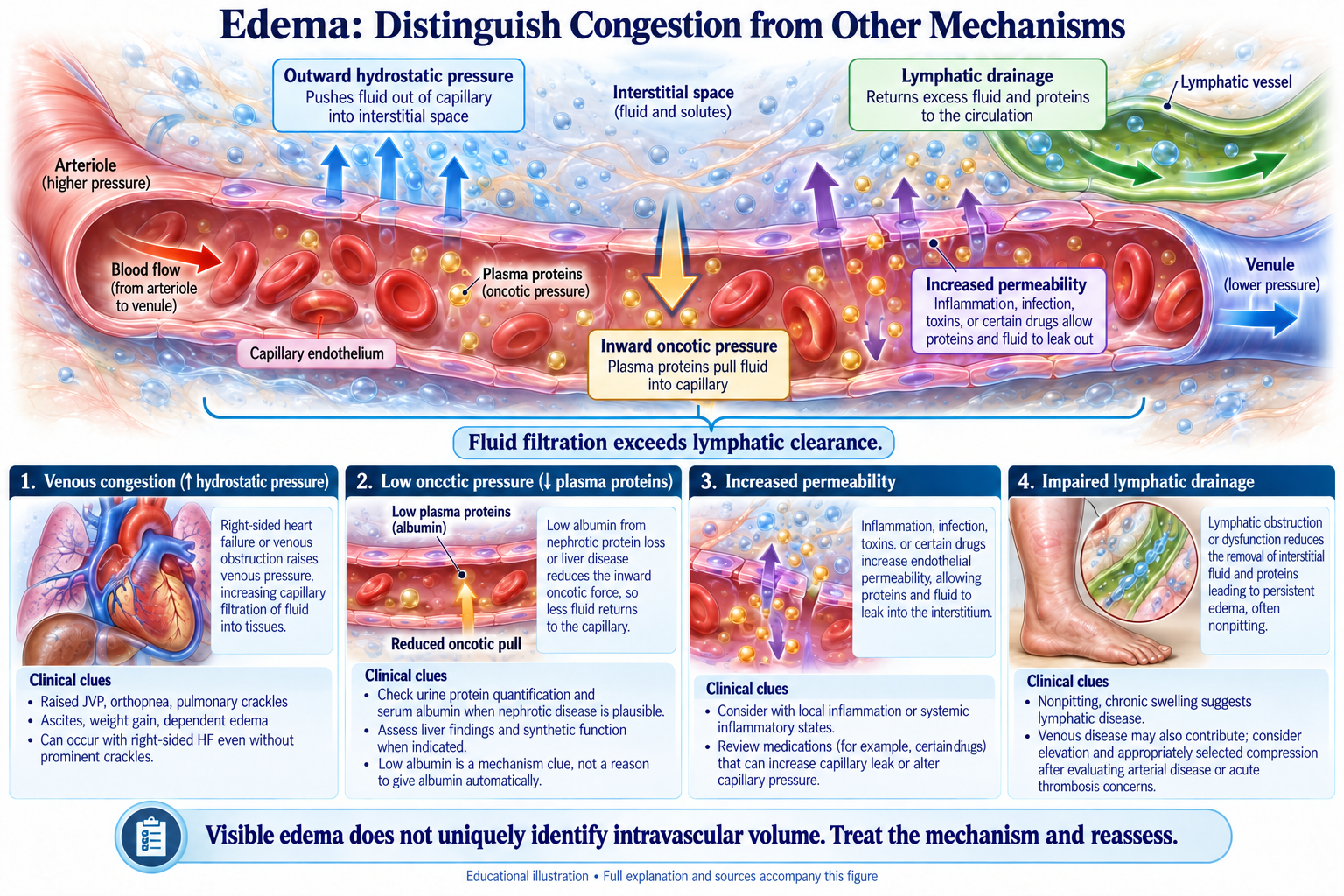
Pre-Case Assessment: Test Your Baseline Knowledge
Answer these questions before reviewing the case to assess your understanding of edema physiology and cardiorenal disease
What is the primary driving force that moves fluid from peripheral edema back to the central circulation for kidney processing?
Learning Point: Fluid mobilization from peripheral edema requires gravitational forces (elevation) and muscular compression (leg wrapping, calf muscle pump) to overcome venous pressure and move fluid back to central circulation where kidneys can process it.
📚 Reference: Full article: 💧 Edema: The Circulation Cycle Approach
In right heart failure with severe tricuspid regurgitation, which mechanism BEST explains diuretic resistance?
Learning Point: Right heart failure creates a paradox: total body fluid overload with decreased effective circulating volume. Poor forward flow means less fluid delivery to kidneys for diuresis, while backpressure causes peripheral pooling.
📚 Reference: Full article: ❤️ Cardiorenal Disease: The Heart-Kidney Connection
Which combination of laboratory findings would MOST strongly suggest cardiac edema rather than renal or hepatic causes?
Learning Point: Cardiac edema typically presents with preserved albumin synthesis (normal albumin), normal liver function, absence of renal losses (no proteinuria), and elevated cardiac biomarkers (BNP). This distinguishes it from renal or hepatic causes.
📚 Reference: Laboratory Assessment Module
Case Presentation
Patient: 67-year-old woman
Chief Complaint: "My legs keep swelling up no matter how much water pill I take"
History: Progressive bilateral lower extremity edema over 6 months. Started on furosemide 40mg daily by PCP 3 months ago, increased to 80mg daily 4 weeks ago with minimal improvement. Now has difficulty walking due to leg swelling. Denies chest pain but reports mild dyspnea on exertion. Some orthopnea requiring 2 pillows.
Past Medical History: Atrial fibrillation (rate controlled), hypertension, type 2 diabetes, previous MI (2018)
Home Medications: Furosemide 80mg daily, metoprolol 50mg BID, lisinopril 10mg daily, metformin 1000mg BID
Social History: Lives alone, limited mobility due to leg swelling, medication adherent
🤔 Initial Clinical Reasoning Questions
Given this patient's presentation of diuretic-resistant edema, what is the MOST important next step in evaluation?
Clinical Reasoning: In a patient with diuretic-resistant edema and cardiac risk factors (AFib, HTN, previous MI), echocardiogram is essential to assess for heart failure and guide treatment. The orthopnea and DOE suggest possible cardiac etiology.
📚 Reference: Full article: ❤️ Cardiorenal Disease: The Heart-Kidney Connection
Physical Examination
Vital Signs & General Appearance
Vital Signs
- Blood Pressure: 145/88 mmHg
- Heart Rate: 88 bpm, irregular (atrial fibrillation)
- Respiratory Rate: 20/min
- Oxygen Saturation: 94% on room air
- Weight: 78 kg (increased from 68 kg baseline)
General Appearance
- Overall: Appears volume overloaded
- Positioning: Prefers to sit upright
- Breathing: Mild dyspnea at rest
- Mobility: Difficulty walking due to leg swelling
Cardiovascular Examination
📍 Key Cardiac Findings
- JVP: Elevated to 16 cm H₂O with prominent v-waves
- Heart sounds: Irregular rhythm, S3 gallop present
- Murmurs: 4/6 holosystolic murmur at LLSB, increases with inspiration
- Hepatojugular reflux: Positive (JVP rises >3 cm with abdominal pressure)
🫁 Pulmonary Findings
- Inspection: Mild use of accessory muscles
- Percussion: Dullness at bilateral bases
- Auscultation: Bibasilar crackles, decreased breath sounds at bases
- Pleural effusions: Small bilateral effusions
Peripheral Examination
💧 Edema Assessment
- Lower extremities: 3+ pitting edema bilateral to mid-thigh level
- Pattern: Symmetric, worse in dependent areas
- Skin changes: Taut, shiny skin over shins
- Abdominal: Mild ascites, hepatomegaly (liver span 14 cm)
- Sacral: 2+ sacral edema when supine
🎯 Physical Examination Analysis
The murmur described (4/6 holosystolic at LLSB, increases with inspiration) is MOST consistent with:
Learning Point: Tricuspid regurgitation presents as a holosystolic murmur at the left lower sternal border that characteristically increases with inspiration (Carvallo's sign) due to increased venous return. The prominent v-waves in JVP support this diagnosis.
📚 Reference: Cardiorenal Module - Tricuspid Regurgitation
Laboratory Data & Analysis
Laboratory Values
| Parameter | Value | Normal Range | Clinical Significance |
|---|---|---|---|
| BNP | 2,450 pg/mL | <100 pg/mL | Markedly elevated, indicates heart failure |
| Albumin | 3.8 g/dL | 3.5-5.0 g/dL | Normal - rules out hepatic/nutritional causes |
| Creatinine | 1.2 mg/dL | 0.8-1.4 mg/dL | Normal kidney function |
| AST/ALT | 28/32 U/L | <40 U/L | Normal liver enzymes |
| Bilirubin | 1.1 mg/dL | <1.2 mg/dL | Normal - no hepatic dysfunction |
| Sodium | 134 mEq/L | 135-145 mEq/L | Mild hyponatremia from fluid overload |
| Potassium | 3.2 mEq/L | 3.5-5.0 mEq/L | Hypokalemia from diuretic therapy |
Urinalysis Results
🔬 Dipstick Results
- Specific Gravity: 1.015
- Protein: Negative
- Glucose: Negative
- Blood: Negative
- Leukocyte Esterase: Negative
📊 Additional Tests
- Urine Protein/Creatinine: 0.08 g/g (<0.15 normal)
- Microscopy: No casts, few epithelial cells
- 24-hr Urine Protein: 95 mg (<150 mg normal)
📊 Laboratory Analysis Questions
What is the MOST important conclusion from this patient's laboratory and urinalysis results?
Learning Point: Normal albumin (rules out hepatic/nutritional causes), normal liver enzymes (rules out liver disease), and absence of proteinuria (rules out renal protein loss) combined with markedly elevated BNP strongly points to cardiac etiology of edema.
📚 Reference: Laboratory Assessment - Edema Workup
Echocardiogram Results
📈 Key Echocardiographic Findings
Left Heart Assessment
- LV Ejection Fraction: 50% (normal)
- LV Size: Normal dimensions
- Wall Motion: Mild inferoposterior hypokinesis
- Mitral Valve: Mild mitral regurgitation
- Left Atrium: Mildly enlarged
Right Heart Assessment
- RV Function: Severely reduced
- RV Size: Severely dilated
- Tricuspid Regurgitation: Severe (4+/4)
- RVSP: 65 mmHg (elevated)
- Right Atrium: Severely enlarged
🎯 Echocardiogram Interpretation
Based on the echocardiogram findings, what is the PRIMARY pathophysiologic mechanism causing this patient's diuretic resistance?
Learning Point: Severe tricuspid regurgitation creates a vicious cycle: poor forward flow reduces kidney perfusion (limiting diuretic effectiveness), while regurgitant flow increases venous pressure, promoting peripheral edema formation and retention.
📚 Reference: Cardiorenal Module - Right Heart Failure
The Edema-to-Urine Pathway: Understanding the Problem
🔄 Normal Pathway: From Peripheral Edema to Urine Formation
1️⃣ Mobilization
Leg elevation + compression → fluid moves from interstitium to venous circulation
2️⃣ Venous Return
Mobilized fluid travels through venous system → right heart → pulmonary circulation
3️⃣ Forward Flow
Left heart pumps oxygenated blood → kidneys receive adequate perfusion
4️⃣ Diuresis
Well-perfused kidneys respond to diuretics → excess fluid eliminated as urine
❌ What Goes Wrong in Right Heart Failure with Severe TR
🔄 Circulation Problems
- Poor forward flow: Severe TR means much of RV stroke volume regurgitates back to RA instead of going to lungs
- Reduced preload to LV: Less blood reaches left heart → reduced cardiac output
- Kidney hypoperfusion: Poor forward flow = inadequate kidney blood flow
- Activation of RAAS: Kidneys sense low perfusion → salt/water retention
🌊 Pressure Problems
- Elevated venous pressure: TR causes systemic venous hypertension
- Impaired venous return: High RA pressure opposes venous drainage
- Persistent edema formation: High venous pressure drives fluid into tissues
- Diuretic resistance: Even mobilized fluid can't return effectively to circulation
Treatment Strategy & Management Questions
What is the MOST effective initial strategy to improve diuretic responsiveness in this patient?
Treatment Rationale: In right heart failure with severe TR, mechanical assistance (leg elevation, compression) helps overcome high venous pressure to mobilize fluid, while optimizing diuretics addresses the limited forward flow. Simply increasing doses won't overcome the mechanical problem.
📚 Reference: Full article: 💧 Edema: The Circulation Cycle Approach
How does leg wrapping/compression therapy specifically help in this case?
Learning Point: Leg compression provides external pressure (20-30 mmHg) that exceeds the elevated venous pressure from tricuspid regurgitation, mechanically forcing interstitial fluid back into the circulation where it can reach the kidneys for processing.
📚 Reference: Full article: 💧 Edema: The Circulation Cycle Approach
Right Heart Failure Cascade: Breaking the Vicious Cycle
🔄 The Vicious Cycle
Severe Tricuspid Regurgitation
↓ Forward flow to kidneys
→ Poor diuretic response
→ Fluid retention
→ ↑ Preload → ↑ TR severity
Elevated Venous Pressure
↑ Venous pressure
→ Impaired venous return
→ Persistent edema
→ ↑ Venous pressure
⚡ Breaking the Cycle: Multi-Modal Approach
🦵 Mechanical Interventions
- Leg elevation: 30° elevation when resting
- Compression therapy: 20-30 mmHg graduated stockings
- Sequential pneumatic compression: For hospitalized patients
- Calf muscle exercises: Activate muscle pump
💊 Pharmacological Optimization
- Sequential nephron blockade: Loop + thiazide
- Timing optimization: Divide daily doses
- IV diuretics: If oral resistance
- Afterload reduction: If appropriate
Treatment Implementation & Results
Comprehensive Treatment Plan
🦵 Mechanical Interventions
- Leg elevation: 30° elevation for 2-3 hours, 3x daily
- Compression stockings: 20-30 mmHg graduated compression
- Positioning: Sleep with legs elevated on pillows
- Activity: Ankle pumps and calf raises 10x every hour when awake
💊 Optimized Diuretic Regimen
- Furosemide: 80mg twice daily (morning and early afternoon)
- Metolazone: 2.5mg daily (added for synergy)
- Potassium supplementation: 20 mEq twice daily
- Monitoring: Daily weights, BUN/Cr, electrolytes
Treatment Results After 2 Weeks
| Parameter | Baseline | After 2 Weeks | Change | Clinical Impact |
|---|---|---|---|---|
| Weight | 78 kg | 71 kg | -7 kg | Significant fluid loss |
| Edema | 3+ to thighs | 1+ to ankles | Marked improvement | Improved mobility |
| Dyspnea | DOE, orthopnea | Mild DOE only | Much improved | Better quality of life |
| BNP | 2,450 pg/mL | 1,850 pg/mL | -600 pg/mL | Reduced cardiac stress |
| Creatinine | 1.2 mg/dL | 1.4 mg/dL | +0.2 mg/dL | Acceptable rise with diuresis |
📈 Treatment Response Analysis
The patient's excellent response to combined mechanical and pharmacological therapy demonstrates which key principle?
Treatment Principle: The success came from addressing both components: mechanical mobilization (compression, elevation) overcame high venous pressure to move fluid centrally, while optimized diuretics handled the fluid once it reached the kidneys. Neither alone would have been as effective.
📚 Reference: Full article: 💧 Edema: The Circulation Cycle Approach
Learning Objectives Assessment
Evaluate your mastery of the key learning objectives from this case
🎯 Learning Objective 1: Understanding Edema-to-Urine Pathway
Objective: Students should understand the complete pathway from peripheral edema mobilization to kidney processing and how right heart failure disrupts this pathway
Which step in the edema-to-urine pathway is MOST impaired in severe tricuspid regurgitation?
Competency Demonstration: Understanding that elevated venous pressure from TR creates a mechanical barrier to venous return, preventing mobilized fluid from reaching the central circulation and kidneys for processing.
📚 Master This: Full article: 💧 Edema: The Circulation Cycle Approach
🎯 Learning Objective 2: Cardiorenal Syndrome Recognition
Objective: Students should recognize the clinical presentation and pathophysiology of right heart failure-induced cardiorenal syndrome
A patient presents with massive edema but normal albumin, normal liver function, and no proteinuria. The MOST likely diagnosis is:
Competency Demonstration: Shows understanding that cardiac edema typically preserves organ function (normal albumin synthesis, no renal protein loss) while other causes directly affect albumin levels or protein balance.
📚 Master This: Full article: ❤️ Cardiorenal Disease: The Heart-Kidney Connection
🎯 Learning Objective 3: Therapeutic Approach to Diuretic Resistance
Objective: Students should understand multimodal approaches to overcome diuretic resistance in cardiac edema
Why is leg compression therapy particularly effective in tricuspid regurgitation with diuretic resistance?
Competency Demonstration: Understanding that mechanical interventions can overcome pathophysiologic barriers (elevated venous pressure) that limit effectiveness of pharmacologic interventions alone.
📚 Master This: Full article: 💧 Edema: The Circulation Cycle Approach
Advanced Clinical Reasoning
Apply your understanding of right heart failure, diuretic resistance, and cardiorenal physiology
A patient with severe TR and diuretic resistance has a serum creatinine that rises from 1.2 to 1.8 mg/dL after furosemide dose escalation. What is the MOST likely mechanism?
Learning Point: In right heart failure with severe TR, aggressive diuresis can reduce preload to the right ventricle, further decreasing an already impaired forward cardiac output. This results in reduced renal perfusion and rising creatinine - a hallmark of cardiorenal syndrome type 1. The solution is not more diuretics but improving forward flow with mechanical mobilization and careful volume management.
📚 Reference: Cardiorenal Syndrome Module
Which BNP level pattern BEST distinguishes right heart failure from nephrotic syndrome as the cause of bilateral lower extremity edema?
Learning Point: BNP (B-type natriuretic peptide) is released from ventricular myocytes in response to wall stress from volume or pressure overload. In heart failure, BNP is markedly elevated (often >500 pg/mL). In nephrotic syndrome, BNP is typically normal or only mildly elevated since the primary problem is oncotic pressure, not cardiac wall stress. This makes BNP a valuable differentiating biomarker.
📚 Reference: Full article: 💧 Edema: The Circulation Cycle Approach
When adding metolazone to furosemide in a patient with diuretic resistance from right heart failure, which electrolyte abnormality requires the MOST vigilant monitoring?
Learning Point: Sequential nephron blockade (metolazone + furosemide) causes synergistic natriuresis and kaliuresis. Metolazone blocks the distal convoluted tubule, preventing compensatory sodium reabsorption that occurs during loop diuretic use. This combination can cause profound hypokalemia — potassium can drop substantially within 12–24 hours, often by more than 1 mEq/L, which is especially dangerous in patients already on digoxin or with cardiac arrhythmia risk. Classic dosing is metolazone 2.5–10 mg given approximately 30 minutes before the loop diuretic to time peak distal blockade with the loop natriuresis. Aggressive potassium and magnesium replacement plus frequent monitoring (within 12–24 h of initiation) are mandatory. [Softened 2026-05-03 — earlier "1-2 mEq/L in hours" was the dramatized end of typical experience; clinically meaningful drops usually evolve over 12–24 h.]
📚 Reference: Electrolyte Module - Diuretic Complications
A patient with right heart failure has jugular venous distension to the angle of the jaw, hepatomegaly, and 4+ pitting edema bilaterally. The JVP finding indicates elevated pressure in which vascular compartment?
Learning Point: The internal jugular vein is a direct manometer of right atrial pressure. JVD to the angle of the jaw indicates severely elevated right atrial pressure (>15 cmH2O), which in the setting of TR creates the backward transmission of pressure that causes hepatic congestion, ascites, and peripheral edema. This elevated venous pressure is the key mechanical barrier to edema fluid mobilization.
📚 Reference: Full article: ❤️ Cardiorenal Disease: The Heart-Kidney Connection
In a patient with right heart failure and elevated renal venous pressure, which mechanism MOST contributes to reduced glomerular filtration rate?
Learning Point: GFR is determined by the net filtration pressure across the glomerular capillary. Elevated renal venous pressure from right heart failure transmits back to the peritubular capillaries and Bowman's capsule, increasing the opposing force to filtration. This reduces the net filtration pressure and consequently the GFR, even if cardiac output is preserved. This concept explains why venous congestion (not just reduced forward flow) impairs kidney function.
📚 Reference: Full article: ❤️ Cardiorenal Disease: The Heart-Kidney Connection
Which classification of cardiorenal syndrome BEST describes a patient with chronic right heart failure causing progressive CKD?
Learning Point: Cardiorenal syndrome is classified into 5 types based on the primary organ and acuity. Type 2 describes chronic cardiac dysfunction (such as chronic right heart failure with TR) leading to progressive renal impairment. This differs from Type 1 (acute cardiac decompensation causing AKI), Type 3 (AKI causing cardiac dysfunction), Type 4 (CKD causing cardiac disease), and Type 5 (systemic conditions affecting both simultaneously).
📚 Reference: Cardiorenal Syndrome Classification
A patient with severe TR and diuretic resistance is being considered for ultrafiltration. What is the PRIMARY advantage of ultrafiltration over IV diuretics in this clinical scenario?
Learning Point: Ultrafiltration removes isotonic fluid at a controlled rate via a venovenous circuit, bypassing the kidneys entirely. In patients with true diuretic resistance (where increased doses fail to produce adequate natriuresis), ultrafiltration provides reliable fluid removal. However, it requires vascular access, anticoagulation, and carries risks of hypotension and catheter complications. It is typically reserved for patients who have failed aggressive pharmacologic therapy and mechanical mobilization.
📚 Reference: Dialysis Module - Ultrafiltration
Case Reflection & Multi-Module Integration
💧 Edema Module Integration
- Starling forces and venous pressure effects on fluid distribution
- Mechanical interventions for fluid mobilization
- Understanding the edema-to-urine pathway
- Compression therapy principles and applications
❤️ Cardiorenal Disease Integration
- Right heart failure pathophysiology and presentation
- Tricuspid regurgitation hemodynamic effects
- Forward flow concepts in cardiorenal syndrome
- Differentiating cardiac from other causes of edema
💊 Diuretic Pharmacology Integration
- Mechanisms of diuretic resistance in heart failure
- Sequential nephron blockade strategies
- Timing and dosing optimization
- Monitoring parameters and safety considerations
🔬 Laboratory Assessment Integration
- BNP interpretation in heart failure
- Urinalysis in edema differential diagnosis
- Albumin and liver function assessment
- Proteinuria evaluation and significance
🎯 Key Integration Concepts
This case demonstrates how cardiorenal syndrome requires understanding of both cardiac hemodynamics and renal physiology. The success of treatment depended on recognizing that diuretic resistance wasn't just a pharmacological problem but a mechanical one - elevated venous pressure preventing fluid mobilization. The case shows how different organ systems (heart, kidneys, peripheral circulation) interact and how therapeutic interventions must address multiple levels of pathophysiology simultaneously.
📝 Case Summary & Clinical Pearls
This case of right heart failure with severe tricuspid regurgitation illustrates the complex pathophysiology of cardiorenal syndrome and diuretic resistance. The patient's normal albumin, liver function, and absence of proteinuria pointed to cardiac etiology, confirmed by echocardiogram showing severe TR. The key insight was understanding that diuretic resistance resulted from impaired fluid mobilization due to elevated venous pressure, not just reduced kidney perfusion. Successful treatment required both mechanical interventions (leg compression, elevation) and optimized pharmacotherapy, demonstrating the importance of addressing the complete edema-to-urine pathway.
🔑 Key Clinical Pearls from This Case:
- Pathway Thinking: Consider the complete journey from peripheral edema → venous return → cardiac output → kidney perfusion → diuresis
- Mechanical Solutions: When venous pressure is elevated, external compression can be more effective than higher diuretic doses
- Laboratory Clues: Normal albumin + normal LFTs + no proteinuria + elevated BNP = cardiac edema
- Right Heart Focus: Severe TR creates unique hemodynamics with poor forward flow and elevated venous pressure
- Multimodal Approach: Combine mechanical mobilization with optimized pharmacotherapy for best results