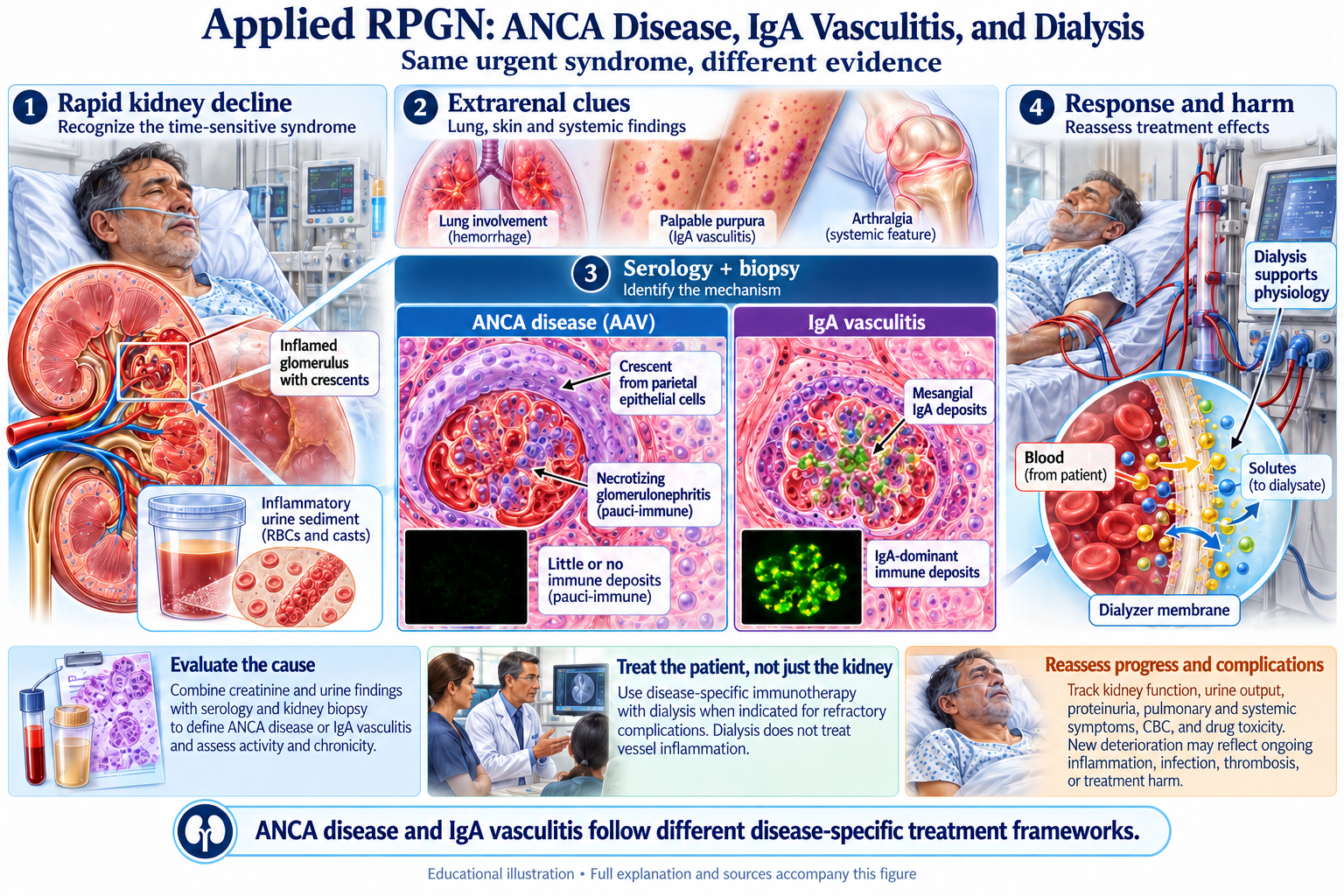
Pre-Case Assessment: RPGN & Dialysis Fundamentals
Test your baseline knowledge before reviewing this complex case
Which of the following RPGN presentations typically has NORMAL complement levels?
Learning Point: ANCA-associated vasculitis (GPA, MPA, EGPA) typically presents with normal complement levels, distinguishing it from immune complex-mediated diseases that consume complement.
📚 Reference: RPGN Differential Diagnosis Table
What is the "Rule of 8" for determining dialysate potassium concentration?
Learning Point: The Rule of 8 helps prevent cardiac arrhythmias by avoiding rapid K+ shifts. If serum K is 6.5, use 2K bath (6.5 + 2 ≈ 8.5). This prevents excessive K removal and rebound hyperkalemia.
📚 Reference: Dialysis Prescription Writing
RBC casts in the urine sediment most strongly suggest which process?
Learning Point: RBC casts form when RBCs enter the tubular lumen through damaged glomeruli and become trapped in Tamm-Horsfall protein. They strongly support a glomerular source in this clinical setting but do not identify the immune mechanism; absence of casts does not exclude GN.
📚 Reference: Urinary Cast Interpretation
Case Presentation
Patient: 58-year-old male
Chief Complaint: "I haven't urinated in 2 days and I'm having trouble breathing"
History of Present Illness: Patient presents with 3-week history of progressive fatigue, anorexia, and tea-colored urine. Over the past week, developed bilateral lower extremity edema and dyspnea on exertion. Two days ago, noted oliguria progressing to anuria. Also reports recent epistaxis and hemoptysis. Denies fever, rash, or joint pain.
Past Medical History: • Chronic sinusitis (recurrent, treated with multiple antibiotics) • Hypertension (diagnosed 1 month ago) • No known kidney disease
Home Medications: • Lisinopril 10mg daily (started 1 month ago) • Recently completed prednisone taper for sinusitis (60mg x 5 days, just finished)
Social History: Non-smoker, no illicit drugs, works as accountant
🤔 Initial Clinical Reasoning
Based on the presentation with hemoptysis, epistaxis, sinusitis, and rapidly progressive renal failure, what is your leading differential diagnosis?
Clinical Reasoning: The triad of upper respiratory involvement (chronic sinusitis), lower respiratory symptoms (hemoptysis), and glomerulonephritis strongly suggests GPA. The rapid progression and multi-organ involvement are classic for ANCA vasculitis.
📚 Reference: ANCA Vasculitis Diagnosis
Physical Examination
Vital Signs: BP 178/102, HR 96, RR 24, O2 sat 92% on room air, Temp 37.2°C
General: Ill-appearing, mild respiratory distress
HEENT: Saddle nose deformity, dried blood in nares, pale conjunctivae
Cardiovascular: Tachycardic, regular rhythm, no murmurs, JVP 12 cm
Pulmonary: Bilateral basilar crackles extending to mid-lung fields
Abdomen: Soft, non-tender, no organomegaly
Extremities: 3+ pitting edema to knees bilaterally
Neurological: Alert, oriented, asterixis present
Laboratory Data & Analysis
Initial Laboratory Values
| Parameter | Value | Normal Range | Clinical Significance |
|---|---|---|---|
| BUN | 180 mg/dL | 8-20 mg/dL | Severe azotemia (steroid effect + hypercatabolism) |
| Creatinine | 12.5 mg/dL | 0.6-1.2 mg/dL | Severe renal failure |
| BUN:Cr Ratio | 14.4 | 10-20:1 | Within normal ratio despite high values |
| Potassium | 6.8 mEq/L | 3.5-5.0 mEq/L | Life-threatening hyperkalemia |
| Bicarbonate | 14 mEq/L | 22-28 mEq/L | Metabolic acidosis |
| Hemoglobin | 7.2 g/dL | 14-18 g/dL | Severe anemia |
| WBC | 14.2 x 10³/µL | 4.5-11 x 10³/µL | Leukocytosis (inflammation) |
| Platelets | 385 x 10³/µL | 150-400 x 10³/µL | Normal (rules out TTP/HUS) |
Serologic Studies
| Test | Result | Normal | Interpretation |
|---|---|---|---|
| C-ANCA (PR3) | Positive 1:320 | Negative | Highly suggestive of GPA |
| P-ANCA (MPO) | Negative | Negative | Rules out MPA |
| Anti-GBM | Negative | Negative | Rules out Goodpasture's |
| C3 | 98 mg/dL | 90-180 mg/dL | Normal (typical for ANCA vasculitis) |
| C4 | 24 mg/dL | 10-40 mg/dL | Normal |
| IgA level | 245 mg/dL | 70-400 mg/dL | Normal (not suggestive of IgA nephropathy) |
| ANA | Negative | Negative | Rules out lupus |
Urinalysis
| Parameter | Result | Significance |
|---|---|---|
| Color | Dark amber | Concentrated, hematuria |
| Protein | 3+ | Significant proteinuria |
| Blood | 3+ | Hematuria |
| Specific Gravity | 1.025 | Concentrated |
| RBC Casts | 5-10/hpf | Diagnostic of glomerulonephritis |
| Dysmorphic RBCs | >50% | Glomerular source |
| WBC | 10-20/hpf | Inflammation |
📊 Laboratory Interpretation
Why is the BUN disproportionately elevated (180 mg/dL) compared to what you'd expect from the creatinine alone?
Learning Point: Corticosteroids increase protein catabolism, leading to increased urea production. This patient just completed a prednisone taper, explaining the disproportionately high BUN. This is important when considering dialysis disequilibrium risk.
📚 Reference: Azotemia Differential
Based on the serologic panel with positive C-ANCA, negative P-ANCA, negative anti-GBM, and normal complements, what is the diagnosis?
Learning Point: C-ANCA (PR3) positivity is 90% specific for GPA. The normal complements distinguish this from immune complex GN. P-ANCA (MPO) would suggest MPA. The clinical triad of upper respiratory, lower respiratory, and renal involvement confirms GPA.
📚 Reference: RPGN Differential Table
Urgent Dialysis Indication
Which of the following is the MOST urgent indication for dialysis in this patient?
Learning Point: Life-threatening hyperkalemia (>6.5) with oliguria/anuria is an absolute dialysis indication. While uremia, volume overload, and acidosis are also present, hyperkalemia poses the most immediate threat to life through cardiac arrhythmias.
📚 Remember AEIOU: Acidosis, Electrolytes (K), Intoxication, Overload, Uremia
📚 Reference: Urgent Dialysis Indications
Dialysis Prescription Development
⚠️ Critical Consideration: With BUN 180 mg/dL, this patient is at HIGH RISK for dialysis disequilibrium syndrome. We must use a graduated approach to prevent cerebral edema.
Progressive Dialysis Schedule
| Day | Duration | Blood Flow (Qb) | Dialysate Flow (Qd) | K+ Bath | Target URR | Rationale |
|---|---|---|---|---|---|---|
| Day 1 | 2 hours | 200 mL/min | 400 mL/min | 2 mEq/L | ~30% | Gentle initiation to prevent disequilibrium |
| Day 2 | 3 hours | 300 mL/min | 500 mL/min | 2 mEq/L | ~45% | Progressive increase in clearance |
| Day 3 | 4 hours | 400 mL/min | 600 mL/min | 3 mEq/L | ~65% | Target prescription achieved |
💊 Dialysis Prescription Questions
Using the "Rule of 8", why did we choose a 2K bath for Day 1 when serum K is 6.8?
Learning Point: The Rule of 8 prevents cardiac arrhythmias from rapid K+ shifts. With serum K 6.8, using a 2K bath (sum = 8.8) allows controlled K removal. A 1K bath would be too aggressive (sum = 7.8) and risk arrhythmias.
📚 Reference: Dialysis Electrolyte Management
Why start with only 2 hours of dialysis on Day 1 despite severe uremia (BUN 180)?
Learning Point: Dialysis disequilibrium syndrome occurs when rapid urea removal creates an osmotic gradient between blood and brain, causing cerebral edema. Risk factors include BUN >175, first dialysis, and pediatric/elderly patients. Symptoms range from headache to seizures and coma.
Prevention: Short initial sessions, lower blood flow, higher dialysate sodium
📚 Reference: Dialysis Complications
What additional measures should be taken to prevent dialysis disequilibrium in this high-risk patient?
Prevention Strategies: • Sodium modeling: Start with Na 145-148 mEq/L • Mannitol 0.5-1 g/kg can be given prophylactically • Target URR <40% for first session • Monitor for symptoms: headache, nausea, confusion
📚 Reference: Dialysis Disequilibrium Prevention
Vascular Access Considerations
What is the most appropriate vascular access for urgent dialysis in this patient with RPGN?
Rationale: Temporary IJ catheter is appropriate because: • Urgent dialysis needed NOW • RPGN may be reversible with treatment (cyclophosphamide/rituximab) • Right IJ preferred: straight path to atrium, preserves left for future access • Avoid femoral in ambulatory patients (infection risk) • Tunneled catheter premature until chronicity established
📚 Reference: Dialysis Access Selection
Comprehensive Treatment Plan
Immediate Management Priorities
- Urgent hemodialysis - Graduated approach as outlined
- Immunosuppression for GPA
- Pulse methylprednisolone 1000mg IV x 3 days
- Cyclophosphamide or Rituximab induction
- Consider plasmapheresis if pulmonary hemorrhage worsens
- Supportive care
- Blood pressure control (target <140/90 initially)
- Treat hyperkalemia acutely (calcium, insulin/glucose, albuterol)
- PJP prophylaxis with immunosuppression
- Monitor for infection (immunosuppressed + dialysis catheter)
🎯 Treatment Integration Questions
When should kidney biopsy be performed in this patient with C-ANCA positive RPGN requiring dialysis?
Rationale: Biopsy should be done after uremia is partially corrected (reduces bleeding risk) but before extensive immunosuppression. It confirms diagnosis, assesses chronicity (% crescents, fibrosis), and guides prognosis. Even with positive ANCA, 10% may have concurrent anti-GBM or other pathology.
📚 Reference: Kidney Biopsy in RPGN
What percentage of patients with ANCA vasculitis requiring dialysis at presentation recover renal function with treatment?
Prognosis: Despite requiring dialysis at presentation, 40-60% of ANCA vasculitis patients recover renal function with aggressive immunosuppression. Predictors of recovery include: • <50% crescents on biopsy • Minimal chronicity/fibrosis • Early treatment initiation • Preserved kidney size on ultrasound This justifies aggressive treatment even in dialysis-dependent patients.
📚 Reference: ANCA Vasculitis Outcomes
Case Evolution & Learning Points
Day 1-3 Hospital Course
Day 1: • Initiated HD: 2 hours, Qb 200, Qd 400, 2K bath • Post-HD: K 5.2, BUN 145, no disequilibrium symptoms • Started pulse steroids 1g methylprednisolone IV
Day 2: • HD: 3 hours, Qb 300, Qd 500, 2K bath • Post-HD: K 4.8, BUN 110, mild headache (treated with acetaminophen) • Kidney biopsy: 70% crescents, mild interstitial fibrosis • Started rituximab 375 mg/m² (chose over cyclophosphamide)
Day 3: • HD: 4 hours, Qb 400, Qd 600, 3K bath • Post-HD: K 4.5, BUN 75, no symptoms • Hemoptysis resolved, oxygen requirements decreased
📈 Follow-up Questions
The kidney biopsy showed 70% cellular crescents with mild fibrosis. How does this impact prognosis?
Interpretation: 70% crescents indicates severe disease, but CELLULAR crescents (not fibrous) suggest acute, potentially reversible injury. Mild fibrosis is encouraging. Studies show: • <50% crescents: 80% renal survival • 50-75% crescents: 50% renal survival • >75% crescents: 20% renal survival BUT aggressive treatment can improve these odds.
📚 Reference: Crescentic GN Prognosis
How long should you continue dialysis before determining if renal recovery will occur?
Timeline for Recovery: • Most recovery occurs within 3-6 months • Monitor urine output, creatinine trends • Consider permanent access (AVF) at 6-8 weeks if no improvement • Some late recovery possible up to 12 months (rare) • Continue immunosuppression during this period • May trial holding dialysis if urine output increases and creatinine plateaus
📚 Reference: Renal Recovery in RPGN
Advanced RPGN & Dialysis Management
Deepen your understanding of dialysis initiation, immunosuppression, and renal recovery in RPGN
Why is rituximab often preferred over cyclophosphamide for ANCA-associated vasculitis in 2024 practice?
Learning Point: The RAVE and RITUXVAS trials demonstrated that rituximab is non-inferior to cyclophosphamide for induction therapy in ANCA vasculitis. Rituximab offers advantages including no gonadal toxicity (important in younger patients), no increased bladder cancer risk, and no cumulative dose-limiting myelosuppression. However, cyclophosphamide may still be preferred in some severe cases with extensive crescentic disease or alveolar hemorrhage. Both require concomitant glucocorticoids.
📚 Reference: GN Module - ANCA Vasculitis Treatment
A patient on dialysis for ANCA vasculitis begins producing 800 mL of urine daily after 6 weeks. What is the MOST appropriate next step?
Learning Point: Increasing urine output in a dialysis-dependent RPGN patient is an encouraging sign of renal recovery. The approach should be systematic: monitor serum creatinine trends between dialysis sessions, obtain a 24-hour urine for creatinine clearance to assess residual renal function, and if clearance is improving (typically >10-15 mL/min), consider a supervised trial off dialysis with close laboratory monitoring. Abrupt discontinuation without assessment risks uremia.
📚 Reference: Dialysis Module - Renal Recovery Assessment
What is dialysis disequilibrium syndrome, and why was the initial treatment prescription designed to prevent it?
Learning Point: Dialysis disequilibrium syndrome (DDS) results from rapid removal of urea from the blood during dialysis. Because urea crosses the blood-brain barrier slowly, a transient osmolar gradient develops between plasma (lower osmolality) and brain (higher osmolality), causing water movement into the brain and cerebral edema. Symptoms range from headache and nausea to seizures and coma. Prevention includes: starting with short sessions (2 hours), low blood flow rates, using a high-sodium dialysate, and considering prophylactic mannitol in patients with BUN >175 mg/dL.
📚 Reference: Dialysis Module - Disequilibrium Syndrome
Which biopsy finding would be MOST predictive of irreversible renal damage and unlikely recovery from dialysis in ANCA vasculitis?
Learning Point: Biopsy findings predict recovery potential in ANCA vasculitis. Cellular crescents represent acute, potentially reversible injury that responds to immunosuppression. Fibrous crescents indicate chronic, scarred glomeruli that are unlikely to recover. The Berden classification categorizes ANCA vasculitis biopsies as focal, crescentic, mixed, or sclerotic, with the sclerotic class (>50% globally sclerosed glomeruli) having the worst prognosis. Extensive interstitial fibrosis and tubular atrophy further indicate chronic irreversible damage.
📚 Reference: GN Module - Biopsy Prognostication
A GPA patient on dialysis develops hemoptysis and dropping hemoglobin. CT shows diffuse alveolar hemorrhage. What is the MOST appropriate urgent intervention in addition to pulse steroids?
Learning Point: Diffuse alveolar hemorrhage (DAH) in ANCA vasculitis is a life-threatening complication requiring aggressive management. Plasma exchange (PLEX) rapidly removes circulating ANCA antibodies and inflammatory mediators. The PEXIVAS trial showed PLEX did not reduce the primary endpoint of death or ESRD overall, but clinical practice still favors PLEX for DAH and anti-GBM disease specifically. In the acute setting with active pulmonary hemorrhage, PLEX combined with pulse steroids and rituximab/cyclophosphamide can be life-saving.
📚 Reference: GN Module - Pulmonary-Renal Syndromes
At what point should vascular access planning transition from a temporary catheter to a permanent arteriovenous fistula (AVF) in a dialysis-dependent RPGN patient?
Learning Point: In RPGN, there is potential for renal recovery with immunosuppression, so a temporary catheter is appropriate initially. However, if after 6-8 weeks of treatment there is no improvement in urine output or creatinine, permanent access planning should begin. An AVF requires 6-8 weeks to mature, so early referral prevents prolonged catheter dependence with its associated risks of infection, thrombosis, and central venous stenosis. This decision involves balancing the hope for recovery against the complications of extended catheter use.
📚 Reference: Dialysis Module - Vascular Access Planning
Case Synthesis: Multi-Module Integration
🔬 Glomerulonephritis Module
- RPGN differential with complements
- ANCA vasculitis pathophysiology
- Immunosuppression protocols
- Biopsy interpretation & prognosis
🩺 Dialysis Module
- Urgent dialysis indications (AEIOU)
- Prescription writing & Rule of 8
- Disequilibrium prevention
- Vascular access selection
🔬 Urinalysis Module
- RBC cast significance
- Dysmorphic RBC identification
- Proteinuria quantification
- Active sediment interpretation
🎯 Key Integration Concepts
This case demonstrates the critical intersection of acute glomerulonephritis management and dialysis initiation. The high BUN from steroid-induced catabolism created additional complexity for dialysis planning. Understanding both the immunologic basis of ANCA vasculitis AND the technical aspects of safe dialysis initiation is essential for managing these critically ill patients. The potential for renal recovery justifies aggressive immunosuppression despite dialysis dependence.
📝 Case Summary & Clinical Pearls
🔑 Top 10 Clinical Pearls from This Case:
- RPGN with normal complements: Think ANCA vasculitis, anti-GBM, or IgA nephropathy
- C-ANCA (PR3) positive: 90% specific for GPA (Wegener's)
- RBC casts: Strongly support glomerular bleeding; evaluate the underlying cause
- Rule of 8: Serum K + dialysate K ≈ 8 for safe K removal
- BUN >175: High risk for dialysis disequilibrium syndrome
- Graduated dialysis: Start with 2 hours, low blood flow to prevent disequilibrium
- Steroid effect: Increases protein catabolism → disproportionately high BUN
- Recovery potential: 40-60% of dialysis-requiring ANCA vasculitis recover renal function
- Biopsy timing: After initial stabilization but before heavy immunosuppression
- Access planning: Temporary catheter initially; assess for recovery at 6-8 weeks
This case illustrates the complexity of managing severe RPGN requiring dialysis, emphasizing the importance of systematic evaluation, careful dialysis initiation, and aggressive immunosuppression for potentially reversible disease.