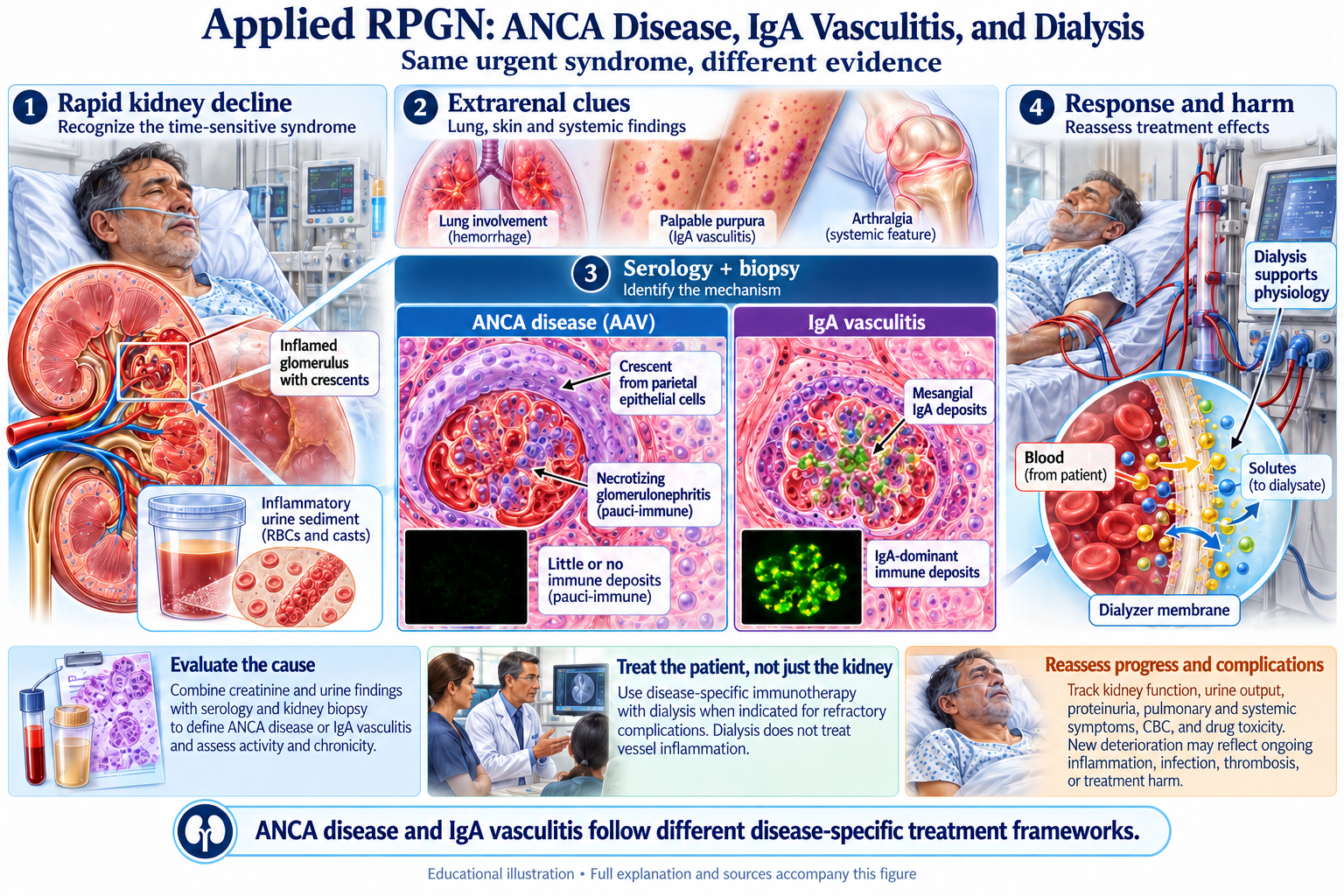
Pre-Case Assessment: Test Your Baseline Knowledge
Answer these questions before reviewing the case to assess your starting knowledge
Which of the following is the MOST specific urinary finding for glomerular hematuria?
Learning Point: Acanthocytes and RBC casts support glomerular hematuria. More than 5% acanthocytes usually indicates a glomerular inflammatory source; this threshold does not apply to all dysmorphic cells. Neither sediment finding alone establishes the immune cause, and their absence does not exclude GN.
📚 Reference: Urinalysis Module: Dysmorphic RBCs
What defines rapidly progressive glomerulonephritis (RPGN)?
Learning Point: RPGN is a syndrome of rapidly worsening kidney function with suspected glomerular injury. Escalate immediately; a 50% GFR decline is not a waiting threshold. Evaluate hematuria, quantified proteinuria, sediment, serology, and biopsy as appropriate.
📚 Reference: Glomerular Disease Module: RPGN
In a patient on anticoagulation who needs tissue diagnosis for suspected glomerulonephritis, which alternative to kidney biopsy may be diagnostic?
Learning Point: Skin biopsy of purpuric or vasculitic lesions can show immunofluorescence patterns (IgA, IgG, C3) that correlate with renal pathology, particularly useful in IgA vasculitis/HSP and cryoglobulinemic vasculitis.
📚 Reference: Vasculitis Module: Diagnostic Approaches
Case Presentation
Patient: 75-year-old male farmer
Chief Complaint: "I've been peeing blood for the past 3 days, and I've got this rash on my legs"
History of Present Illness: Previously healthy farmer presents with 3-day history of gross hematuria and palpable purpura on lower extremities. Also reports mild abdominal pain, arthralgias in knees and ankles, and decreased urine output over past week. Denies recent URI, but had a "sore throat" about 2 weeks ago that resolved without treatment.
Past Medical History: Atrial fibrillation (on apixaban), hypertension, osteoarthritis
Home Medications: Apixaban 5 mg BID, lisinopril 20 mg daily, hydrochlorothiazide 25 mg daily
Social History: Retired farmer, still helps on family farm, non-smoker, occasional alcohol
Physical Examination
- Vital Signs: BP 165/95, HR 88 (irregular), RR 18, T 37.2°C, O2 sat 96% RA
- General: Alert, mild distress, appears stated age
- Skin: Palpable purpura on bilateral lower extremities, non-blanching
- HEENT: No oral ulcers, mild pharyngeal erythema
- Cardiovascular: Irregular rhythm, no murmurs
- Pulmonary: Clear to auscultation bilaterally
- Abdomen: Soft, mild diffuse tenderness, no organomegaly
- Extremities: 1+ pitting edema bilaterally, purpuric rash as noted
- Joints: Mild swelling and tenderness of knees and ankles
🚨 Critical Finding: Leukocytoclastic Vasculitic Rash
Palpable purpura with areas of confluence on bilateral lower extremities, characteristic of small vessel vasculitis. The distribution and appearance are classic for IgA vasculitis (formerly Henoch-Schönlein purpura).
🤔 Initial Clinical Reasoning Questions
Based on the presentation of palpable purpura, gross hematuria, abdominal pain, and arthralgia in this 75-year-old, what is the most likely diagnosis?
Clinical Reasoning: The tetrad of palpable purpura, arthralgia, abdominal pain, and glomerulonephritis is classic for IgA vasculitis. While more common in children, it can occur in adults where it often has a more severe renal course.
📚 Reference: IgA Vasculitis Clinical Features
What is the most important immediate concern in this patient's management?
Clinical Reasoning: Adult-onset IgA vasculitis has a higher risk of severe renal involvement and RPGN compared to pediatric cases. Early recognition and treatment are crucial to prevent irreversible kidney damage.
📚 Reference: RPGN Emergency Management
Laboratory Data & Analysis
Initial Laboratory Values
| Parameter | Value | Normal Range | Clinical Significance |
|---|---|---|---|
| Serum Creatinine | 3.2 mg/dL | 0.7-1.3 mg/dL | Acute kidney injury |
| Baseline Cr (1 month ago) | 1.0 mg/dL | 0.7-1.3 mg/dL | Significant acute change |
| BUN | 78 mg/dL | 7-20 mg/dL | Azotemia |
| Hemoglobin | 10.8 g/dL | 14-18 g/dL | Mild anemia |
| Platelets | 245,000/μL | 150,000-400,000/μL | Normal (rules out TTP/HUS) |
| C3 Complement | 95 mg/dL | 90-180 mg/dL | Normal |
| C4 Complement | 28 mg/dL | 16-48 mg/dL | Normal |
| ASO Titer | 450 IU/mL | <200 IU/mL | Elevated (red herring) |
| ANCA | Negative | Negative | Rules out ANCA vasculitis |
| Anti-GBM | Negative | Negative | Rules out anti-GBM disease |
Urinalysis
| Parameter | Value | Clinical Significance |
|---|---|---|
| Appearance | Grossly bloody | Gross hematuria |
| Protein | 3+ (300 mg/dL) | Significant proteinuria |
| Blood | 4+ | Severe hematuria |
| RBC | TNTC/hpf | Glomerular bleeding |
| RBC Morphology | 80% dysmorphic RBCs (acanthocytes) | Diagnostic of glomerular hematuria |
| RBC Casts | 2-3/lpf | Confirms glomerular injury |
| WBC | 10-15/hpf | Mild pyuria |
🔬 Critical Urinalysis Finding: Dysmorphic RBCs
The presence of 80% dysmorphic RBCs (especially acanthocytes with characteristic "Mickey Mouse ears" appearance) is highly specific for glomerular hematuria and strongly supports the diagnosis of glomerulonephritis. This finding, combined with RBC casts, strongly supports a glomerular source; clinical evaluation and tissue findings establish the disease mechanism.
📊 Laboratory Analysis Questions
The elevated ASO titer in this patient is significant because:
Learning Point: Elevated ASO titers can persist for months after streptococcal infection and may be incidentally elevated. In this case with normal complements, IgA vasculitis presentation, and skin biopsy showing IgA deposition, the ASO is a red herring. Post-streptococcal GN typically has low C3.
📚 Reference: Post-Infectious GN vs IgA Nephropathy
Why are the normal complement levels (C3 and C4) helpful in this case?
Learning Point: Normal complements rule out hypocomplementemic GN (post-infectious, lupus, cryoglobulinemia, C3 glomerulopathy). This narrows the RPGN differential to IgA nephropathy/vasculitis, ANCA vasculitis, and anti-GBM disease.
📚 Reference: Complement Patterns in GN
Diagnostic Approach & Tissue Diagnosis
⚠️ Diagnostic Dilemma: Anticoagulation
Challenge: Patient on apixaban for atrial fibrillation, making kidney biopsy high-risk for bleeding complications.
Options considered:
- Hold anticoagulation for biopsy (risk of stroke)
- Bridge with heparin (still increased bleeding risk)
- Empiric treatment (miss potential diagnoses)
- Alternative tissue diagnosis → Skin biopsy of purpuric lesions ✓
🔬 Skin Biopsy Results
Direct Immunofluorescence:
- IgA: Strongly positive (3+) in vessel walls
- C3: Positive (2+) in vessel walls
- IgG, IgM: Negative
- Fibrinogen: Positive in vessel walls
Light Microscopy: Leukocytoclastic vasculitis with neutrophilic infiltration and nuclear debris
Diagnosis: IgA vasculitis (Henoch-Schönlein purpura) confirmed
🔍 Diagnostic Questions
In IgA vasculitis, skin biopsy immunofluorescence findings typically correlate with renal pathology. What would you expect to see on kidney biopsy?
Learning Point: IgA vasculitis shows identical immunofluorescence patterns in skin and kidney: predominant IgA deposition (with C3) in vessel walls (skin) and mesangium (kidney). This correlation allows skin biopsy to serve as a surrogate for renal biopsy when the latter is contraindicated.
📚 Reference: IgA Nephropathy Pathology
What percentage of adults with IgA vasculitis develop kidney involvement, and how does this compare to children?
Learning Point: Adults with IgA vasculitis have higher rates of renal involvement (60-90%) compared to children (20-40%), and adult renal disease tends to be more severe with higher risk of progression to ESRD.
📚 Reference: Adult vs Pediatric IgA Vasculitis
Treatment & Management
Initial Management Decision
Given the diagnosis of IgA vasculitis with RPGN (creatinine rising from 1.0 to 3.2 mg/dL), immediate immunosuppression is indicated.
Treatment Protocol Initiated:
- Methylprednisolone 500 mg IV daily × 3 days (pulse therapy)
- Followed by prednisone 1 mg/kg/day (75 mg daily)
- Continue apixaban (given high stroke risk)
- Hold ACE inhibitor temporarily (hyperkalemia risk)
- PPI for GI protection
- PJP prophylaxis with TMP-SMX
What is the primary rationale for using pulse methylprednisolone in this patient?
Treatment Rationale: Pulse methylprednisolone provides rapid, high-intensity immunosuppression crucial for RPGN/crescentic GN. The goal is to quickly halt inflammatory injury and prevent irreversible glomerular scarring. Time is nephrons!
📚 Reference: Pulse Steroid Protocols in GN
Which monitoring parameter is MOST important during the first 48 hours of pulse steroid therapy?
Monitoring Point: High-dose steroids can cause significant hyperglycemia (even in non-diabetics), hypokalemia, and fluid retention. Monitor glucose q6h during pulse therapy and check electrolytes daily. Watch for steroid psychosis in elderly patients.
📚 Reference: Steroid Therapy Monitoring
Clinical Course & Response to Treatment
Treatment Timeline
| Day | Creatinine | Clinical Status | Management |
|---|---|---|---|
| Day 1 | 3.2 mg/dL | Gross hematuria, oliguria | Started pulse steroids |
| Day 2 | 3.6 mg/dL | Continued oliguria | Pulse steroid day 2 |
| Day 3 | 4.0 mg/dL (peak) | Minimal urine output | Pulse steroid day 3, considered dialysis |
| Day 4 | 3.8 mg/dL | Urine output improving | Started oral prednisone 75 mg |
| Day 7 | 3.2 mg/dL | Hematuria resolving | Continue prednisone |
| Day 14 | 2.4 mg/dL | Rash resolved, no hematuria | Prednisone 60 mg |
| Day 30 | 1.8 mg/dL | Stable, proteinuria 500 mg/day | Prednisone taper begun |
| Month 4 | 1.0 mg/dL (baseline) | Complete recovery, trace proteinuria | Prednisone 10 mg, continuing taper |
💡 Clinical Pearl: Early Treatment Saves Kidneys
This case powerfully demonstrates that early recognition and treatment of RPGN can lead to COMPLETE renal recovery. Despite the creatinine peaking at 4.0 mg/dL (a level that often causes panic), prompt immunosuppression allowed full return to baseline function by month 4. This reinforces the critical teaching point: "Time is nephrons!" - delays of even days can mean the difference between complete recovery and dialysis dependence.
📈 Clinical Course Questions
What is the diagnostic accuracy of checking serum IgA levels for diagnosing IgA nephropathy?
Clinical Pearl: Serum IgA levels are NOT diagnostically useful for IgA nephropathy. They can be normal, elevated, or occasionally low. The diagnosis requires demonstration of IgA deposition in kidney or skin tissue. Don't be misled by the disease name - checking serum IgA is a common mistake!
📚 Reference: IgA Nephropathy Diagnosis
This patient's complete recovery to baseline creatinine by month 4 demonstrates:
Prognosis Point: Complete recovery to baseline demonstrates that treatment was initiated before irreversible glomerular scarring occurred. This emphasizes the critical importance of early recognition and treatment of RPGN - "time is nephrons!" Delayed treatment often results in permanent kidney damage.
📚 Reference: RPGN Outcomes with Early Treatment
Understanding IgA Nephropathy: The 4-Hit Hypothesis & New Treatments
The 4-Hit Hypothesis: A Student's Guide to IgA Nephropathy Pathogenesis
IgA nephropathy develops through a sequential process of four "hits" that lead from abnormal antibody production to kidney damage. Understanding these steps helps explain why new drugs target specific points in this pathway.
🎯 Hit 1: Abnormal IgA Production
What happens: The gut's immune system (Peyer's patches) produces defective IgA1 antibodies missing galactose sugars (Gd-IgA1)
Why it matters: These abnormal antibodies become "foreign" to the body
Drug targets: Tarpeyo (gut-targeted steroid), APRIL inhibitors
🎯 Hit 2: Autoantibody Formation
What happens: The immune system makes antibodies against the abnormal IgA1
Why it matters: Creates an autoimmune response
Drug targets: B-cell depletion, BAFF/APRIL inhibitors
🎯 Hit 3: Immune Complex Creation
What happens: The abnormal IgA1 and anti-IgA1 antibodies bind together forming large complexes
Why it matters: These complexes circulate and can deposit in kidneys
Drug targets: Complement inhibitors (iptacopan)
🎯 Hit 4: Kidney Damage
What happens: Complexes deposit in kidney mesangium causing inflammation and scarring
Why it matters: Leads to proteinuria and kidney failure
Drug targets: Sparsentan, SGLT2 inhibitors
🔬 New FDA-Approved Therapies (2023-2025): A Revolution in Treatment
Three Game-Changing Approvals:
1. Tarpeyo (Nefecon) - Targeted Gut Therapy
- How it works: Releases budesonide (steroid) specifically in the gut where abnormal IgA is made
- Key benefit: 27% proteinuria reduction, minimal systemic steroid effects
- Student pearl: Think "local treatment at the source" - like using a nasal spray for allergies instead of oral steroids
2. Sparsentan (Filspari) - Dual Blockade
- How it works: Blocks both endothelin AND angiotensin receptors (two bad actors in kidney disease)
- Key benefit: approximately 49.8% within-arm proteinuria reduction from baseline at 36 weeks (PROTECT trial, Heerspink HJL et al. Lancet 2023;401:1584-94, PMID 37015244); between-arm vs irbesartan, sparsentan reduced UPCR by approximately 41% more (LSM ratio 0.59). Distinguish within-arm from between-arm reduction.
- Student pearl: Like blocking two exits instead of one - more effective than ARBs alone
3. SGLT2 Inhibitors - Kidney Protection
- How it works: Originally diabetes drugs, now proven to protect kidneys regardless of diabetes
- Key benefit: 30% reduction in kidney function decline
- Student pearl: These drugs "rest" the kidney by reducing its workload - like putting an injured arm in a sling
🚀 Coming Soon (In Trials):
- APRIL inhibitors: Target the very first hit - may prevent disease at its source
- Complement inhibitors: Block the inflammation cascade (Hit 3)
- Combination therapy: Using multiple drugs to target different hits simultaneously
📚 Test Your Understanding: 4-Hit Hypothesis & New Therapies
A patient asks why their new medication Tarpeyo (targeted-release budesonide) is better than regular prednisone for IgA nephropathy. Your best explanation would be:
Teaching Point: Tarpeyo targets "Hit 1" by delivering budesonide directly to Peyer's patches in the gut where abnormal Gd-IgA1 is produced. About 90% is metabolized on first pass through the liver, minimizing systemic steroid side effects while treating the disease at its source.
📚 Reference: Targeted Therapies in IgAN
According to the 4-hit hypothesis, which "hit" would be most effectively prevented by APRIL inhibitors currently in clinical trials?
Mechanism Insight: APRIL (A Proliferation-Inducing Ligand) controls IgA class switching and production in gut-associated lymphoid tissue. Blocking APRIL prevents the initial production of abnormal Gd-IgA1, theoretically stopping the disease at its origin. Early trials show 50-60% proteinuria reduction!
📚 Reference: Future Therapies in IgAN
Why might combining drugs that target different "hits" be more effective than monotherapy in IgA nephropathy?
Strategic Thinking: Since IgA nephropathy involves a sequential cascade (4 hits), interrupting multiple steps simultaneously may provide synergistic benefit. For example, reducing abnormal IgA production (Hit 1) while also blocking kidney inflammation (Hit 4) addresses both upstream and downstream pathology. This is the future of IgAN treatment!
📚 Reference: Combination Strategies in IgAN
Learning Objectives Assessment
Evaluate your mastery of the key learning objectives from this case
🎯 Learning Objective 1: Recognize RPGN as a Nephrology Emergency
A 65-year-old presents with creatinine rising from 1.2 to 2.8 mg/dL over 10 days with hematuria and proteinuria. What is the MOST appropriate initial step?
Emergency Recognition: RPGN is a nephrology emergency requiring urgent evaluation and often same-day decisions about immunosuppression. Delays lead to irreversible kidney failure. Expedited serologies and tissue diagnosis (kidney or alternative) are crucial.
📚 Master This: RPGN Emergency Protocol
🎯 Learning Objective 2: Utilize Alternative Tissue Diagnosis When Kidney Biopsy is Contraindicated
Which clinical scenarios would make skin biopsy particularly useful for diagnosing glomerulonephritis?
Diagnostic Strategy: Skin biopsy with immunofluorescence can diagnose IgA vasculitis, cryoglobulinemic vasculitis, and sometimes lupus when purpuric/vasculitic lesions are present. The IF pattern correlates with renal pathology.
📚 Master This: Alternative Tissue Diagnosis in GN
🎯 Learning Objective 3: Understand Role of Dysmorphic RBCs in GN Diagnosis
A urinalysis shows 50-100 RBC/hpf. Which finding would most strongly suggest glomerular rather than urological source?
Urinalysis Mastery: Acanthocytes (ring forms with blebs) are highly specific for glomerular bleeding. >5% dysmorphic RBCs or >20% acanthocytes indicates glomerular source. Phase-contrast microscopy or special stains may be needed for visualization.
📚 Master This: RBC Morphology in Urinalysis
Advanced IgA Vasculitis & RPGN Integration
Test your mastery of IgA vasculitis pathophysiology and clinical decision-making
An adult patient with IgA vasculitis and RPGN achieves remission with steroids. Six months later, creatinine begins rising and proteinuria increases to 2 g/day. What is the MOST likely explanation?
Learning Point: IgA vasculitis (and IgA nephropathy) has a significant relapse rate, particularly in adults. Unlike the pediatric form which is often self-limited, adult IgA vasculitis can have a chronic relapsing course with progressive renal damage from ongoing mesangial IgA deposition. Rising creatinine and proteinuria after initial remission should prompt repeat urinalysis for active sediment and consideration of repeat biopsy. Long-term monitoring with urinalysis and serum creatinine is essential, as some patients progress to ESRD despite initial treatment response.
📚 Reference: GN Module - IgA Nephropathy Prognosis
Which feature MOST reliably distinguishes IgA vasculitis (Henoch-Schonlein purpura) from IgA nephropathy on clinical presentation?
Learning Point: IgA vasculitis and IgA nephropathy share the same renal pathology (mesangial IgA deposition) and are considered part of the same disease spectrum. The key distinguishing feature is the systemic manifestations in IgA vasculitis: palpable purpura (required for diagnosis), arthritis/arthralgias, abdominal pain (from GI vasculitis), and sometimes scrotal involvement. IgA nephropathy presents as isolated renal disease without these systemic features. Both have normal complement levels and both may show elevated serum IgA, so these features do not differentiate them.
📚 Reference: GN Module - IgA Vasculitis vs IgA Nephropathy
Case Reflection & Multi-Module Integration
🔬 Glomerular Disease Integration
- RPGN differential diagnosis approach
- Role of complement levels in narrowing differential
- IgA nephropathy pathophysiology
- Crescentic transformation of IgAN
🔍 Urinalysis Integration
- Dysmorphic RBC identification
- Distinguishing glomerular from urological hematuria
- RBC cast significance
- Proteinuria quantification
💊 Immunosuppression Integration
- Pulse steroid protocols
- Monitoring during high-dose steroids
- Infection prophylaxis
- Steroid tapering strategies
🎯 Key Integration Concepts
This case demonstrates the critical intersection of clinical pattern recognition, laboratory interpretation, and urgent management decision-making in RPGN. The integration of skin pathology findings with renal disease, the significance of urinary biomarkers like dysmorphic RBCs, and the time-sensitive nature of treatment initiation all highlight the importance of a systematic, multi-disciplinary approach to rapidly progressive glomerulonephritis.
Key takeaway: "Time is nephrons" - early recognition and treatment of RPGN can mean the difference between renal recovery and dialysis dependence.
📝 Case Summary & Clinical Pearls
This case of a 75-year-old farmer with IgA vasculitis presenting as RPGN illustrates several critical concepts in nephrology. The combination of palpable purpura, gross hematuria with dysmorphic RBCs, and rapidly rising creatinine demanded urgent intervention. The use of skin biopsy as an alternative to kidney biopsy in an anticoagulated patient proved diagnostic, showing IgA deposition consistent with IgA vasculitis. Early treatment with pulse steroids led to complete renal recovery with return to baseline creatinine by month 4, powerfully demonstrating that prompt recognition and treatment can prevent permanent kidney damage.
🔑 Key Clinical Pearls from This Case:
- RPGN is a nephrology emergency: Rapid evaluation and treatment within days can prevent dialysis dependence
- Dysmorphic RBCs are diagnostic gold: Acanthocytes >5% of urinary RBCs usually indicate a glomerular inflammatory source; interpret sediment with proteinuria and the clinical course
- Skin can substitute for kidney: In IgA vasculitis and cryoglobulinemia, skin biopsy IF correlates with renal pathology
- Normal complements narrow the differential: Points toward IgA nephropathy, ANCA vasculitis, or anti-GBM disease
- Don't be fooled by red herrings: Elevated ASO doesn't always mean post-streptococcal GN - consider the whole clinical picture
- Adult IgA vasculitis is more severe: Higher rates of renal involvement and worse prognosis than pediatric cases
- Early steroids save nephrons: This case proves it - complete recovery from Cr 4.0 to baseline 1.0 with prompt treatment
- Don't check serum IgA levels: Common mistake - they're normal in most cases and not diagnostically useful