Pre-Case Assessment: Test Your Baseline Knowledge
Answer these questions before reviewing the case to assess your starting knowledge
Which clinical findings most strongly suggest secondary hypertension and warrant further evaluation?
Learning Point: Sudden onset severe hypertension in a young patient without family history is a classic presentation for secondary hypertension, particularly renal artery stenosis or endocrine causes. Age <30 or >55 years, severity >180/110 mmHg, and resistance to multiple medications are key red flags.
📚 Reference: Secondary HTN Screening Module
What is the most common cause of renovascular hypertension in patients over 50 years old?
Learning Point: Atherosclerotic renal artery stenosis is the most common cause of renovascular hypertension in patients >50 years, especially those with cardiovascular risk factors. It typically affects the proximal renal artery (ostial/aorto-ostial). Fibromuscular dysplasia is more common in younger patients, especially women <50 years.
📚 Reference: Secondary HTN Screening Module
In the renin-angiotensin system, what is the expected pattern in unilateral renal artery stenosis?
Learning Point: Unilateral renal artery stenosis causes decreased perfusion to the affected kidney, triggering increased renin release. This stimulates aldosterone production, leading to high renin and normal to high aldosterone levels. This pattern helps distinguish RAS from primary aldosteronism (low renin, high aldosterone).
📚 Reference: Secondary HTN Screening Module
Case Presentation
Patient: 75-year-old woman
Chief Complaint: "My blood pressure has been really high lately, and I'm having headaches"
History of Present Illness: Previously normotensive woman presents for evaluation of worsening hypertension. Three months ago, routine check-up revealed blood pressure of 165/105 mmHg, representing a significant increase from her baseline of 130-140/80-85 mmHg over the past several years. Started on lisinopril 10mg daily with minimal improvement. Recent home readings consistently 170-190/100-115 mmHg despite increasing lisinopril to 20mg and adding hydrochlorothiazide 25mg daily. Reports occasional frontal headaches, no visual changes, no chest pain or shortness of breath.
Past Medical History: Mild hypertension controlled on low-dose HCTZ for 5 years (baseline BP 130-140/80-85), osteoarthritis, previous cholecystectomy (2018), no diabetes or coronary artery disease
Home Medications: Lisinopril 20mg daily, hydrochlorothiazide 25mg daily (started 4 weeks ago)
Family History: Father had hypertension and died of stroke at age 78. Mother died of ovarian cancer at age 82. No family history of kidney disease.
Social History: Retired teacher, former smoker (quit 20 years ago, 10 pack-year history), social alcohol use (1-2 drinks/week), walks daily, BMI 26
🤔 Initial Clinical Reasoning Questions
Based on this presentation, what is the most concerning aspect that suggests secondary hypertension?
Clinical Reasoning: The sudden worsening of previously controlled hypertension in an elderly patient is a classic red flag for secondary hypertension, particularly atherosclerotic renal artery stenosis. While family history and poor medication response are also concerning, the acute change in blood pressure control pattern is most suggestive of an underlying vascular cause.
📚 Learn More: Secondary HTN Red Flags
What physical examination findings would you specifically look for in this patient?
Clinical Reasoning: For suspected renovascular hypertension, key findings include abdominal bruits (especially epigastric or flank), pulse differentials between arms (suggesting aortic coarctation), and fundoscopic changes indicating target organ damage. These findings help guide the secondary hypertension workup.
📚 Learn More: Renovascular HTN Physical Exam Findings
Physical Examination Findings
| System | Findings | Clinical Significance |
|---|---|---|
| Vital Signs | BP 185/115 mmHg (confirmed), HR 78, T 98.6°F, BMI 24 | Severe hypertension, normal weight |
| General | Well-appearing, alert, no acute distress | No signs of hypertensive emergency |
| Cardiovascular | RRR, no murmurs, PMI not displaced | No left heart strain yet |
| Abdominal | Soft, non-tender, systolic bruit heard in right upper quadrant | Suggestive of renal artery stenosis |
| Extremities | Equal pulses bilaterally, no edema | No coarctation, no volume overload |
| Fundoscopic | Grade II hypertensive retinopathy (AV nicking) | Early target organ damage |
📊 Physical Examination Analysis
The presence of a systolic abdominal bruit in this patient is most significant because:
Learning Point: An abdominal systolic bruit, especially in the epigastrium or flanks, is found in 40-60% of patients with renal artery stenosis. When heard in a young patient with new-onset severe hypertension, it significantly increases the likelihood of renovascular hypertension and warrants further imaging evaluation.
📚 Reference: Secondary HTN Physical Findings
Laboratory Data & Analysis
Initial Laboratory Results
| Parameter | Value | Normal Range | Clinical Significance |
|---|---|---|---|
| Serum Creatinine | 1.0 mg/dL | 0.6-1.1 mg/dL | Normal kidney function |
| eGFR | 85 mL/min/1.73m² | >60 mL/min/1.73m² | Normal |
| Potassium | 3.2 mEq/L | 3.5-5.0 mEq/L | Mild hypokalemia |
| Sodium | 142 mEq/L | 136-145 mEq/L | Normal |
| BUN | 18 mg/dL | 7-20 mg/dL | Normal |
🧬 Renin-Aldosterone System Evaluation
Hormone Testing Results (after stopping ACE inhibitor for 2 weeks)
| Parameter | Value | Normal Range | Interpretation |
|---|---|---|---|
| Plasma Renin Activity (PRA) | 8.5 ng/mL/hr | 0.2-2.3 ng/mL/hr | Markedly elevated |
| Aldosterone | 22 ng/dL | 4-31 ng/dL | Upper normal |
| Aldosterone/Renin Ratio | 2.6 | >20 suggests primary aldosteronism | Low ratio - excludes primary aldosteronism |
🎯 Hormone Pattern Interpretation
High Renin Pattern Indicates:
- Renovascular hypertension: Most likely diagnosis
- Volume depletion: Rule out with clinical assessment
- Malignant hypertension: Not present clinically
- Renin-secreting tumor: Very rare
Pattern Rules Out:
- Primary aldosteronism: Would have low renin, high aldosterone
- Essential hypertension: Usually normal to low renin
- Cushing syndrome: Usually suppressed renin
- Pheochromocytoma: Variable but often normal renin
📊 Hormone Analysis Questions
The combination of markedly elevated plasma renin activity (8.5 ng/mL/hr) with normal aldosterone in this hypertensive patient most strongly suggests:
Learning Point: Renovascular hypertension classically presents with high renin (due to decreased perfusion stimulating renin release) and normal to high aldosterone. The low aldosterone/renin ratio (2.6) excludes primary aldosteronism, which would show high aldosterone with suppressed renin (ratio >20).
📚 Reference: Renin-Aldosterone Testing
Why is it important to stop the ACE inhibitor before renin-aldosterone testing?
Learning Point: ACE inhibitors block the conversion of angiotensin I to angiotensin II, which leads to compensatory increases in renin release. This can interfere with interpretation of renin levels. Ideally, ACE inhibitors should be stopped 2 weeks before testing, with alternative antihypertensive agents used if needed.
📚 Reference: Hormone Testing Protocols
Imaging Evaluation
🔍 Initial Renal Doppler Ultrasound
Ultrasound Findings
| Parameter | Right Kidney | Left Kidney | Normal Values | Interpretation |
|---|---|---|---|---|
| Kidney Length | 7.5 cm | 11.2 cm | 9-12 cm | Right kidney atrophic |
| Cortical Thickness | 0.8 cm | 1.5 cm | 1.2-1.8 cm | Right cortical thinning |
| Peak Systolic Velocity | 350 cm/sec | 120 cm/sec | <180 cm/sec | Severe RAS indicated |
| Resistive Index | 0.85 | 0.65 | <0.80 | Elevated, suggests chronic changes |
📊 Doppler Ultrasound Interpretation
- Size discrepancy: >1.5 cm difference suggests unilateral renal artery stenosis
- Peak systolic velocity >300 cm/sec: Indicates >80% stenosis
- High resistive index (0.85): Suggests parenchymal damage and poor salvageability
- Overall impression: Severe right renal artery stenosis with chronic changes
🔍 Imaging Analysis Questions
The finding of a 7.5 cm right kidney compared to an 11.2 cm left kidney is most significant because:
Learning Point: A size difference >1.5 cm between kidneys strongly suggests unilateral renal artery stenosis. The smaller kidney (7.5 cm) indicates chronic ischemia and atrophy. Normal kidney length is 9-12 cm, so the right kidney is significantly atrophic while the left appears normal to slightly enlarged (compensatory hypertrophy).
📚 Reference: Renal Imaging Interpretation
A peak systolic velocity of 350 cm/sec in the right renal artery indicates:
Learning Point: Doppler ultrasound criteria for renal artery stenosis: Normal <180 cm/sec, 60-80% stenosis 180-300 cm/sec, >80% stenosis >300 cm/sec. A velocity of 350 cm/sec indicates severe stenosis. However, very tight stenosis (>95%) may show decreased velocities due to reduced flow.
📚 Reference: Doppler Ultrasound Criteria
🏥 CT Angiography (CTA) Results
Indication: Confirm renal artery stenosis and plan potential intervention
CTA Findings:
- Right renal artery: 85% stenosis at the origin, consistent with atherosclerotic plaque
- Left renal artery: Normal caliber, no stenosis
- Kidney size: Confirms right kidney 7.8 cm, left kidney 11.5 cm
- Perfusion: Delayed enhancement of right kidney, normal left kidney perfusion
- Collateral circulation: Minimal collateral development
Interactive Timeline: Diagnostic Workup Progression
Navigate through the chronological decision points in evaluating this patient's renal artery stenosis
Day 1 — Initial Evaluation: A 75-year-old woman presents with sudden worsening of previously controlled hypertension (now 195/105) and an abdominal bruit. Which initial diagnostic study is most appropriate?
Clinical Reasoning: Renal Doppler ultrasound is the preferred initial screening test — it is noninvasive, avoids contrast exposure in a patient with unknown renal function, provides functional data (resistive index, peak systolic velocity), and assesses kidney size asymmetry. CT angiography is confirmatory but involves iodinated contrast. Captopril renography has largely been replaced by Doppler in clinical practice.
📚 Reference: Renal Imaging Module
Day 3 — Doppler Results Return: Right renal artery PSV 385 cm/sec, renal-aortic ratio 4.2, right kidney 7.8 cm vs left 11.5 cm. While awaiting confirmatory CTA, which additional laboratory studies should be obtained to guide management?
Clinical Reasoning: With strong imaging evidence of RAS, the renin-aldosterone profile confirms the pathophysiology (high renin from renal ischemia) and helps exclude primary aldosteronism (which shows suppressed renin). The BMP establishes baseline kidney function — critical for monitoring after any ACE inhibitor or ARB initiation. The other options evaluate vasculitis or adrenal causes, which are not supported by the Doppler findings.
📚 Reference: Secondary HTN Screening Protocol
Day 7 — CTA Confirms Severe RAS: The CTA shows >90% right renal artery stenosis. The patient's blood pressure is 175/98 on amlodipine 10 mg and losartan 50 mg, with creatinine stable at 1.0 mg/dL. What does the stable creatinine tell you about initiating RAAS blockade in this patient?
Clinical Reasoning: In unilateral RAS, the contralateral kidney maintains GFR when RAAS blockade reduces filtration in the stenotic kidney. Stable creatinine confirms adequate compensation. However, a rise >30% suggests bilateral disease, solitary functioning kidney, or more severe stenosis than anticipated — and warrants immediate discontinuation. Close monitoring (1-2 weeks) after any RAAS blocker initiation or dose change is mandatory.
📚 Reference: HTN Medical Management + AKI Recognition
Month 3 — Follow-Up: Blood pressure is 145/88 on amlodipine 10 mg, losartan 100 mg, and chlorthalidone 25 mg. Creatinine remains 1.0 mg/dL. What is the significance of needing three antihypertensives to achieve partial control?
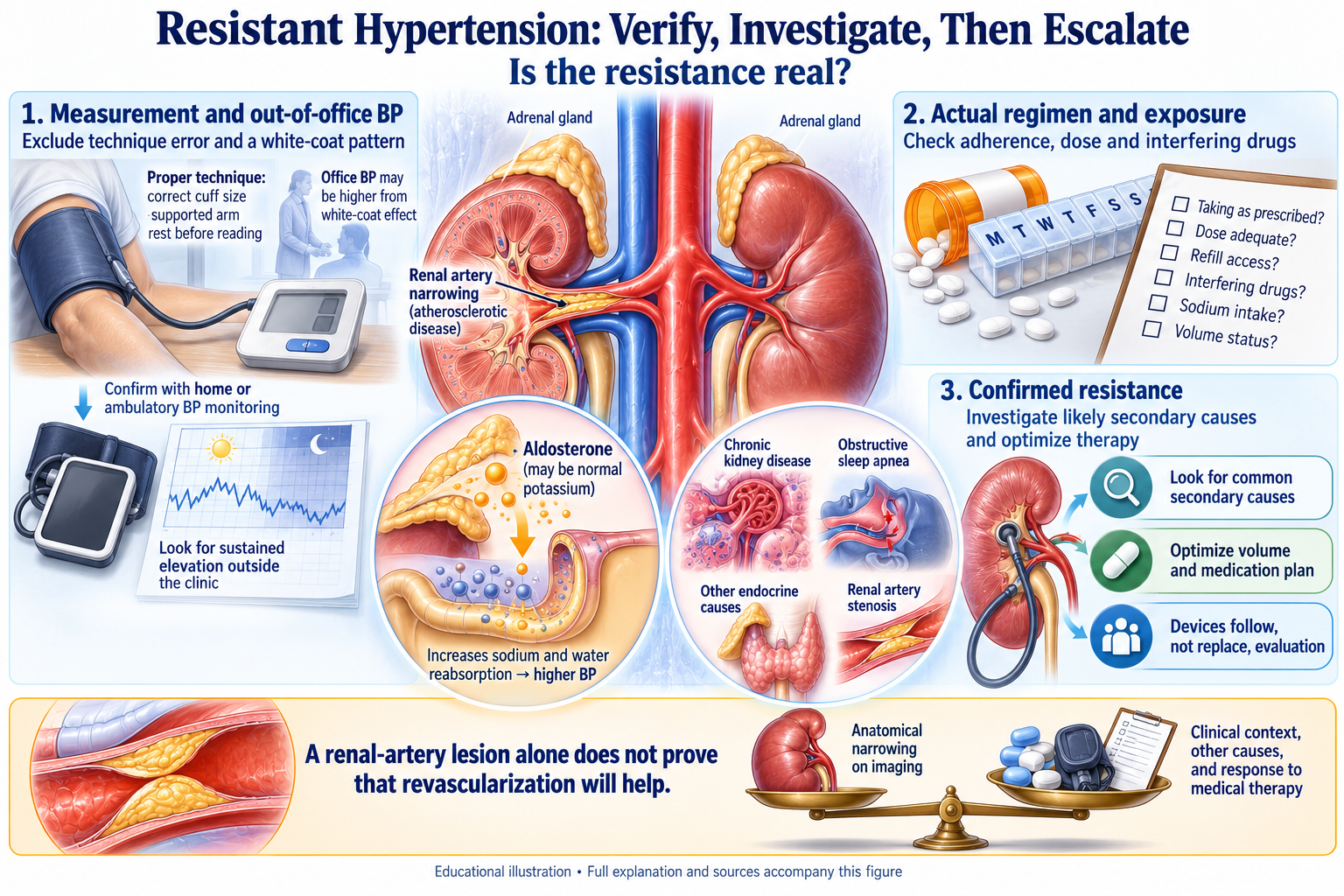
Clinical Reasoning: Resistant hypertension (uncontrolled BP on 3+ drugs including a diuretic) in the setting of known RAS is a recognized indication for revascularization. Current guidelines define resistant HTN as a threshold for reconsidering stenting, particularly if BP remains uncontrolled on optimal medical therapy. However, the decision requires weighing the small atrophic kidney (poor salvageability) against the potential BP benefit — making this a complex multidisciplinary decision.
What target is she failing? Name it explicitly: <130/80 mmHg (2025 AHA/ACC, ADA Standards of Care). KDIGO 2021 (Blood Pressure in CKD) suggests systolic <120 mmHg when tolerated on standardized office measurement (grade 2B, driven by the CKD subgroup of SPRINT, PMID 26551272), and explicitly excludes transplant recipients and dialysis patients. Much of the gap between the two numbers is measurement technique rather than disagreement about physiology — KDIGO's lower number presumes a standardized or unattended reading, which most routine clinic cuffs do not meet. At 145/88 she is above both thresholds, so "resistant" holds under either guideline.
📚 Reference: Resistant HTN and Device Therapy
Treatment Decision Making
Given the findings of severe right renal artery stenosis with an atrophic kidney (7.5 cm), what is the most appropriate initial management?
Treatment Rationale: While there is severe stenosis, the small kidney size (7.5 cm), high resistive index (0.85), and normal creatinine suggest limited salvageability. Current guidelines recommend optimized medical management as first-line therapy. Stenting is reserved for resistant hypertension, kidney function decline, or flash pulmonary edema.
📚 Reference: Interventional HTN Management
What would be the most appropriate medical management for this patient?
Treatment Rationale: In unilateral RAS with preserved overall kidney function, calcium channel blockers are preferred first-line agents. ARBs may be used with caution and close monitoring. Statins are indicated for cardiovascular protection. ACE inhibitors should be used cautiously as they may worsen kidney function in bilateral RAS or solitary kidney with RAS.
📚 Reference: HTN Medical Management
Renal Artery Stenting: Decision Framework
📋 Current Guidelines for Renal Artery Stenting
✅ Indications for Stenting
- Flash pulmonary edema: Recurrent acute episodes
- Progressive kidney dysfunction: >30% eGFR decline
- Resistant hypertension: >3 drugs at max doses
- Unstable angina: With preserved kidney function
- Large kidney (>9 cm): Good salvage potential
❌ Relative Contraindications
- Small atrophic kidney (<8 cm): Limited benefit
- High resistive index (>0.80): Poor salvageability
- Normal kidney function: With unilateral disease
- Advanced age (>80): Increased procedural risk
- Significant comorbidities: Limited life expectancy
🎯 This Patient's Stenting Assessment
| Factor | Patient Status | Stenting Favor | Comments |
|---|---|---|---|
| Kidney Size | 7.5 cm (small) | Against | Below threshold for good salvage |
| Resistive Index | 0.85 (high) | Against | Suggests parenchymal damage |
| Kidney Function | Normal (Cr 1.0) | Against | No evidence of functional decline |
| Flash Pulmonary Edema | Absent | Against | Not reported in history |
| Age | 75 years (elderly) | Against | Increased procedural risk, limited life expectancy benefit |
| HTN Control | Resistant | Neutral | May respond to optimal medical therapy |
🎯 Recommendation: Medical Management First
Rationale: Small kidney size, high resistive index, and normal overall kidney function suggest limited benefit from stenting. Current guidelines support medical management as first-line therapy with stenting reserved for specific indications not present in this case.
Learning Objectives Assessment
Evaluate your mastery of the key learning objectives from this case
🎯 Learning Objective 1: Secondary Hypertension Recognition and Workup
Objective: Identify clinical features suggestive of secondary hypertension and initiate appropriate diagnostic evaluation
A 78-year-old woman with previously controlled hypertension develops sudden worsening. Which combination of findings would most strongly support proceeding with secondary hypertension workup?
Competency Demonstration: This answer shows mastery of secondary HTN red flags in elderly patients: sudden severe worsening of previously controlled HTN, physical findings (abdominal bruit), and preserved kidney function despite severe HTN. These findings mandate secondary HTN evaluation regardless of age.
📚 Master This: Complete Secondary HTN Screening Protocol
🎯 Learning Objective 2: Renin-Aldosterone System Interpretation
Objective: Interpret renin-aldosterone patterns to differentiate causes of secondary hypertension
A patient has PRA 12 ng/mL/hr (high) and aldosterone 8 ng/dL (low-normal). This pattern is most consistent with:
Competency Demonstration: High renin with low-normal aldosterone suggests impaired aldosterone response to high renin, typical of renovascular hypertension. Primary aldosteronism shows high aldosterone/low renin; essential HTN usually shows normal/low renin.
📚 Master This: Renin-Aldosterone Pattern Recognition
🎯 Learning Objective 3: Imaging Interpretation for Renal Artery Stenosis
Objective: Interpret renal imaging studies to diagnose and assess severity of renal artery stenosis
On renal Doppler ultrasound, which combination of findings best indicates severe (>80%) renal artery stenosis?
Competency Demonstration: Peak systolic velocity >300 cm/sec indicates >80% stenosis, and kidney size difference >1.5 cm suggests hemodynamically significant stenosis with compensatory changes. This combination confirms severe stenosis.
📚 Master This: Complete Renal Imaging Module
🎯 Learning Objective 4: Stenting Decision Making
Objective: Apply evidence-based criteria to determine appropriateness of renal artery stenting
According to current guidelines, renal artery stenting is most appropriate for a patient with:
Competency Demonstration: Flash pulmonary edema with bilateral RAS is a Class I indication for revascularization according to current guidelines. The other scenarios either lack strong indications or have features suggesting poor salvageability.
📚 Master This: Interventional HTN Guidelines
Integration Challenge: Complex Scenario
Apply knowledge from multiple modules to solve complex clinical problems
A 45-year-old woman with the same RAS findings develops acute kidney injury (creatinine increases from 1.0 to 2.1 mg/dL) after starting lisinopril 10mg daily. What is the most appropriate next step?
Integration Synthesis: ACE inhibitor-induced AKI in the setting of known RAS suggests bilateral disease or RAS in a solitary functioning kidney. This scenario changes the risk-benefit analysis and may justify urgent revascularization. Continuing ACE inhibitors could worsen kidney function further.
📚 Integration: AKI Recognition + HTN Management
If this patient were to develop resistant hypertension requiring 4 medications and progressive kidney dysfunction, how would you approach the stenting decision?
Integration Synthesis: While small kidney size and high resistive index usually preclude stenting, the development of resistant HTN and progressive kidney dysfunction changes the risk-benefit ratio. The decision requires multidisciplinary discussion weighing procedural risks against continued deterioration.
📚 Integration: Resistant HTN + CKD Progression
Case Reflection & Multi-Module Integration
💓 Hypertension Module Integration
- Secondary HTN screening criteria and red flags
- Physical examination findings in RAS
- Medical management of renovascular HTN
- Resistant HTN evaluation and treatment
🔬 Renal Imaging Integration
- Doppler ultrasound interpretation for RAS
- Size discrepancy significance
- Resistive index and salvageability
- CT angiography confirmatory findings
⚡ Endocrine Evaluation Integration
- Renin-aldosterone system physiology
- Hormone testing protocols and interpretation
- Differential diagnosis using hormone patterns
- Effect of medications on testing
🩺 Interventional Nephrology Integration
- Evidence-based stenting criteria
- Procedural indications and contraindications
- Risk-benefit analysis for intervention
- Multidisciplinary decision making
🎯 Key Integration Concepts
This case demonstrates the importance of integrating clinical assessment, laboratory evaluation, imaging interpretation, and evidence-based treatment guidelines to manage secondary hypertension. The decision-making process requires synthesizing information from multiple domains to provide optimal patient care while avoiding unnecessary interventions.
📝 Case Summary & Clinical Pearls
This case illustrates a classic presentation of atherosclerotic renal artery stenosis in an elderly woman. The combination of sudden worsening of previously controlled hypertension, abdominal bruit, elevated renin, and imaging findings of unilateral RAS with an atrophic kidney demonstrates the systematic approach to secondary hypertension evaluation in older adults.
🔑 Key Clinical Pearls from This Case:
- Age and Presentation Matter: Sudden worsening of previously controlled HTN in elderly patients warrants secondary HTN workup
- Physical Exam is Critical: Abdominal bruits significantly increase the likelihood of renovascular HTN
- Hormone Patterns are Diagnostic: High renin with normal aldosterone strongly suggests renovascular HTN
- Size Matters for Intervention: Small atrophic kidneys (<8 cm) rarely benefit from revascularization
- Medical Management First: Current evidence supports optimal medical therapy before considering stenting