Beta Blockers in the Cardiac-Rehab Patient
HR isn't the target. RPE is. And never tell them to stop.
Visual reference
Open the visual review after completing the case
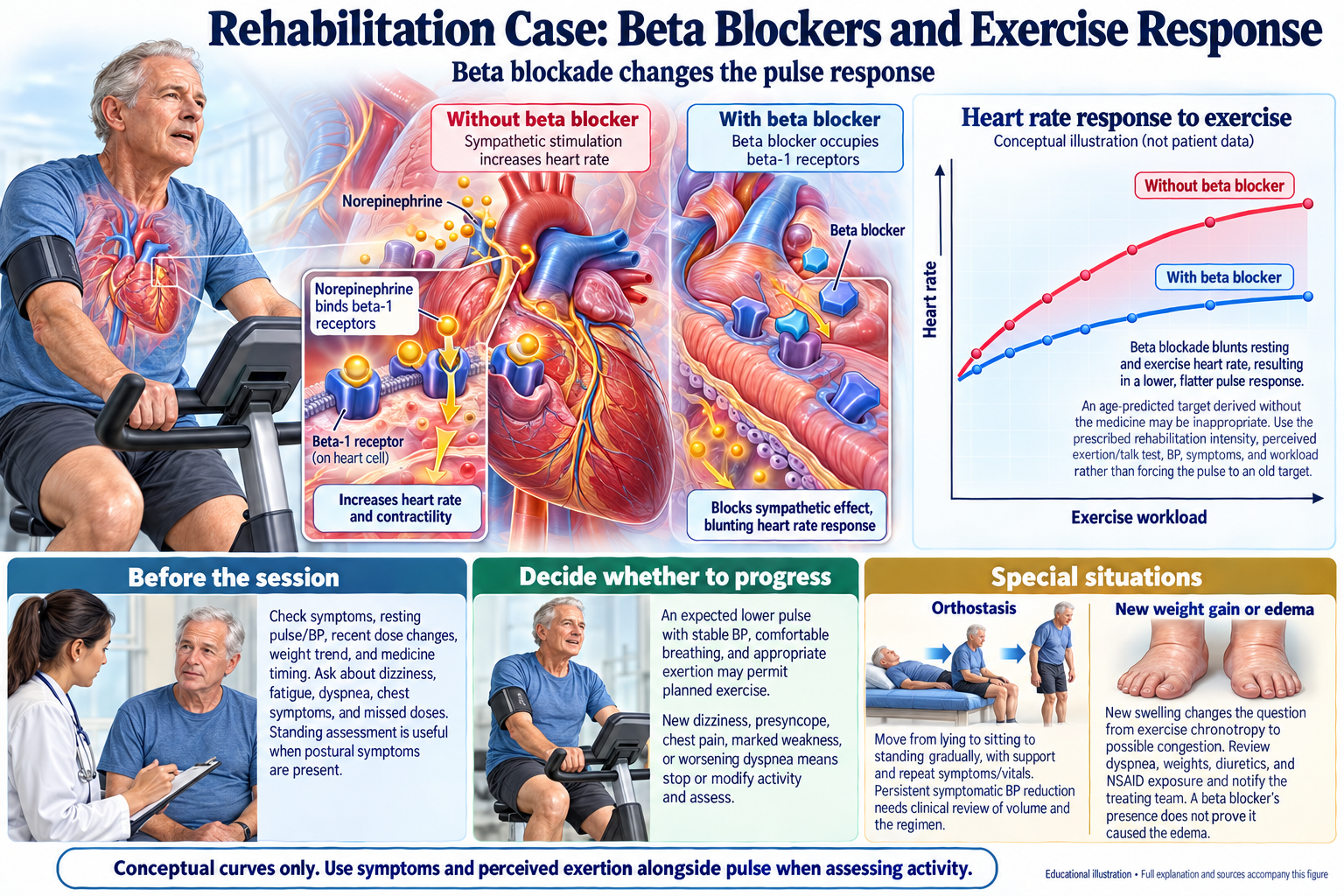
Browse the visual reference library · Download lesson Markdown
🔗 Cross-Linked Track 1 Handouts & Lectures
This case integrates with the Track 1 PT handouts already shipped and with the existing cardiorenal / hypertension modules.
💧 Hydration PT handout
Orthostatic differential + volume status in cardiac rehab.
💉 GLP-1 RA PT handout
Cardiac-rehab patients on GLP-1 are a common overlap.
💊 NSAIDs PT handout
Triple-whammy AKI risk when NSAID added to diuretic + ACEi/ARB.
🏋️ Creatine PT handout
Sarcopenia prevention during cardiac rehab.
🎯 Lecture Alignment & the Four-Agent Beta-Blocker Quartet
This case reinforces the cardiorenal HF lecture (2025_UDPA_Lectures_Live/cardiorenal-disease/hf-diuretic-resistance.html) which names carvedilol, metoprolol succinate, and bisoprolol as the HFrEF guideline-directed medical therapy (GDMT) beta-blocker triad. Bisoprolol is out of scope for this case; the four agents discussed below cover the class Andy wants students to recognize.
| Agent (brand) | β1 / β2 / α1 profile | Lipophilic? | HFrEF GDMT? | PT-relevant signal |
|---|---|---|---|---|
| Carvedilol (Coreg) | Non-selective β1/β2 + α1 antagonist | Yes | Yes — Class I GDMT. COMET mortality edge over metoprolol tartrate[3]; severe HF benefit in COPERNICUS[5] | α1 vasodilation = more BP lowering, more orthostasis. Peak HR blunted. Take with food to blunt absorption peak. |
| Metoprolol succinate (Toprol-XL) | β1-selective | Yes (less than propranolol) | Yes — Class I GDMT. MERIT-HF 34% mortality reduction vs placebo[4] | "Cleaner" HR blockade, no vasodilator component. Less orthostasis than carvedilol. |
| Metoprolol tartrate (Lopressor) | β1-selective | Yes | NOT a GDMT choice for HFrEF. Short-acting; inferior to carvedilol in COMET[3] | Common in post-MI / HTN / rate control. If a HFrEF patient is on tartrate, flag for prescriber — succinate is the HF formulation. |
| Atenolol | β1-selective | No (hydrophilic) | No — not recommended for HFrEF; common for HTN/rate control | Does NOT cross blood–brain barrier → less fatigue / CNS side effects. Historically called "exercise-friendlier" for young active patients on this basis. |
| Propranolol (Inderal) | Non-selective β1/β2 | Yes (very) | No — not preferred for HFrEF; use for tremor, migraine, thyroid storm, portal HTN | β2 blockade may blunt bronchodilation and exercise muscle vasodilation. Most CNS side effects of the class. |
🔬 Clinical Question: Does Carvedilol "Recover" With Exercise Sympathetic Tone?
The hypothesis (clinical intuition): Coreg produces more resting bradycardia, but its α1 vasodilation allows the patient's own sympathetic drive during exercise to "punch through" and make Coreg relatively more exercise-friendly than pure β1-selective agents like metoprolol or atenolol.
What the head-to-head literature actually shows — in three honest parts:
- Resting HR: at equipotent HF doses, carvedilol and metoprolol succinate produce broadly similar resting HR reductions. Carvedilol's α1 vasodilation lowers BP and produces a small reflex sympathetic push on the sinoatrial node, which can leave resting HR modestly less suppressed than with pure β1-blockade — the opposite direction from the "more resting bradycardia" intuition. Clinical experience varies by dose, tolerance, and individual autonomic state.
- Exercise-peak HR: both agents blunt peak-exercise HR substantially and by similar magnitudes. β1 is the dominant exercise chronotropic receptor, and both agents block it. There is no compelling head-to-head evidence that carvedilol preferentially preserves exercise HR response.
- Exercise capacity over months: both agents, as GDMT in HFrEF, improve exercise capacity over 3–12 months via reverse remodeling — not via acute-session HR differences. COMET (Poole-Wilson et al. 2003) showed carvedilol extended survival vs metoprolol tartrate (HR 0.83, 95% CI 0.74–0.93; 34% vs 40% all-cause mortality at 58 months)[3]. Notably COMET used tartrate, not the HFrEF-preferred succinate — a contested design choice that matters for how the result generalizes.
⚠️ What this means for PT — honest reframe
Carvedilol is not more exercise-friendly than metoprolol succinate in the "my heart rate can do more during exercise" sense. If anything, carvedilol's α1 vasodilation makes it more likely to produce orthostatic symptoms and exercise-induced BP drops in older cardiac-rehab patients. The reason HFrEF prescribers still often choose carvedilol is the mortality signal (COMET + COPERNICUS), not exercise physiology.
For the DPT student, the operational rule is the same regardless of which of the four agents the patient is on: do not use heart rate to prescribe intensity. Use Borg RPE 11–13 and talk-test. The "exercise-friendliness" ranking within the quartet is subtle and clinician-specific; the HR-blunting rule is universal.
📍 Clinical Addendum — the rest-to-ambulation signal
A bedside observation from the prescribing clinician: in HFrEF patients on carvedilol, resting HR in the 40s that climbs to 60–70 on standing and ambulation is a pattern not typically seen on metoprolol succinate. That swing is real and clinically noticeable. It extends — but does not invert — the honest synthesis above.
Mechanism beneath the observation. Carvedilol's α1 blockade produces a larger orthostatic BP drop on standing because the arteriolar constriction that normally offsets gravitational pooling is blunted. The bigger BP drop triggers a bigger baroreflex unloading; carvedilol also improves baroreflex sensitivity in HFrEF (Mortara et al. 2000 JACC, n=19: BRS rose 3.7 → 7.1 ms/mmHg over 6 months on carvedilol, unchanged in matched controls)[9], amplifying the autonomic response to that same postural stimulus. The HR response is further facilitated by β2-mediated reduction in cardiac norepinephrine spillover — a mechanism carvedilol has and metoprolol lacks (Kubo et al. 2005 Eur J Heart Fail)[10]. In T2DM head-to-head data (Vinik et al. 2014 Heart Int, n=147), the differential emerged directly: resting parasympathetic activity decreased on metoprolol but increased on carvedilol[11].
The intensity-range ceiling — why this doesn't invert the earlier teaching
| Intensity range | What the patient may experience on carvedilol vs metoprolol succinate |
|---|---|
| Rest → standing → slow ambulation | Larger HR swing on carvedilol via the baroreflex + α1 mechanism above. Patients may feel "a little more headroom" with ADLs and short walks. This is the rest-to-ambulation signal the prescriber sees in clinic. |
| Steady submaximal walking / cardiac rehab conditioning | Neutral to mild edge. Poltavskaya et al. 2007 (n=147 HFrEF) showed 6-minute walk distance improvement of +110.7 m and DASI daily-activity gains on both carvedilol and metoprolol over 6–12 months[12]. Submaximal functional parameters improve comparably between agents. |
| Peak exertion / maximal work | Ceiling — carvedilol's β2 blockade reduces skeletal-muscle vasodilation at peak. Metra, Nodari & Dei Cas 2001 noted "a lack of improvement in maximal exercise capacity with carvedilol, compared with selective beta-blockers"[13]. Peak VO₂ is not reliably better and occasionally slightly worse. |
What does not change: the operational PT rule. Never use heart rate to prescribe intensity in a beta-blocked patient — Borg RPE 11–13 and talk-test across all four agents. The rest-to-ambulation signal is interesting physiology and a useful bedside observation for the prescribing clinician. It is not a programming tool for the cardiac-rehab session.
Orthostatic caveat preserved: the same α1 mechanism that produces the chronotropic reserve on standing produces the larger orthostatic BP drop. In a rehab-frail patient, that dizziness-and-fall signal may matter more than the HR-reserve gift. If the patient is symptomatic on standing, hold the intensification, check BP supine vs standing, and loop the prescriber.
Evidence transparency: no large RCT has directly compared session-level exercise HR responsiveness across all four agents (carvedilol / metoprolol succinate / atenolol / propranolol) in HFrEF cardiac rehab. The teaching here synthesizes the pharmacology, the COMET/MERIT-HF/COPERNICUS mortality signals, the baroreflex + autonomic literature (Mortara 2000, Kubo 2005, Vinik 2014), the submaximal functional-capacity data (Poltavskaya 2007), the intensity-ceiling review (Metra 2001), and the standard cardiac-rehab exercise-prescription literature[1][3][4][5][9][10][11][12][13]. If the UDPA cardiology lecture adds data beyond this synthesis, defer to the lecture.
🎯 Learning Objectives
By the end of this case, the DPT student will be able to:
- Differentiate the four main beta-blockers a cardiac-rehab PT will see — carvedilol, metoprolol succinate, atenolol, propranolol — by mechanism (β1/β2/α1 selectivity), lipophilicity, and HFrEF GDMT status.
- Recognize that HR-based exercise prescription fails in beta-blocked patients across the entire class, and reach for RPE (Borg 6–20) or talk-test instead.
- Apply the "do NOT hold this drug" rule for HFrEF patients on guideline-directed beta blockade — abrupt discontinuation risks rebound ischemia, rebound tachycardia, and HF decompensation.
- Differentiate the common causes of orthostasis in a beta-blocked cardiac-rehab patient (titration, volume depletion, dehydration, hypoglycemia, autonomic dysfunction) without assuming the diagnosis — noting that carvedilol's α1 vasodilation predisposes to more orthostatic symptoms than β1-selective agents.
- Recognize worsening HF signs during PT sessions — rapid weight gain, new edema, new orthopnea or PND — and escalate.
- Execute a "pause the session / escalate to prescriber / continue with modifications" decision algorithm using defined thresholds.
- Counsel the patient on adherence, dosing timing, never-stop-abruptly, and daily weights using tested language.
🧪 Pre-Case Assessment — Test Your Baseline
Click an answer to see the explanation. You can change your answer anytime.
A 68-year-old on carvedilol for HFrEF is at your clinic. His peak HR during a submaximal bike test is 92 bpm despite clearly effortful breathing. The best tool to titrate intensity is:
Learning Point: Carvedilol blunts the HR response to exercise — an HR ceiling at submaximal work is the drug doing its job, not evidence of undertraining. HR-based prescription (Karvonen, age-predicted HRmax) is unreliable in beta-blocked patients. Borg RPE (target 11–13 = "light" to "somewhat hard") plus the talk-test are the validated alternatives per AHA 2013 exercise-training guidance.
📚 Reference: See Visit 1, Scenario 1A for the extended discussion.
Same patient calls you before his next session. He is dizzy and says "I'm just going to skip my carvedilol today before I come in so I can exercise." The best PT response is:
Learning Point: Abrupt beta-blocker discontinuation causes rebound sympathetic surge — risk of ischemia, arrhythmia, and HF decompensation, especially within 48 hours. The PT never tells the patient to hold, halve, or skip a cardiac medication. The right answer is always: continue as prescribed, pause the session, escalate to the prescriber.
📚 Reference: See Visit 2 for the rebound physiology.
Between visits, the same patient gains 4 lb in 3 days and notices new ankle swelling. He still wants to exercise today. The best PT action is:
Learning Point: Rapid weight gain (>2 lb in 24 h or >5 lb in a week) plus new edema in an HFrEF patient is decompensating heart failure until proven otherwise. Exercising through decompensation risks pulmonary edema and arrhythmia. PT role: hold the session, escalate to the HF/cardiology team same-day, reinforce daily-weight monitoring. PTs do not adjust diuretic doses.
📚 Reference: See Visit 3 on volume-status red flags.
🧑⚕️ Patient Presentation
Mr. R. is a 68-year-old retired machinist referred to your outpatient cardiac-rehab PT clinic approximately 4 weeks after an anterior STEMI treated with LAD stenting. Post-MI echo showed LVEF 32%. He has been discharged on guideline-directed medical therapy: carvedilol 25 mg BID, sacubitril-valsartan 49/51 mg BID, empagliflozin 10 mg daily, atorvastatin 80 mg daily, and aspirin 81 mg daily. He also takes metformin 1,000 mg BID for longstanding T2DM and was recently started on semaglutide 0.5 mg weekly for glycemic control and weight loss.
He tells you at intake that he has been fatigued, occasionally lightheaded when standing from a chair, and "can't get my heart rate up anymore" on his walks. He is worried the beta blocker is the problem and is considering "cutting back" on his own.
Intake vitals (today, seated):
| Measure | Value | Reference / context |
|---|---|---|
| Blood pressure (seated, after 5 min) | 112 / 68 mmHg | Acceptable range for HFrEF |
| Blood pressure (standing, 1 min) | 96 / 60 mmHg | Orthostatic (drop >20 mmHg SBP) |
| Heart rate (seated) | 58 bpm | Beta-blocked range; not pathological alone |
| Heart rate (standing) | 64 bpm | Blunted rise (expected) |
| SpO₂ | 97% | Normal |
| Symptoms standing | Mild lightheadedness, resolves after 30 s | Symptomatic orthostasis |
| Weight (today) | 93.2 kg | Baseline at intake |
| Last carvedilol dose | Approximately 2 hours before arrival | Peak absorption window |
| Breakfast | Coffee + half a bagel (semaglutide nausea) | Reduced intake — volume / glucose implication |
🔄 Visit 1 — Intake & First Exercise Attempt
Scenario 1A — the "my heart rate won't come up" complaint
On the recumbent bike at a light workload, Mr. R.'s HR rises from 58 to 84 bpm, and he reports Borg RPE 13 ("somewhat hard") with appropriate breathing rate and a positive talk-test (single sentences between breaths).
No. He is on carvedilol — a non-selective beta blocker with alpha-blockade — which predictably blunts HR response to submaximal and maximal work. An HR of 84 bpm at RPE 13 on a light workload is physiologically appropriate for a beta-blocked patient. The HR ceiling is the drug doing its job.
PT action: switch the intensity metric. Use Borg RPE 11–13 (light to somewhat hard) as the primary target, with talk-test as a cross-check. Do NOT apply Karvonen using age-predicted HRmax (220 − age). The American Heart Association 2013 scientific statement on exercise testing and training explicitly notes that HR-based prescription must be adjusted when patients are on HR-limiting drugs, and RPE is a validated alternative[1].
Scenario 1B — the symptomatic orthostasis
Standing BP is 96/60 with mild lightheadedness after 1 minute. He has been nauseated all week from semaglutide titration and ate only half a bagel for breakfast.
Multiple coexisting contributors, not just the beta blocker. The PT's job is to recognize the differential, not to pick one:
- Early-dose-titration effect of sacubitril-valsartan + carvedilol (the vasodilating ARNI is a notorious contributor).
- Relative volume depletion from reduced oral intake (GLP-1 nausea) plus the SGLT2i (empagliflozin) — expected mild osmotic diuresis.
- Pre-exercise hypoglycemia risk if any component of his regimen lowers glucose further with a missed meal.
- Timing of the last dose (approximately 2 hours post-carvedilol = peak absorption window).
- Autonomic dysfunction — common in long-standing T2DM; a diagnosis for the prescriber, not the PT.
PT action today: rehydrate with approximately 250–500 mL water before the bike work. Adjust intensity down (RPE 9–11 instead of 11–13). Recheck orthostatic vitals at 5 minutes. If still symptomatic >20 mmHg drop → hold the session, notify the prescribing team. Ask the patient about carvedilol dose timing going forward — but do NOT instruct him to move the dose or skip it.
Cross-link: see the Hydration PT handout for the volume vs tonicity differential and the sick-day rules that cover reduced intake during GLP-1 titration (GLP-1 RA PT handout).
Scenario 1C — the "I'm going to skip the pill" statement
Before leaving, Mr. R. says, "I'm going to skip the carvedilol tomorrow so I can exercise without feeling slow."
Direct, clear, and non-negotiable: do not stop or skip carvedilol on your own.
- Beta blockers in HFrEF are mortality-reducing core guideline-directed medical therapy per the 2022 AHA/ACC/HFSA HF guideline (Heidenreich et al.)[2].
- Abrupt discontinuation risks rebound adrenergic activity — tachycardia, hypertension, and in patients with ischemic heart disease a measurable rebound-ischemia signal[6].
- Skipping is a prescriber-level adjustment, not a PT- or patient-level one.
PT script: "I hear you — the slowness is frustrating. Carvedilol is one of the medicines keeping your heart working. Stopping or skipping on your own can cause your heart to race, your blood pressure to spike, and in a heart attack patient can bring back chest pain. We are not going to do that. Instead, let's target effort with the Borg scale instead of a number on the watch — that's how we train beta-blocked patients. I'll also call your cardiology team today about the dizziness so they can look at whether to adjust any dose."
🔄 Visit 2 — Three Weeks Later: the Weight Gain
Scenario 2A — new ankle edema + 3-lb overnight weight gain
Mr. R. arrives 3 weeks later. RPE-based training has gone well. However, today's pre-session check shows: weight 96.1 kg (+2.9 kg / approximately 6.4 lb over the week; +1.4 kg overnight), new 1+ pitting edema to mid-shin bilaterally, and he reports two pillows last night versus his usual one.
No. Hold the session and escalate today.
The combination — rapid weight gain, new bilateral edema, new orthopnea — is HF decompensation until proven otherwise. None of this is a "push through" scenario. Exercise on top of decompensated HF worsens the decompensation.
PT actions:
- Pause today's session.
- Call the cardiology / HF clinic team directly; do not wait for the next scheduled visit.
- Document objective findings — weight trend, orthostatic vitals, edema grade, orthopnea count.
- Reinforce daily weights and the "call if >2 lb overnight or >5 lb in a week" rule with the patient.
- Do NOT recommend the patient adjust his own diuretic or hold his beta blocker — that's a prescriber decision.
Cross-link: the same daily-weight + volume-overload rules appear in the Hydration PT handout quick-reference card.
Scenario 2B — the "I took an ibuprofen for my back" disclosure
During the call, Mr. R. mentions he started taking ibuprofen 400 mg three times daily for a week for low-back pain after lifting boxes.
Highly relevant — this is a classic triple-whammy AKI setup.
He takes sacubitril-valsartan, is vulnerable to volume depletion, and has added an oral NSAID. Lapi et al. (2013) observed increased AKI risk with concurrent NSAID, ACE inhibitor/ARB, and conventional diuretic use. That effect size cannot be directly assigned to an SGLT2 inhibitor/GLP-1 regimen. His fluid retention warrants assessment for both HF decompensation and NSAID-related sodium retention.
PT actions:
- Flag the NSAID on the urgent cardiology call.
- Counsel the patient to stop oral ibuprofen; route him to the NSAIDs PT handout approach — topical diclofenac (Voltaren), lidocaine patch for localized pain, and non-pharm tools.
- Arrange PT follow-up for the back pain itself once the HF piece is stabilized.
🔄 Visit 3 — Return After Cardiology Stabilizes Him
Scenario 3A — stable return, cleared for rehab
Two weeks later, after a diuretic adjustment, NSAID discontinuation, and dietary sodium reinforcement from the HF clinic, Mr. R. returns. Weight has returned to baseline. Edema resolved. Orthopnea gone. Orthostatic vitals resolved. Carvedilol was continued throughout. He is cleared for graded exercise.
Resume RPE-based cardiac rehab with specific additions:
- Intensity: continue Borg RPE 11–13 as primary target; HR is diagnostic, not prescriptive.
- Session gate: check daily weights and orthostatic vitals every session; re-confirm "call if +2 lb overnight / +5 lb weekly" rule.
- Resistance training: add 2–3 sessions/week covering all major muscle groups at moderate intensity — protects lean mass against the GLP-1 sarcopenia signal (see GLP-1 PT handout) and supports cardiac-rehab outcomes.
- Protein counseling: 1.2–1.5 g/kg/day distributed across 3–4 meals (Protein PT handout).
- Creatine consideration: if rapid weight loss continues and sarcopenia risk is material, discuss 3–5 g/day monohydrate with the prescriber (Creatine PT handout).
- Pain management: topical NSAIDs / lidocaine patch / percussion massage if he reports recurrent back pain (NSAIDs PT handout).
- Safety monitoring: pre-session orthostatic vitals, RPE, session-end symptom check.
🧠 Key Teaching Points
Pearl 1 — HR is diagnostic, RPE is prescriptive (in beta-blocked patients)
Heart rate in a beta-blocked patient tells you something about the drug effect, not about how hard the patient is working. Use Borg RPE 11–13 as the intensity target. HR monitoring still has value — trending, arrhythmia detection, recovery — but do not chase a number on the treadmill display.
Pearl 2 — In HFrEF, beta blockers are mortality therapy. Never counsel a hold.
Carvedilol, metoprolol succinate, and bisoprolol are cornerstone GDMT in HFrEF. Abrupt discontinuation can cause rebound ischemia and HF decompensation. The PT's answer to any "should I stop?" question is always "do not stop — call your prescriber."
Pearl 3 — Orthostasis in cardiac rehab has a differential, not a single cause
Early titration, volume depletion, dehydration, hypoglycemia, autonomic dysfunction, dose-timing, SGLT2i diuresis, GLP-1 reduced intake — all can coexist. The PT recognizes and escalates; the prescriber diagnoses.
Pearl 4 — Daily weights are the single best volume-overload early warning system
Greater than 2 lb overnight or greater than 5 lb in a week = call. Teach this at every HFrEF PT visit. Pair with a visible home chart.
Pearl 5 — The triple-whammy is real and common in cardiac rehab
NSAID (including "just a little ibuprofen") + ACEi/ARB/ARNi + diuretic (or SGLT2i functioning as one) = +31% AKI risk; highest in the first 30 days of the combination[7]. Ask about OTC meds at every visit.
🚩 Red Flag Summary Table
Any of these → pause the session, act, and escalate to the prescribing clinician.
| Finding | PT action |
|---|---|
| SBP <90 mmHg with symptoms | Pause; rehydrate if appropriate; recheck; escalate if unresolved |
| Orthostatic drop >20 mmHg SBP with symptoms | Pause; differential per Scenario 1B; escalate if unresolved after hydration |
| HR <50 bpm with lightheadedness | Pause; ECG/cardiology; do not tell patient to hold the beta blocker |
| New SOB disproportionate to workload | Pause; check vitals; call HF/cardiology team |
| Weight up >2 lb overnight or >5 lb in a week | Hold session; call HF clinic |
| New bilateral lower-extremity edema | Hold session; call HF clinic |
| New orthopnea or PND | Hold session; call HF clinic |
| New chest pain / pressure | Stop immediately; ED / EMS if severe or persistent |
| Fall or near-fall since last visit | Reassess vitals, medications, and home hazards; escalate |
| Patient reports stopping or planning to stop the beta blocker | Do NOT endorse; escalate same day |
| Patient on NSAID + ACEi/ARB/ARNi + diuretic-like state | Flag urgently (triple-whammy AKI risk) |
🗣️ Patient Teaching Scripts
The "RPE over HR" script
"Your medicine keeps your heart rate low on purpose — that's part of how it saves your heart. The number on the watch doesn't tell us how hard you're working anymore. We're going to use how the effort feels — a number between 6 and 20 called the Borg scale — and aim for 11 to 13, 'light' to 'somewhat hard.' That's the target."
The "never stop the beta blocker on your own" script
"Carvedilol is one of the medicines keeping you alive after your heart attack. Stopping it abruptly can send your heart rate and blood pressure spiking, bring back chest pain, and make your heart weaker. If any symptom makes you want to stop, call your cardiologist the same day instead. We adjust the dose together with your doctor — never alone."
The "daily weights" script
"Weigh yourself every morning, same time, same scale, after you've used the bathroom and before you eat. Write it on a note on the fridge. Call me or your cardiology clinic if you gain more than two pounds overnight or more than five pounds in a week. That's fluid, not fat, and your heart notices it long before you do."
The "no ibuprofen" script
"Over-the-counter ibuprofen and similar drugs — Advil, Aleve, Motrin — are not a good match for your current medication list. They can strain your kidneys and cause fluid to build up. If you need something for back pain, we can use the gel (Voltaren), a lidocaine patch, ice, and the exercises we do together. Call me before you add any over-the-counter pain med."
The "call me" script
"Five reasons to call this week before your next visit: (1) weight up more than two pounds overnight, (2) new swelling in your legs, (3) trouble breathing lying flat, (4) any chest pain, (5) a fall or near-fall. You don't have to decide if it's important — let me know and we'll figure it out."
📚 References
- Fletcher GF, Ades PA, Kligfield P, Arena R, Balady GJ, Bittner VA, Coke LA, Fleg JL, Forman DE, Gerber TC, Gulati M, Madan K, Rhodes J, Thompson PD, Williams MA; American Heart Association. Exercise standards for testing and training: a scientific statement from the American Heart Association. Circulation 2013;128(8):873–934. PMID: 23877260. PubMed — AHA exercise-prescription standard; RPE guidance when HR is blunted.
- Heidenreich PA, Bozkurt B, Aguilar D, et al. 2022 AHA/ACC/HFSA Guideline for the Management of Heart Failure: A Report of the American College of Cardiology/American Heart Association Joint Committee on Clinical Practice Guidelines. Circulation 2022;145(18):e895–e1032. PMID: 35363499. PubMed — Class I GDMT beta-blockers in HFrEF: carvedilol, metoprolol succinate, bisoprolol.
- Poole-Wilson PA, Swedberg K, Cleland JG, Di Lenarda A, Hanrath P, Komajda M, Lubsen J, Lutiger B, Metra M, Remme WJ, Torp-Pedersen C, Scherhag A, Skene A; Carvedilol Or Metoprolol European Trial Investigators. Comparison of carvedilol and metoprolol on clinical outcomes in patients with chronic heart failure in the Carvedilol Or Metoprolol European Trial (COMET): randomised controlled trial. Lancet 2003;362(9377):7–13. PMID: 12853193. PubMed — head-to-head mortality comparison. Carvedilol vs metoprolol tartrate; HR 0.83 (95% CI 0.74–0.93); 34% vs 40% all-cause mortality at 58 months. Design caveat: metoprolol tartrate (not succinate — the HFrEF formulation) limits how the result generalizes.
- MERIT-HF Study Group. Effect of metoprolol CR/XL in chronic heart failure: Metoprolol CR/XL Randomised Intervention Trial in Congestive Heart Failure (MERIT-HF). Lancet 1999;353(9169):2001–7. PMID: 10376614. PubMed — metoprolol succinate CR/XL vs placebo in HFrEF; all-cause mortality RR 0.66 (95% CI 0.53–0.81). Establishes metoprolol succinate as HFrEF GDMT.
- Packer M, Coats AJ, Fowler MB, Katus HA, Krum H, Mohacsi P, Rouleau JL, Tendera M, Castaigne A, Roecker EB, Schultz MK, DeMets DL; Carvedilol Prospective Randomized Cumulative Survival Study Group. Effect of carvedilol on survival in severe chronic heart failure. N Engl J Med 2001;344(22):1651–8. PMID: 11386263. PubMed — COPERNICUS. Carvedilol in severe HF (LVEF <25%); 35% reduction in risk of death.
- Houston MC, Hodge R. Beta-adrenergic blocker withdrawal syndromes in hypertension and other cardiovascular diseases. Am Heart J 1988;116(2 Pt 1):515–23. PMID: 2899971. PubMed — seminal review documenting rebound tachycardia, hypertension, angina, and arrhythmia after abrupt beta-blocker withdrawal.
- Lapi F, Azoulay L, Yin H, Nessim SJ, Suissa S. Concurrent use of diuretics, angiotensin converting enzyme inhibitors, and angiotensin receptor blockers with non-steroidal anti-inflammatory drugs and risk of acute kidney injury: nested case-control study. BMJ 2013;346:e8525. PMID: 23299844. PubMed — the "triple whammy" paper; 487,372 patients; rate ratio 1.31 (1.12–1.53); 1.82 (1.35–2.46) in first 30 days.
- Borg GA. Psychophysical bases of perceived exertion. Med Sci Sports Exerc 1982;14(5):377–81. PMID: 7154893. PubMed — foundational reference for the Borg RPE scale used in cardiac rehab when HR is blunted.
- Mortara A, La Rovere MT, Pinna GD, Maestri R, Capomolla S, Cobelli F. Nonselective beta-adrenergic blocking agent, carvedilol, improves arterial baroreflex gain and heart rate variability in patients with stable chronic heart failure. J Am Coll Cardiol 2000;36(5):1612–8. PMID: 11079666. PubMed — canonical baroreflex-sensitivity reference for carvedilol in CHF; case-control n=19, BRS 3.7 → 7.1 ms/mmHg over 6 months, unchanged in matched controls.
- Kubo T, Parker JD, Azevedo ER, Atchison DJ, Newton GE, Picton P, Floras JS. Vagal heart rate responses to chronic beta-blockade in human heart failure relate to cardiac norepinephrine spillover. Eur J Heart Fail 2005;7(5):878–81. PMID: 16087140. PubMed — HFrEF n=19 on either carvedilol or metoprolol; BRS rose 4.8 → 7.9 ms/mmHg; links vagal HR control gain to pre-junctional β2-mediated reduction in cardiac NE spillover — the distinctive carvedilol mechanism.
- Vinik AI, Bloom HL, Colombo J. Differential effects of adrenergic antagonists (Carvedilol vs Metoprolol) on parasympathetic and sympathetic activity: a comparison of measures. Heart Int 2014;9(1):7–14. PMID: 27004091. PubMed — head-to-head autonomic comparison in T2DM n=147: ongoing metoprolol decreased resting parasympathetic activity, ongoing carvedilol increased it.
- Poltavskaia MG, Syrkin AL, Andreev DA, Svet AV, Sarkisova EA, Kalashnikov VIu. [The effects of beta-adrenoblocker therapy on the physical working capacity of patients with chronic heart failure of various origin]. Klin Med (Mosk) 2007;85(5):37–41. PMID: 17665602. PubMed — 147 HFrEF patients (108 postinfarct + 39 DCM) on carvedilol or metoprolol × 6–12 months; 6-minute walk +110.7 m, DASI improvement on both agents; peak VO₂ unchanged; submaximal functional gains comparable. Russian-language; abstract in English.
- Metra M, Nodari S, Dei Cas L. Beta-blockade in heart failure: selective versus nonselective agents. Am J Cardiovasc Drugs 2001;1(1):3–14. PMID: 14728047. PubMed — review synthesizing COMET-era data; directly notes carvedilol's "lack of improvement in maximal exercise capacity… compared with selective beta-blockers" attributed to β2 blockade of skeletal-muscle vasodilation. Establishes the intensity-ceiling teaching point.
Andrew Bland, MD, FACP, FAAP
Medical Associates Department of Nephrology · University of Illinois College of Medicine at Peoria · University of Dubuque PA & DPT Programs · Butler College of Osteopathic Medicine
Interactive PT teaching case · Track 2 · Case 2a
© 2026 · urinenephrology.org