Protein — PT Edition
Level: DPT Student · Duration: 20–30 minutes · Version: 2026-04-19
What this handout gets you
- A defensible protein target for every common PT patient — older adult, athlete, CKD, dialysis, post-op.
- The single most-confused teaching point in renal nutrition: the CKD → ESRD reversal. Restrict before dialysis, then intake goes UP once dialysis starts.
- The per-meal rule (leucine threshold) — total daily grams is not enough; distribution matters.
- The sarcopenia toolkit: protein + resistance training + (often) creatine.
- Scripts you can use today.
Visual reference
Browse the visual reference library · Download lesson Markdown
1. Why This Matters to You as a PT
Protein is the single most important nutritional lever for almost every PT goal: rehab, sarcopenia prevention, post-op recovery, strength gain, weight loss without muscle loss, frailty reduction. And it is the lever most likely to be set wrong by the patient in front of you. The older adult hitting the 0.8 g/kg/day RDA and still losing strength. The cardiac-rehab patient on a GLP-1 RA eating a quarter of what they used to. The CKD patient who heard "no protein" ten years ago and now, on dialysis, should be eating more than they were before. The college athlete buying expensive proprietary powders when a rotisserie chicken would do the same job.
Three realities drive what PT needs to own:
- Older adults and rehab patients need more protein than the DRI. The 0.8 g/kg/day Recommended Dietary Allowance is the minimum to avoid deficiency in healthy young adults. For older adults, rehab populations, and athletes it is inadequate. The PROT-AGE consensus (2013) recommends at least 1.0–1.2 g/kg/day in healthy older adults and 1.2–1.5 g/kg/day in those with acute or chronic disease[1].
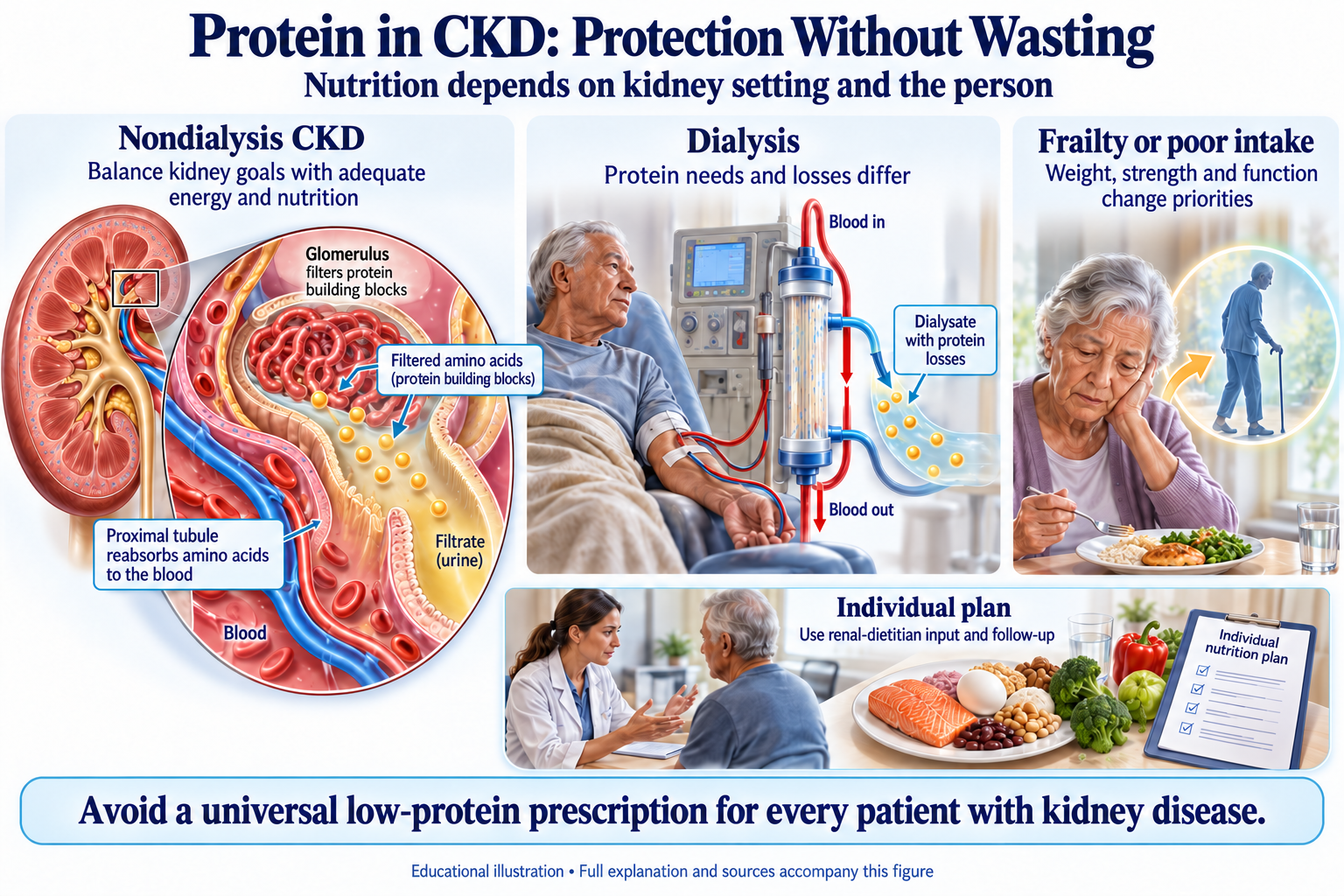
- CKD restriction flips once dialysis starts. Pre-dialysis CKD patients may benefit from moderate protein restriction (approximately 0.55–0.60 g/kg/day with ketoacid analogs, or 0.60–0.80 g/kg/day without, per the 2020 KDOQI guideline)[2]. Once a patient transitions to dialysis, the target reverses and rises to approximately 1.0–1.2 g/kg/day to offset catabolic losses. Missing this flip is one of the most common nutritional errors in renal care.
- Total daily grams is not the whole story — distribution and quality matter. Older adults have anabolic resistance; they need a bigger per-meal dose than younger adults to trigger muscle protein synthesis.
The PT's three jobs on protein
- Know the target for the patient in front of you — older adult, athlete, rehab, CKD, dialysis, post-op are all different.
- Teach per-meal distribution — 3–4 meals/day, ≥0.4 g/kg per meal in older adults, with enough leucine (roughly 25–40 g total protein per meal from a complete source) to cross the anabolic threshold.
- Flag the CKD → ESRD transition — a patient whose restriction has not been updated on starting dialysis is at risk of protein-energy wasting.
2. What Protein Actually Does (Minimal)
The Biology in One Paragraph
Dietary protein is broken down to amino acids, which the body uses for structural tissue (muscle, bone matrix, enzymes), immune molecules, hormones, and — when needed — energy. Muscle protein synthesis is regulated; it does not happen continuously. It is triggered by feeding (the "protein meal") and by resistance-loading (the "exercise stimulus"). The two triggers combine multiplicatively: a protein meal after resistance training produces more muscle protein synthesis than either alone. The amino acid that most directly signals synthesis is leucine. Each meal needs enough leucine to cross a threshold, or the meal does not produce a meaningful anabolic signal. That threshold rises with age.
The Per-Meal Rule — Why Distribution Matters
A large body of stable-isotope work shows that muscle protein synthesis rises, plateaus, then falls with single-meal protein dose. In young adults, the plateau is reached around 0.24 g protein per kg body weight per meal. In older adults, the plateau is higher — approximately 0.40 g/kg per meal — reflecting anabolic resistance with aging[3].
Practical translation for a 70-kg adult:
| Population | Per-meal target | Meals/day | Daily total (approx) |
|---|---|---|---|
| Young adult | approximately 0.24 g/kg = approximately 17 g | 3–4 | 0.8–1.0 g/kg (baseline RDA) |
| Older adult | approximately 0.40 g/kg = approximately 28 g | 3–4 | 1.2–1.6 g/kg |
| Strength-training athlete | 0.4–0.55 g/kg = approximately 28–40 g | 3–5 | 1.6–2.2 g/kg |
Translation: "I eat enough protein" is not the right question. The right questions are "How much per meal?" and "How many meals?"
Quality and Sources — What to Prioritize
- Complete proteins (animal sources — meat, poultry, fish, eggs, dairy; soy among plant sources) contain all essential amino acids in adequate ratios.
- Leucine density matters most. Whey protein delivers the most leucine per gram; beef, chicken, eggs, dairy, and soy are strong. Most other plant sources require larger total protein intake or strategic combinations to hit the leucine threshold.
- Whole-food vs supplement: whole food is the default. Protein powder is a tool when meals are disrupted (GLP-1 RA patients with GI symptoms, athletes with high targets, rehab patients with small appetites).
- Animal vs plant for CKD: plant protein is often preferred in CKD because it produces less acid and less phosphorus load. Total grams and sources both matter — not just grams.
3. What You Will See in Clinic — Targets by Population
The Master Target Table
| Population | Daily target (g/kg/day) | PT emphasis |
|---|---|---|
| Healthy adult, sedentary (RDA baseline) | 0.8 | Minimum to avoid deficiency; NOT optimal for most PT patients. |
| Healthy older adult | 1.0–1.2[1] | Anabolic resistance — need more per meal AND more per day. |
| Older adult with acute/chronic disease | 1.2–1.5[1] | Recovery, sarcopenia, frailty — highest-value PT population. |
| General exercise / endurance athlete | 1.2–1.4 | Slightly elevated to support repair; total calories matter as much. |
| Strength / power athlete | 1.6–2.2[4] | Per-meal distribution across 3–5 meals matters. |
| Post-op / trauma / critical illness (under supervision) | 1.2–1.5+ | Catabolic state; coordinate with surgical team + dietitian. |
| Weight loss while active (GLP-1 RA, bariatric, athletic cut) | 1.2–1.6 | Protect lean mass during calorie deficit. Pair with resistance training. |
| CKD stages 3–5, NOT on dialysis (select patients) | 0.55–0.60 with keto-analogs, or 0.60–0.80 without[2] | Under nephrology + dietitian supervision only. Do NOT improvise. |
| Dialysis (HD and PD) — the reversal | 1.0–1.2+ (PD often 1.2–1.3)[2] | Higher than pre-dialysis. Protein-energy wasting is a major mortality driver. |
| Kidney transplant recipient (stable) | 0.8–1.0 maintenance; higher peri-transplant | Coordinate with transplant team. |
The CKD → ESRD Reversal — the Teaching Point
⚠️ The classic confusion: pre-dialysis restrict, on dialysis MORE
Many CKD patients — and many clinicians — internalize "kidney disease = low protein" and carry that rule onto dialysis. It is wrong. On dialysis, protein needs rise because:
- Dialysis itself removes amino acids and peptides (approximately 6–12 g per HD session).
- Dialysis triggers catabolism through inflammation and bioincompatibility.
- Protein-energy wasting (PEW) is one of the strongest predictors of mortality in dialysis.
The PT's role: when a patient transitions from advanced CKD onto dialysis, flag the protein rule has changed. Ask them what their dialysis team has told them. If they still think "no protein," route to the renal dietitian.
Other Scenarios You Will See
- Older adult on GLP-1 RA with small appetite. The risk is under-eating protein during the GI-heavy early titration. Protein-first eating, small frequent meals, and a whey shake on bad days preserve lean mass. See the GLP-1 PT handout.
- Athletic college student spending on powders. Most can meet their target with whole food plus a simple whey shake. Proprietary formulations are rarely cost-justified.
- Post-op knee or hip replacement. Protein + resistance training dominates recovery; under-eating in the first 2–4 weeks accelerates strength loss. Coordinate with the surgical team.
- Frail older adult on diuretic + low appetite. At-risk for sarcopenic hypovolemia. Protein + fluid balance + resistance training — see the Hydration PT handout.
- Patient worried about "damage to kidneys" from protein. In patients with normal kidney function, higher protein intake within ranges studied (up to approximately 2.2 g/kg/day) has not been shown to harm the kidney.
4. What to Do — The PT Decision Algorithm
Decision Algorithm
Patient arrives to PT — is protein intake appropriate?
        ↓
Step 1 — Do they have CKD or ESRD (on dialysis)?
        ├── CKD stage 3–5 NOT on dialysis → defer to nephrology + renal
        │     dietitian. Do NOT set a protein target independently.
        │
        ├── On dialysis (HD or PD) → target 1.0–1.2+ g/kg/day.
        │     Flag if they still think "low protein" from pre-dialysis era.
        │
        └── Normal / preserved kidney function → continue below.
        ↓
Step 2 — Age, activity, and disease status?
        ├── Younger, sedentary, healthy → 0.8–1.0 g/kg/day is often fine
        │     baseline, but rehab context pushes higher.
        ├── Older, healthy → 1.0–1.2 g/kg/day.
        ├── Older + acute/chronic disease OR in rehab → 1.2–1.5 g/kg/day.
        ├── Strength/power athlete → 1.6–2.2 g/kg/day.
        └── Weight-losing active adult (GLP-1, athletic cut, bariatric)
            → 1.2–1.6 g/kg/day + resistance training + sometimes creatine.
        ↓
Step 3 — Per-meal distribution?
        Hit ≥0.4 g/kg per meal in older adults (approximately 25–40 g
        complete protein). 3–4 meals/day. Do not "back-load" the entire
        day's protein into dinner.
        ↓
Step 4 — Source quality?
        Prioritize complete proteins + leucine density. Supplement with
        whey only when meals are inadequate. In CKD, favor plant-forward
        sources (lower acid + phosphorus load) per renal dietitian.
4b. The Sarcopenia Toolkit — Protein + Resistance Training (+ Creatine)
The European Working Group on Sarcopenia in Older People 2 (EWGSOP2) consensus defines sarcopenia by low muscle strength, reduced muscle quantity/quality, and reduced physical performance[5]. The evidence-based intervention combination:
- Resistance training — 2–3 sessions/week, progressive load, all major muscle groups. Non-negotiable.
- Protein — 1.2–1.5 g/kg/day in older adults with acute/chronic disease[1], ≥0.4 g/kg per meal, 3–4 meals/day[3].
- Creatine monohydrate — 3–5 g/day, especially in older adults in a structured resistance-training program. Pairs with protein for lean-mass and strength gain. See Creatine PT handout.
- Adequate total calories. Protein does not build muscle in a prolonged calorie deficit without resistance training protection.
- Vitamin D sufficiency and treatment of underlying inflammation / catabolic conditions.
4c. Practical Eating Plan — How to Hit the Numbers
| Meal | Example (70-kg older adult, target 1.2 g/kg = approximately 85 g/day, approximately 28 g/meal × 3) |
|---|---|
| Breakfast | 3 large eggs (18 g) + 1 cup Greek yogurt (15 g) = 33 g |
| Lunch | 4 oz chicken breast (30 g) + side salad with beans (7 g) = 37 g |
| Dinner | 5 oz salmon (35 g) + 1/2 cup lentils (9 g) = 44 g |
| Total | approximately 114 g/day (1.6 g/kg/day) — exceeds minimum, easily covers per-meal threshold |
When meals are disrupted (GLP-1 nausea, post-op small appetite, athletic cut): one 25–30 g whey shake replaces a meal. Keep it in the kitchen. Treat it as insurance, not as the plan.
4d. Patients Where "Eat More Protein" Is Not Automatic
- CKD stage 3–5 not on dialysis — target is LOWER, not higher. Defer to nephrology + renal dietitian.
- Inborn errors of metabolism (PKU, urea cycle disorders) — always specialist-directed.
- Active hepatic encephalopathy — protein intake may be temporarily adjusted; coordinate with hepatology.
- Patients with severe nausea or vomiting — fix the underlying issue before pushing protein.
5. What to Teach the Patient
Scripts You Can Use Today
The "RDA is the floor, not the goal" script for older adults
"The 0.8 grams per kilogram recommendation you may have seen is the minimum to avoid deficiency in a healthy 25-year-old. It's not what we aim for in rehab. For someone your age, aiming for about 1.2 to 1.5 grams per kilogram per day — that's roughly 80 to 105 grams for a 70-kilo adult — and spreading it across three meals is what actually protects muscle and helps you recover."
The "three plates of protein" script
"Think of it as three plates. Breakfast, lunch, dinner — each one gets a palm-sized portion of a protein source. Eggs, Greek yogurt, chicken, fish, beans, tofu, cottage cheese, lean beef. If a meal doesn't have a protein on it, it's not doing its job. Three plates beats one big dinner — your body can only use so much protein at one time."
The "you're on dialysis now" script
"Before you started dialysis, your doctor probably had you on a lower-protein diet to protect your kidneys. That rule changes now. Dialysis pulls protein out of your body every session, and people on dialysis who don't eat enough protein do worse. Your target is actually higher than most people's. Your renal dietitian has specific numbers for you — let's make sure you're following their current recommendation, not the one from before."
The "whey is a tool, not a magic shake" script for athletes
"Protein powder is useful when you can't get a real meal in. It's not better than whole food. A rotisserie chicken, a can of tuna, Greek yogurt, eggs, and cottage cheese all deliver the same amino acids the shake does — usually cheaper. Use the shake when meals get interrupted; rely on food the rest of the time."
The "GLP-1 eating plan" script
"Because the medication kills your appetite, it's easy to end up short on protein. Three moves help. Eat the protein on your plate first, before anything else. Aim for about 25 to 40 grams at each meal — that's a palm-sized piece of meat or fish, or a cup of Greek yogurt plus an egg. And keep a whey shake in the house for bad GI days — don't skip the protein."
The "resistance training needs protein" script
"Lifting builds muscle only if you give your body the raw material. The workouts we do together stimulate the signal; the protein you eat provides the bricks. Skip the protein and the workouts produce less than half the benefit. Sleep also matters — but protein is the one you control at every meal."
When to Call — Patient Action List
- Unintentional weight loss >2 lb per week for more than two weeks.
- Inability to tolerate food for more than 24–48 hours.
- Progressive weakness despite training.
- New edema, rapid weight gain, or confusion (volume shift red flags).
- Labs showing rising BUN disproportionate to creatinine change without clear cause.
- CKD or dialysis patient uncertain about current protein target.
6. Quick-Reference Card (One Page, Printable)
Protein & PT — At a Glance
DAILY TARGETS (g/kg/day):
- Healthy young sedentary adult: 0.8 (RDA floor)
- Healthy older adult: 1.0–1.2 [PROT-AGE]
- Older adult + acute/chronic disease / rehab: 1.2–1.5 [PROT-AGE]
- Strength/power athlete: 1.6–2.2 [ISSN 2017]
- Weight loss while active (GLP-1, cut): 1.2–1.6
- CKD 3–5 NOT on dialysis: 0.55–0.80 (specialist-set) [KDOQI 2020]
- Dialysis (HD/PD): 1.0–1.2+ — THE REVERSAL [KDOQI 2020]
PER-MEAL RULE: older adults need approximately 0.4 g/kg per meal (approximately 25–40 g complete protein) across 3–4 meals to overcome anabolic resistance [Moore 2015].
THE SARCOPENIA TOOLKIT: resistance training (2–3×/week) + protein (1.2–1.5 g/kg/day, distributed) + creatine monohydrate (3–5 g/day) + adequate calories + vitamin D sufficiency. EWGSOP2 defines sarcopenia by low strength, quantity/quality, performance [Cruz-Jentoft 2019].
THE CKD → ESRD REVERSAL (critical teaching point):
- Pre-dialysis CKD: restrict (0.55–0.80 g/kg/day)
- On dialysis: INCREASE (1.0–1.2+ g/kg/day)
- Patients often carry the pre-dialysis rule into dialysis; flag this, route to renal dietitian.
QUALITY: complete proteins + leucine density. Animal sources + soy are complete. Whey is highest leucine per gram. Plant-forward diets in CKD for lower acid + phosphorus load.
RED FLAGS — ESCALATE: unintentional weight loss >2 lb/wk · inability to eat >24–48 hr · progressive weakness despite training · new edema/confusion · BUN out of proportion to creatinine · CKD/dialysis patient unclear on current target.
CROSS-LINKS: Creatine (toolkit partner) · GLP-1 RAs (protein during weight loss) · Hydration (fluid + protein balance in CKD/dialysis).
References
- Bauer J, Biolo G, Cederholm T, Cesari M, Cruz-Jentoft AJ, Morley JE, Phillips S, Sieber C, Stehle P, Teta D, Visvanathan R, Volpi E, Boirie Y. Evidence-based recommendations for optimal dietary protein intake in older people: a position paper from the PROT-AGE Study Group. J Am Med Dir Assoc 2013;14(8):542–59. PMID: 23867520. PubMed
- Ikizler TA, Burrowes JD, Byham-Gray LD, Campbell KL, Carrero JJ, Chan W, Fouque D, Friedman AN, Ghaddar S, Goldstein-Fuchs DJ, Kaysen GA, Kopple JD, Teta D, Yee-Moon Wang A, Cuppari L. KDOQI Clinical Practice Guideline for Nutrition in CKD: 2020 Update. Am J Kidney Dis 2020;76(3 Suppl 1):S1–S107. PMID: 32829751. PubMed
- Moore DR, Churchward-Venne TA, Witard O, Breen L, Burd NA, Tipton KD, Phillips SM. Protein ingestion to stimulate myofibrillar protein synthesis requires greater relative protein intakes in healthy older versus younger men. J Gerontol A Biol Sci Med Sci 2015;70(1):57–62. PMID: 25056502. PubMed
- Jäger R, Kerksick CM, Campbell BI, Cribb PJ, Wells SD, Skwiat TM, Purpura M, Ziegenfuss TN, Ferrando AA, Arent SM, Smith-Ryan AE, Stout JR, Arciero PJ, Ormsbee MJ, Taylor LW, Wilborn CD, Kalman DS, Kreider RB, Willoughby DS, Hoffman JR, Krzykowski JL, Antonio J. International Society of Sports Nutrition Position Stand: protein and exercise. J Int Soc Sports Nutr 2017;14:20. PMID: 28642676. PubMed
- Cruz-Jentoft AJ, Bahat G, Bauer J, Boirie Y, Bruyère O, Cederholm T, Cooper C, Landi F, Rolland Y, Sayer AA, Schneider SM, Sieber CC, Topinkova E, Vandewoude M, Visser M, Zamboni M; Writing Group for the European Working Group on Sarcopenia in Older People 2 (EWGSOP2). Sarcopenia: revised European consensus on definition and diagnosis. Age Ageing 2019;48(1):16–31. PMID: 30312372. PubMed
- Chilibeck PD, Kaviani M, Candow DG, Zello GA. Effect of creatine supplementation during resistance training on lean tissue mass and muscular strength in older adults: a meta-analysis. Open Access J Sports Med 2017;8:213–226. PMID: 29138605. PubMed — cross-cited from Module 4 for the sarcopenia toolkit pairing.