⭕ Isomorphic RBCs
Uniform biconcave discs
Stones, tumors, cystitis, BPH, trauma
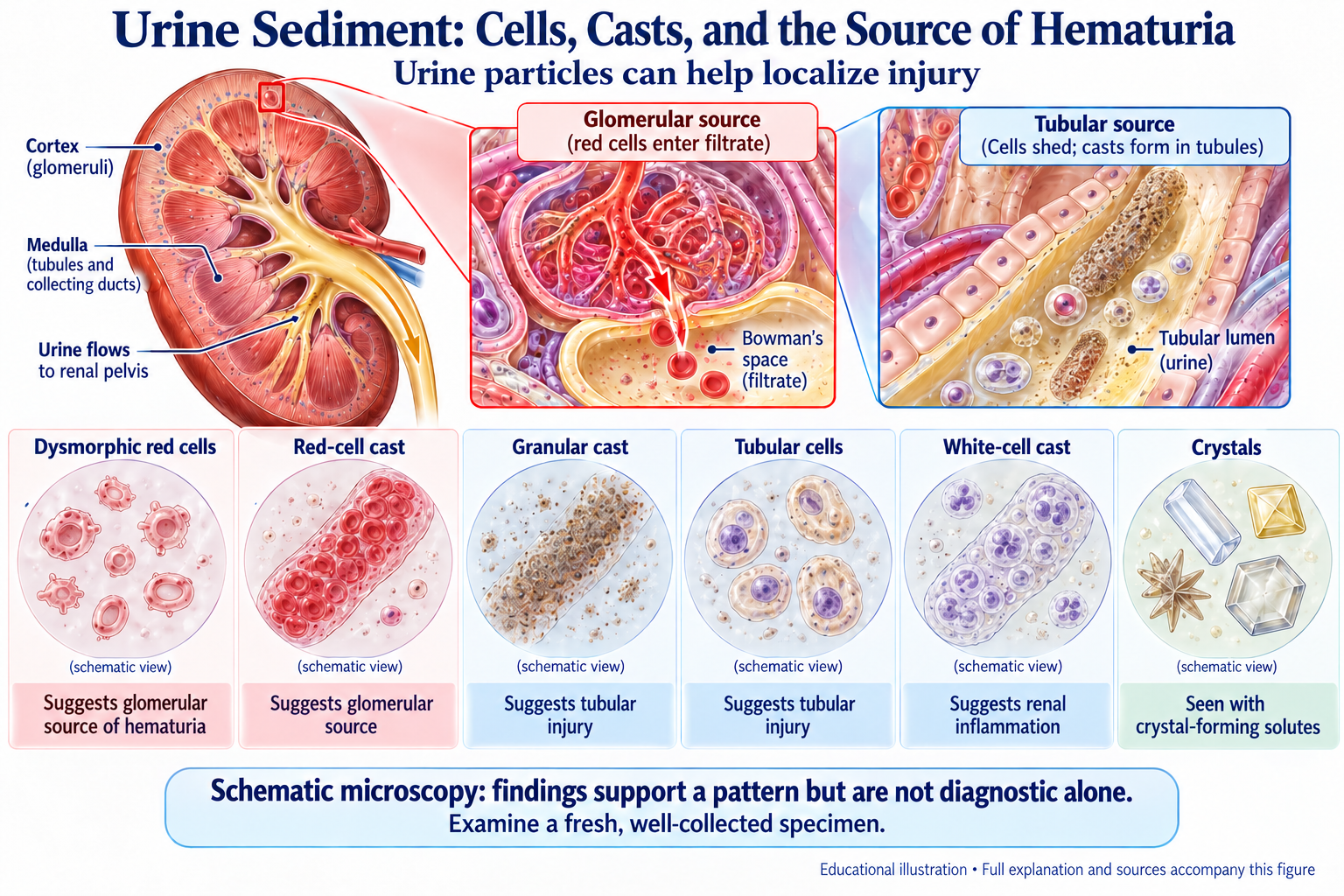
🔴 Dysmorphic RBCs
Misshapen from glomerular passage
Glomerulonephritis—acanthocytes most specific
📊 Diagnostic Thresholds
Dysmorphic RBCs
Suggests glomerular
Acanthocytes
Highly specific for GN (Kohler 1991)
Dysmorphic
Strong GN indicator
🚨 RBC Casts: A Strong Diagnostic Clue
RBC casts strongly support a glomerular source of bleeding in the appropriate setting. They contain red cells trapped in a uromodulin (Tamm–Horsfall protein) matrix. They do not identify the immune cause, and their absence does not exclude glomerulonephritis.
Often sparse—scan multiple fields. Ensure fresh sediment and proper centrifugation.
⚡ Clinical Pearl
RBC casts + AKI = Nephrology Emergency
Consider RPGN and initiate urgent workup including complements, ANCA, and anti-GBM.
🔗 Clinical Integration
| Proteinuria Present | Strengthens glomerular pattern diagnosis |
| Clots/Terminal Stream | Favor urologic source—consider imaging + urology |
| Smoker >35 + Hematuria | Prioritize malignancy exclusion |
⚠️ Common Pitfalls
📋 Referral Guidance
→ Nephrology
Glomerular pattern: Dysmorphic RBCs, RBC casts ± proteinuria
→ Urology
Isomorphic RBCs with risk factors (age >35, smoking, gross hematuria)
→ Both
Mixed patterns or persistent hematuria—coordinated approach
📚 Sources
- Köhler H, Wandel E, Brunck B. Acanthocyturia — a characteristic marker for glomerular bleeding. Kidney Int. 1991;40(1):115-120. PMID: 1921146. — Foundational paper for acanthocyte specificity in glomerular hematuria; supports the >5% acanthocyte threshold.
- Fairley KF, Birch DF. Hematuria: a simple method for identifying glomerular bleeding. Kidney Int. 1982;21(1):105-108. PMID: 7077941. — Original phase-contrast paper for dysmorphic RBC differentiation.
- Muriithi AK, Nasr SH, Leung N. Utility of urine eosinophils in the diagnosis of acute interstitial nephritis. Clin J Am Soc Nephrol. 2013;8(11):1857-1862. PMID: 24052222. — Adjacent reference for urine sediment evaluation; sensitivity 30.8%, specificity 68.2% for AIN.