Visual summary
Locate the blockage, explain the initial chemistry, then anticipate how the physiology changes after drainage.
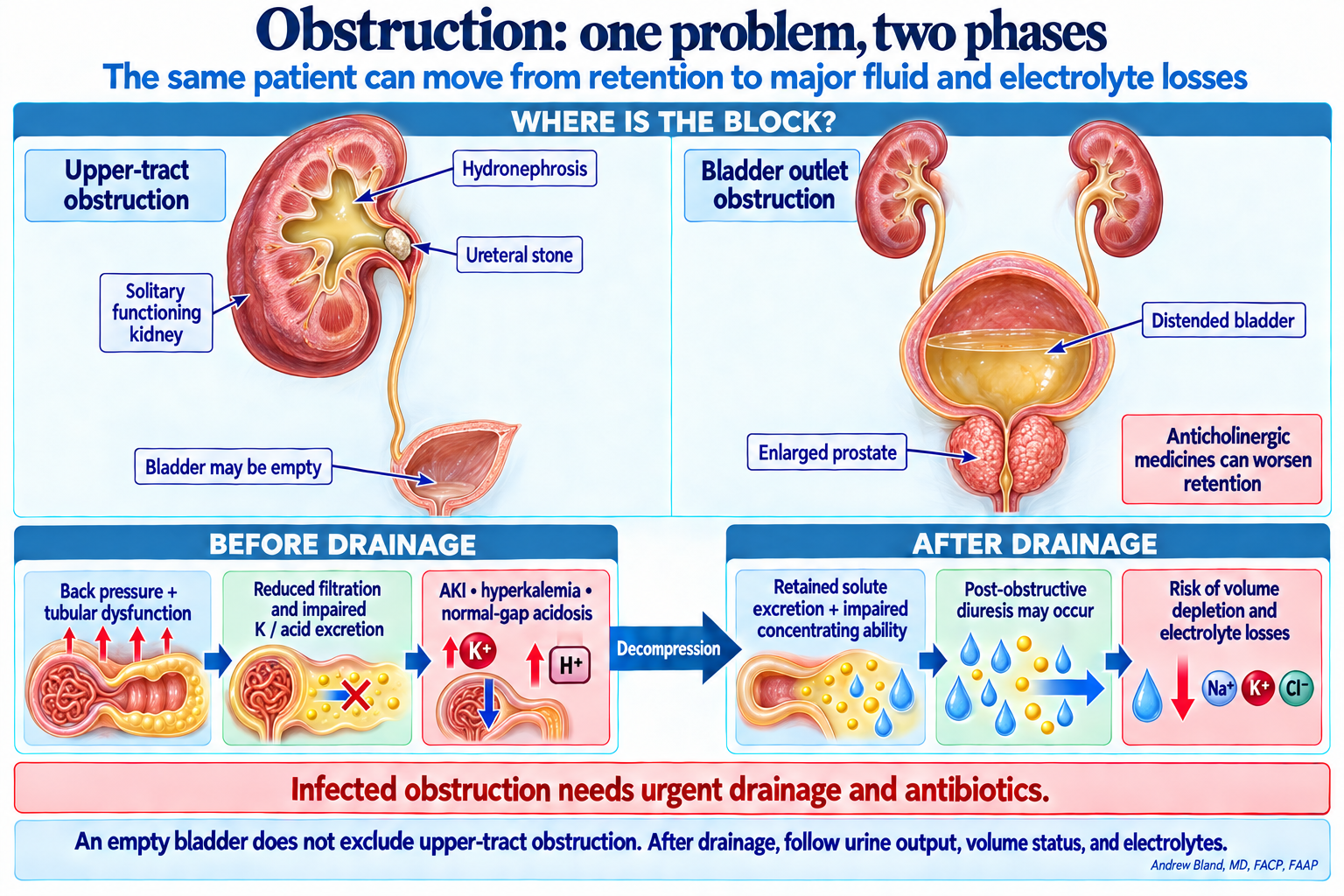
Locate the blockage, explain the initial chemistry, then anticipate how the physiology changes after drainage.
Text version
The bladder answers only one question
A full bladder supports retention at or below the outlet. An empty bladder does not exclude an upstream obstruction. In a solitary functioning kidney, obstruction of that ureter can compromise total filtration. Imaging and the clinical context determine the level and urgency.
Before decompression
Back pressure and tubular dysfunction reduce filtration and impair potassium and acid excretion. AKI, hyperkalemia, and normal-gap acidosis can therefore occur together. An infected obstructed collecting system requires urgent drainage and antibiotics; correcting the potassium does not remove the obstruction.
After decompression
Excretion of retained solute and impaired concentrating ability may produce post-obstructive diuresis. Substantial losses can cause volume depletion and electrolyte disturbances. Reassess urine output, circulation, weight, and serial chemistry; fluid replacement is individualized rather than a fixed rule for every patient.
Why can the treatment priorities reverse after the obstruction is relieved?
Before drainage, the kidney may retain potassium, acid, salt, and water. After drainage, excretion of retained solute plus incomplete recovery of tubular concentration can produce major water and electrolyte losses. Reassessment follows the phase of the illness.