Visual summary
Compare thiazide-associated hyponatremia, postoperative antidiuresis, and lithium-associated ADH resistance.
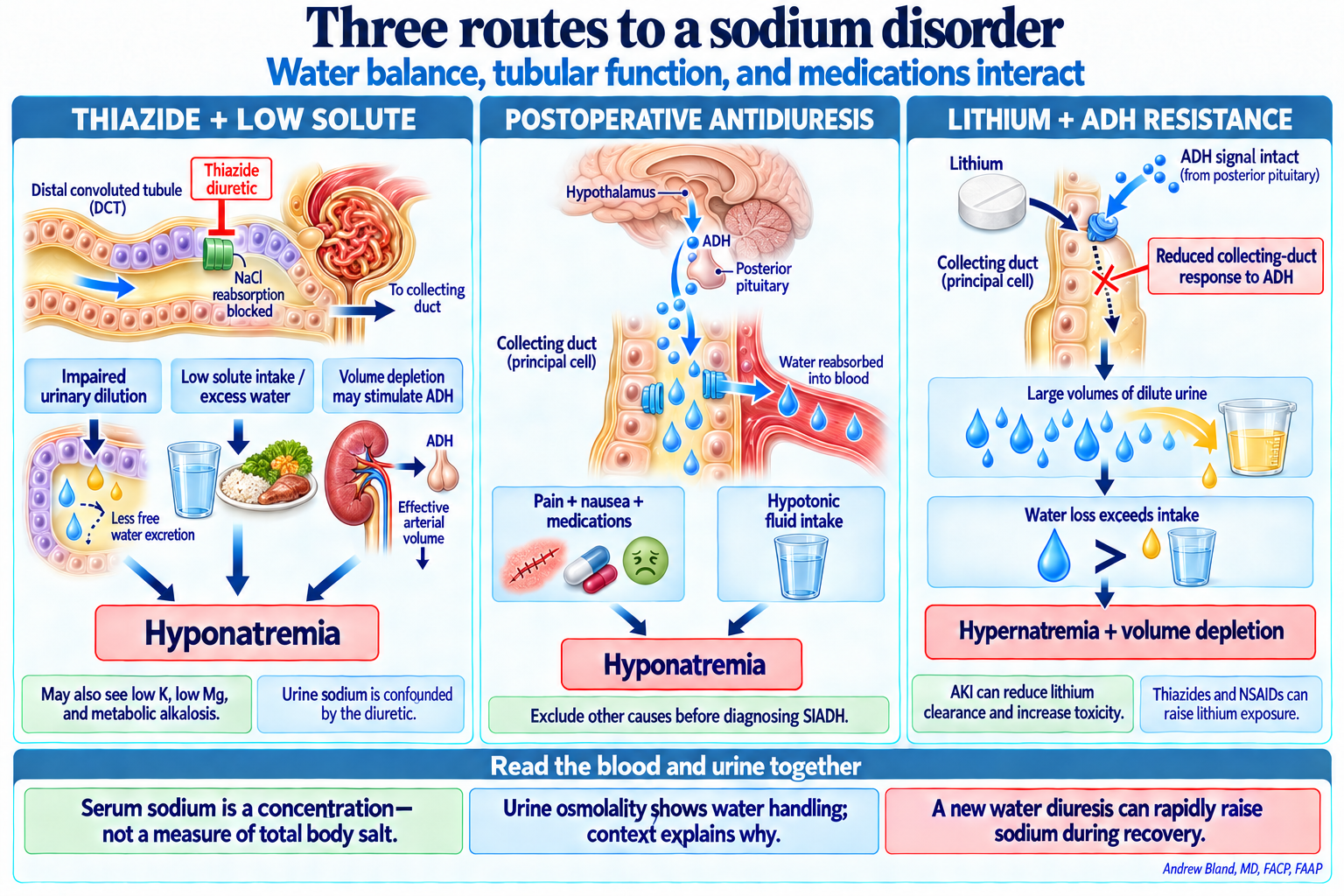
Compare thiazide-associated hyponatremia, postoperative antidiuresis, and lithium-associated ADH resistance.
Text version
Thiazide plus low solute
Reduced urinary dilution, low dietary solute, excess water intake, and sometimes volume-driven ADH activity can combine. Potassium and magnesium depletion and metabolic alkalosis may coexist. Urine sodium is difficult to interpret during a diuretic effect; it does not independently diagnose SIADH.
Postoperative antidiuresis
Pain, nausea, and medications can maintain antidiuresis. Adding hypotonic fluid can then lower sodium. Exclude other causes before labeling SIADH. Once the stimulus resolves, a water diuresis can make sodium rise unexpectedly quickly; serial sodium and urine-output assessment are essential.
Lithium and renal ADH resistance
With impaired collecting-duct response to ADH, the kidney may produce large amounts of dilute urine. Hypernatremia appears when water loss exceeds intake. Volume depletion and AKI can reduce lithium clearance, while interacting drugs can further raise exposure. This creates a cycle linking polyuria, dehydration, impaired filtration, and toxicity.
Why does a high urine sodium not settle the diagnosis in the patient taking a thiazide?
The drug itself changes renal sodium handling. Interpret urine osmolality and electrolytes with volume status, dietary intake, medication timing, and the clinical course. Concentrated urine indicates impaired water excretion but does not identify one unique cause.