Visual summary
Kidneys maintain the internal environment through eight linked functions. Filtration is one part of this work; urine is the route through which many adjustments are made.
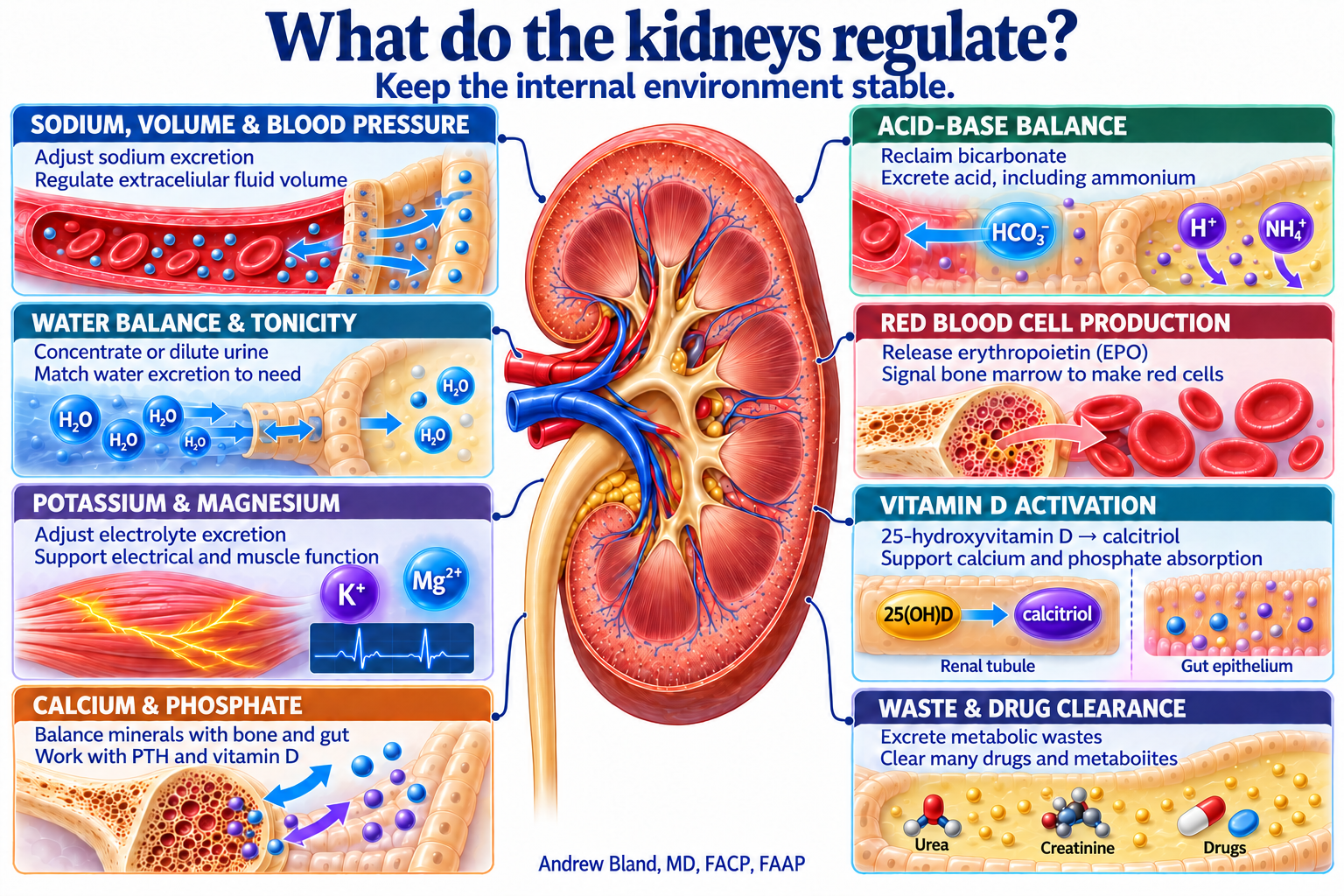
Illustration updated October 19, 2026. Educational schematic. Full teaching text and sources follow.
Diagram description
Eight panels surround the kidneys: sodium and extracellular volume; water and tonicity; potassium and magnesium; calcium and phosphate; acid–base balance; erythropoietin and red-cell production; vitamin D activation; and waste and drug clearance.
Text version
Sodium, extracellular volume, and blood pressure
Regulation of total-body sodium helps determine extracellular fluid volume. RAAS promotes sodium retention when effective circulation is low; natriuretic peptides provide a counter-signal.
Water and tonicity
ADH changes collecting-duct water permeability, helping match water excretion to need. Serum sodium mainly reflects water relative to sodium and potassium; it is not a direct measure of extracellular volume.
Electrolytes and acid–base balance
The kidneys regulate potassium and magnesium, calcium and phosphate, and acid–base balance. They reclaim filtered bicarbonate and generate new bicarbonate while excreting net acid.
Endocrine functions
Renal erythropoietin supports red-cell production, and renal activation of vitamin D supports calcium and phosphate homeostasis. These functions can be impaired even when urine output persists.
Waste and drug clearance
Filtration, secretion, and reabsorption determine the excretion of metabolic wastes and many drugs or metabolites. Creatinine is a useful filtration marker but does not measure every renal function.
Connect the measurements
Use creatinine/eGFR to discuss filtration, urine albumin to discuss injury and risk, and electrolytes, acid–base status, volume, and endocrine effects to understand the broader picture.