Visual summary
Enhancement, tissue when useful, competing risk, and renal reserve determine the plan; size alone does not establish histology or mandate surgery.
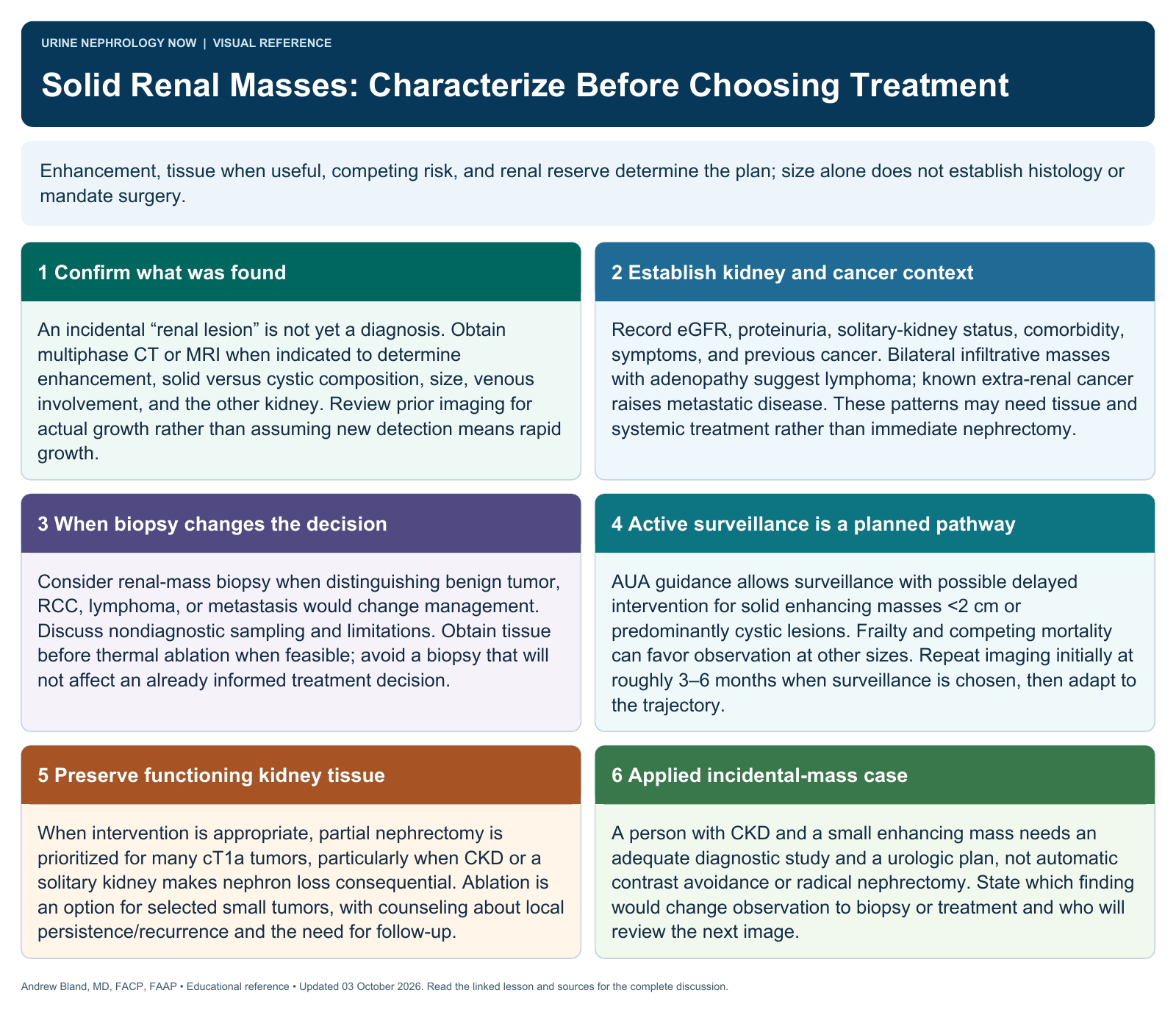
Text version
Confirm what was found
An incidental “renal lesion” is not yet a diagnosis. Obtain multiphase CT or MRI when indicated to determine enhancement, solid versus cystic composition, size, venous involvement, and the other kidney. Review prior imaging for actual growth rather than assuming new detection means rapid growth.
Establish kidney and cancer context
Record eGFR, proteinuria, solitary-kidney status, comorbidity, symptoms, and previous cancer. Bilateral infiltrative masses with adenopathy suggest lymphoma; known extra-renal cancer raises metastatic disease. These patterns may need tissue and systemic treatment rather than immediate nephrectomy.
When biopsy changes the decision
Consider renal-mass biopsy when distinguishing benign tumor, RCC, lymphoma, or metastasis would change management. Discuss nondiagnostic sampling and limitations. Obtain tissue before thermal ablation when feasible; avoid a biopsy that will not affect an already informed treatment decision.
Active surveillance is a planned pathway
AUA guidance allows surveillance with possible delayed intervention for solid enhancing masses <2 cm or predominantly cystic lesions. Frailty and competing mortality can favor observation at other sizes. Repeat imaging initially at roughly 3–6 months when surveillance is chosen, then adapt to the trajectory.
Preserve functioning kidney tissue
When intervention is appropriate, partial nephrectomy is prioritized for many cT1a tumors, particularly when CKD or a solitary kidney makes nephron loss consequential. Ablation is an option for selected small tumors, with counseling about local persistence/recurrence and the need for follow-up.
Applied incidental-mass case
A person with CKD and a small enhancing mass needs an adequate diagnostic study and a urologic plan, not automatic contrast avoidance or radical nephrectomy. State which finding would change observation to biopsy or treatment and who will review the next image.