Pre-Case Assessment: Test Your Baseline Knowledge
Answer these questions before reviewing the case to assess your starting knowledge
According to 2024 guidelines, which terminology BEST reflects current understanding of post-contrast renal dysfunction?
Learning Point: The paradigm shift from CIN to CAN reflects improved understanding that post-procedural renal dysfunction is multifactorial, not solely due to contrast exposure.
📚 Reference: Contrast Terminology Evolution
A Bosniak II cystic lesion is characterized by which features and requires what management?
Learning Point: Bosniak II lesions are minimally complex cysts with <1% malignancy risk, requiring no routine follow-up imaging.
📚 Reference: Bosniak Classification 2019
Which Group II gadolinium-based contrast agent can be safely used in patients with eGFR <30 mL/min/1.73m²?
Learning Point: Group II agents (ProHance, Dotarem, Gadavist) have no unconfounded NSF cases in >4,900 administrations to eGFR <30 patients and are considered safe when clinically indicated.
📚 Reference: GBCA Safety Guidelines
Case Presentation
Patient: 68-year-old woman
Chief Complaint: Incidental renal masses found on CT scan for abdominal pain
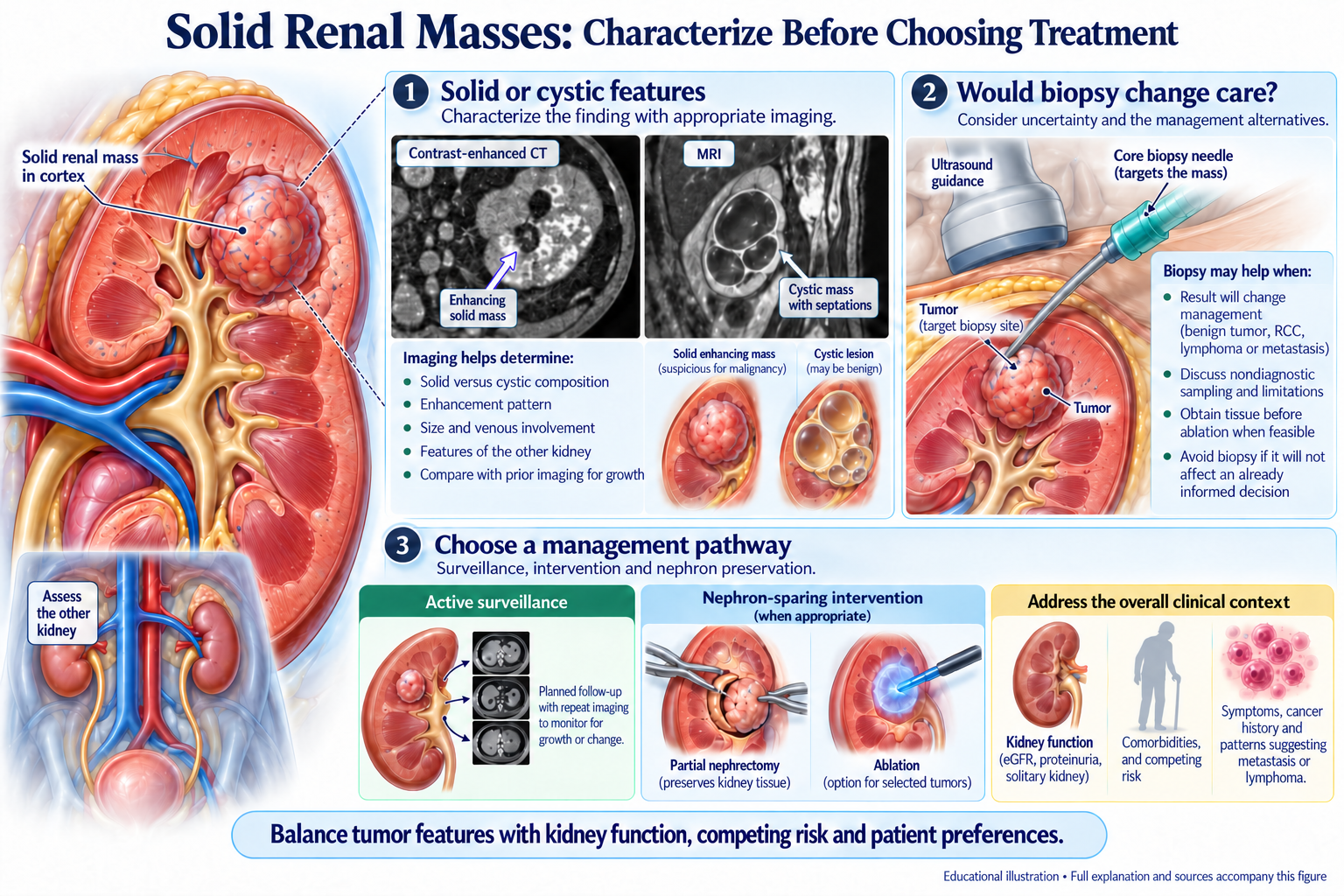
History: Recent CT scan for persistent right upper quadrant pain revealed incidental bilateral renal lesions. CT showed a 5.1 cm heterogeneous solid mass in the right kidney and a 2.8 cm cystic lesion with thin septations in the left kidney.
Past Medical History: Hypertension, type 2 diabetes mellitus (15 years), stage 3b CKD
Current Medications: Lisinopril 20mg daily, metformin 1000mg BID, amlodipine 10mg daily
Allergies: Shellfish (hives), no known contrast allergy history
🤔 Initial Clinical Reasoning Questions
What is your PRIMARY concern regarding the 5.1 cm right renal mass?
Clinical Reasoning: A 5.1 cm heterogeneous solid renal mass in a 68-year-old has high probability of malignancy and requires enhanced imaging for characterization and staging.
📚 Learn More: Renal Cell Carcinoma Evaluation
The 2.8 cm left cystic lesion with thin septations most likely represents which Bosniak category?
Learning Point: Thin septations characterize Bosniak II lesions with <1% malignancy risk and no required follow-up.
📚 Reference: Bosniak Classification
Laboratory Data & Contrast Risk Assessment
Current Laboratory Values
| Parameter | Value | Normal Range | Clinical Significance |
|---|---|---|---|
| Serum Creatinine | 1.9 mg/dL | 0.6-1.2 mg/dL | Stage 3b CKD |
| eGFR | 28 mL/min/1.73m² | >60 mL/min/1.73m² | Significantly reduced kidney function |
| BUN | 45 mg/dL | 8-20 mg/dL | Proportional to creatinine elevation |
| Hemoglobin A1c | 8.2% | <7.0% | Suboptimal diabetes control |
| Proteinuria | 300 mg/g | <30 mg/g | Moderate proteinuria |
⚠️ Contrast Risk Assessment
What is this patient's estimated risk for contrast-associated nephropathy with iodinated contrast?
Risk Factors: eGFR 28, diabetes, age 68, moderate proteinuria. Multiple risk factors indicate high CAN risk requiring enhanced prevention strategies.
📚 Reference: Contrast Risk Calculator
Which imaging approach is MOST appropriate for characterizing the right renal mass in this patient?
Rationale: MRI with Group II GBCA (ProHance, Dotarem, Gadavist) provides excellent soft tissue characterization with significantly lower nephrotoxicity risk in CKD patients.
📚 Reference: MRI in CKD Patients
Evidence-Based Imaging Protocol Selection
🎯 Imaging Decision Framework
Contrast-Enhanced CT
- ✓ Excellent spatial resolution
- ✓ Standard of care for RCC
- ❌ High CAN risk with eGFR 28
- ❌ Requires extensive hydration
MRI with Group II GBCA
- ✓ Superior soft tissue contrast
- ✓ Safe in eGFR <30 with Group II
- ✓ No ionizing radiation
- ❌ Longer acquisition time
Non-Contrast Imaging
- ✓ No contrast nephrotoxicity
- ✓ Widely available
- ❌ Cannot assess enhancement
- ❌ Limited tissue characterization
📋 Protocol Selection Questions
If MRI with Group II GBCA is selected, which agent would be MOST appropriate?
Learning Point: Group II agents (ProHance, Dotarem, Gadavist) have the lowest NSF risk and are safe in advanced CKD when clinically indicated.
📚 Learn More: GBCA Safety in CKD
What enhancement threshold indicates a solid renal mass rather than complex cyst?
Learning Point: Enhancement >20 HU is considered significant and indicates a solid mass requiring further evaluation. <30 HU rule applies to Bosniak classification.
📚 Learn More: Renal Mass Enhancement Criteria
MRI Results and Interpretation
🔍 MRI with Gadoteridol (ProHance) Findings
Right Kidney Mass (5.1 cm)
- T1-weighted: Heterogeneous signal intensity
- T2-weighted: Intermediate signal with areas of low signal
- Post-contrast: Avid enhancement (>30% signal increase)
- Character: Solid, enhancing mass suspicious for RCC
- Staging: No local extension, no lymphadenopathy
Left Kidney Cyst (2.8 cm)
- T1-weighted: Hypointense (fluid signal)
- T2-weighted: Hyperintense (simple fluid)
- Post-contrast: No enhancement
- Septations: Thin, non-enhancing
- Classification: Bosniak II - benign
📊 Imaging Interpretation Questions
Based on MRI findings, what is the most likely diagnosis for the right renal mass?
Learning Point: A 5.1 cm avidly enhancing solid renal mass has very high probability of malignancy and requires urgent urologic consultation for treatment planning.
📚 Learn More: RCC Treatment Planning
What follow-up is indicated for the left Bosniak II cystic lesion?
Learning Point: Bosniak II lesions have <1% malignancy risk and require no routine follow-up unless clinically indicated.
📚 Reference: Bosniak 2019 Guidelines
Multidisciplinary Treatment Planning
Given the patient's CKD stage 3b, what is the MOST important preoperative consideration for potential nephrectomy?
Treatment Rationale: With baseline eGFR 28, nephron preservation is critical. Partial nephrectomy or ablative techniques should be strongly considered to avoid progression to ESRD.
📚 Learn More: Nephron-Sparing Surgery in CKD
What perioperative contrast precautions should be implemented if additional CT imaging is needed?
Prevention Strategy: IV hydration (0.9% saline 1-1.5 mL/kg/hr × 6-12 hours) and minimizing contrast volume are evidence-based CAN prevention strategies.
📚 Reference: CAN Prevention Protocols
Learning Objectives Assessment
Evaluate your mastery of the key learning objectives from this case
🎯 Learning Objective 1: Safe Imaging in CKD
Objective: Apply evidence-based principles for safe imaging selection in patients with reduced kidney function.
A 72-year-old man with eGFR 25 requires imaging for a 4.2 cm renal mass. Which approach demonstrates optimal clinical decision-making?
Competency Demonstration: Selecting MRI with Group II GBCA shows understanding of nephrotoxicity profiles, current safety evidence, and optimal patient care in CKD.
📚 Master This: Full article: 🏥 Renal Imaging Modalities
🎯 Learning Objective 2: Bosniak Classification Mastery
Objective: Accurately classify cystic renal lesions and determine appropriate management based on malignancy risk.
A 3.5 cm cystic lesion has thick irregular septations with nodular enhancement. What is the classification and management?
Competency Demonstration: Thick septations with nodular enhancement indicate Bosniak III (approximately 50% malignancy risk) requiring surgical evaluation.
📚 Master This: Interactive Bosniak Calculator
🎯 Learning Objective 3: Renal Mass Risk Stratification
Objective: Assess malignancy probability and treatment urgency for solid renal masses based on size, imaging features, and patient factors.
Which factor MOST significantly increases malignancy risk for a solid renal mass?
Competency Demonstration: Size >4 cm significantly increases malignancy probability from T1a (5.4%) to T1b/T2 (15-20% metastatic rates).
📚 Master This: RCC Risk Calculator
Advanced Imaging & Mass Management
Test your understanding of contrast safety, renal mass workup, and nephroprotection
A patient with eGFR 22 mL/min needs a contrast-enhanced CT for pulmonary embolism evaluation. Which IV hydration protocol is MOST evidence-based for CAN prevention?
Learning Point: Isotonic saline (normal saline or balanced crystalloid) at 1-1.5 mL/kg/hr starting 6-12 hours before and continuing 6-12 hours after contrast exposure is the best-studied prevention strategy for CAN. The PRESERVE trial showed sodium bicarbonate was not superior to normal saline. Volume expansion increases renal blood flow, dilutes contrast in the tubules, and maintains medullary oxygenation. Oral hydration is inferior, and D5W provides free water without effective volume expansion.
📚 Reference: Contrast Safety - Prevention Protocols
What is the MOST important advantage of the updated 2019 Bosniak classification over the original 1986 system?
Learning Point: The 2019 Bosniak classification update incorporated MRI criteria (the original was CT-only), provided evidence-based malignancy percentages for each class, created clearer definitions of enhancement and septation thickness, and introduced the concept of imaging modality-specific criteria. This improved inter-observer agreement and reduced unnecessary surgeries for benign lesions, particularly in the Bosniak IIF and III categories.
📚 Reference: Bosniak 2019 Update
A patient with CKD stage 3b has a 3.5 cm enhancing solid renal mass. The urologist recommends partial nephrectomy. Why is this approach preferred over radical nephrectomy?
Learning Point: For T1a masses (<4 cm), partial nephrectomy provides equivalent oncologic outcomes to radical nephrectomy while preserving nephron mass. This is critically important in patients with pre-existing CKD, as the additional nephron loss from radical nephrectomy can accelerate progression to ESRD. Studies show a 60% reduction in risk of developing eGFR <45 with partial compared to radical nephrectomy for appropriate candidates.
📚 Reference: RCC - Nephron-Sparing Surgery
Which finding on ultrasound would MOST strongly suggest a renal angiomyolipoma rather than renal cell carcinoma?
Learning Point: Angiomyolipomas (AMLs) are the most common benign solid renal tumors. Their hallmark is macroscopic fat, which appears hyperechoic on ultrasound and demonstrates negative Hounsfield units (typically -20 to -80 HU) on non-contrast CT. This finding is nearly pathognomonic for AML and distinguishes them from RCC, which almost never contains macroscopic fat. However, fat-poor AMLs can mimic RCC and may require biopsy for definitive diagnosis.
📚 Reference: Renal Mass Module - Angiomyolipoma
What is nephrogenic systemic fibrosis (NSF), and which patients are at highest risk?
Learning Point: NSF is a debilitating fibrosing condition affecting the skin, joints, and internal organs that occurs almost exclusively in patients with severe renal impairment (eGFR <30) exposed to Group I (linear, non-ionic) gadolinium-based contrast agents. The risk is highest in dialysis patients. Group II (macrocyclic) agents like gadoteridol (ProHance) and gadobutrol (Gadavist) have essentially zero reported NSF cases due to their greater molecular stability, making them safe even in advanced CKD.
📚 Reference: Contrast Safety - Nephrogenic Systemic Fibrosis
Case Reflection & Multi-Module Integration
📷 Renal Imaging Module Integration
- CAN vs CIN terminology evolution and clinical implications
- Group II GBCA safety revolution in CKD patients
- Evidence-based modality selection for renal masses
- Risk stratification tools and prevention protocols
- Cost-effectiveness analysis in imaging decisions
🫘 Renal Masses Module Integration
- Bosniak 2019 classification precision and accuracy
- Solid mass enhancement thresholds and significance
- Active surveillance vs intervention decision-making
- Nephron-sparing approaches in CKD patients
- Multidisciplinary care coordination strategies
🧪 CKD Management Integration
- eGFR interpretation and staging accuracy
- CKD progression risk factor identification
- Nephron preservation strategies in oncology
- Perioperative renal protection protocols
- Long-term CKD monitoring post-intervention
💊 Contrast Safety Integration
- Multifactorial CAN pathophysiology understanding
- Evidence-based prevention strategy implementation
- Risk-benefit analysis for essential imaging
- Alternative contrast agent selection criteria
- Post-exposure monitoring and management
🎯 Key Integration Concepts
This case demonstrates the critical intersection of oncologic urgency and nephroprotection in patients with CKD. Modern nephrology requires balancing diagnostic accuracy with kidney preservation, utilizing evidence-based imaging strategies that maximize clinical benefit while minimizing nephrotoxic risk. The integration of 2024 contrast safety guidelines with contemporary renal mass management represents the evolution toward personalized, precision medicine approaches.
💡 Clinical Decision Integration
How evidence-based guidelines transform clinical practice, moving from empirical tradition to precision medicine approaches
🔍 Diagnostic Integration
Synthesizing imaging capabilities, contrast safety profiles, and patient-specific risk factors for optimal outcomes
🛡️ Nephroprotection Integration
Balancing oncologic urgency with kidney preservation through informed imaging decisions and prevention strategies
📝 Case Summary & Clinical Pearls
This case exemplifies evidence-based imaging decision-making in CKD patients with incidental renal masses. The 68-year-old woman with stage 3b CKD (eGFR 28) required careful balance between oncologic evaluation and nephroprotection. MRI with Group II GBCA provided optimal tissue characterization while minimizing nephrotoxic risk, demonstrating how 2024 guidelines enable safer care.
🔑 Key Clinical Pearls from This Case:
- Terminology Evolution: CAN (associated) vs CIN (induced) reflects multifactorial causation understanding
- Group II GBCA Revolution: Safe in eGFR <30 when clinically indicated based on >4,900 patient safety data
- Bosniak II Classification: Thin septations = <1% malignancy risk, no follow-up required
- Enhancement Threshold: >20 HU indicates solid mass requiring characterization
- Nephron Preservation: Critical in CKD patients - partial nephrectomy/ablation preferred
- Risk-Benefit Analysis: Essential imaging justified despite CKD when cancer suspected