SGLT2 Inhibitors in the Post-Op HFpEF Patient
Peri-op holds, euglycemic DKA, and why you don't just tell the patient to stop.
Visual reference
Open the visual review after completing the case
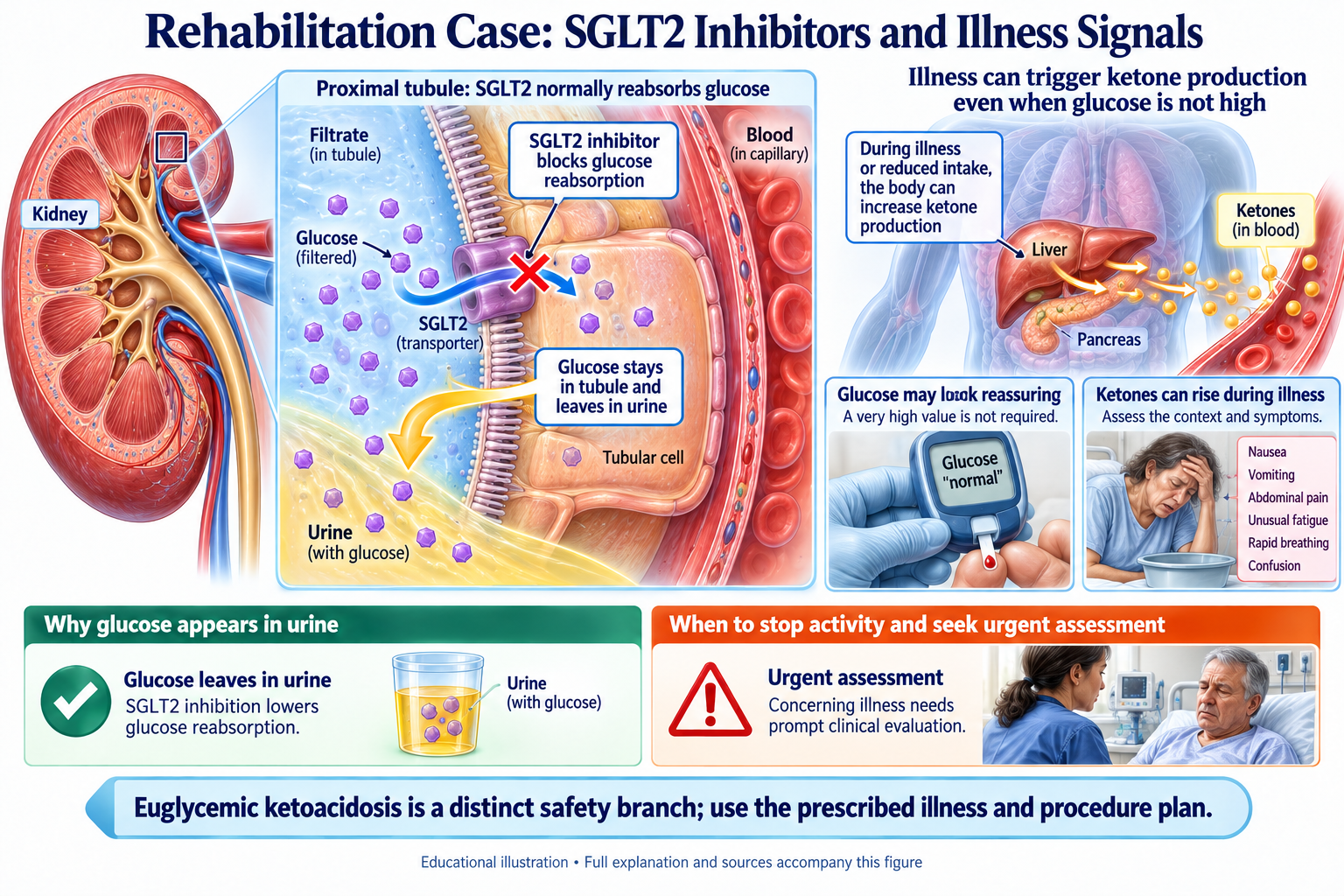
Browse the visual reference library · Download lesson Markdown
🔗 Cross-Linked Track 1 Handouts & Lectures
This case integrates the SGLT2i class story with the shipped Track 1 PT handouts and the existing UDPA cardiorenal / CKD lectures.
💧 Hydration PT handout
SGLT2i osmotic diuresis + orthostasis management; volume axis.
💉 GLP-1 RA PT handout
Common co-therapy; peri-op and hydration overlap.
💊 NSAIDs PT handout
Triple-whammy AKI — SGLT2i functions as diuretic for the combination.
🥩 Protein PT handout
Post-op recovery protein targets for older HFpEF patients.
🎯 Lecture Alignment & the SGLT2 Inhibitor Class
This case reinforces two existing UDPA lectures:
2025_UDPA_Lectures_Live/cardiorenal-disease/hf-diuretic-resistance.html— names dapagliflozin, empagliflozin as the SGLT2i GDMT pillar in HFrEF/HFpEF/CKD; key teaching lines: "Can initiate with eGFR ≥20; continue until dialysis. Hemodynamic benefit occurs within days. Additive diuretic effect."2025_UDPA_Lectures_Live/ckd/comprehensive-ckd-management.html— lists SGLT2i as Pillar 2 disease-modifying therapy in CKD with DAPA-CKD and EMPA-KIDNEY as anchor trials.
| Agent (brand) | Primary PT-relevant trials | Unique signal to know | Peri-op hold |
|---|---|---|---|
| Empagliflozin (Jardiance) | EMPA-REG OUTCOME (T2DM + CV risk)[1]; EMPEROR-Preserved (HFpEF)[4]; EMPA-KIDNEY (CKD) | Broadest evidence base across HFrEF, HFpEF, CKD, T2DM+CV. | Hold 3 days before elective procedure (per FDA label 2020 update)[6] |
| Dapagliflozin (Farxiga) | DAPA-HF (HFrEF)[3]; DELIVER (HFpEF)[5]; DAPA-CKD (CKD) | DELIVER supports reduction in the composite of worsening HF or CV death; CV death alone was not significantly reduced. | Hold 3 days before elective procedure[6] |
| Canagliflozin (Invokana) | CANVAS (T2DM + CV risk)[2]; CREDENCE (T2DM + CKD) | Amputation signal in CANVAS (toe / metatarsal; HR 1.97, 95% CI 1.41–2.75) — drove an FDA boxed warning 2017, later removed 2020 after further data. Still worth knowing for teaching. | Hold at least 3 days before scheduled surgery per product instructions[6] |
| Ertugliflozin (Steglatro) | VERTIS CV (T2DM + CV risk) | CV outcomes trial showed non-inferiority but not superiority for MACE; rarely first-line now. | Hold at least 4 days before elective procedure[6] |
🎯 Learning Objectives
By the end of this case, the DPT student will be able to:
- Recognize the SGLT2i class — empagliflozin, dapagliflozin, canagliflozin, ertugliflozin — and distinguish their unique signals (canagliflozin amputation history; empa/dapa as HFpEF/HFrEF/CKD workhorses).
- Apply the peri-operative hold rule — at least 3 days before scheduled surgery for empagliflozin, dapagliflozin, and canagliflozin; at least 4 days for ertugliflozin — and route patients to the surgical team if a hold is missing.
- Recognize euglycemic DKA (eDKA) — nausea + vomiting + abdominal pain + Kussmaul breathing with normal or only mildly elevated glucose — as an emergency, and call 911 without waiting for hyperglycemia.
- Differentiate volume-depletion orthostasis driven by SGLT2i osmotic diuresis from other causes in the post-op HFpEF cardiac-rehab patient.
- Recognize genitourinary infections — mycotic balanitis/vulvovaginitis and UTIs — and urosepsis precursors; escalate early.
- Inspect the diabetic foot every session, especially for canagliflozin patients post-op.
- Counsel the patient against "just holding it themselves" — SGLT2i confers HFpEF/HFrEF mortality benefit and CKD protection; adjustments belong to the prescriber.
- Execute a clear pause/modify/escalate decision algorithm with defined thresholds.
🧪 Pre-Case Assessment — Test Your Baseline
Click an answer to see the explanation. You can change your answer anytime.
A 72-year-old with HFpEF + T2DM on empagliflozin arrives to outpatient PT 3 weeks after an elective right knee arthroscopy. She tells you she took her empagliflozin the morning of surgery "because nobody told me to stop." The most important PT action is:
Learning Point: Before scheduled surgery, the minimum hold is 3 days for empagliflozin, dapagliflozin, or canagliflozin and 4 days for ertugliflozin, following the product label and treating team — a gap that frequently falls through the cracks in surgical workflows. The PT's role is to recognize the gap, screen for post-op euglycemic DKA symptoms, and escalate to the surgeon and prescriber. PTs do not stop or double drugs on their own.
📚 Reference: See Visit 1 for peri-op hold guidance.
Same patient, one week into PT, reports nausea, worsening lower-abdominal ache, and fatigue. Her home glucometer reads 184 mg/dL — "about my usual." The most urgent PT response is:
Learning Point: Euglycemic DKA is the signature SGLT2i adverse event. Glucose often 150–250 mg/dL — looks "normal" — but ketones and acidosis are life-threatening. Trigger signals: GI symptoms, malaise, post-op stress, low carb intake. PT recognizes pattern and escalates immediately — does not give insulin, IV fluids, or advice to hold/resume on their own.
📚 Reference: See Visit 2 on euglycemic DKA recognition.
She recovers, returns for PT, and mentions itchy vulvar discomfort and burning with urination. The best PT response is:
Learning Point: Mycotic genital infections and UTIs are common SGLT2i class effects (glucosuria feeds yeast and bacteria). These are treatable — not a reason to stop a cardiorenal-protective drug. PT recognizes the pattern, escalates for evaluation and treatment, and reinforces hygiene counseling. Medication decisions stay with the prescriber.
📚 Reference: See Visit 3 on class-effect adverse events.
🧑⚕️ Patient Presentation
Mrs. K. is a 72-year-old retired school teacher with HFpEF (LVEF 55%, NYHA II), T2DM (HbA1c 7.2%), CKD stage 3a (eGFR 52 mL/min/1.73 m²), hypertension, and obesity (BMI 34). She underwent elective right knee arthroscopy four weeks ago and was referred to outpatient PT for post-op rehab. Her medication list:
| Medication | Dose | Indication |
|---|---|---|
| Empagliflozin (Jardiance) | 10 mg daily | T2DM + HFpEF + CKD — triple indication |
| Metformin | 1,000 mg BID | T2DM |
| Lisinopril | 20 mg daily | HTN / HFpEF |
| Furosemide | 20 mg daily | Mild lower-extremity edema |
| Atorvastatin | 40 mg daily | Cardiovascular risk |
| ASA 81 mg daily | 81 mg | CV prevention |
Today's intake — she walks into your clinic cheerful but slightly shaky. On questioning she reveals that she did take her empagliflozin the morning of her knee surgery and throughout the hospital stay. No one on the surgical side flagged a hold. Post-op course was notable for mild post-anesthesia nausea and low oral intake for about 36 hours.
Intake vitals (today, seated):
| Measure | Value | Context |
|---|---|---|
| BP (seated, after 5 min) | 118 / 72 mmHg | Acceptable |
| BP (standing, 1 min) | 100 / 66 mmHg | Borderline orthostatic (−18 mmHg SBP) |
| HR (seated / standing) | 82 / 92 bpm | Compensatory HR rise present (not beta-blocked) |
| Weight | 79.1 kg | Down 2.0 kg from pre-op baseline |
| SpO₂ | 98% | Normal |
| Capillary glucose (fasting) | 138 mg/dL | Stable for her |
| Home fluid intake past 3 days | "Maybe 4 glasses of water a day" | Sub-target for her usual |
| Right knee | Healing; residual mild effusion; incision intact | On schedule post-arthroscopy |
🔄 Visit 1 — Intake & the Missed Peri-Op Hold
Scenario 1A — "nobody told me to stop my empagliflozin before surgery"
Mrs. K. took empagliflozin the morning of surgery and every day of her 1-night hospital stay.
Yes, it's a miss — but the risk window is behind her, not in front of her.
- The 2020 FDA label update advised holding SGLT2i for 3 days before elective procedures (at least 4 days for ertugliflozin) to reduce peri-op euglycemic DKA risk[6]. A 2023 multi-society statement (ADA, ASA, SAMBA, and others) aligns with this window and emphasizes individualized risk assessment for major surgery[7].
- Patients who take SGLT2i right up to surgery have an elevated eDKA risk in the peri-operative window (roughly the first 72 hours post-op), especially with reduced oral intake, N/V, or post-op infection.
- Mrs. K. is now 4 weeks post-op, clinically well, and her eDKA window has closed — but she had a real close call, and the lesson needs to be captured for future procedures.
PT actions today:
- Document the missed hold and the post-op course — low oral intake × 36 hr is the red flag for what didn't happen.
- Message her primary care and/or endocrinologist the same day so the miss is captured in the shared record.
- Give her a written "before any future procedure" instruction card: Stop empagliflozin 3 days before any planned procedure requiring NPO, fasting, or general anesthesia. Resume only when you are eating and drinking normally and cleared by the surgical team.
- Educate on eDKA warning signs (Scenario 3A below) so she can recognize them if they happen in the future.
Scenario 1B — the borderline orthostasis on intake
Standing BP drop of 18 mmHg with compensatory HR rise to 92 bpm. Fluid intake by report has been about 4 glasses/day. She is on furosemide + empagliflozin + lisinopril — three agents that each lower volume or afterload.
Relative volume depletion with multiple contributors — classic post-op / SGLT2i / diuretic stack.
- SGLT2i-induced osmotic diuresis — empagliflozin produces ongoing mild glucosuria-driven fluid loss. In the context of reduced oral intake and post-op fluid shifts, it contributes.
- Loop diuretic — furosemide 20 mg daily adds to net negative fluid balance.
- RAAS blockade — lisinopril produces vasodilation; orthostasis more prominent when volume is low.
- Reduced oral intake — approximately half her usual fluid consumption.
- Post-op inflammation — mild cytokine-driven vasodilation in the post-arthroscopy period.
PT action today:
- Rehydrate pre-session with 250–500 mL water if tolerated.
- Reduce intensity for today's session; RPE 9–11 instead of 11–13; watch for symptoms.
- Recheck orthostatic vitals at end of session.
- Counsel baseline fluid intake target — her usual pattern, not a prescribed number (per the Hydration PT handout). Do NOT tell her to "push fluids" without considering her HFpEF.
- Flag volume status to her prescriber if orthostasis persists at next session.
- Do NOT tell her to hold or skip empagliflozin, furosemide, or lisinopril on your own.
Scenario 1C — the "should I just stop taking it?" question
Mrs. K. asks, "All these medicines seem to be working against me post-op. Should I just pause the empagliflozin for a while so I can rehab without feeling dizzy?"
No — route this to her prescriber. SGLT2i is mortality-reducing for her HFpEF.
- Empagliflozin in HFpEF reduced the composite of CV death or HF hospitalization in EMPEROR-Preserved (Anker et al. 2021; HR approximately 0.79 vs placebo)[4]. Dapagliflozin produced a similar benefit in DELIVER (Solomon et al. 2022)[5]. These are the reasons she is on this drug.
- Unilateral patient-side discontinuation risks losing that benefit and can trigger fluid retention / symptom recurrence.
- The appropriate path for any dose adjustment is the prescriber, not the patient or the PT.
PT script: "I hear you. Empagliflozin is one of the medicines actually protecting your heart and kidneys — the evidence for HFpEF is strong. We don't stop it on our own. What we can do is adjust how we exercise so the dizziness doesn't run the session: more fluids before, lower intensity, standing checks every visit. If the dizziness keeps being a problem, I'll call your endocrinology and cardiology team today so we can decide together whether any dose needs adjustment."
🔄 Visit 2 — One Week Later: GU Symptoms + Foot Check
Scenario 2A — new genitourinary complaints
Mrs. K. mentions, with some hesitation, "down-there" itching and burning on urination for the past 3 days. No fever. No flank pain. Urinary frequency slightly up.
Recognize as a class effect; escalate today.
- Mycotic genital infections (vulvovaginitis in women, balanitis in men) are a well-documented SGLT2i class effect. The glucosuria creates a sugar-rich environment favorable to candida. Women are at higher absolute risk (EMPA-REG: approximately 6–9% per year in women on drug vs approximately 1–2% placebo)[1].
- UTIs are more modestly increased but can progress faster in CKD + diabetic patients — pyelonephritis and rare Fournier gangrene have been reported with SGLT2i (FDA safety communication).
PT actions:
- Hold or modify today's session if she is uncomfortable; pelvic floor positions and hip extension work may exacerbate symptoms.
- Escalate same-day to primary care or OBGYN — urinalysis + culture, topical antifungal if appropriate.
- Counsel perineal hygiene — wipe front to back, avoid prolonged wet clothing, immediate voiding after sexual activity.
- Flag any development of flank pain, fever, or perineal/genital redness-with-pain (possible Fournier precursor) as emergency triggers — ED, not clinic.
- Do NOT stop empagliflozin on your authority. Prescriber decides.
Scenario 2B — the foot inspection you almost forgot
During shoe-off transfer practice, you notice Mrs. K. has a small healing abrasion on her right fifth metatarsal. She hadn't mentioned it. She has mild diabetic peripheral neuropathy on her last podiatry note.
Treat it seriously. Historical amputation signal from the canagliflozin trials makes diabetic foot care an even higher priority in any SGLT2i + diabetes + neuropathy patient, even though she is on empagliflozin.
- The CANVAS Program (Neal et al. 2017) reported an increased risk of lower-extremity amputation with canagliflozin (HR 1.97, 95% CI 1.41–2.75; primarily toe / metatarsal)[2]. The FDA added a boxed warning in 2017 and removed it in 2020 after subsequent data did not reproduce the signal in most real-world analyses and in other SGLT2i trials. Not a reason to avoid SGLT2i overall, but a durable teaching reminder that diabetic foot care intersects the class.
- Mrs. K. is on empagliflozin, not canagliflozin, but diabetic + neuropathic feet require the same meticulous inspection regardless of which SGLT2i.
PT actions:
- Inspect both feet at every PT session, shoes and socks off — skin, web spaces, callus, nails, pressure points.
- Clean, dress, and offload the current abrasion; photograph for chart tracking.
- Notify her podiatrist / PCP today; any worsening → same-day evaluation.
- Patient education: daily self-inspection with a mirror, proper footwear, immediate reporting of any new wound.
🔄 Visit 3 — Week 3: The Call That Matters
Scenario 3A — the call before the session
Mrs. K. phones the clinic an hour before her session. She's been nauseated since last night, vomited twice this morning, has a dull lower-abdominal ache, feels weak and short of breath, and "breathing feels weird — like I can't slow it down." She checked her glucometer: 184 mg/dL. She's been recovering from a head cold for 2 days.
This is euglycemic DKA (eDKA) until proven otherwise. Call 911 or direct her to the ED now.
🚩 Euglycemic DKA — the pattern every PT must recognize
What it is: DKA with serum glucose typically <250 mg/dL (sometimes completely normal). The ketogenesis is driven by SGLT2i-mediated glucosuria + reduced insulin + stress / infection / reduced intake — not by severe hyperglycemia. Because glucose looks "OK," patients and even clinicians miss it. Patients die of missed eDKA.
Triggers: reduced caloric intake, infection, surgery/anesthesia, prolonged exercise, alcohol, ketogenic/very-low-carb diets, missed insulin doses, pregnancy.
Symptoms to recognize: nausea, vomiting, abdominal pain, malaise, tachypnea or "Kussmaul" deep breathing, fruity breath odor, dehydration, altered mental status in severe cases — with a glucose that doesn't look alarming.
PT action: STOP. Do not give food, insulin, or fluids. Call 911 or send directly to ED. Treatment is IV insulin + IV fluids + correction of ketosis — hospital work.
- Mrs. K. has every trigger stacked — recent viral illness (reduced intake), ongoing SGLT2i, her baseline T2DM, CKD stage 3a reducing buffer reserve.
- Her glucose of 184 is a distractor. The pattern — GI + tachypnea + malaise + recent illness + on SGLT2i — wins over the glucose number.
PT script: "I need you to stop what you're doing and go to the emergency room right now. I'm worried about a complication from your empagliflozin called euglycemic DKA — it can look mild at first because your sugar isn't that high, but it's serious and only the hospital can treat it. Do not drive yourself. Call 911 or have someone drive you. Tell them you take empagliflozin. I'll call your endocrinologist now as well."
🔄 Visit 4 — After ED Treatment: Return to Rehab
Scenario 4A — stabilized return
eDKA confirmed in the ED (bicarb 14, anion gap elevated, ketones positive, glucose 210). Treated with IV insulin drip + IV fluids; bicarb normalized over 24 hours. Empagliflozin was held during the admission and restarted at discharge after a nutrition consult and patient education. Mrs. K. returns to PT 10 days later, feeling well.
Resume graded rehab with explicit sick-day integration and Track 1 module coordination.
- Sick-day rule education: if she gets the flu, GI illness, or any acute illness with vomiting/diarrhea/reduced intake → hold empagliflozin (and metformin, and furosemide) and call her prescriber or clinic same-day. Reinforce this at every visit for the next month.
- Peri-op rule education: any future elective procedure — 3 days off empagliflozin before, resume when eating/drinking normally.
- Hydration education: re-read Hydration PT handout with her. In HFpEF, "push fluids" is not automatic — follow her cardiology fluid target. But dehydration during acute illness warrants calling, not pushing through.
- Diabetic foot check at every PT visit; reinforce daily home self-inspection.
- Protein intake 1.2–1.5 g/kg/day during the post-op recovery phase — cross-link Protein PT handout.
- NSAID avoidance — she is on the NSAID + ACEi + diuretic-like state (SGLT2i) combination; any future NSAID request should route to topical diclofenac or non-pharm tools per the NSAIDs PT handout.
- RPE-based intensity (Borg 11–13) as usual; she is not beta-blocked but HR is modestly elevated post-illness — watch trend.
🧠 Key Teaching Points
Pearl 1 — Peri-op hold: at least 3 days (4 for ertugliflozin)
For scheduled surgery, stop empagliflozin/dapagliflozin/canagliflozin at least 3 days before and ertugliflozin at least 4 days before, following the treating team and product instructions. Resume when eating/drinking normally and the surgical team clears it[6][7]. PTs are often the pre-hab/pre-op contact — verify the hold plan, flag the gap.
Pearl 2 — Euglycemic DKA: glucose is a distractor
Nausea, vomiting, abdominal pain, tachypnea, malaise on SGLT2i → eDKA until proven otherwise, even if glucose looks fine. Call 911 / ED. Do not give food, insulin, or fluids. Triggers: acute illness, reduced intake, surgery, prolonged exercise, ketogenic diet.
Pearl 3 — Volume management is both axes — tonicity AND volume
SGLT2i produces osmotic diuresis. Stacked with loop diuretic + RAAS blockade, it predisposes to orthostasis during reduced oral intake. But in HFpEF, "push fluids" without cardiology input can worsen decongestion. Follow the prescribed fluid target; rehydrate judiciously at the session; escalate persistent orthostasis (cross-link: Hydration PT handout).
Pearl 4 — Mycotic / UTI infections are common; Fournier is rare but emergent
Vulvovaginitis / balanitis are a known class effect. Recognize and escalate — do not manage with OTCs in a diabetic patient with CKD. Fournier gangrene (perineal necrotizing fasciitis) is rare but described — fever, severe perineal pain/redness out of proportion → ED, not clinic.
Pearl 5 — Diabetic foot inspection every visit
Canagliflozin's amputation signal in CANVAS is the durable teaching moment[2]. Inspect both feet at every PT session for any SGLT2i + diabetic patient. Photograph, chart, escalate.
🚩 Red Flag Summary Table
Any of these → pause the session, act, and escalate or route to ED per severity.
| Finding | PT action |
|---|---|
| Nausea + vomiting + abdominal pain + tachypnea on SGLT2i, even with near-normal glucose | STOP. Call 911 / route to ED. Euglycemic DKA until proven otherwise. |
| Fever + severe perineal pain or redness out of proportion | Possible Fournier gangrene — ED immediately |
| Flank pain + fever + dysuria | Pyelonephritis — urgent evaluation same-day |
| New vulvovaginitis / balanitis symptoms | Escalate to PCP / OBGYN same-day; do not stop SGLT2i on own |
| Orthostatic drop >20 mmHg SBP with symptoms after hydration attempt | Pause session; flag prescriber |
| Rapid weight change (>2 lb overnight or >5 lb/wk) | Volume overload (HFpEF) — flag cardiology |
| New diabetic foot wound or ulcer | Dress, photograph, same-day podiatry / PCP |
| Surgery scheduled without SGLT2i hold plan | Flag surgical team; confirm the agent-specific minimum hold: 3 days for empagliflozin/dapagliflozin/canagliflozin; 4 days for ertugliflozin |
| Sick-day illness with reduced intake / vomiting / diarrhea on SGLT2i | Patient must hold SGLT2i and call prescriber; watch for eDKA |
| Patient reports stopping or planning to stop SGLT2i unilaterally | Do NOT endorse; escalate same day |
| On NSAID + ACEi/ARB + SGLT2i-as-diuretic simultaneously | Flag triple-whammy AKI risk — cross-link NSAIDs handout |
🗣️ Patient Teaching Scripts
The "sick-day rule" script
"Any day you can't eat normally — stomach bug, bad flu, vomiting, diarrhea, fasting for a test — stop your empagliflozin that day and call your doctor's office. Same rule for metformin and the water pill. Restart only when you're eating and drinking normally. Don't tough it out — the biggest risk on this medicine happens when the body is under stress and not getting fuel."
The "3 days before surgery" script
"If you ever have another planned procedure — surgery, colonoscopy, dental work with sedation, anything requiring NPO — you stop empagliflozin three full days before. You restart only when the surgical team tells you to and you're eating and drinking normally again. Carry a card in your wallet that lists this drug and this rule so the anesthesia team sees it."
The "eDKA" patient script
"Because you're on empagliflozin, there's one pattern you need to know. If you ever get nausea, vomiting, or belly pain — especially if you're sick or have been eating less — call 911 or go to the ER. Don't wait to see if your blood sugar goes up. On this medicine, your sugar can look normal while your blood is getting dangerously acidic. That combination is what we're watching for."
The "infection hygiene" script
"This medicine pushes sugar out in your urine, which can feed yeast infections and bladder infections, especially in women. Wipe front to back, change out of wet clothes right away, empty your bladder after sex. If you get itching, burning, or unusual discharge — call your doctor. If you get a fever or severe pain down there — go to the ER."
The "foot check" script
"Check both feet every evening when you take your shoes off. Look between the toes, under the foot, around the heel. Use a mirror if you can't see well. Any blister, cut, or red spot — call the podiatrist that week. Don't wait. A small sore on a diabetic foot can turn into something serious fast."
The "don't stop on your own" script
"Empagliflozin is doing three things for you at once — helping your diabetes, protecting your heart from the HFpEF, and protecting your kidneys from further damage. The trials behind it show a real survival benefit. If something about it is bothering you, call me or your cardiologist or endocrinologist — we'll sort it out together. Stopping it on your own gives up those benefits."
📚 References
- Zinman B, Wanner C, Lachin JM, Fitchett D, Bluhmki E, Hantel S, Mattheus M, Devins T, Johansen OE, Woerle HJ, Broedl UC, Inzucchi SE; EMPA-REG OUTCOME Investigators. Empagliflozin, Cardiovascular Outcomes, and Mortality in Type 2 Diabetes. N Engl J Med 2015;373(22):2117–28. PMID: 26378978. PubMed — foundational CV outcomes trial; 7,020 patients; primary CV composite HR 0.86 (0.74–0.99); all-cause mortality 32% reduction; HF hospitalization 35% reduction.
- Neal B, Perkovic V, Mahaffey KW, de Zeeuw D, Fulcher G, Erondu N, Shaw W, Law G, Desai M, Matthews DR; CANVAS Program Collaborative Group. Canagliflozin and Cardiovascular and Renal Events in Type 2 Diabetes. N Engl J Med 2017;377(7):644–57. PMID: 28605608. PubMed — 10,142 patients; primary CV composite HR 0.86 (0.75–0.97); amputation signal HR 1.97 (1.41–2.75), primarily toe/metatarsal — drove 2017 FDA boxed warning (removed 2020 after further data).
- McMurray JJV, Solomon SD, Inzucchi SE, Køber L, Kosiborod MN, Martinez FA, Ponikowski P, Sabatine MS, Anand IS, Bělohlávek J, et al.; DAPA-HF Trial Committees and Investigators. Dapagliflozin in Patients with Heart Failure and Reduced Ejection Fraction. N Engl J Med 2019;381(21):1995–2008. PMID: 31535829. PubMed — DAPA-HF; dapagliflozin in HFrEF regardless of diabetes status.
- Anker SD, Butler J, Filippatos G, Ferreira JP, Bocchi E, Böhm M, Brunner-La Rocca HP, Choi DJ, Chopra V, Chuquiure-Valenzuela E, et al.; EMPEROR-Preserved Trial Investigators. Empagliflozin in Heart Failure with a Preserved Ejection Fraction. N Engl J Med 2021;385(16):1451–61. PMID: 34449189. PubMed — EMPEROR-Preserved; first SGLT2i HFpEF outcomes trial; primary composite HR approximately 0.79.
- Solomon SD, McMurray JJV, Claggett B, de Boer RA, DeMets D, Hernandez AF, Inzucchi SE, Kosiborod MN, Lam CSP, Martinez F, et al.; DELIVER Trial Committees and Investigators. Dapagliflozin in Heart Failure with Mildly Reduced or Preserved Ejection Fraction. N Engl J Med 2022;387(12):1089–98. PMID: 36027570. PubMed — DELIVER; dapagliflozin in HFpEF / HFmrEF.
- U.S. Food and Drug Administration. FDA Drug Safety Communication: FDA revises labels of SGLT2 inhibitors for diabetes to include warnings about too much acid in the blood and serious urinary tract infections. (2015; peri-operative hold language updated on product labels subsequently.) Cited here for the 3-day (empagliflozin/dapagliflozin/canagliflozin) / 4-day (ertugliflozin) peri-operative hold recommendation embedded in US Prescribing Information. See Invokana prescribing information and Steglatro prescribing information. FDA
- U.S. Food and Drug Administration. Invokana (canagliflozin) prescribing information, 2024, section 2.5 (Temporary Interruption for Surgery). Official prescribing information.
- Lapi F, Azoulay L, Yin H, Nessim SJ, Suissa S. Concurrent use of diuretics, angiotensin converting enzyme inhibitors, and angiotensin receptor blockers with non-steroidal anti-inflammatory drugs and risk of acute kidney injury: nested case-control study. BMJ 2013;346:e8525. PMID: 23299844. PubMed — cross-cite from Modules 1 + 3; triple-whammy AKI context when SGLT2i + ACEi/ARB + NSAID are combined.
Andrew Bland, MD, FACP, FAAP
Medical Associates Department of Nephrology · University of Illinois College of Medicine at Peoria · University of Dubuque PA & DPT Programs · Butler College of Osteopathic Medicine
Interactive PT teaching case · Track 2 · Case 2b
© 2026 · urinenephrology.org