Pre-Case Assessment: Test Your Baseline Knowledge
Answer these questions before reviewing the case to assess your starting knowledge
Which sodium level typically requires emergency treatment with hypertonic saline in symptomatic patients?
Learning Point: Emergency treatment with hypertonic saline is indicated for severe symptomatic hyponatremia, typically <120 mEq/L with life-threatening symptoms (seizures, coma, cardiopulmonary arrest). The presence of severe symptoms, not just the absolute sodium level, determines the need for emergency treatment.
📚 Reference: Hyponatremia Emergency Management
What is the initial bolus dose of 3% hypertonic saline for emergency hyponatremia treatment?
Learning Point: The standard initial bolus is 150 mL (or 2-3 mL/kg) of 3% hypertonic saline given IV over 20 minutes. This should raise sodium by approximately 2-4 mEq/L. The bolus can be repeated if severe symptoms persist, with a goal of 4-6 mEq/L rise in the first hour.
📚 Reference: Emergency Protocol Guidelines
Which of the following best defines SIADH?
Learning Point: SIADH is characterized by inappropriate (excessive) ADH secretion leading to: euvolemic hyponatremia, inappropriately concentrated urine (>100 mOsm/kg), elevated urine sodium (>30 mEq/L), and normal thyroid/adrenal function. Patients are euvolemic (not hypervolemic) due to compensation mechanisms.
📚 Reference: SIADH Diagnostic Criteria
What is the recommended sodium correction TARGET in the first 24 hours to prevent osmotic demyelination syndrome (ODS) in this high-risk patient?
Learning Point: Conservative correction target per modern consensus (Sterns RH. NEJM 2015;372(1):55-65, PMID 25551526; ESS 2014 European hyponatremia guideline) is 6–8 mEq/L per 24 hours in high-risk patients (chronic hyponatremia, malnutrition, alcoholism, liver disease, hypokalemia). Hard upper limit is 10 mEq/L in any 24-hour window for any patient. Higher rates increase osmotic demyelination syndrome (ODS) risk.
📚 Reference: Full article: 🌊 Hyponatremia Management
Case Presentation
Patient: 58-year-old woman
Chief Complaint: "Generalized tonic-clonic seizure lasting 3 minutes"
History: Found by family having seizure at home. No prior seizure history. Progressive confusion and weakness over 4 days. Family reports she has been "acting strange" and drinking large amounts of water.
Past Medical History: Small cell lung cancer (recently diagnosed), depression, hypertension
Home Medications: Sertraline 100mg daily, lisinopril 10mg daily, recent chemotherapy (cyclophosphamide, doxorubicin, vincristine - last cycle 2 weeks ago)
🤔 Initial Clinical Reasoning Questions
Given the seizure in a 58-year-old with no prior seizure history, what is your most immediate concern and first action?
Clinical Reasoning: In new-onset seizures, metabolic causes (hypoglycemia, severe hyponatremia, hypocalcemia) are immediately life-threatening and easily correctable. Blood glucose can be checked at bedside, and stat electrolytes should be ordered immediately. While imaging is important, correcting metabolic abnormalities takes priority in the emergent setting.
📚 Reference: Emergency Electrolyte Assessment
The initial electrolyte panel shows: Na+ 118 mEq/L, K+ 3.8 mEq/L, Cl- 88 mEq/L, CO2 24 mEq/L, glucose 102 mg/dL. What is your next immediate step?
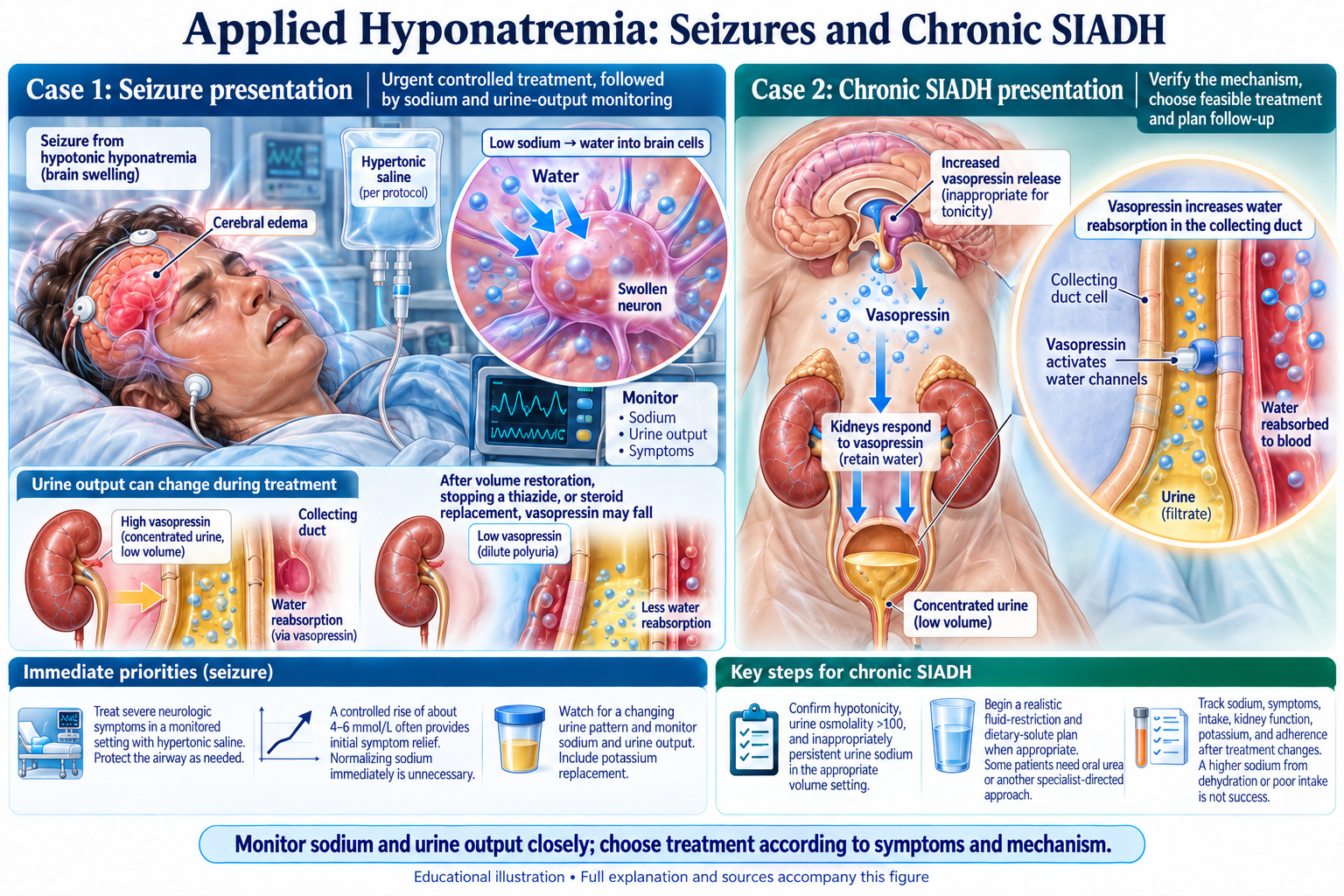
Clinical Reasoning: Severe symptomatic hyponatremia with seizures requires immediate emergency treatment with hypertonic saline. The goal is to raise sodium by 4-6 mEq/L in the first hour to stop seizure activity. Workup can proceed simultaneously, but treatment cannot be delayed for diagnostic studies.
📚 Reference: Emergency Treatment Protocols
Laboratory Data & Analysis
Initial Laboratory Values
| Parameter | Value | Normal Range | Clinical Significance |
|---|---|---|---|
| Sodium | 118 mEq/L | 136-145 mEq/L | Severe hyponatremia causing seizures |
| Potassium | 3.8 mEq/L | 3.5-5.0 mEq/L | Normal |
| Chloride | 88 mEq/L | 98-107 mEq/L | Proportionally decreased with sodium |
| CO2 | 24 mEq/L | 22-28 mEq/L | Normal acid-base status |
| Glucose | 102 mg/dL | 70-99 mg/dL | Normal (rules out hypoglycemic seizure) |
| Urine Osmolality | 700 mOsm/kg | <300 mOsm/kg | Inappropriately concentrated - confirms SIADH |
📊 Laboratory Analysis Questions
Physical exam shows: euvolemic appearance (moist mucous membranes, normal skin turgor, no edema, no JVD). Given this and the patient's cancer history, what is the most likely diagnosis?
Learning Point: Small cell lung cancer is one of the most common causes of malignancy-associated SIADH, occurring in 7-16% of patients. The euvolemic presentation (normal volume status) is classic for SIADH. Additionally, sertraline (SSRI) can potentiate SIADH.
📚 Reference: SIADH Causes and Diagnosis
To confirm SIADH, which laboratory studies would you order?
Learning Point: SIADH diagnosis requires: 1) Serum osmolality <280 mOsm/kg, 2) Urine osmolality >100 mOsm/kg (inappropriately concentrated), 3) Urine sodium >30 mEq/L, 4) Normal thyroid function (TSH), 5) Normal adrenal function (cortisol). ADH levels are not routinely measured.
📚 Reference: Urine Studies for SIADH
Interactive Timeline: Critical Decision Points
Navigate through critical decision points in real-time management of severe hyponatremia
HOUR 0-1: Emergency Phase - After the first 150 mL bolus of 3% saline, repeat sodium is 122 mEq/L (increase of 4 mEq/L). The patient is more alert but still confused. What is your next step?
Learning Point: The goal for emergency treatment is 4-6 mEq/L rise in the first hour to completely resolve severe symptoms. Since persistent confusion suggests incomplete symptom resolution, another bolus is appropriate to achieve the target 6-8 mEq/L total rise, then transition to controlled correction.
📚 Reference: Emergency Correction Goals
HOUR 6: Overcorrection Recognition - 6-hour sodium level is 128 mEq/L (total rise now 10 mEq/L from baseline 118). Patient clinically stable. You've exceeded the safe daily correction rate. What's your next move?
Learning Point: 10 mEq/L rise in 6 hours exceeds the safe daily correction rate of 6-8 mEq/L. This IS overcorrection. Immediate action required: 1) STOP all hypertonic saline, 2) Give 250 mL D5W bolus to actively lower sodium, 3) Recheck sodium in 1-2 hours, 4) May need additional D5W if sodium doesn't drop. Goal is to bring total 24-hour correction back to 6-8 mEq/L range.
📚 Reference: Full article: 🌊 Hyponatremia Management
DAY 2-5: Long-term Management - Patient stable on day 3 with sodium 132 mEq/L. SIADH confirmed from small cell lung cancer. What's your evidence-based long-term management plan?
Learning Point: For stable chronic SIADH, address the cause, ensure adequate nutrition/solute, and begin a feasible fluid-restriction plan when appropriate. Selected persistent cases need specialist-directed treatment such as oral urea. Salt plus loop therapy can cause electrolyte or kidney complications and is not automatically effective. SGLT2 therapy has limited SIADH research evidence and is not a routine first-line substitution. Severe neurologic symptoms require emergency hypertonic saline rather than this chronic pathway.
📚 Reference: Full article: 🌊 Hyponatremia Management
Module-Specific Deep Dive: Advanced Concepts
Advanced concepts testing deeper understanding of hyponatremia pathophysiology and management
Why did this patient's sodium only rise 2-3 mEq/L per 150 mL of 3% saline bolus when the Adrogue-Madias formula predicted much higher? Her urine osmolality is 700 mOsm/kg.
Learning Point: Adrogue-Madias formula: ΔNa = (513-118)/(35+0.15) = 11.2 mEq/L predicted. BUT urine osmolality 700 mOsm/kg means kidneys are still concentrating urine 2x higher than serum (350 mOsm/kg). This ongoing aggressive water retention means much of the administered sodium gets diluted by continued water reabsorption. High urine osmolality predicts blunted response to hypertonic saline - this is why monitoring urine studies matters!
📚 Reference: Full article: 🔬 Urinalysis Mastery
Why does small cell lung cancer cause SIADH more than other cancer types?
Learning Point: Small cell lung cancer (SCLC) is a neuroendocrine tumor derived from primitive neuroectodermal cells that retain the ability to produce hormones including ADH, ACTH, and others. This ectopic hormone production occurs in 7-16% of SCLC patients and can be the presenting symptom.
📚 Reference: Full article: 🌊 Hyponatremia Management
What is the pathophysiology behind why rapid correction of chronic hyponatremia causes osmotic demyelination syndrome?
Learning Point: In chronic hyponatremia, brain cells adapt by losing organic osmolytes (taurine, glutamate, myo-inositol) to reduce cell volume. During rapid correction, these osmolytes cannot be rapidly regenerated, causing excessive cell shrinkage, particularly affecting oligodendrocytes and leading to demyelination in the pons and other areas.
📚 Reference: Full article: 🌊 Hyponatremia Management
Learning Objectives Assessment
Evaluate your mastery of the key learning objectives from this case
🎯 Learning Objective 1: Demonstrate ability to recognize and manage life-threatening electrolyte emergencies
Objective: Students should be able to rapidly identify severe symptomatic hyponatremia and implement appropriate emergency treatment protocols
A 45-year-old man presents with confusion and Na+ 115 mEq/L. He's alert but disoriented. What's the appropriate initial management?
Competency Demonstration: Emergency treatment depends on symptom severity, not just the absolute sodium level. Confusion with Na+ 115 mEq/L warrants careful assessment. If symptoms are moderate-to-severe (significant confusion, lethargy), hypertonic saline is appropriate. The decision should be individualized based on clinical presentation.
📚 Master This: Full article: 🌊 Hyponatremia Management
🎯 Learning Objective 2: Apply evidence-based protocols for safe sodium correction
Objective: Students should understand correction rate limits and prevention of osmotic demyelination syndrome
You're managing a patient with SIADH. After emergency correction, how do you determine the daily correction rate for the next 3 days?
Competency Demonstration: After emergency phase, safe correction is 6-8 mEq/L per day. Goal is sodium 130-135 mEq/L (not complete normalization). This prevents symptoms while minimizing ODS risk. Slower correction (2-4 mEq/L) may be too conservative and prolong hospitalization unnecessarily.
📚 Master This: Evidence-Based Correction Protocols
Integration Challenge: Multi-System Synthesis
Apply knowledge from all modules to solve a complex, multi-system clinical challenge
📋 Complex Scenario
Three months later, the same patient returns to the ED with confusion and weakness. She's been compliant with fluid restriction but has not been able to tolerate protein supplementation due to nausea. Current labs: Na+ 112 mEq/L, K+ 2.8 mEq/L, BUN 18 mg/dL, Creatinine 2.1 mg/dL (baseline 0.8). She appears volume depleted. Her cancer has progressed despite chemotherapy.
What has likely changed in her clinical situation to cause this presentation?
Learning Point: Dual mechanism worsening SIADH: 1) Volume depletion (low BUN 18 mg/dL with AKI) stimulates additional ADH release, 2) Inability to tolerate protein supplementation means poor urea production and reduced free water clearance. Cancer progression causes nausea/poor intake, leading to this "double hit" - both volume-stimulated ADH AND reduced urea-mediated water clearance. This demonstrates how multiple pathophysiologic mechanisms can compound in complex patients.
Integration Points: Volume-ADH physiology + protein metabolism + urea clearance + cancer complications
📚 Reference: Volume Depletion and ADH
How would your management differ from the previous presentation?
Learning Point: Mixed physiology requires two parallel decisions. Seizures or other severe neurologic symptoms attributable to hypotonic hyponatremia require prompt monitored hypertonic saline; do not delay it until volume correction. Treat demonstrated hypovolemia and hypokalemia with frequent sodium/urine-output reassessment. Reversal of antidiuresis and potassium replacement can accelerate correction; track the total rise and use a specialist overcorrection plan when needed.
Integration Points: Volume assessment + AKI management + electrolyte correction + cancer care coordination
📚 Learn More: Hyponatremia: Comprehensive Management
Advanced Clinical Integration
Apply advanced concepts to challenging hyponatremia scenarios
A patient with SIADH is receiving 3% saline and has corrected from Na+ 108 to 118 mEq/L in 10 hours. What is the most appropriate next step?
Learning Point: Correction of 10 mEq/L in 10 hours has reached the hard upper limit (10 mEq/L in any 24-hour window) and overshoots the modern target of 6-8 mEq/L per 24 hours for high-risk patients. Per Sterns 2015 NEJM (PMID 25551526) and 2014 European hyponatremia guideline (Spasovski). The DDAVP-clamp strategy is now standard: give DDAVP 2-4 mcg IV q6-8h (this case uses the lower 1-2 mcg q8h dose, defensible for less aggressive clamping) to "lock" ADH activity and prevent further free water excretion, then administer D5W to actively re-lower sodium if needed. Goal is to bring the 24-hour total back into the 6-8 mEq/L safe range.
📚 Reference: Full article: 🌊 Hyponatremia Management
Which of the following patients with hyponatremia is at HIGHEST risk for osmotic demyelination syndrome if sodium is corrected too rapidly?
Learning Point: Risk factors for ODS include chronic hyponatremia (>48 hours), alcoholism, malnutrition, liver disease, hypokalemia, and very low baseline sodium. The combination of alcoholism + malnutrition + hypokalemia creates the highest risk because: (1) chronic adaptation has depleted brain organic osmolytes, (2) correcting hypokalemia raises serum sodium independently (K+ enters cells, Na+ exits), and (3) malnourished brains are more susceptible to demyelination.
📚 Reference: Full article: 🌊 Hyponatremia Management
In a patient with SIADH from small cell lung cancer, the urine osmolality is 650 mOsm/kg and urine sodium is 85 mEq/L. What do these urine studies tell you about the expected response to fluid restriction alone?
Learning Point: The Furst formula (urine Na+ + urine K+) / serum Na+ predicts fluid restriction effectiveness. When urine osmolality is very high (>500 mOsm/kg) and urine cation concentration exceeds serum sodium, the kidney is producing concentrated urine that retains more electrolyte-free water than is being restricted. This ratio >1.0 predicts fluid restriction failure. In this patient, (85 + estimated K+) / serum Na+ likely exceeds 1.0, meaning additional pharmacologic intervention (salt tablets, urea, or SGLT2 inhibitor) is needed.
📚 Reference: SIADH: Predicting Treatment Response
Case Reflection & Multi-Module Integration
🧪 Electrolyte Module Integration
- Emergency hyponatremia protocols
- SIADH diagnosis and management
- Osmotic demyelination prevention
🔬 Urinalysis Module Integration
- Urine osmolality interpretation
- Urine sodium significance
- SIADH confirmatory testing
🎯 Key Integration Concepts
This case demonstrates how emergency nephrology care requires integration across multiple domains: electrolyte emergency management, oncology knowledge of paraneoplastic syndromes, pharmacology understanding of drug interactions (SSRIs), and critical care monitoring protocols. The complexity of mixed disorders later in the case shows how clinical presentations evolve and require adaptive management strategies.
📝 Case Summary & Clinical Pearls
This case of severe hyponatremia with seizures demonstrates the critical importance of rapid recognition and appropriate emergency management while preventing overcorrection complications. The integration of oncology, pharmacology, and electrolyte management principles shows the complexity of modern nephrology practice.
🔑 Key Clinical Pearls from This Case:
- Emergency Recognition: Seizures + hyponatremia = immediate 3% saline (symptoms drive treatment, not just sodium level)
- Safe Correction: 4-6 mEq/L in first hour for emergency symptom control, then 6-8 mEq/L per 24-hour target with a hard upper limit of 10 mEq/L in any 24-hour window to prevent ODS (per 2014 ESS / Sterns 2015 NEJM)
- SIADH in Cancer: Small cell lung cancer commonly causes SIADH through ectopic ADH production
- Drug Interactions: SSRIs can potentiate SIADH through multiple mechanisms
- Complex Presentations: Mixed disorders require adaptive management (hypovolemic + SIADH)