Pre-Case Assessment: Test Your Baseline Knowledge
Answer these questions before reviewing the case to assess your starting knowledge
Which urinalysis finding supports interstitial inflammation in suspected AIN but is not specific to AIN?
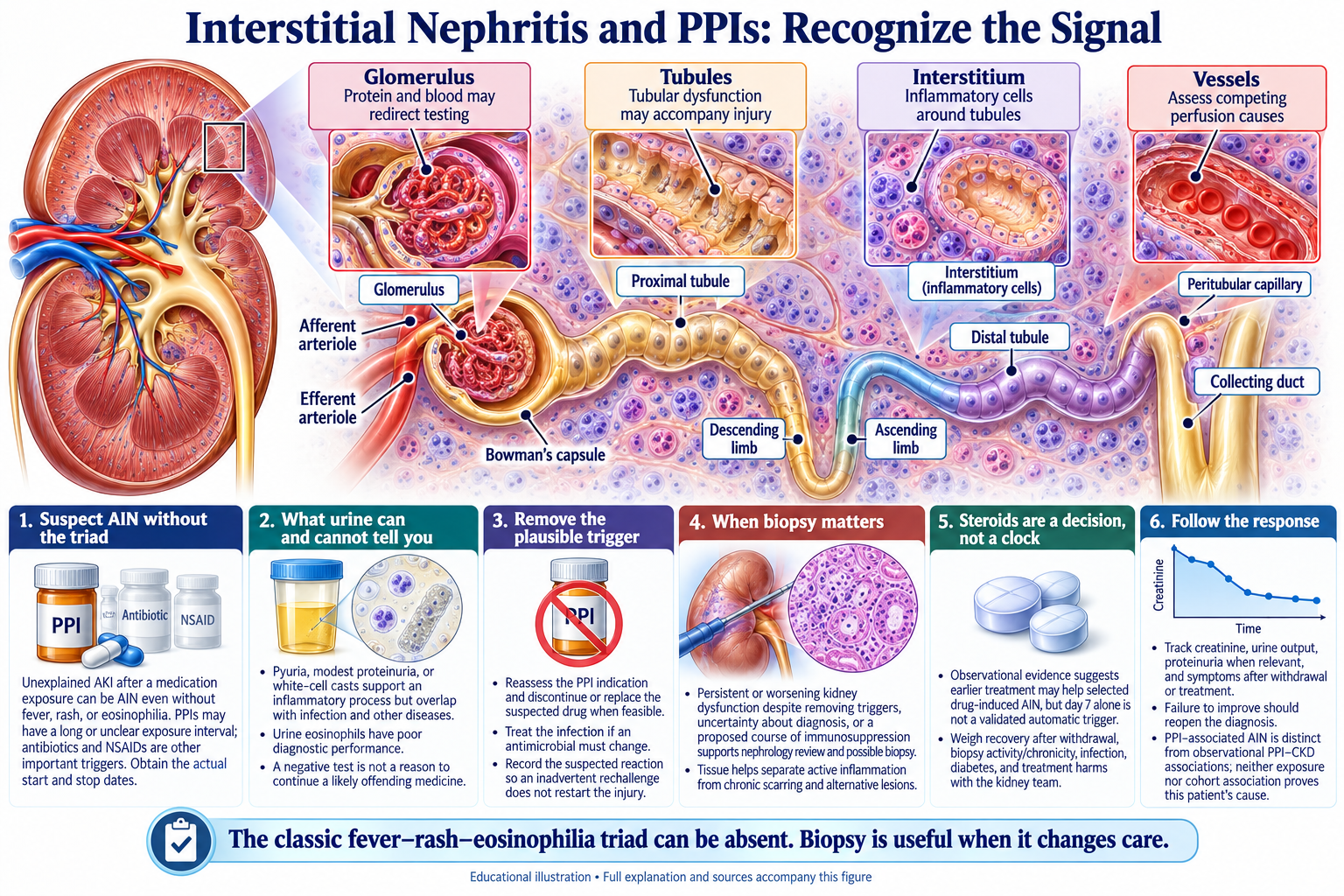
Learning Point: White blood cell casts support intrarenal inflammation and can occur in AIN, pyelonephritis, and other inflammatory kidney disorders. Neither their presence nor their absence establishes or excludes AIN; combine the finding with exposure history, cultures when indicated, and kidney-function trends.
📚 Reference: Complete Cast Interpretation Guide
Which medication class is the MOST common cause of drug-induced AIN in 2024?
Learning Point: PPIs now account for ~35% of drug-induced AIN cases, surpassing NSAIDs due to widespread use and often inappropriate duration. PPI-induced AIN has a delayed onset (weeks to months) and is often missed clinically.
📚 Reference: PPI Nephrotoxicity Deep Dive
The classic triad of AIN (fever, rash, eosinophilia) is present in what percentage of cases?
Learning Point: The classic triad is actually rare (<10%), making AIN diagnosis challenging. Most patients present with nonspecific subacute AKI. High clinical suspicion based on drug exposure and urinalysis is key.
📚 Reference: AIN Diagnostic Challenges
When should corticosteroid therapy be considered for AIN treatment?
Learning Point: Drug withdrawal is the primary therapy. Steroids are considered if no improvement occurs within 7-14 days or if severe AKI is present at diagnosis. Early steroid therapy (within 2 weeks) is most effective.
📚 Reference: Full article: 💊 Drug-Induced Nephrotoxicity
Case Presentation
Patient: 48-year-old woman
Chief Complaint: Fatigue, decreased appetite, and "feeling puffy" for 2 weeks
History: Gradual onset of fatigue and malaise over 2 weeks. Reports decreased urine output and mild ankle swelling. No fever, dysuria, or flank pain. Has been taking omeprazole for several months for GERD symptoms.
Past Medical History: GERD, hypertension, osteoarthritis
Medications: Omeprazole 40mg daily (started 4 months ago), lisinopril 10mg daily, ibuprofen 600mg TID PRN (increased frequency recently), calcium carbonate PRN
Social History: No tobacco, occasional alcohol, works as teacher
🤔 Initial Clinical Reasoning Questions
Based on this presentation, which drug combination poses the highest risk for AIN?
Clinical Reasoning: PPI + NSAID combination creates additive nephrotoxicity risk. Both can independently cause AIN, and concurrent use elevates risk further (Leonard et al. 2012 PMID 22887960 confirmed PPI as independent AIN risk; combined-exposure quantification varies by study). The 4-month duration of PPI therapy plus recent increased NSAID use creates the perfect storm for AIN.
📚 Reference: Drug-Induced AKI: Synergistic Nephrotoxicity
What clinical timeline pattern would you expect for PPI-induced AIN?
Learning Point: PPI-induced AIN has a characteristic subacute onset, developing weeks to months after initiation. This contrasts with NSAID-induced AIN (days to weeks) and ATN (hours to days). The delayed onset often leads to missed diagnosis.
📚 Reference: PPI Nephrotoxicity Timeline
Physical Examination & Laboratory Data
Vital Signs & Physical
- BP: 148/88 mmHg (↑ from 130/80)
- Weight: 72 kg (↑ 3 kg from baseline)
- General: Mild fatigue, periorbital puffiness
- Extremities: 1+ bilateral ankle edema
- Notable: No fever, no rash, no lymphadenopathy
Current Laboratory Values
- Creatinine: 2.1 mg/dL (baseline 0.9)
- BUN: 38 mg/dL (BUN:Cr 18:1)
- eGFR: 25 mL/min/1.73m² (vs 85)
- Eosinophils: 8% (0.64 K/μL)
- Hemoglobin: 10.8 g/dL
Urinalysis Results - AIN Pattern
Dipstick Results
- Specific Gravity: 1.016
- Protein: 2+ (100 mg/dL)
- Blood: 1+ (microscopic)
- Leukocyte Esterase: 2+ (positive)
- Nitrites: Negative
Microscopy: AIN Findings
- WBCs: 25-50/hpf
- WBC Casts: 3-5/lpf ⭐ KEY FINDING
- RBCs: 5-10/hpf
- Tubular Epithelial Cells: Present
- Urine Culture: No growth (sterile pyuria)
🔬 Urinalysis Analysis Questions
What is the significance of finding WBC casts with sterile pyuria in this patient?
Learning Point: WBC casts with sterile pyuria raise concern for AIN in this medication-exposure setting, but do not identify the cause by themselves. Assess symptoms, urine cultures when indicated, and other inflammatory kidney disorders; nephrology may recommend biopsy if uncertainty changes treatment.
📚 Reference: Full article: 🔬 Urinalysis Interpretation
The peripheral eosinophilia (8%) in this patient:
Learning Point: Peripheral eosinophilia supports AIN diagnosis but is neither sensitive nor specific. Present in 30-40% of AIN cases. More common with antibiotic-induced AIN than PPI-induced. Its absence doesn't rule out AIN.
📚 Reference: Eosinophiluria: Limits and Pitfalls
Calculate the FENa for this patient and interpret the result:
Given: Urine Na 45 mEq/L, Serum Na 138 mEq/L, Urine Cr 25 mg/dL, Serum Cr 2.1 mg/dL
Calculation: FENa = [(45×2.1)/(138×25)] × 100 ≈ 2.7%. This result is compatible with impaired sodium reabsorption but does not confirm AIN or distinguish its cause. Diuretics, CKD, and other AKI processes can change FENa; interpret the result with urine sediment and the clinical course.
📚 Reference: Interactive FENa Calculator
Interactive Clinical Timeline Analysis
Click through each decision point to analyze the development and management of AIN
📅 Month 1: PPI Initiation (4 months ago)
Patient started omeprazole 40mg daily for GERD symptoms. Normal baseline kidney function. When does AIN risk begin?
PPI Risk Timeline Analysis:
- Immediate risk: Low - toxicity requires weeks to develop
- 30-day mark: Risk begins to increase as cumulative exposure accumulates
- Duration-dependent: Risk increases with prolonged use; magnitude varies by study (Antoniou CMAJ Open 2015; Klepser BMC Nephrol 2013)
- Dose-dependent: Higher daily doses (e.g. omeprazole 40 mg) carry greater AKI/AIN risk than lower doses, but a discrete "2.1× vs 20 mg" figure is not from a verified primary source
🎯 Teaching Point: Most PPI prescriptions lack appropriate indication and duration limits. Early deprescribing review could prevent AIN.
📅 Month 3: NSAID Escalation (Recent)
Patient increased ibuprofen frequency for arthritis pain. Now taking PPI + NSAID combination. How does this affect AIN risk?
Combined Exposure Analysis:
- Individual risks: PPI (high-dose, >30 days), NSAID (frequent use)
- Combined effect: Risk is additive — both drugs cause AIN by independent mechanisms; concurrent exposure plausibly increases incidence (Leonard 2012 PMID 22887960 reported combined-exposure OR 1.33 for AKI, 95% CI 1.07-1.64).
- Dual mechanisms: Both drugs can independently cause AIN
- Timeline overlap: PPI primed kidney + NSAID trigger
⚠️ Clinical Pearl: Always review ALL medications when one nephrotoxin is identified. Multiple drug interactions are common.
📅 Present: AIN Recognition & Diagnosis
Patient presents with subacute AKI, WBC casts, and eosinophilia. How do you confirm AIN diagnosis?
AIN Diagnostic Confirmation:
- Clinical pattern: Subacute AKI (weeks) + drug exposure ✓
- Urinalysis: WBC casts (supportive but nonspecific) + sterile pyuria ✓
- Supporting findings: Eosinophilia + mild proteinuria ✓
- Exclusions: No infection, no obstruction, no glomerular disease ✓
Diagnosis: Drug-induced (PPI + NSAID) acute interstitial nephritis
📚 Reference: Complete AIN Diagnostic Criteria
📅 Management Decision: Drug Withdrawal vs Immediate Steroids
Should you start steroids immediately or trial drug withdrawal first? What factors guide this decision?
Treatment Decision Analysis:
- Severity assessment: Stage 2 AKI (2.3× baseline increase)
- Clinical status: Stable, no uremic symptoms
- Timeline factor: Recent onset (2 weeks), early intervention opportunity
- Evidence base: Drug withdrawal is primary therapy
🎯 Decision: Stop plausible culprit drugs promptly. Persistent or worsening dysfunction warrants nephrology review and possible biopsy when it changes treatment. Steroid use is individualized by diagnostic confidence, biopsy activity/chronicity, recovery after withdrawal, infection, and treatment risk; day 7 alone is not a validated automatic trigger.
PPI-Induced AIN: Molecular Mechanisms & Epidemiology
🧬 Pathophysiology of PPI-Induced Nephrotoxicity
Type IV Hypersensitivity Mechanism
- T-cell mediated: Delayed hypersensitivity reaction
- Antigen presentation: PPI metabolites as haptens
- Inflammatory cascade: Th1/Th17 cell activation
- Timeline: Weeks to months for sensitization
Direct Tubular Effects
- Proton pump inhibition: Disrupts cellular pH homeostasis
- Magnesium wasting: Hypomagnesemia in 25% of users
- Microbiome alterations: Gut-kidney axis disruption
- Drug accumulation: Tubular cell toxicity
🔬 PPI Mechanism Analysis
Why does PPI-induced AIN have a delayed onset compared to NSAID-induced AIN?
Mechanism: PPI-induced AIN involves Type IV (T-cell mediated) hypersensitivity, requiring weeks to months for antigen presentation and T-cell sensitization. NSAID-induced AIN can involve both immediate hemodynamic effects and delayed hypersensitivity.
📚 Reference: PPI-Induced AIN: Mechanism
Which patient characteristic increases susceptibility to PPI-induced AIN?
Pharmacogenomics: CYP2C19 polymorphisms affect PPI metabolism — poor metabolizers have higher drug exposure, which is the basis for the inferred greater AIN susceptibility.
📚 Reference: PPI Pharmacogenomics
AIN-Causing Medications: 2024 Update
💊 Current AIN Epidemiology (2024 Data)
| Drug Class | % of AIN Cases | Typical Onset | Key Risk Factors | This Patient |
|---|---|---|---|---|
| PPIs | 35% | Weeks-months | Duration >30d, High dose | ✓ Primary suspect |
| NSAIDs | 25% | Days-weeks | Chronic use, COX-2 selective | ✓ Co-contributory |
| Antibiotics | 20% | Days-weeks | β-lactams, sulfonamides | ❌ None recent |
| Immune checkpoint inhibitors | 10% | Weeks-months | PD-1/PD-L1 inhibitors | ❌ No oncology history |
| Others | 10% | Variable | Diuretics, allopurinol | ❌ None identified |
💊 Drug Culprit Analysis
Rank this patient's medications by AIN causation likelihood:
Analysis: Omeprazole (4 months, high-dose) + ibuprofen (recent escalation) create synergistic risk. ACE inhibitors rarely cause AIN. The subacute timeline (weeks) favors PPI over NSAID as primary culprit.
📚 Reference: Full article: 💊 Drug-Induced Nephrotoxicity
What is the immediate medication management strategy?
Rationale: Complete withdrawal of offending agents is essential for AIN recovery. Dose reduction or agent switching within the same class is insufficient. Early, complete discontinuation provides the best chance for recovery.
📚 Reference: Full article: 💊 Drug-Induced Nephrotoxicity
What are appropriate alternatives for this patient's GERD and pain management?
Safe Alternatives: H2 blockers have minimal AIN risk and provide adequate GERD control. Acetaminophen (max 3g/day) for pain management. Lifestyle modifications (diet, weight, elevation) for long-term GERD control.
📚 Reference: Safe Medication Alternatives
Individualized Steroid Treatment Assessment
🎯 AIN Steroid Decision Factors
Indications for Steroids
- Persistent dysfunction: Reassess diagnosis and consider biopsy when recovery is inadequate after drug withdrawal
- Severity: Use the trajectory and complications; no single creatinine cutoff mandates steroids
- Timing evidence: Observational studies associate earlier treatment in selected drug-induced AIN with better recovery; they do not establish an automatic deadline
- Treatment risks: Assess infection, glycemic control, and other steroid harms before treatment
If steroids are selected by the treating team
- Regimen: Select dose and duration with nephrology according to severity, biopsy findings, response, and toxicity; no universally validated regimen applies to every AIN
- Taper: Individualize to duration, response, and adverse effects rather than applying one fixed schedule
- Response: Follow creatinine and clinical trajectory; lack of improvement prompts diagnostic and treatment reassessment
- Monitoring: Daily creatinine, glucose, BP, potassium
💊 Steroid Management Questions
Day 7 post-drug withdrawal: Creatinine remains 2.0 mg/dL (minimal improvement from 2.1). What is the appropriate management?
Decision Rationale: Minimal improvement warrants reassessment, not automatic prednisone. Review recovery after withdrawal, competing diagnoses, biopsy usefulness, and infection/treatment risks. Earlier steroids may help selected drug-induced AIN in observational studies, but neither day 7 nor creatinine 2.0 mg/dL is a validated stand-alone initiation criterion.
📚 Reference: Full article: 💊 Drug-Induced Nephrotoxicity
What is the expected recovery pattern with steroid therapy for AIN?
Recovery Pattern: AIN recovery is gradual. In the largest biopsy-proven drug-AIN steroid-treated series (González et al., Kidney Int 2008;73(8):940-946, PMID 18185501, n=61, with 52 steroid-treated), approximately half of treated patients achieved complete recovery to baseline renal function and the rest remained in renal failure (with several requiring chronic dialysis); earlier steroid initiation (within approximately 2 weeks of drug withdrawal) was associated with significantly better recovery and less interstitial fibrosis on repeat biopsy.
📚 Reference: Full article: 💊 Drug-Induced Nephrotoxicity
Hypertension Management Integration
💓 BP Management During AIN Recovery
ACE Inhibitor Management
- During AIN: Hold lisinopril due to reduced GFR
- Monitoring: Risk of hyperkalemia with AKI
- Alternative: Calcium channel blocker (amlodipine 5mg)
- After recovery: Restart at lower dose when Cr <1.5
PPI-Hypertension Interactions
- Magnesium depletion: Can worsen hypertension
- Drug interactions: CYP2C19 effects on other medications
- Volume effects: PPI discontinuation may affect fluid balance
- Long-term: Address underlying GERD without PPIs
📚 Integration: BP Management in Kidney Disease
💓 Hypertension Management Questions
What is the optimal antihypertensive strategy during AIN recovery?
Strategy: Hold ACE inhibitor during AKI/AIN to reduce risk of hyperkalemia and further GFR decline. Use a dihydropyridine calcium channel blocker (e.g., amlodipine 5mg daily) as a renal-safe bridge. Thiazide diuretics are generally less effective when eGFR <30 mL/min/1.73m² and may worsen electrolytes/volume status. Restart ACE inhibitor after recovery once creatinine is improving toward baseline and potassium is safe.
📚 Reference: Hypertension in AKI: When to Hold ACEi/ARBs · Drug-Induced AKI Management
Learning Objectives Assessment
Evaluate your mastery of the key learning objectives from this case
🎯 Learning Objective 1: AIN Pattern Recognition
Objective: Recognize the clinical pattern, timeline, and diagnostic features of drug-induced AIN.
A 62-year-old man develops AKI 3 weeks after starting high-dose omeprazole. Urinalysis shows 30 WBCs/hpf, 2-3 WBC casts/lpf, negative nitrites. What is the most likely diagnosis?
Pattern Recognition: Subacute timeline (3 weeks), PPI exposure, WBC casts + sterile pyuria classic for PPI-induced AIN. The combination of findings with drug exposure is diagnostic.
📚 Master This: Complete AIN Recognition Guide
🎯 Learning Objective 2: Drug Stewardship & Prevention
Objective: Apply evidence-based principles for PPI stewardship and AIN prevention.
Which PPI prescribing practice would MOST effectively reduce AIN risk in clinical practice?
Stewardship Principle: Systematic deprescribing review with clear indication documentation addresses the root cause - inappropriate duration and unclear indications. 8 weeks allows adequate treatment while minimizing toxicity risk.
📚 Master This: PPI Stewardship & Deprescribing
🎯 Learning Objective 3: Steroid Treatment Optimization
Objective: Apply evidence-based steroid protocols for AIN treatment and monitoring.
A patient with confirmed AIN shows no improvement 10 days after drug withdrawal. How should steroid treatment be selected?
Evidence-Based Protocol: Available treatment evidence is mainly observational. If steroids are selected for active drug-induced AIN, avoid unnecessary delay, but select dose, duration, and taper according to clinical and biopsy findings and monitor response and toxicity. No single regimen has been proven optimal for every patient.
📚 Master This: Full article: 💊 Drug-Induced Nephrotoxicity
🎯 Final Integration Challenge
COMPREHENSIVE CASE QUESTION: A 55-year-old woman with multiple comorbidities presents with subacute AKI. Which combination of findings would MOST strongly support PPI-induced AIN and guide optimal management?
Integrated Analysis: WBC casts with sterile pyuria support interstitial inflammation but also occur in other inflammatory or infectious conditions; they are not pathognomonic for AIN. PPI duration >30 days + concurrent NSAID creates high-risk profile. Management involves immediate drug withdrawal with early steroid consideration given dual drug exposure and subacute onset.
🎯 Key Integration: This combines urinalysis mastery, drug recognition, epidemiologic risk factors, and evidence-based treatment protocols - the core competencies for AIN management.
📚 Complete Integration: Drug-Induced AKI: Complete AIN Guide
Case Reflection & Multi-Module Integration
🚨 AKI Module Integration
- Subacute AKI pattern recognition
- Intrinsic vs prerenal differentiation
- FENa interpretation in AIN
- KDIGO staging application
- Recovery timeline expectations
💊 Drug Nephrotoxicity Integration
- PPI-induced AIN mechanisms
- Drug interaction synergies
- Stewardship principles
- Prevention strategies
- Safe alternative selections
🔬 Urinalysis Integration
- WBC cast localization and limitations
- Sterile pyuria interpretation
- Eosinophiluria limitations
- FENa calculation in AIN
- Proteinuria patterns in AIN
💓 Hypertension Integration
- ACE inhibitor management in AKI
- PPI-antihypertensive interactions
- Alternative agent selection
- Post-recovery medication restart
- Long-term BP management with CKD
🎯 Key Integration Concepts
This case exemplifies the complexity of drug-induced kidney injury, requiring integration of clinical pharmacology (PPI mechanisms and interactions), nephrology (AIN recognition and treatment), laboratory medicine (urinalysis interpretation), and internal medicine (medication management and stewardship). Success in managing AIN depends on synthesizing knowledge across multiple domains to achieve early recognition, appropriate treatment, and effective prevention strategies.
🧬 Mechanistic Understanding
How drug structure and metabolism determine toxicity patterns and inform prevention strategies
📊 Clinical Integration
Combining clinical patterns, laboratory findings, and treatment protocols for optimal outcomes
🛡️ Prevention Excellence
How systematic stewardship and risk assessment prevent drug-induced kidney injury
Clinical Course & Recovery
Day 0-3: Drug Withdrawal Phase
Actions: Omeprazole and ibuprofen discontinued
Alternatives: Famotidine 20mg BID for GERD, acetaminophen for pain
Day 3 labs: Creatinine stable at 2.1 mg/dL
Day 7: Steroid Decision Point
Assessment: Creatinine 2.0 mg/dL (minimal improvement)
Illustrated case decision: After specialist review, prednisone 1 mg/kg (60mg) daily was selected; this describes this case rather than an automatic rule.
Rationale: Persistent dysfunction prompted individualized review of diagnosis, recovery, and steroid risks. Day 7 alone does not establish an indication.
Week 2-4: Steroid Response
Week 2: Creatinine 1.6 mg/dL, improved energy
Week 3: Creatinine 1.3 mg/dL, edema resolving
Week 4: Creatinine 1.1 mg/dL, near baseline recovery
Month 2-3: Complete Recovery
Month 2: Creatinine 0.95 mg/dL, steroid taper complete
Month 3: Sustained recovery at baseline function
Long-term plan: PPI avoidance, annual monitoring
📝 Case Summary & Clinical Pearls
This case demonstrates classic PPI-induced acute interstitial nephritis with multiple contributory factors including concurrent NSAID use. The case emphasizes the importance of systematic drug review, recognition of AIN patterns (WBC casts, sterile pyuria, eosinophilia), and evidence-based treatment protocols. Key learning points include the myth of the "classic triad," the critical importance of early drug withdrawal, appropriate steroid use, and comprehensive prevention strategies including PPI stewardship.
🔑 Key Clinical Pearls from This Case:
- WBC Casts: Support intrarenal inflammation but are not specific to AIN; absence does not exclude AIN
- Classic Triad Myth: Fever + rash + eosinophilia present in <10% of cases
- PPI Stewardship: >50% of prescriptions lack appropriate indication or duration limits
- Combined Toxicity: PPI + NSAID exposure elevates AIN risk above either drug alone
- Early treatment evidence: Earlier steroids are associated with better recovery in selected observational AIN cohorts; timing must be interpreted with diagnostic confidence and treatment risk
- Recovery Patterns: approximately half of steroid-treated patients achieve complete recovery; the rest remain in renal failure (some requiring chronic dialysis) — González et al., Kidney Int 2008;73(8):940-946 (PMID 18185501)