Eating Well with Kidney Disease
If you have kidney disease, you have probably been handed a list of foods to avoid — and it may have felt like the list was everything you enjoy. Here is the more hopeful truth: eating well with kidney disease is less about a long list of forbidden foods and more about a few changes that genuinely matter, done consistently. This page walks through what those changes are and, just as important, which restrictions you can likely skip. It is written for patients, not for medical staff.
There is no single "kidney diet." For most people the biggest wins are cutting back on sodium, eating a sensible amount of protein — not too much and not too little — and building meals around plants. Strict limits on potassium and phosphorus are not for everyone; your blood tests decide whether they apply to you. And the medicines your kidney doctor prescribes protect your kidneys more than any diet can, so those come first.
Visual reference
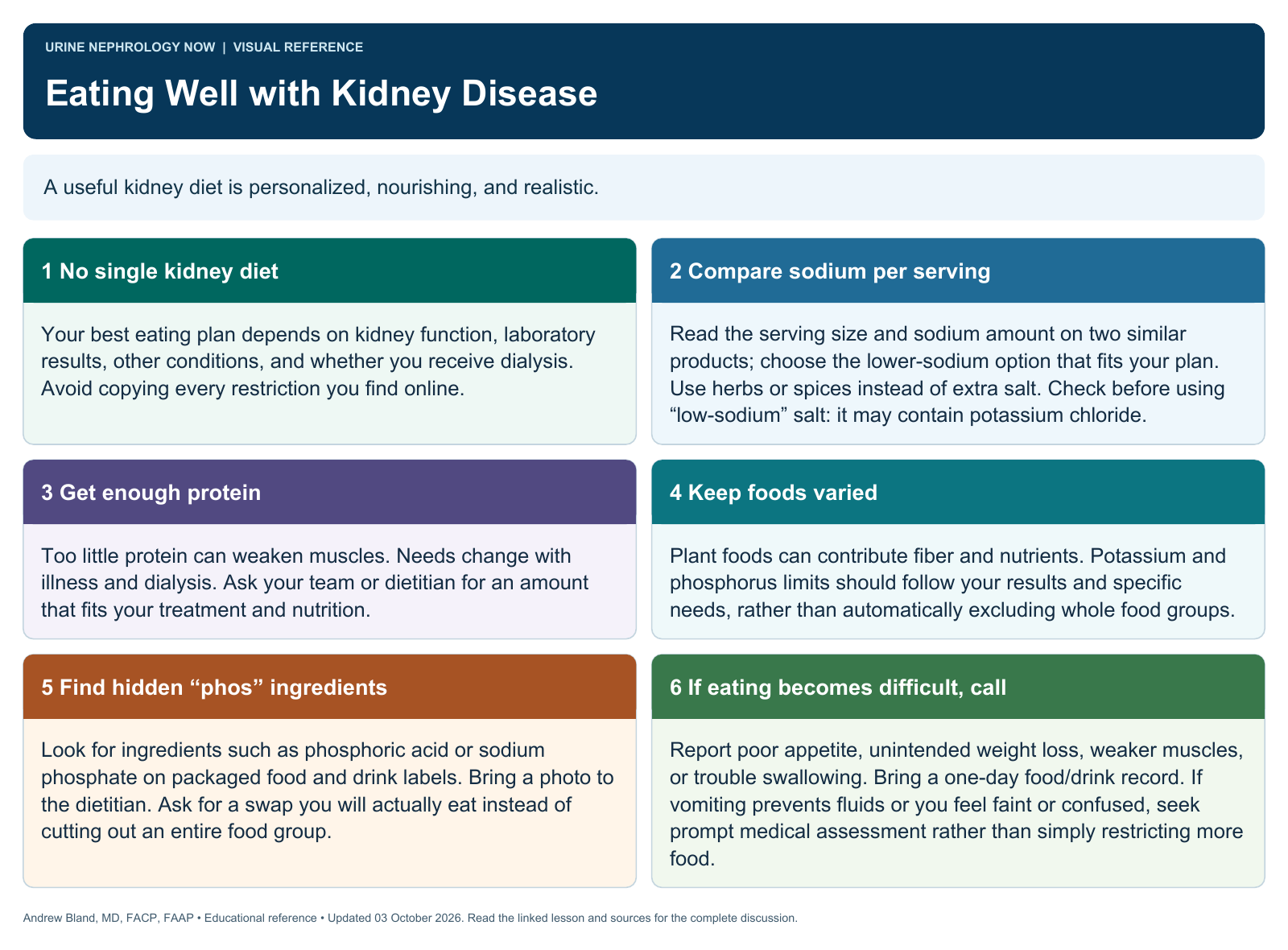
Browse the visual reference library · Download lesson Markdown
There is no one kidney diet
You may have read strict rules online, or heard them from a friend on dialysis, and assumed they apply to you. They may not. What is right for you depends on how well your kidneys are working, your age, whether you are on dialysis, your recent blood tests, and how well nourished you are.
Even kidney experts disagree about some of these rules — and when the experts split, it usually means the evidence behind the rule is weaker than it sounds. That is why your own kidney team's advice, built around your numbers, beats any generic list you find elsewhere.
Start with sodium (salt)
If you change one thing, make it sodium. Too much sodium makes your body hold on to water, which raises your blood pressure and asks your heart and kidneys to work harder. Most people with kidney disease feel better, and have steadier blood pressure, when they cut back.
Here is the part that surprises people: most of the sodium you eat does not come from the salt shaker. It is already baked into packaged, canned, and restaurant food before it reaches your plate. A common goal is to stay under about 2,000 milligrams of sodium a day — roughly one teaspoon of salt from all sources combined. Reading labels and cooking more at home does far more than simply putting the shaker away.
| Often high in sodium | A lower-sodium swap |
|---|---|
| Canned soups and canned vegetables | Low-sodium or "no salt added" versions; rinse canned beans |
| Deli meats, bacon, sausage, hot dogs | Fresh roasted chicken, turkey, or fish |
| Frozen dinners and boxed meal kits | Home-cooked meals you can portion and freeze yourself |
| Chips, salted crackers, salted nuts | Unsalted nuts, fresh fruit, plain popcorn |
| Table salt and seasoning-salt blends | Herbs, garlic, lemon, pepper, salt-free spice blends |
Salt substitutes are worth a word of caution: many replace sodium with potassium, which is not automatically safe for kidney patients. Ask your team before you use one.
Protein: aim for the middle, not the extremes
Protein is where a lot of kidney-diet advice goes wrong. For years, patients were told to eat as little protein as possible to "spare" the kidneys. We now know that story was oversold. The largest studies never showed a clear benefit from strict protein limits, and people placed on the most extreme low-protein diets sometimes did worse rather than better — because cutting protein too far costs you muscle.
So the goal is the middle, not either extreme:
- Not too much. Eating very large amounts of protein every day — big meat servings plus protein shakes on top — can push tired kidneys to work harder over time.
- Not too little. Cutting protein too far leads to muscle loss and weakness. That is genuinely dangerous, especially as you get older, because it leads to falls and loss of independence.
For most people with earlier kidney disease, a normal, sensible amount of protein is the right target — there is no need to restrict at all. Your kidney team can give you a number that fits your kidney function and your body. Do not guess, and do not crash-cut protein on your own.
A very strict, specially supplemented low-protein diet can slow things down for a small, carefully chosen group of people with advanced kidney disease. It only works with close guidance from a kidney dietitian and regular monitoring — and it is not right for most patients. If this has never been offered to you, that is usually because you are not one of the few people it suits.
Build your plate around plants
Where your protein comes from matters, not only how much of it you eat. Shifting some of your protein from animal sources to plants — beans, lentils, tofu, nuts, and whole grains — appears to be easier on the kidneys and better for your heart.
You do not have to become a vegetarian. Swapping even a few meat meals a week for plant-based ones is a real step forward. Eating this way naturally adds fiber and cuts back on the saturated fat that raises heart risk, which counts for a lot: heart disease, not kidney failure, is the biggest threat to most people with kidney disease.
Potassium and phosphorus: only if your numbers say so
This is the section most worth getting right, because so many people restrict these minerals when they do not need to. Limits on potassium and phosphorus are not blanket rules for everyone with kidney disease. They depend on your blood tests and how advanced your kidney disease is.
Potassium. Your kidneys help keep potassium in balance. If yours runs high on blood tests, your team may ask you to ease up on certain high-potassium foods. But if your potassium is normal, there is usually no reason to avoid healthy foods like fruit and vegetables just because they contain potassium — many of them are exactly what is good for your heart.
Phosphorus. Phosphorus tends to climb later, in more advanced kidney disease and on dialysis. When it does apply, the most useful move is to cut phosphate additives — the ingredients hidden in processed foods, fast food, deli meats, and dark colas. Check labels for "PHOS." Your body soaks up those additives far more easily than the phosphorus that occurs naturally in whole foods, so dropping them gives you the biggest benefit for the least sacrifice.
| Change | Who it applies to |
|---|---|
| Lower sodium | Almost everyone with kidney disease |
| Sensible protein (usually no restriction) | Most people; a strict low-protein diet only for a select few |
| More plants | Almost everyone; good for kidneys and heart |
| Limit potassium | Only if your blood potassium is high |
| Limit phosphorus (especially additives) | Mainly advanced kidney disease and dialysis |
Let your medicines carry the load
Here is something that gets lost in all the talk about food: the medicines your kidney doctor prescribes do more to protect your kidneys than any diet. Two newer groups stand out. SGLT2 inhibitors (such as empagliflozin, sold as Jardiance, and dapagliflozin, sold as Farxiga) and GLP-1 medicines (such as semaglutide, sold as Ozempic) have been shown in large studies to slow kidney disease and help people live longer — results no diet has matched.
Eating well supports these medicines; it does not replace them. Take them as prescribed, and think of your food choices as the partner to your treatment rather than the whole of it.
When the usual advice flips
A few groups should set the "eat less protein" message aside entirely:
- Older adults. As you age, protecting muscle protects your independence — your ability to stand, walk, and avoid falls. Older adults with kidney disease usually need more protein, not less.
- People on dialysis. Dialysis pulls protein out of your body, so your needs go up, not down. If you are on dialysis and were told to limit protein, ask about it — the rules are different for you.
- Children. Kids need protein to grow. Protein is never restricted in children with kidney disease.
Signs your diet may be doing more harm than good
• Losing weight without trying, or your clothes getting loose
• Feeling weaker, tiring easily, or struggling to get up from a chair
• Loss of appetite, or skipping meals because food does not appeal to you
• A blood test showing your albumin — a marker of nutrition — is dropping
• Diet rules so strict that you can barely find anything to eat
These can be signs of poor nutrition, which is more dangerous for people with kidney disease than most realize. A stricter diet is not always a safer diet. If eating well has started to mean eating too little, that is a reason to check in, not to push harder.
Questions worth asking your kidney team
- Given my kidney function, how much protein should I eat — and do I really need to restrict it at all?
- Do my recent blood tests mean I need to limit potassium or phosphorus, or can I eat normally?
- What sodium target should I aim for, and where is most of my sodium coming from?
- Would seeing a kidney dietitian help me build a plan that fits my life?
- Am I on the medicines, such as an SGLT2 inhibitor, that protect my kidneys?
- Are any of my current food restrictions ones I no longer need?
About this guide
This guide is based on current international kidney-care guidelines (KDIGO) and the medical literature.
Related pages on urinenephrology.org: