Diuretics in the Exercising Cardiac-Rehab Patient
Volume, electrolytes, orthostasis — every visit, every patient.
Visual reference
Open the visual review after completing the case
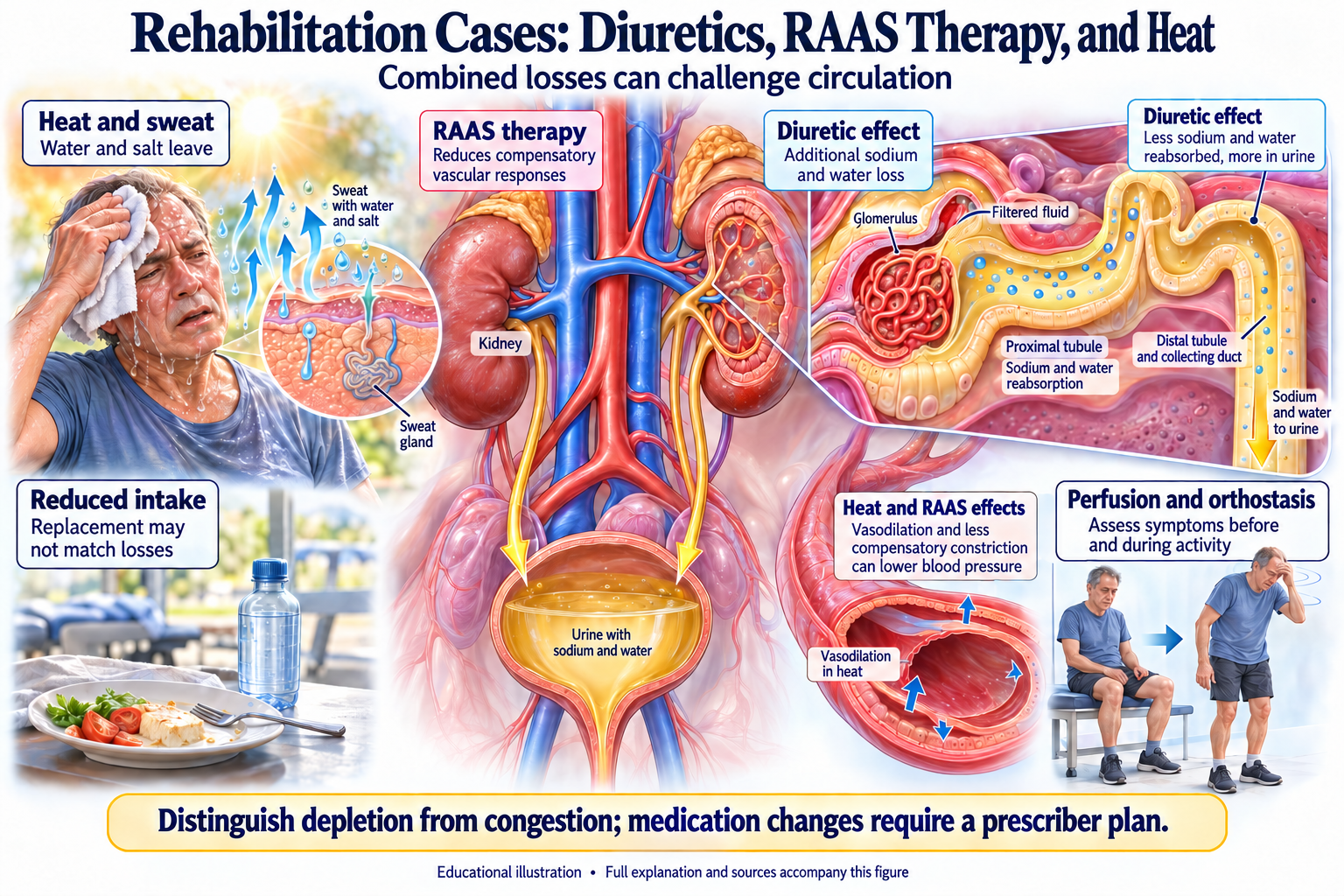
Browse the visual reference library · Download lesson Markdown
🔗 Cross-Linked Track 1 Handouts & Lectures
This case integrates the diuretic class story with the shipped Track 1 PT handouts and the UDPA cardiorenal / hypertension lectures.
💧 Hydration PT handout
The primary cross-link. Diuretic patients live on the volume axis.
💊 NSAIDs PT handout
Triple-whammy AKI. And — gout flares on loop/thiazide; do NOT reach for ibuprofen.
💉 GLP-1 RA PT handout
Dehydration stacking in summer / heat; combined GI losses.
🥩 Protein PT handout
Sick-day diuretic hold + adequate protein through recovery.
🎯 Lecture Alignment & the Diuretic Class Map
This case reinforces three existing UDPA lectures:
2025_UDPA_Lectures_Live/cardiorenal-disease/hf-diuretic-resistance.html— the primary diuretic teaching at UDPA. Covers loop + thiazide + MRA pharmacology, diuretic resistance mechanisms (hypoalbuminemia, reduced renal perfusion, diuretic braking), and the ADVOR 2022 acetazolamide-added-to-loop approach[4].2025_UDPA_Lectures_Live/hypertension/diuretic-selection.html— class selection in HTN.2025_UDPA_Lectures_Live/hypertension/thiazide-safety.html— thiazide-specific teaching.
| Class | Agents (brand) | Site of action & effect | PT-relevant signal | Anchor trial(s) |
|---|---|---|---|---|
| Loop | Furosemide (Lasix), torsemide (Demadex), bumetanide (Bumex) | Thick ascending limb NKCC2 blockade → big Na⁺/Cl⁻/K⁺/Mg²⁺ losses → potent volume removal | Hypokalemia, hypomagnesemia, orthostasis, gout flares, post-dose urgency (timing vs session) | Used across HF GDMT alongside MRA + RAAS + β-blocker + SGLT2i |
| Thiazide | HCTZ, chlorthalidone, metolazone, indapamide | Distal convoluted tubule NCC blockade → modest Na⁺/Cl⁻ loss, K⁺ wasting, Ca²⁺ retention | Hypokalemia, hyponatremia (classic "thiazide hyponatremia" in older women), gout, photosensitivity | Long HTN history; CLOROTIC 2023 added HCTZ to loop in ADHF |
| MRA (K⁺-sparing) | Spironolactone (Aldactone), eplerenone (Inspra); non-steroidal: finerenone (Kerendia) | Aldosterone receptor antagonism in collecting duct → K⁺-sparing diuresis + anti-fibrotic / anti-remodeling effect | Hyperkalemia — not hypokalemia. Gynecomastia / breast tenderness (spironolactone). HFrEF + HFpEF mortality and hospitalization signals. | RALES (spironolactone, severe HFrEF; 30% mortality reduction)[1]; EPHESUS (eplerenone, post-MI + LV dysfunction; 15% mortality reduction; hyperkalemia 5.5% vs 3.9%)[2]; TOPCAT (spironolactone, HFpEF; primary composite NS; HF hospitalization reduced; hyperkalemia doubled 18.7% vs 9.1%)[3]. |
| Carbonic anhydrase inhibitor (adjunct) | Acetazolamide (Diamox) | Proximal tubule carbonic anhydrase → reduces proximal Na⁺ reabsorption → more Na⁺ delivered to loop for loop-diuretic action | In hospital / acute decompensated HF; PT usually sees the outpatient downstream. Know the name and the indication. | ADVOR 2022 — IV acetazolamide 500 mg daily added to IV loops in ADHF improved decongestion at 3 days (42.2% vs 30.5%; RR 1.46, 95% CI 1.17–1.82)[4]. |
Conceptual split to memorize: loops + thiazides cause hypokalemia; MRAs cause hyperkalemia. Adding them together is how HF prescribers balance the K⁺ — not a PT decision, but a PT must know why the combination exists.
🎯 Learning Objectives
By the end of this case, the DPT student will be able to:
- Identify the four diuretic classes in the cardiac-rehab panel — loop / thiazide / MRA / CA inhibitor — and recognize their distinct electrolyte and volume signals.
- Apply daily weights and orthostatic vitals as the primary PT-facing volume-status tools, with specific thresholds for escalation.
- Recognize hypokalemia (loop/thiazide), hyperkalemia (MRA), and hypomagnesemia (loop) presentations the PT might see during exercise.
- Time PT sessions around diuretic dosing to minimize urinary urgency and orthostasis interference.
- Differentiate true diuretic resistance from non-adherence / over-restriction / diet-driven sodium reload and escalate appropriately.
- Recognize the triple-whammy AKI trap (NSAID + ACEi/ARB + loop/thiazide) and the gout-with-loop trap (do NOT recommend ibuprofen).
- Execute sick-day-hold counseling for intercurrent illness / heat exposure / GLP-1 RA GI losses.
- Counsel adherence, dose timing, daily weights, and "when to call" using tested patient language.
🧪 Pre-Case Assessment — Test Your Baseline
Click an answer to see the explanation. You can change your answer anytime.
Your cardiac-rehab patient on furosemide 40 mg BID + spironolactone 25 mg daily arrives with standing BP 98/60 (supine 118/72), mild lightheadedness on rising, and mentions she "doubled up on her Lasix" yesterday because she retained water after a salty dinner. The single best next PT action is:
Learning Point: Patient self-doubling is a red flag — it signals both an acute volume issue and a counseling gap. The PT's job is to hold or modify the session for safety, document the event, escalate same-day to the prescriber, and reinforce the non-negotiable rule: diuretic dose changes belong to the prescriber. PTs do not tell patients to stop or bolus fluids.
📚 Reference: See Visit 1 on orthostasis management.
Same patient, next visit. Labs from yesterday: K⁺ 5.8 mEq/L, Cr 1.4 (up from baseline 1.1). She started a twice-daily ibuprofen for "knee flare" three days ago. The most likely mechanism of the labs is:
Learning Point: The "triple whammy" (NSAID + RAAS blocker + diuretic) raises AKI risk approximately 31% overall and higher in the first 30 days of the combination (Lapi 2013). Spironolactone on top of falling GFR dangerously retains K⁺. This is the highest-yield OTC-screen question in cardiorenal PT — always ask about ibuprofen/naproxen at every visit.
📚 Reference: See Visit 2 on triple-whammy AKI.
A different patient on HCTZ + lisinopril for HTN reports a painful red great-toe MTP joint. He asks if he should take ibuprofen. The best PT response is:
Learning Point: Thiazides elevate uric acid and can precipitate acute gout — a known class effect. Adding an NSAID on top of HCTZ + ACEi creates the triple whammy. The right framing: recognize the gout/triple-whammy collision, escalate for proper gout therapy (colchicine, short-course prednisone, or an IA injection), and keep the PT lane clean — no medication start/stop decisions.
📚 Reference: See Visit 3 on thiazide-induced gout.
🧑⚕️ Patient Presentation
Mr. D. is a 66-year-old retired carpenter with HFrEF (LVEF 28%), T2DM (HbA1c 7.4%), HTN, obesity (BMI 33), and CKD stage 3a (eGFR 54 mL/min/1.73 m²). Admitted 3 weeks ago for a decompensated-HF flare (excess dietary sodium + missed doses). Discharged 10 days ago on guideline-directed medical therapy and referred to outpatient cardiac rehab.
| Medication | Dose | Indication |
|---|---|---|
| Furosemide (Lasix) | 40 mg BID | Congestion / volume |
| Spironolactone | 25 mg daily | HFrEF GDMT (RALES)[1] |
| Sacubitril-valsartan (Entresto) | 49/51 mg BID | HFrEF GDMT (ARNI) |
| Carvedilol | 12.5 mg BID (titrating) | HFrEF GDMT (see Case 26) |
| Empagliflozin | 10 mg daily | HFrEF + T2DM + CKD (see Case 27) |
| Metformin | 1,000 mg BID | T2DM |
| Atorvastatin | 40 mg daily | Primary prevention |
| Aspirin | 81 mg daily | CV prevention |
| Potassium chloride | 20 mEq daily | Offset loop-diuretic K⁺ losses |
He's motivated. His wife has the HF-clinic dietitian's business card on the fridge. He tells you he weighs himself every morning and writes it on the calendar. His best friend just started a GLP-1 RA and lost 30 lb; Mr. D. wonders if he should ask his cardiologist about one.
Intake vitals (today, seated, 90 minutes after morning furosemide):
| Measure | Value | Context |
|---|---|---|
| BP (seated) | 116 / 70 mmHg | Acceptable |
| BP (standing, 1 min) | 104 / 64 mmHg | Borderline orthostatic (−12 mmHg SBP; mild symptoms) |
| HR (seated / standing) | 62 / 68 bpm | Carvedilol-blunted rise (see Case 26) |
| Weight (today vs yesterday AM) | 92.1 kg (−0.5 kg overnight) | Post-diuresis trend; stable |
| Weight (vs last visit) | −1.8 kg over 7 days | Likely loss of residual congestion |
| SpO₂ | 97% | Normal |
| Lower extremities | Trace edema left ankle; resolved right | Improving |
| Last furosemide dose | About 90 min ago | Peak natriuresis window |
🔄 Visit 1 — Dose Timing, Orthostasis, Daily Weights
Scenario 1A — "I took my Lasix an hour before driving here"
He laughs about needing the bathroom on the way over. Your clinic is 25 minutes from his house.
Yes — session timing is a teachable PT move.
- Furosemide's peak natriuresis is about 1–2 hours post-oral-dose; urinary urgency is highest at that window.
- For an outpatient PT session, align his dose so peak diuresis has passed before he starts exercising. Two typical patterns:
- Schedule PT in the afternoon (at least 3–4 hours after the AM dose).
- Or have him take the morning dose AFTER he arrives at clinic and uses the restroom — but confirm with the prescribing clinician that moving the dose is acceptable.
- Either way, have the restroom location explicit at intake, and budget for a mid-session break without the patient having to ask.
PT action: document the dose-to-session interval, schedule his next visit for a better window, do NOT tell him to hold or delay the dose without prescriber awareness.
Scenario 1B — the 12-mmHg orthostatic drop with symptoms
Standing BP 104/64 with mild lightheadedness after 1 min. He's been told to limit fluids to 1.8 L/day per HF clinic.
Modify, don't fully hold — with explicit criteria for escalation.
The orthostatic drop is real but below the 20-mmHg-plus-symptoms threshold for an automatic hold. It has multiple contributors:
- Loop diuretic peak — 90 min post-dose is peak volume loss.
- MRA additive effect — spironolactone adds modest natriuresis.
- ARNI vasodilation — sacubitril-valsartan lowers BP.
- Carvedilol — α1 vasodilation on top of β-blockade (see Case 26).
- SGLT2i osmotic diuresis — empagliflozin adds low-level ongoing fluid loss (see Case 27).
- Appropriate fluid restriction — 1.8 L/day is HF-target, not dehydration; fluid status is a prescribed balance, not a "push fluids" scenario (see Hydration PT handout).
PT actions today:
- Modify intensity — RPE 9–11 today (he's usually at 11–13).
- Slow the sit-to-stand transitions; use a gait belt; watch for symptoms.
- Recheck orthostatic vitals mid-session and end-of-session.
- Escalate if SBP drop ever exceeds 20 mmHg with symptoms, or if new symptoms develop (see Red Flag table).
- Schedule the next visit outside the diuretic peak window.
Scenario 1C — the daily weight conversation
He proudly shows you his calendar. Weights for the past 10 days — all within 1 kg, trending slightly down. Today is his first weight below 92 kg since hospitalization.
Validate hard, then tighten the thresholds.
- Daily weights are the single most powerful home volume-monitoring tool in HF. He has the habit locked in — praise it explicitly.
- Call-the-clinic thresholds (laminate or text him):
- Up >2 lb overnight.
- Up >5 lb in a week.
- Any rapid gain plus new SOB / edema / orthopnea / PND.
- Same scale, same time (morning, after voiding, before eating), same minimal clothing. Write it on the calendar. Use a digital scale that stores history.
PT script: "This calendar is doing half of your cardiologist's job. Keep doing it exactly. If you ever go up more than two pounds overnight or more than five pounds in a week, call the HF clinic before your next visit. That's fluid — your heart and kidneys notice it long before you feel it."
🔄 Visit 2 — One Week Later: Labs + NSAID Confession
Scenario 2A — new ibuprofen use + labs out of whack
Mr. D. reports starting ibuprofen 400 mg three times daily four days ago after he "tweaked his knee" loading firewood. He felt good enough that he also restarted yardwork and ate pizza Friday night ("It was one slice!"). HF clinic ran labs yesterday: K⁺ 5.8, Cr 1.4 (baseline 1.1), BUN 42. They called for a same-day visit.
🚩 Textbook triple-whammy AKI + MRA-amplified hyperkalemia
Three drug categories are colliding:
- NSAID (ibuprofen) — blocks prostaglandin-mediated afferent arteriolar dilation.
- RAAS blockade (sacubitril-valsartan ARNI component) — blocks efferent arteriolar vasoconstriction.
- Diuretic (furosemide ± MRA component of spironolactone) — lowers intravascular volume.
The result is a predictable drop in glomerular perfusion pressure → hemodynamic AKI. Lapi et al. (2013) quantified it in 487,372 patients: adding an NSAID to ACEi/ARB + diuretic raises AKI risk 31% overall (RR 1.31, 95% CI 1.12–1.53); the highest risk is the first 30 days of the combination (RR 1.82, 1.35–2.46)[5].
The K⁺ 5.8 layers on top. Spironolactone holds K⁺ in at baseline. Add AKI (reduced K⁺ excretion) plus a potassium chloride supplement plus RAAS blockade and you get hyperkalemia.
PT actions:
- Hold today's session. Exercise into an AKI + hyperkalemia state is not safe.
- Counsel him to stop the ibuprofen now. Reinforce the NSAIDs PT handout bundle for the knee — topical Voltaren gel, lidocaine patch, percussion massage, ice, acetaminophen within limits.
- Do NOT adjust furosemide, spironolactone, sacubitril-valsartan, or the K⁺ supplement on your own — prescriber's call.
- Call the HF clinic and relay the NSAID use + current vitals. This changes their plan.
- Patient education: if a knee flare happens again, call BEFORE starting any OTC pain medication.
Scenario 2B — "my leg cramped up last night"
After resolving 2A, Mr. D. mentions his left calf cramped hard around 2 AM last night and the day before. He sleeps with his window cracked; room temperature was fine.
Differential for nocturnal cramps on a loop diuretic:
- Hypokalemia from loop/thiazide effect — classic.
- Hypomagnesemia — loop diuretics waste Mg²⁺ along with K⁺. Hypokalemia that doesn't correct with K⁺ replacement is almost always concurrent hypomagnesemia — the Mg²⁺ is needed for cellular K⁺ retention.
- Hyponatremia — particularly in thiazide patients; less common on loop alone.
- Volume depletion — same story; weight and vitals trend will tell.
- Dehydration + reduced intake — summer / heat exposure / GI illness.
On this regimen, his baseline K⁺ is usually kept in a comfortable range by the spironolactone + K⁺ supplement combination — but the current AKI has tipped it the other direction. His Mg²⁺ was not drawn. Worth asking for.
PT actions:
- Flag the cramping and the timing to the HF clinic. Recommend Mg²⁺ be added to the lab panel.
- Do NOT counsel OTC magnesium supplementation on your own — in a patient with AKI and hyperkalemia, guessing at electrolyte replacement is unsafe.
- Reinforce nocturnal stretching / calf position and hydration within his HF fluid target.
Scenario 2C — the gout parallel — if loop/thiazide is the setup, NSAID is NOT the answer
Separately, a different Mr. D. (your 3 PM slot, not the HFrEF patient) is on chlorthalidone 25 mg + lisinopril 40 mg for HTN. He hobbles in with a hot, swollen, red first MTP joint. He is looking at a bottle of ibuprofen he just bought at the gas station.
Almost certainly gout. Do NOT let him take the ibuprofen. Same-day primary-care / urgent-care route.
- Thiazides precipitate gout — reduce uric-acid excretion → hyperuricemia → crystal deposition.
- NSAID (ibuprofen) + ACEi (lisinopril) + thiazide (HCTZ/chlorthalidone) = the classic triple-whammy AKI setup[5] — and you're about to hand him the NSAID.
- The standard first-line gout treatments in this scenario are oral colchicine or a short course of oral prednisone — not NSAIDs. Prescribing clinician's call; the PT role is preventing harm, routing the patient, and not endorsing the OTC NSAID.
PT script: "That looks like gout, and I need you to not take the ibuprofen. Your diuretic and your lisinopril plus the ibuprofen are a bad combination for the kidneys. Let's get you to urgent care or your PCP today — they'll treat the gout with colchicine or a short steroid course, not an over-the-counter anti-inflammatory. I'll call ahead."
🔄 Visit 3 — Summer Heat & GLP-1 Conversation
Scenario 3A — heatwave, reduced intake, GLP-1 on board
Three weeks later it's 95°F. Mr. D. restarted empagliflozin + semaglutide last week (the cardiologist added the GLP-1 RA for weight loss and additional CV/renal benefit). He reports nausea from semaglutide titration and reduced food and water intake yesterday and today.
This is the sick-day stack. Multiple agents compound the volume-depletion + AKI risk.
- Furosemide — volume loss.
- SGLT2i (empagliflozin) — osmotic diuresis + peri-titration volume effects + euglycemic DKA risk if intake is poor (see Case 27).
- GLP-1 RA (semaglutide) — GI losses + reduced intake (see GLP-1 PT handout).
- RAAS blockade (sacubitril-valsartan) — reduced GFR tolerance during volume loss.
- Heat exposure — additional sensible + insensible losses.
PT actions:
- Hold today's session. This is not a day to exercise into a stacked-risk volume state.
- Contact the HF / endocrinology team immediately. Sick-day rules may require holding empagliflozin, semaglutide, and possibly furosemide until he is eating, drinking, and the heat exposure has resolved — prescriber's call, not yours.
- Counsel him NOT to push fluids beyond his HF target without prescriber input — he has HFrEF, and large volumes of free water can trigger decompensation.
- Reinforce the red-flag thresholds (fever, dark urine, severe lightheadedness, chest symptoms, euglycemic-DKA pattern) and the go-to-ED triggers.
Scenario 3B — "diuretic resistance" — real or self-made?
Different context, a month later: Mr. D. is back to baseline function. But his weight has crept up 4 lb over the last 10 days. He says "the Lasix isn't working anymore" and is frustrated.
The PT's job is to distinguish without diagnosing. Escalate with data.
Per the UDPA HF Diuretic Resistance lecture, true diuretic resistance has several mechanisms: dietary sodium excess, diuretic braking (tubular remodeling on chronic loop), hypoalbuminemia (in HF with low albumin), reduced renal perfusion, and pharmacokinetic issues. PT can ask the questions that help the prescribing team sort this out.
PT assessment questions:
- Adherence — is he taking the dose as prescribed? Morning + afternoon? Not skipping? Check with the patient and (with consent) the pharmacy refill history.
- Sodium intake — has the kitchen changed? Restaurant meals? Processed foods? A single pizza night can hold 3–5 lb of water weight for several days.
- Fluid intake — exceeding his HF target?
- Timing of weight change vs diet change vs dose change.
- Other new drugs — NSAIDs, steroids, new SGLT2i stop, anything that could retain fluid.
Often the "diuretic resistance" story at outpatient PT turns out to be dietary or adherence. When it isn't, the prescribing team's tools include torsemide switch (better bioavailability than furosemide in HF), IV-bolus therapy, thiazide add-on (CLOROTIC approach), or acetazolamide add-on (ADVOR protocol)[4] — but those are all their decisions, not yours. PT move: gather the data, present it cleanly to the HF clinic, do not attempt the dose adjustment independently.
🧠 Key Teaching Points
Pearl 1 — Daily weights are the home volume monitor
+2 lb overnight or +5 lb in a week = call. Pair with orthostatic vitals at every PT visit. These two tools catch volume derangement before the patient feels it.
Pearl 2 — Electrolyte split by class
Loop + thiazide → hypokalemia ± hypomagnesemia. MRA (spironolactone / eplerenone) → hyperkalemia. Refractory hypokalemia on a loop means check magnesium. Hyperkalemia on MRA + RAAS + AKI stacks fast.
Pearl 3 — Time the session around the dose
Peak natriuresis is approximately 1–2 hours post-oral loop. Schedule PT outside that window, or have the patient take the dose after arrival and use the restroom.
Pearl 4 — The triple whammy is the deadliest drug-drug story in the clinic
NSAID + ACEi/ARB/ARNI + diuretic (loop or thiazide or SGLT2i-as-diuretic) raises AKI risk 31% overall, 82% in the first 30 days[5]. Ask about OTC meds every single visit. Cross-link: NSAIDs PT handout.
Pearl 5 — Gout on loop/thiazide is not an NSAID scenario
Thiazides (and loops to a lesser extent) precipitate gout. Adding ibuprofen to a patient on ACEi/ARB + diuretic is the triple whammy. Route to colchicine / short-course prednisone — prescriber decides.
Pearl 6 — Sick-day hold is real
Intercurrent illness, GI losses, heat exposure, GLP-1 GI symptoms → hold the diuretic stack (and SGLT2i, and RAAS blockade) only on prescriber instruction. Your job is to recognize the setup and call, not to instruct the hold yourself.
Pearl 7 — "Diuretic resistance" — distinguish before you escalate
Before blaming the drug, work through adherence, sodium intake, fluid intake, and new-drug interactions. Present the clinical data cleanly; let the prescriber decide whether to switch agents (torsemide), add thiazide (CLOROTIC), or add acetazolamide (ADVOR)[4].
🚩 Red Flag Summary Table
Any of these → pause the session, act, and escalate or route to ED per severity.
| Finding | PT action |
|---|---|
| Weight up >2 lb overnight or >5 lb in a week | Hold session if symptomatic; call HF clinic |
| Orthostatic drop >20 mmHg SBP with symptoms after rehydration within HF fluid target | Hold session; escalate |
| New dyspnea, orthopnea, PND, dramatic new edema | Hold; urgent HF-clinic contact |
| New ibuprofen / other NSAID use | Flag urgently — triple-whammy AKI risk; counsel stop + route to prescriber |
| Acute mono-articular red hot joint on thiazide + ACEi/ARB | Likely gout; do NOT endorse NSAID; route same-day to PCP / urgent care |
| Refractory cramps, fatigue, palpitations | Possible hypokalemia / hypomagnesemia — flag for labs |
| Palpitations, chest heaviness, new arrhythmia sensation on MRA | Possible hyperkalemia — ED if severe; PCP / HF same-day if mild |
| Sick-day pattern: nausea, vomiting, diarrhea, reduced intake, summer heat, GLP-1 titration GI | Hold session; coordinate diuretic hold with prescriber |
| Patient self-doubles or skips a diuretic dose | Document; call prescriber same-day; reinforce "never self-adjust" |
| "My Lasix stopped working" with weight gain | Assess adherence, sodium intake, new drugs; escalate to HF clinic with data |
| Euglycemic DKA pattern in diabetic on SGLT2i + diuretic + reduced intake | ED immediately — see Case 27 |
🗣️ Patient Teaching Scripts
The "daily weights" script
"Weigh yourself every morning, same time, same scale, right after you empty your bladder, before you eat. Write it on the calendar on your fridge. Call me or your HF clinic if you go up more than two pounds overnight or more than five pounds in a week. That's fluid — your heart knows before you do."
The "never self-adjust" script
"Do not take an extra Lasix because the scale went up. Do not skip a dose because you feel dizzy. Do not stop the spironolactone because of the breast tenderness — call us first. Every one of those medicines is dosed for a specific balance in your heart and kidneys. Changing it on your own can flip you to the other kind of trouble. If something is wrong, call."
The "no ibuprofen — ever — without calling" script
"Ibuprofen, Advil, Motrin, naproxen, Aleve — all of them — do not go well with your current combination of medicines. They can make your kidneys fail and drop your blood pressure. Any ache you would normally use them for — knee, back, sinus — call me first. We have gel, patches, ice, acetaminophen within limits, and a whole bundle of safer tools."
The "dose timing" script
"Your water pill works hardest about one to two hours after you take it. Let's schedule your sessions so you don't have to do squats during the peak. Either take the morning dose after you get here, or schedule the afternoon visits — whichever your cardiologist okays."
The "sick-day" script
"Any day you are throwing up, have diarrhea, can't keep fluids down, have a bad flu, or are dealing with a heatwave without air conditioning — call the HF clinic before your next Lasix dose. They'll tell you whether to hold it, and probably also the spironolactone, the ARNI, and the empagliflozin. Trying to tough it out on all those medicines with your body dry is how people end up in the hospital."
The "gout" script
"Your thiazide makes gout more likely. If your big toe or another single joint becomes hot, red, and swollen, that is probably gout. Do NOT take ibuprofen. Call me or your PCP the same day — the right treatment is usually colchicine or a short steroid course. Ibuprofen is a disaster in your medication combination."
📚 References
- Pitt B, Zannad F, Remme WJ, Cody R, Castaigne A, Perez A, Palensky J, Wittes J; Randomized Aldactone Evaluation Study Investigators. The effect of spironolactone on morbidity and mortality in patients with severe heart failure. N Engl J Med 1999;341(10):709–17. PMID: 10471456. PubMed — RALES. Severe HFrEF; spironolactone reduced all-cause mortality 30% (RR 0.70, 95% CI 0.60–0.82). Hyperkalemia minimal when monitored; gynecomastia approximately 10% in men.
- Pitt B, Remme W, Zannad F, Neaton J, Martinez F, Roniker B, Bittman R, Hurley S, Kleiman J, Gatlin M; Eplerenone Post-Acute Myocardial Infarction Heart Failure Efficacy and Survival Study Investigators. Eplerenone, a selective aldosterone blocker, in patients with left ventricular dysfunction after myocardial infarction. N Engl J Med 2003;348(14):1309–21. PMID: 12668699. PubMed — EPHESUS. Post-MI with LV dysfunction + HF; eplerenone reduced all-cause mortality (RR 0.85, 0.75–0.96). Serious hyperkalemia 5.5% vs 3.9%; hypokalemia 8.4% vs 13.1%.
- Pitt B, Pfeffer MA, Assmann SF, Boineau R, Anand IS, Claggett B, Clausell N, Desai AS, Diaz R, Fleg JL, et al.; TOPCAT Investigators. Spironolactone for heart failure with preserved ejection fraction. N Engl J Med 2014;370(15):1383–92. PMID: 24716680. PubMed — TOPCAT. Primary composite NS (HR 0.89, 0.77–1.04, P=0.14); HF hospitalization reduced (HR 0.83, 0.69–0.99). Hyperkalemia doubled — 18.7% vs 9.1% on placebo.
- Mullens W, Dauw J, Martens P, Verbrugge FH, Nijst P, Meekers E, Tartaglia K, Chenot F, Moubayed S, Dierckx R, et al.; ADVOR Study Group. Acetazolamide in Acute Decompensated Heart Failure with Volume Overload. N Engl J Med 2022;387(13):1185–95. PMID: 36027559. PubMed — ADVOR. IV acetazolamide 500 mg daily added to IV loop → successful decongestion 42.2% vs 30.5% (RR 1.46, 95% CI 1.17–1.82).
- Lapi F, Azoulay L, Yin H, Nessim SJ, Suissa S. Concurrent use of diuretics, angiotensin converting enzyme inhibitors, and angiotensin receptor blockers with non-steroidal anti-inflammatory drugs and risk of acute kidney injury: nested case-control study. BMJ 2013;346:e8525. PMID: 23299844. PubMed — the triple whammy paper; 487,372 patients; rate ratio 1.31 (1.12–1.53); 1.82 (1.35–2.46) in first 30 days.
- Heidenreich PA, Bozkurt B, Aguilar D, et al. 2022 AHA/ACC/HFSA Guideline for the Management of Heart Failure. Circulation 2022;145(18):e895–e1032. PMID: 35363499. PubMed — current HF GDMT framework; loops for congestion, MRAs as Class I for HFrEF, SGLT2i across HFrEF/HFpEF. Context for this case.
Andrew Bland, MD, FACP, FAAP
Medical Associates Department of Nephrology · University of Illinois College of Medicine at Peoria · University of Dubuque PA & DPT Programs · Butler College of Osteopathic Medicine
Interactive PT teaching case · Track 2 · Case 2c
© 2026 · urinenephrology.org