ACEi / ARB / ARNI — RAAS Blockade in the PT Patient
Hyperkalemia, cough, angioedema, peri-op holds — and why exercise hemodynamics shift.
Visual reference
Open the visual review after completing the case
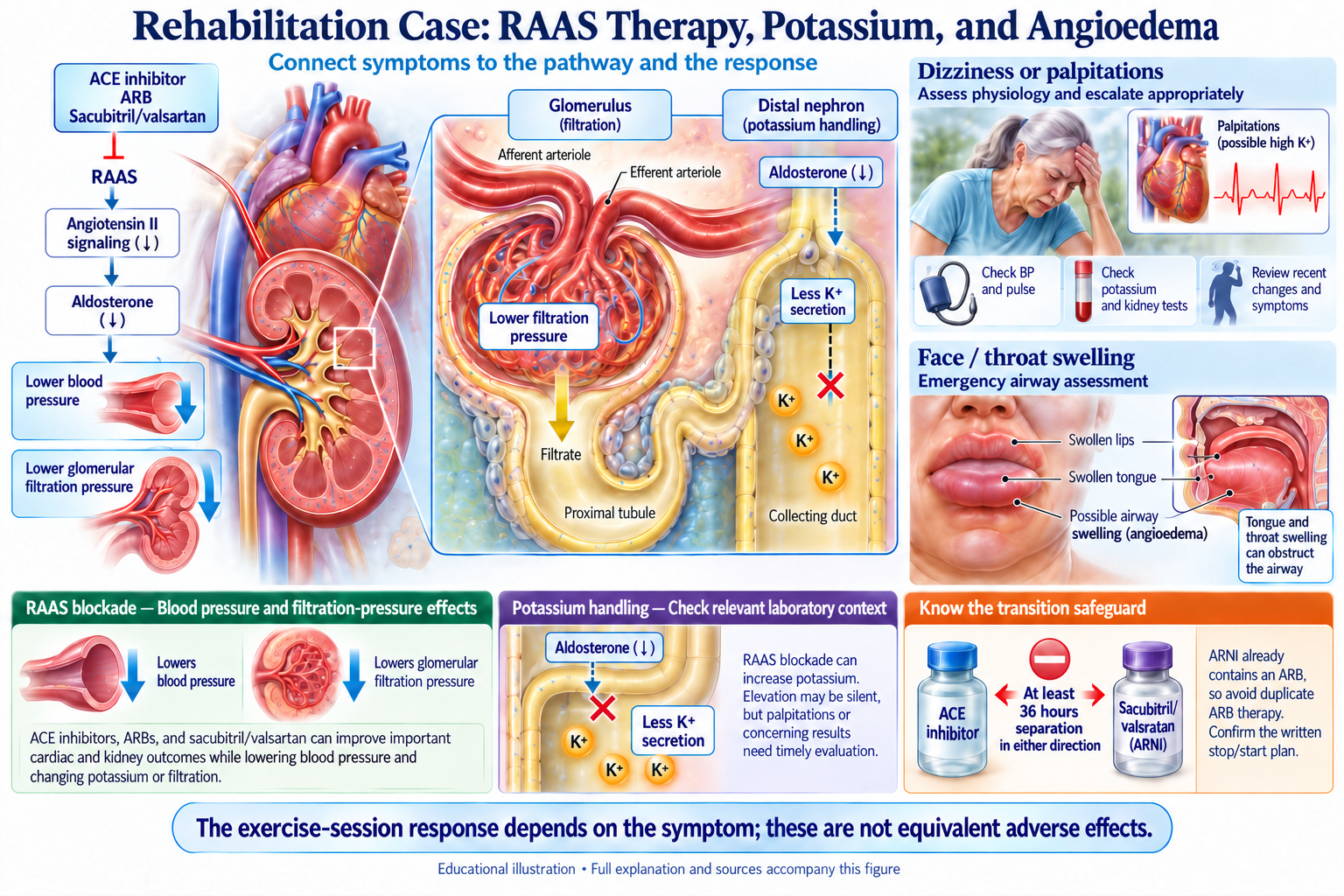
Browse the visual reference library · Download lesson Markdown
🔗 Cross-Linked Track 1 Handouts, Lectures, and Cases
This case completes the RAAS-blockade teaching thread and integrates with the shipped Track 1 handouts and the HFrEF cases.
🔬 RAAS Inhibitors Handout (PA/MD depth)
The comprehensive pharmacology reference. Read it for mechanism depth; this case is for PT decisions.
💊 NSAIDs PT handout
Triple-whammy AKI setup. The single most common ACEi/ARB harm in outpatient PT.
💧 Hydration PT handout
Volume-loss orthostasis is the co-conspirator with RAAS vasodilation.
💉 GLP-1 PT + 🫘 SGLT2i Case 27
Stacking volume/GFR risk in the modern HFrEF/T2DM/CKD polypharmacy patient.
🎯 Lecture Alignment & the RAAS-Blockade Class Map
This case reinforces two existing UDPA lectures plus the comprehensive pharmacology handout:
2025_UDPA_Lectures_Live/hypertension/ace-arb-comparison.html— the primary ACEi-vs-ARB comparison lecture. Covers mechanism, efficacy, side-effect profiles (cough, angioedema, hyperkalemia, renal), HFrEF, DKD, stroke, ARNI transition pharmacokinetics, losartan's uricosuric quirk.2025_UDPA_Lectures_Live/hypertension/arni-transition-protocols.html— sacubitril-valsartan (Entresto) transition protocol, including the 36-hour washout rule.student-resources/pharmacology/raas-inhibitors-student-handout.html— the PA/MD-depth RAAS handout. Pharmacokinetics table, adverse-effect detail, DKD/HF dosing. Read it for mechanism depth; this case gives PT-level decisions on top.
| Class | Agents (brand) | Core mechanism | PT-relevant distinctions | Anchor trial |
|---|---|---|---|---|
| ACE inhibitors | Lisinopril, enalapril, ramipril, perindopril, captopril, fosinopril, benazepril, quinapril | Block angiotensin-converting enzyme → ↓ angiotensin II (↓ efferent vasoconstriction, ↓ aldosterone) + ↑ bradykinin | Dry cough (15–20%) and angioedema (0.1–0.5%) are bradykinin-mediated. Lisinopril is renally cleared (accumulates in CKD). Enalapril and fosinopril have hepatic-metabolism routes. | SAVE (captopril post-MI; mortality benefit)[1]; HOPE (ramipril high-CV-risk; primary composite RR 0.78)[2] |
| ARBs | Losartan, valsartan, candesartan, irbesartan, olmesartan, telmisartan | Block AT1 receptor → similar hemodynamic + anti-remodeling effect without bradykinin accumulation | No cough. Angioedema <10% cross-reactivity if switched from ACEi. Losartan has a unique uricosuric effect (helpful in gout). | ONTARGET (telmisartan non-inferior to ramipril; combination = more harm, no benefit)[3] |
| ARNI | Sacubitril-valsartan (Entresto) | ARB (valsartan) + neprilysin inhibitor (sacubitril) → blocks Ang II AT1 receptor AND inhibits breakdown of natriuretic peptides | HFrEF GDMT (Class I). Greater BP drop and more non-serious angioedema than enalapril, but less cough, renal impairment, hyperkalemia. Requires 36-hour washout when switching from an ACEi (bradykinin accumulation risk during overlap). | PARADIGM-HF (sacubitril-valsartan vs enalapril; CV death or HF hosp HR 0.80, 95% CI 0.73–0.87)[4] |
| Direct renin inhibitor (historical, rarely used) | Aliskiren | Blocks renin → ↓ angiotensin I → ↓ angiotensin II | Not preferred in HFrEF; combination with ACEi/ARB harmful (ALTITUDE). Uncommon in cardiac rehab; know the name. | — |
Core PT idea: all three core classes — ACEi, ARB, ARNI — expand glomerular perfusion's dependence on intravascular volume. Efferent arteriolar tone is what sustains filtration when volume or perfusion drops. Block that, and any subsequent hit — NSAID, diuretic stacking, volume loss from GI illness or heat — drops GFR fast. This is the single most important PT-relevant mechanism in the class.
🎯 Learning Objectives
By the end of this case, the DPT student will be able to:
- Distinguish ACEi from ARB from ARNI by mechanism, adverse-effect profile, and PT-relevant signal.
- Recognize that RAAS blockade expands GFR dependence on intravascular volume — the reason "triple whammy" AKI is a RAAS-class phenomenon, not a diuretic phenomenon alone.
- Recognize hyperkalemia in the RAAS-blocked patient — symptoms, labs, risk-factor stacking (MRA, K⁺ supplement, AKI, T2DM autonomic-neuropathy K⁺ retention).
- Execute the ACEi cough → ARB switch counseling — it is a nuisance, not a danger, and the switch is routine.
- Identify angioedema (lip/tongue/face swelling) as an emergent class effect and route to EMS/ED without reassuring through it.
- Apply peri-op and contrast-study hold guidance in coordination with the prescribing team — NOT by counseling the patient to stop on their own.
- Know the 36-hour washout rule when switching from ACEi to ARNI, and why.
- Counsel pregnancy teratogenicity (2nd/3rd trimester absolute contraindication) in any woman of reproductive age on RAAS blockade.
🧪 Pre-Case Assessment — Test Your Baseline
Click an answer to see the explanation. You can change your answer anytime.
Your 64-year-old cardiac-rehab patient just switched from lisinopril to sacubitril-valsartan. She asks when the first dose was safe to take. The correct answer is:
Learning Point: Sacubitril (the neprilysin inhibitor component) prevents breakdown of bradykinin. ACEi also raises bradykinin. Overlapping them multiplies angioedema risk — hence the FDA-mandated 36-hour washout after the last ACEi dose. No washout needed when switching from an ARB (valsartan, losartan) since ARBs do not elevate bradykinin. This is a high-yield board and safety pearl.
📚 Reference: See Visit 1 on ARNI transition.
A woman in early pregnancy (8 weeks) is on lisinopril for hypertension. She mentions this at her cardiac-rehab intake. The PT's best response is:
Learning Point: ACEi/ARB/ARNI are all teratogenic — FDA category D (pregnancy). Fetal exposure in 2nd/3rd trimester causes oligohydramnios, renal dysgenesis, skull hypoplasia, and neonatal death. The urgency is "today, not next month." But the PT does not unilaterally stop a cardiac medication — same-day escalation to OB and the prescriber is the right play. Both actions (escalate urgently + don't self-direct the patient) must happen.
📚 Reference: See Visit 2 on pregnancy safety.
Your HFrEF patient on sacubitril-valsartan arrives with new lip swelling, tongue feeling "thick," and mild stridor onset over 30 minutes. The correct PT action is:
Learning Point: ACEi/ARNI angioedema is bradykinin-mediated — it does NOT respond to diphenhydramine or epinephrine the way anaphylaxis does. Airway management is the treatment. Any stridor, tongue/lip swelling, or voice change on an ACEi/ARNI = 911 immediately. Hold the ARNI; never rechallenge ACEi or ARNI after angioedema (class effect).
📚 Reference: See Visit 3 on angioedema recognition.
🧑⚕️ Patient Presentation
Mrs. L. is a 64-year-old retired nurse with HFrEF (LVEF 32%) from a large anterior STEMI four weeks ago. Coronary anatomy treated with LAD stenting. CKD stage 3a (eGFR 55) and T2DM on metformin + empagliflozin. She spent 11 days in-hospital, started on lisinopril 10 mg daily initially, then developed a persistent dry cough on day 12 out of hospital. Cardiology switched her to sacubitril-valsartan (Entresto) 49/51 mg BID after a 36-hour ACEi washout. She is 1 week into the ARNI, referred to outpatient cardiac rehab.
| Medication | Dose | Indication |
|---|---|---|
| Sacubitril-valsartan (Entresto) | 49/51 mg BID | HFrEF GDMT (post-PARADIGM-HF)[4] |
| Carvedilol | 12.5 mg BID (titrating) | HFrEF GDMT (see Case 26) |
| Spironolactone | 25 mg daily | HFrEF GDMT (see Case 28) |
| Empagliflozin | 10 mg daily | HFrEF + T2DM + CKD (see Case 27) |
| Furosemide | 20 mg daily | Mild residual congestion |
| Metformin | 1,000 mg BID | T2DM |
| Atorvastatin | 80 mg | ASCVD |
| ASA, clopidogrel | 81 mg / 75 mg | Post-stent DAPT |
She also has a planned elective cholecystectomy in 3 weeks for symptomatic cholelithiasis identified pre-MI. She mentions her daughter is pregnant and was also on lisinopril — made her ask questions about safety.
Intake vitals (today, seated, 90 min after morning Entresto):
| Measure | Value | Context |
|---|---|---|
| BP (seated) | 108 / 64 mmHg | Low-normal; Entresto has stronger BP effect than ARB or ACEi alone |
| BP (standing, 1 min) | 96 / 58 mmHg | −12 mmHg drop; mild lightheadedness |
| HR (seated / standing) | 58 / 64 bpm | Carvedilol-blunted rise |
| K⁺ (yesterday's labs) | 5.0 mEq/L | High-normal; MRA + ARNI at work |
| Cr (yesterday's labs) | 1.15 mg/dL (baseline 1.05) | Mild early-initiation rise; within expected range |
| eGFR (creatinine-based) | 53 mL/min/1.73 m² | CKD 3a; minimal change from baseline |
| Cough | None — resolved within 10 days of ACEi stop | Textbook ACEi-cough resolution |
🔄 Visit 1 — The Cough → ARNI Transition, Orthostasis, Upcoming Surgery
Scenario 1A — "I had to stop lisinopril because I was coughing all night"
She describes a dry, tickling cough that started about a week after lisinopril initiation, worsened at night, kept her from sleeping. Cardiology confirmed it was ACEi-cough, stopped lisinopril, waited 36 hours, then started sacubitril-valsartan. Cough resolved within 10 days.
Validate, explain the mechanism, anchor the future.
- ACEi cough is common — approximately 15–20% of patients. Dry, persistent, worse at night. It is bradykinin-mediated (ACE also breaks down bradykinin, so blocking ACE raises pulmonary bradykinin).
- It's a nuisance, not a danger — the drug is working and the benefit is real, but quality of life matters.
- ARB switch resolves it in the majority of patients because ARBs block the AT1 receptor downstream without touching bradykinin breakdown. ARNI (which contains an ARB) resolves it by the same mechanism.
- The 36-hour washout between ACEi stop and ARNI start is critical — the bradykinin accumulation risk from overlapping the two is a major angioedema trigger.
- Cross-reactivity for angioedema is under 10% when an ARB is substituted in an ACEi-angioedema patient. Her cough was not angioedema, so this does not apply directly to her — but worth knowing.
PT script: "That cough is a known side effect — about one in five people on that class gets it. It's not dangerous, but it's miserable. Switching to Entresto resolves it for most people, and it also happens to be better for your heart failure. Your cardiologist made the right call. If you ever get a new medication from this family, mention the cough history."
Scenario 1B — Upcoming cholecystectomy in 3 weeks
She mentions the surgery and the pre-op clearance visit is scheduled next week. She asks whether to stop her heart medicines before surgery.
Controversial and individualized. Your role: flag the issue to the surgical team, don't decide for the patient.
- Historical practice held ACEi/ARB 24 hours before anesthesia because of intraoperative hypotension risk. Recent data (POISE-3 substudies, STOP-or-NOT trial 2024) question universal hold — for HFrEF specifically, holding may worsen HF decompensation.
- For HFrEF patients, current 2022 AHA/ACC/HFSA HF guideline supports continuing GDMT (including RAAS blockade) through surgery when possible, with anesthesia team managing hypotension risk intraoperatively. Elective case with HFrEF is often: continue. Anesthesia should know the patient is on ARNI.
- Morning-of-surgery dose is the usual hold point when a hold is chosen — not days in advance.
- The SGLT2i hold (3 days; see Case 27) and the GLP-1 RA hold (1 week for semaglutide; see GLP-1 PT handout) are more clear-cut. Empagliflozin needs planning.
PT actions:
- Confirm the pre-op clearance visit is scheduled and the surgical team has her full medication list.
- Flag ARNI, spironolactone, SGLT2i, carvedilol, metformin — each has a different peri-op consideration. Ask her to bring the med list to pre-op.
- Do NOT tell her to hold any of these on your own. The anesthesia team makes the call, with cardiology input for HFrEF GDMT.
- Reinforce: no unilateral med changes; always through the prescribing clinicians.
Scenario 1C — the pregnant daughter question
Mrs. L. mentions her 32-year-old daughter is pregnant (second trimester) and was on lisinopril for mild HTN before pregnancy. Asks if she should be concerned.
Yes — absolutely concerned. Route to OB TODAY if not already handled.
🚩 ACEi/ARB/ARNI teratogenicity — class-wide absolute contraindication in pregnancy
- Second and third trimester exposure → fetal renal dysgenesis, oligohydramnios, pulmonary hypoplasia, neonatal AKI, neonatal death. Class effect — all ACEi, all ARB, and ARNI.
- First trimester exposure — earlier data suggested cardiac malformation risk; more recent analyses are less definitive but the drug should still be stopped as soon as pregnancy is confirmed.
- Standard of care: switch to pregnancy-compatible antihypertensives (labetalol, nifedipine extended-release, methyldopa) the moment pregnancy is known or planned.
PT actions:
- Have Mrs. L. call her daughter today. Make sure her daughter's OB knows about the lisinopril exposure.
- Do not reassure. Do not diagnose. The daughter is not your patient, but this is public-health–level knowledge PT owns.
- Document that you counseled Mrs. L. on the teratogenicity issue.
- For Mrs. L. herself: at 64, not a concern, but the principle applies to any woman of reproductive age starting RAAS blockade — the prescriber should counsel and document pregnancy avoidance.
🔄 Visit 2 — Two Weeks Later: Hyperkalemia Scare
Scenario 2A — K⁺ 5.9, palpitations during exercise
Mrs. L. arrives for her usual session. Mid-exercise (treadmill at RPE 11), she reports "fluttery" palpitations and mild weakness. HR monitor shows isolated ectopy. She had labs drawn at the HF clinic yesterday: K⁺ 5.9 mEq/L (up from 5.0), Cr 1.4 (up from 1.15), BUN 38. She took ibuprofen 200 mg × 2 doses over the weekend for a shoulder strain.
Stop the session. Call the HF clinic. Route to evaluation same-day.
🚩 Triple-whammy AKI + hyperkalemia cascade
The stack:
- NSAID (ibuprofen) — blocks prostaglandin-mediated afferent dilation.
- ARNI (valsartan component) — blocks AT1-mediated efferent constriction.
- Furosemide + SGLT2i + spironolactone — the diuretic-like state.
- Result: hemodynamic AKI → reduced K⁺ excretion → hyperkalemia amplified by MRA + RAAS blockade.
Lapi et al. quantified the triple whammy: NSAID + ACEi/ARB + diuretic raises AKI risk 31%, 82% in the first 30 days[5].
K⁺ 5.9 is moderate hyperkalemia. Her palpitations + ectopy could be benign or could be the first hint of dangerous conduction changes. This needs same-day evaluation.
PT actions:
- Stop the session. Sit her down. Take orthostatic vitals.
- Call the HF clinic. Relay K⁺, Cr, the ibuprofen use, and the new palpitations.
- Route her to same-day evaluation (ED or clinic per HF-team instruction).
- Counsel STOP the ibuprofen now. Reinforce NSAIDs PT handout for shoulder — topical Voltaren, lidocaine patch, non-pharm tools.
- Do NOT adjust ARNI, spironolactone, furosemide, or empagliflozin on your own. Prescriber's call.
What the HF team will likely do: temporarily hold the MRA (spironolactone) and/or reduce ARNI dose, treat hyperkalemia acutely (calcium, insulin/glucose, beta-agonist, potassium binders like patiromer or sodium zirconium cyclosilicate), rehydrate, recheck labs in 24–48 hours.
Scenario 2B — recovery + the "how to watch for this" conversation
One week later, after ED evaluation + MRA hold + NSAID stop, her K⁺ is 4.3, Cr back to 1.1, palpitations resolved. She returns to PT asking how to prevent a recurrence.
Five durable rules. Written, laminated, taped to the fridge.
- No NSAIDs — ever — without calling first. Ibuprofen, Advil, Motrin, naproxen, Aleve. Topical gel and lidocaine patches are fine. See NSAIDs PT handout.
- Sick-day rule: vomiting, diarrhea, heat stress, GLP-1 nausea → call the HF clinic before taking your Entresto, spironolactone, Jardiance, and furosemide. They may hold some temporarily. Do NOT toughing it out.
- New palpitations, muscle weakness, tingling, GI upset on this regimen → could be hyperkalemia. Call or labs same-day.
- High-potassium foods (bananas, oranges, potatoes, tomato-based sauces, salt substitutes containing KCl) → not forbidden, but know they contribute. Salt substitutes in particular — they're often 100% KCl. Ask the dietitian for a list.
- Never stop, reduce, or skip a dose on your own. Call first.
Reinforce with the Hydration PT handout sick-day section and Case 27 sick-day rule for SGLT2i.
🔄 Visit 3 — Angioedema in the Clinic
Scenario 3A — new lip swelling mid-session
A different patient (not Mrs. L.): Mr. G., 71-year-old with HFrEF + HTN on sacubitril-valsartan 97/103 mg BID for 8 months, previously on enalapril for years. He arrives looking a bit "off," mentions his tongue feels thick and his lip is numb. You look. His lower lip is visibly swollen compared to baseline. He denies trauma. No hives. He had his usual morning Entresto 2 hours ago.
🚩 ACEi/ARB/ARNI angioedema — life-threatening, time-critical, EMS now.
- Angioedema incidence — ACEi 0.1–0.5% (higher in Black patients, approximately 2–4×); ARB much lower (estimated 0.1%); ARNI intermediate. Mechanism: bradykinin accumulation (ACEi, ARNI via sacubitril) in subcutaneous tissue of lips, tongue, larynx.
- Onset timing — can be within weeks of starting, or after years of stable use. The "I've been on this for 8 months without issues" does not protect the patient.
- Progression — can progress to airway compromise rapidly (minutes to hours). Tongue, pharynx, and larynx swelling = life-threatening.
- Treatment is supportive + airway-focused: airway management (intubation or surgical airway if needed), IV fluids, possibly icatibant or C1-esterase inhibitor. Benadryl / epinephrine may help symptoms but do not reliably reverse bradykinin-mediated angioedema — it is not histamine-mediated.
PT actions — next 5 minutes matter:
- Call 911. Do not drive him to ED. Do not wait to see if it gets worse.
- Sit him upright. Keep him calm.
- Hold his Entresto — no more doses. Mark the chart.
- Notify his cardiologist and PCP same-day.
- Be ready to assist EMS with history — onset, meds, exposures, no trauma.
- Counsel the family that this is an absolute contraindication to future ACEi and ARNI; ARB can sometimes be used cautiously, but usually the class is avoided going forward. His prescribing team will work through alternatives (hydralazine-nitrate combo is a known replacement for ACEi/ARB intolerant HFrEF).
Key teaching: angioedema can happen at any time during RAAS blockade. The "I've been fine for years" reassurance does not work. Recognize it on sight, do not reassure through it.
🔄 Visit 4 — Mrs. L. Stabilized: Exercise Hemodynamics + Long-Term Plan
Scenario 4A — exercise hemodynamics on RAAS blockade
Mrs. L. is stable, 10 weeks into cardiac rehab, RPE-guided training at 11–13. She asks: "Why do I feel 'heavy' when I start exercising, but better as I warm up?"
RAAS blockade blunts the initial exercise BP rise. Normally, standing and starting exercise trigger a quick angiotensin-II-mediated efferent arteriolar constriction + sympathetic vasoconstriction to maintain central BP. With ACEi/ARB/ARNI on board, that reflex is blunted. The result: a few seconds of relative under-perfusion at effort onset → "heavy" sensation or mild lightheadedness → then compensatory mechanisms catch up and she feels normal.
Layer on carvedilol's blunted HR rise and empagliflozin's mild volume contraction, and the first 1–2 minutes of exercise are the highest-risk window for this patient.
PT coaching:
- Extend the warm-up phase — 5–10 minutes of graded increase rather than a sharp start. Her cardiovascular system needs the ramp.
- Teach positional change awareness — sit-to-stand transitions, getting on/off equipment, bending over — pause and recover.
- Target RPE 11–13 — HR is uninterpretable (carvedilol) and BP is uninterpretable (RAAS + ARNI). RPE and talk-test win.
- Hydration within her HF target — do NOT push free water (she has HFrEF). See Hydration PT handout.
- Cool-down deliberately — avoid immediate standing from a recumbent bike or supine stretches.
🧠 Key Teaching Points
Pearl 1 — RAAS blockade expands GFR's dependence on volume
Every ACEi, ARB, and ARNI reduces efferent arteriolar tone. GFR stays stable under normal conditions but drops fast when any other hit reduces renal perfusion — NSAIDs, diuretic stacking, volume loss, contrast. This is the mechanism underneath the triple whammy[5].
Pearl 2 — ACEi cough is a nuisance; ARB switch resolves it
Bradykinin-mediated, 15–20% incidence, dry and nocturnal. Not dangerous, but miserable. ARB substitution resolves in most. Sacubitril-valsartan (ARNI, contains the ARB valsartan) also resolves the cough.
Pearl 3 — Angioedema is emergent, not observed
New lip / tongue / face swelling on any ACEi/ARB/ARNI = call 911. Bradykinin-mediated, not histamine-mediated — Benadryl and epinephrine help symptoms but do not reliably reverse. Airway compromise is the killer. Absolute class contraindication going forward[3].
Pearl 4 — The 36-hour ACEi → ARNI washout exists to prevent angioedema
Overlapping ACE inhibition with neprilysin inhibition compounds bradykinin accumulation. Stop ACEi → wait 36 hours → start ARNI. Patient should never start ARNI "a few hours" after the last ACEi dose[4].
Pearl 5 — Pregnancy teratogenicity is a class effect
ACEi/ARB/ARNI are absolute contraindications in the 2nd and 3rd trimesters; avoid as soon as pregnancy is known or planned. Renal dysgenesis, oligohydramnios, neonatal AKI. Every woman of reproductive age starting RAAS blockade needs this counseling.
Pearl 6 — Hyperkalemia is the ambulatory safety signal
K⁺ rise with RAAS blockade is expected. K⁺ >5.5 with symptoms or trending up with MRA or RAAS stacking → escalate. Watch for palpitations, muscle weakness, GI upset. Potassium supplements, salt substitutes (KCl), and high-K⁺ foods stack with the drug effect.
Pearl 7 — Peri-op hold is individualized, not automatic
Historical hold-before-surgery practice is being reconsidered, especially in HFrEF where GDMT continuation may outweigh intraoperative hypotension risk. PT's role is to ensure the surgical team knows the medication list — not to instruct a hold.
Pearl 8 — Do not combine ACEi + ARB (or either with aliskiren)
ONTARGET showed combination therapy produces more hypotension, syncope, renal dysfunction without outcome benefit[3]. If you ever see an outpatient on both an ACEi and an ARB (or either + aliskiren), flag to the prescribing team — likely a medication-reconciliation error.
🚩 Red Flag Summary Table
Any of these → pause the session, act, and escalate or route to ED per severity.
| Finding | PT action |
|---|---|
| New lip / tongue / face swelling; voice change; stridor | ANGIOEDEMA — call 911 immediately. Hold next dose. Do NOT wait. |
| New palpitations, muscle weakness, tingling, GI upset on RAAS + MRA ± K⁺ supplement | Possible hyperkalemia — labs same-day; hold session; escalate |
| New ibuprofen / NSAID use in a RAAS-blocked patient | Triple-whammy AKI risk — counsel stop, route to NSAID-bundle alternatives |
| Orthostatic drop >20 mmHg SBP with symptoms | Hold session; escalate if persistent after appropriate rehydration |
| Woman of reproductive age on ACEi/ARB/ARNI planning or newly pregnant | Escalate to OB / prescriber SAME DAY for class change |
| Persistent dry cough on ACEi | Route to prescriber — likely ARB or ARNI switch after 36-hour washout if ARNI chosen |
| Patient on BOTH ACEi AND ARB (or either + aliskiren) | Medication-reconciliation error — flag to prescribing team |
| Sick-day with reduced intake / vomiting / heat exposure | Prescriber-directed temporary hold; watch for AKI / hyperkalemia |
| Surgery scheduled without peri-op plan discussed | Flag to surgical + cardiology teams; do NOT instruct a hold independently |
| Patient stopping ACEi and starting ARNI within the same day | Angioedema risk — confirm 36-hour washout with the prescriber |
| New creatinine rise >30% from baseline within 4 weeks of initiation | Expected is 10–30%; >30% → prescriber evaluation; consider volume status, NSAID use, bilateral RAS |
🗣️ Patient Teaching Scripts
The "cough is a nuisance, not a danger" script
"The dry cough is a known side effect of this class — about one in five people get it. It's not dangerous, but it can be miserable. Tell your cardiologist. They can switch you to a cousin medicine (called an ARB) or to Entresto, which usually resolves the cough and can be even better for your heart."
The "lip swelling is 911" script
"If you ever wake up with a swollen lip, a thick tongue, or a hard time speaking — call 911. This medicine can rarely cause dangerous swelling in the airway. Don't try to drive yourself. Don't take Benadryl and wait. Call 911 and they'll know what to do. After that happens, this whole family of medicines comes off your list."
The "no NSAIDs" script
"Ibuprofen, Advil, Motrin, naproxen, Aleve — none of those belong in your pill box while you're on Entresto. They can cause your kidneys to fail and your potassium to shoot up. If you have pain, we have a whole list of safer tools — gel, patches, ice, acetaminophen within limits, exercise. Call me first."
The "potassium" script
"Your medicines hold potassium in. That's usually fine. But three things stack it high: sick days when you aren't drinking much, any ibuprofen-type pill, and salt substitutes that use potassium chloride instead of sodium. If you ever get muscle weakness, strange tingling, or palpitations on this regimen — call the same day. The first sign is often on a blood test before you feel it."
The "surgery" script
"Any planned surgery or procedure — make sure the surgical team has your full medication list at the pre-op visit. Your Entresto, spironolactone, empagliflozin, and metformin each have different rules. The anesthesia team decides what to hold and when. You don't stop anything on your own, but you DO make sure they know."
The "pregnancy" script (for women of reproductive age)
"If you become pregnant or are planning to — call us BEFORE trying. This medicine is not safe in pregnancy and has to be switched out. Same rule if your daughter, sister, or friend is on one of these and gets pregnant: make sure her OB knows immediately."
📚 References
- Pfeffer MA, Braunwald E, Moyé LA, Basta L, Brown EJ Jr, Cuddy TE, Davis BR, Geltman EM, Goldman S, Flaker GC, et al. Effect of captopril on mortality and morbidity in patients with left ventricular dysfunction after myocardial infarction. Results of the survival and ventricular enlargement trial. The SAVE Investigators. N Engl J Med 1992;327(10):669–77. PMID: 1386652. PubMed — foundational ACEi post-MI mortality trial.
- Heart Outcomes Prevention Evaluation Study Investigators (Yusuf S, Sleight P, Pogue J, Bosch J, Davies R, Dagenais G). Effects of an angiotensin-converting-enzyme inhibitor, ramipril, on cardiovascular events in high-risk patients. N Engl J Med 2000;342(3):145–53. PMID: 10639539. PubMed — HOPE. Ramipril 10 mg daily in 9,297 high-CV-risk patients; primary composite RR 0.78 (0.70–0.86); reduced MI, stroke, CV death.
- ONTARGET Investigators (Yusuf S, Teo KK, Pogue J, Dyal L, Copland I, Schumacher H, Dagenais G, Sleight P, Anderson C). Telmisartan, ramipril, or both in patients at high risk for vascular events. N Engl J Med 2008;358(15):1547–59. PMID: 18378520. PubMed — ONTARGET. Telmisartan non-inferior to ramipril. Combination = more hypotension, syncope, renal dysfunction without outcome benefit. Defines the "do not combine" rule. Confirmed ARB class has less cough (1.1% vs 4.2%) and less angioedema (0.1% vs 0.3%).
- McMurray JJV, Packer M, Desai AS, Gong J, Lefkowitz MP, Rizkala AR, Rouleau JL, Shi VC, Solomon SD, Swedberg K, Zile MR; PARADIGM-HF Investigators and Committees. Angiotensin-neprilysin inhibition versus enalapril in heart failure. N Engl J Med 2014;371(11):993–1004. PMID: 25176015. PubMed — PARADIGM-HF. Sacubitril-valsartan (LCZ696) vs enalapril in HFrEF NYHA II–IV; primary composite HR 0.80 (0.73–0.87); all-cause mortality HR 0.84; CV mortality HR 0.80. Sacubitril-valsartan produced more hypotension and non-serious angioedema but less cough, renal impairment, and hyperkalemia than enalapril.
- Lapi F, Azoulay L, Yin H, Nessim SJ, Suissa S. Concurrent use of diuretics, angiotensin converting enzyme inhibitors, and angiotensin receptor blockers with non-steroidal anti-inflammatory drugs and risk of acute kidney injury: nested case-control study. BMJ 2013;346:e8525. PMID: 23299844. PubMed — triple-whammy paper; cross-cite from Modules 1, 3, and Cases 26 + 27 + 28.
- Heidenreich PA, Bozkurt B, Aguilar D, et al. 2022 AHA/ACC/HFSA Guideline for the Management of Heart Failure. Circulation 2022;145(18):e895–e1032. PMID: 35363499. PubMed — current HF GDMT framework; ARNI / ACEi / ARB Class I for HFrEF; peri-op continuation guidance.
Andrew Bland, MD, FACP, FAAP
Medical Associates Department of Nephrology · University of Illinois College of Medicine at Peoria · University of Dubuque PA & DPT Programs · Butler College of Osteopathic Medicine
Interactive PT teaching case · Track 2 · Case 2d
© 2026 · urinenephrology.org