Visual reference
Open the visual review after completing the case
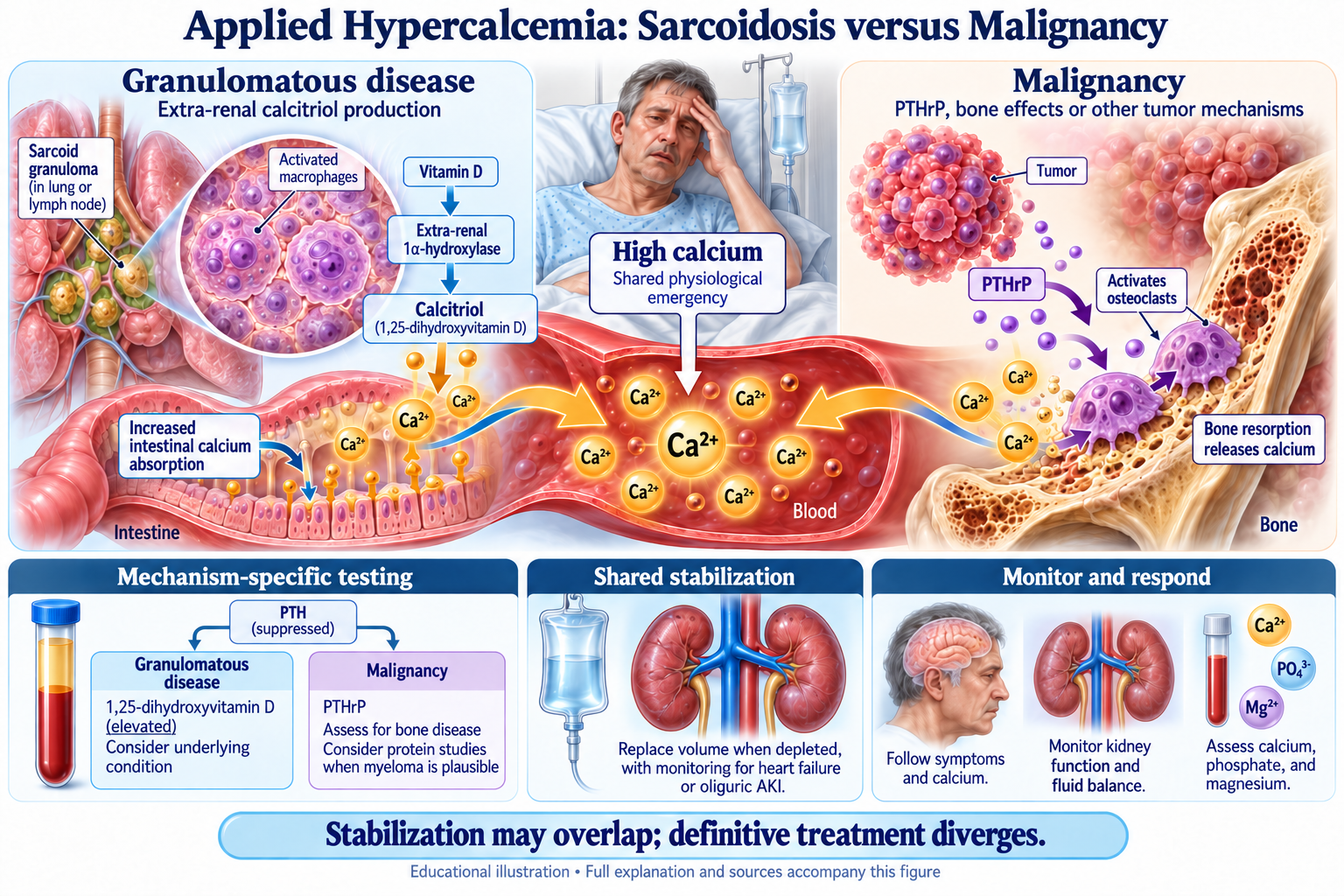
Browse the visual reference library · Download lesson Markdown
Integrated Learning Modules
This enhanced case integrates content from multiple lecture modules for comprehensive learning
🚨 Primary Module: Calcium Disorders
Hypercalcemia recognition, laboratory patterns, and emergency management protocols
🔬 Supporting Module: Laboratory Interpretation
PTH/PTHrP patterns, corrected calcium, and diagnostic algorithms
💊 Supporting Module: AKI Recognition
Hypercalcemia-induced nephropathy and nephrogenic diabetes insipidus
⚡ Supporting Module: Emergency Nephrology
Acute management of severe hypercalcemia and associated complications
Quick Access to Related Content:
🦴 Hypercalcemia Lecture 🔬 Diagnostic Flowchart 🚨 AKI Module 💧 Urinalysis & NDI ⚡ Emergency ElectrolytesA. Pre-Case Assessment: Test Your Baseline Knowledge
Answer these questions before reviewing the case to assess your starting knowledge
What is the most likely etiology of hypercalcemia in a hospitalized patient with calcium >13 mg/dL?
Learning Point: In hospitalized patients with calcium >13 mg/dL, malignancy accounts for 80-90% of cases. Primary hyperparathyroidism is more common in outpatient settings with mild hypercalcemia.
📚 Reference: Hypercalcemia Lecture - Malignancy Section
Which laboratory pattern suggests PTHrP-mediated hypercalcemia?
Learning Point: PTHrP mimics PTH action, causing appropriate PTH suppression. Elevated PTHrP (>4.2 pmol/L) with suppressed PTH (<20 pg/mL) is diagnostic of PTHrP-mediated hypercalcemia.
📚 Reference: Laboratory Patterns Section
What is the mechanism by which hypercalcemia causes nephrogenic diabetes insipidus?
Learning Point: Hypercalcemia reduces AQP2 expression, disrupts V2 receptor signaling, and causes calcium deposition in medullary structures, leading to impaired urine concentration.
📚 Reference: Urinalysis Module - Concentrating Defects
Case Presentation
Patient: 65-year-old man
Chief Complaint: "Confusion, weakness, and decreased oral intake for 1 week"
History: Progressive decline in mental status over the past month, with acute worsening in the last week. Family reports personality changes, increasing forgetfulness, polyuria (4-5L/day), polydipsia, and severe fatigue. Patient unable to provide reliable history.
Past Medical History: Metastatic lung adenocarcinoma (T4N3M1), diagnosed 8 months ago with brain and bone metastases. Currently receiving palliative chemotherapy with carboplatin/paclitaxel.
Current Medications: Ondansetron PRN, morphine 15mg q4h PRN, prednisone 10mg daily, allopurinol 300mg daily
Social History: 40 pack-year smoking history, quit 1 year ago. Lives with wife who provides care.
🤔 B. Initial Clinical Reasoning Questions
Given this patient's presentation and history, what is the most likely primary diagnosis?
Clinical Reasoning: The combination of confusion, polyuria, polydipsia, and weakness in a patient with known malignancy is classic for hypercalcemia. The 4-5L/day polyuria suggests nephrogenic diabetes insipidus from hypercalcemia.
📚 Reference: Clinical Manifestations Section
What clinical findings would you expect on physical examination?
Clinical Reasoning: Hypercalcemia causes volume depletion (polyuria), decreased muscle excitability (hyporeflexia), and neurological effects (confusion). Hyperreflexia would suggest hypocalcemia instead.
📚 Learn More: Hypercalcemia - Clinical Manifestations
Physical Examination
Vital Signs
- Blood Pressure: 102/68 mmHg (orthostatic: lying 115/75, standing 95/60)
- Heart Rate: 98 bpm (regular rhythm)
- Temperature: 37.2°C (99.0°F)
- Respiratory Rate: 16/min
- Oxygen Saturation: 95% on room air
- Weight: 68 kg (down 5 kg from baseline)
Physical Findings
- General: Lethargic, oriented to person only, poor attention span
- HEENT: Dry mucous membranes, poor skin turgor, sunken eyes
- Cardiovascular: Regular rate, no murmurs, weak peripheral pulses
- Pulmonary: Decreased breath sounds right upper lobe, no wheeze
- Neurological: Confused, decreased deep tendon reflexes (1+), no focal deficits
- Extremities: No edema, muscle weakness
🔍 C. Physical Examination Analysis
The presence of orthostatic hypotension in this patient is most likely due to:
Clinical Reasoning: Hypercalcemia causes nephrogenic diabetes insipidus, leading to massive fluid losses (4-5L/day polyuria) and volume depletion. The clinical signs of dehydration support this mechanism.
📚 Learn More: Hypercalcemia - Renal Effects
Laboratory Data & Comprehensive Analysis
Emergency Department Laboratory Values
| Parameter | Value | Normal Range | Clinical Significance |
|---|---|---|---|
| Total Calcium | 15.2 mg/dL | 8.5-10.5 mg/dL | Severely elevated |
| Albumin | 2.8 g/dL | 3.5-5.0 g/dL | Hypoalbuminemia |
| Ionized Calcium | 1.85 mmol/L | 1.12-1.32 mmol/L | Critically elevated |
| Phosphorus | 2.1 mg/dL | 2.5-4.5 mg/dL | Low (expected with PTHrP) |
| Magnesium | 1.4 mg/dL | 1.8-2.4 mg/dL | Low |
| Creatinine | 2.8 mg/dL | 0.7-1.3 mg/dL | Baseline 1.1 mg/dL (AKI Stage 2) |
| BUN | 68 mg/dL | 8-20 mg/dL | BUN:Cr ratio = 24 (prerenal) |
| Sodium | 148 mEq/L | 135-145 mEq/L | Hypernatremia (diabetes insipidus) |
| Potassium | 3.2 mEq/L | 3.5-5.0 mEq/L | Hypokalemia |
Corrected Calcium Calculation
Formula: Corrected Ca = Measured Ca + 0.8 × (4.0 - Measured Albumin)
Calculation: 15.2 + 0.8 × (4.0 - 2.8) = 15.2 + 0.96 = 16.16 mg/dL
Interpretation: Severe Hypercalcemia (>14 mg/dL)
Note: Ionized calcium (1.85 mmol/L) is even more concerning and represents the physiologically active fraction
📊 D. Laboratory Analysis & Integration
The BUN:Creatinine ratio of 24 in this patient suggests:
Learning Point: BUN:Cr ratio >20 suggests prerenal azotemia. The severe volume depletion from hypercalcemia-induced polyuria causes reduced renal perfusion and preferential BUN retention.
📚 Reference: AKI Module - Prerenal AKI
The hypernatremia (Na+ 148) in this patient is most likely due to:
Learning Point: Hypercalcemia >11.5 mg/dL impairs renal concentrating ability through AQP2 downregulation and medullary damage, causing excessive free water loss and hypernatremia.
📚 Reference: Hypernatremia Lecture
Additional Diagnostic Workup
Parathyroid Studies
- PTH: 8 pg/mL (normal: 15-65 pg/mL) - Appropriately suppressed
- PTHrP: 45 pmol/L (normal: <2.5 pmol/L) - Markedly elevated
- 25-OH Vitamin D: 18 ng/mL (low normal, 30-50 optimal)
- 1,25-OH Vitamin D: 42 pg/mL (normal: 25-65 pg/mL)
Additional Laboratory Values
- Hemoglobin: 9.2 g/dL (anemia of chronic disease)
- Alkaline Phosphatase: 285 U/L (elevated, suggests bone involvement)
- Lactate Dehydrogenase: 420 U/L (elevated)
- ECG: Short QT interval (QTc 380 ms), no arrhythmias
Urinalysis & Urine Studies
- Urine specific gravity: 1.005 (very dilute)
- Urine osmolality: 180 mOsm/kg (inappropriately low)
- 24-hour urine volume: 4.8 L
- 24-hour urine calcium: 680 mg (markedly elevated)
📊 Hypercalcemia Laboratory Patterns by Etiology
Complete diagnostic framework for identifying the underlying cause of hypercalcemia
🔬 E. Laboratory Pattern Integration
Based on the laboratory pattern (PTH 8 pg/mL, PTHrP 45 pmol/L), this patient has:
Learning Point: The combination of suppressed PTH (<20 pg/mL) with markedly elevated PTHrP (>4.2 pmol/L) is diagnostic of PTHrP-mediated hypercalcemia, the most common mechanism in solid tumor malignancies (85% of cases).
📚 Reference: Laboratory Patterns Table
Why is the phosphorus level low (2.1 mg/dL) in this patient?
Learning Point: PTHrP activates the same receptors as PTH, causing increased renal phosphate excretion. This phosphaturia leads to hypophosphatemia, which is characteristic of both primary hyperparathyroidism and PTHrP-mediated hypercalcemia.
📚 Learn More: PTHrP-Mediated Hypercalcemia
🔑 This Case Laboratory Pattern Analysis
Patient's Results
- PTH: 8 pg/mL (↓ Suppressed)
- PTHrP: 45 pmol/L (↑↑ Markedly elevated)
- 1,25(OH)₂D: 42 pg/mL (Normal)
- 25(OH)D: 18 ng/mL (Normal)
- Phosphate: 2.1 mg/dL (↓ Low)
Diagnostic Interpretation
- Diagnosis: PTHrP-mediated hypercalcemia
- Mechanism: Tumor PTHrP secretion
- Source: Lung adenocarcinoma
- Severity: Life-threatening (Ca >15 mg/dL)
- Prognosis: Poor (median survival 2-3 months)
F. Emergency Management Decision Points
What is the immediate priority in managing this patient?
Treatment Rationale: Aggressive hydration is the immediate priority to restore intravascular volume, improve renal perfusion, and increase calcium excretion. Goal is 200-300 mL/hr initially, monitoring for fluid overload.
📚 Reference: Emergency Protocol Section
After 2 hours of hydration, calcium is 13.8 mg/dL. What is the next step?
Treatment Rationale: With severe hypercalcemia greater than 13 mg/dL, bisphosphonates provide definitive therapy (onset 12-24 hours, peak 2-4 days; Major 2001 PMID 11208851). Calcitonin 4-8 IU/kg SC q12h provides rapid additional effect (2-4 hours) but tachyphylaxis limits use to 48-72 hours. Steroids are not effective for PTHrP-mediated hypercalcemia (no extra-renal 1-alpha-hydroxylase activity to suppress). CrCl caveat: Zoledronic acid 4 mg IV carries an FDA contraindication at CrCl less than 30-35 mL/min (per case 14 Q13 own teaching). This patient's admission Cr 2.8 mg/dL likely puts eGFR at approximately 25 mL/min (subtract baseline). Best practice is to give an initial saline load, recheck Cr, and either dose-reduce ZA to 3.5 mg if eGFR has improved to greater than 35 OR substitute denosumab 120 mg SC (Hu 2014 PMID 24915117) which has no renal contraindication. The MCQ as written is the textbook reflex answer; in real practice the timing requires renal recheck. [Note added 2026-05-03 — earlier explanation gave ZA 4 mg IV without flagging the CrCl contraindication that this case series's case 14 explicitly teaches. The narrative timeline at the bottom of this case correctly defers ZA. Aligned the MCQ explanation with that teaching.]
Comprehensive Treatment Protocol
Phase 1: Immediate Stabilization (0-2 hours)
Step 1: Assessment & Monitoring
- Cardiac monitoring: Watch for arrhythmias, short QT interval (QTc 380 ms)
- Neurologic assessment: Mental status checks q2h, seizure precautions
- IV access: Large bore peripheral IV (18-gauge or larger)
- Volume status: Assess orthostatics, skin turgor, urine output
Step 2: Aggressive Hydration
- Initial bolus: Normal saline 1-2L over 1-2 hours
- Maintenance: 200-300 mL/hr (goal 3-4L in first 24 hours)
- Monitoring: Urine output goal >100 mL/hr, daily weights
- Expected effect: ↓ calcium by 1-3 mg/dL within 4-6 hours
Phase 2: Specific Treatment (2-6 hours)
Bisphosphonate Administration (Definitive Therapy)
- Drug of choice: Zoledronic acid 4mg IV over 15 minutes
- Alternative: Pamidronate 90mg IV over 2-4 hours
- Onset: 12-24 hours, peak effect 2-4 days
- Duration: 2-4 weeks
- Contraindications: CrCl <30 mL/min (check first)
Calcitonin (Rapid Effect)
- Dose: 4 units/kg SC/IM q12h (typical 200-400 units)
- Onset: 2-4 hours (most rapid available treatment)
- Duration: 6-8 hours (tachyphylaxis develops in 48-72h)
- Use: Bridge therapy until bisphosphonate takes effect
G. Learning Objectives Assessment
Evaluate your mastery of key learning objectives from this integrated case
🎯 Learning Objective 1: Recognize Hypercalcemia as an Oncologic Emergency
Objective: Students should rapidly identify severe hypercalcemia in cancer patients and understand the urgency of treatment
A cancer patient presents with confusion and calcium of 14.5 mg/dL. What is the most important immediate action?
Competency Demonstration: Recognition that calcium >14 mg/dL is a medical emergency requiring immediate treatment. Hydration is the safest and most effective initial intervention while awaiting other therapies.
📚 Master This: Emergency Protocols
🎯 Learning Objective 2: Integrate Laboratory Patterns for Differential Diagnosis
Objective: Students should use laboratory patterns to distinguish between different causes of hypercalcemia
A patient has: Ca 13.2 mg/dL, PTH 12 pg/mL, PTHrP 2.0 pmol/L, 1,25(OH)₂D 95 pg/mL. Most likely diagnosis?
Competency Demonstration: Suppressed PTH + normal PTHrP + elevated 1,25(OH)₂D indicates extra-renal 1α-hydroxylase activity, characteristic of granulomatous diseases like sarcoidosis.
📚 Master This: Laboratory Patterns Table
🎯 Learning Objective 3: Recognize Hypercalcemia-Induced AKI and NDI
Objective: Students should understand the renal complications of hypercalcemia and their management
A patient with hypercalcemia has polyuria (5L/day), urine osmolality 180 mOsm/kg, and hypernatremia. This represents:
Competency Demonstration: Hypercalcemia >11.5 mg/dL impairs renal concentrating ability through AQP2 downregulation and medullary damage, causing polyuria, inappropriate urinary dilution, and hypernatremia.
📚 Master This: Concentrating Defects Module
H. Clinical Course & Treatment Response
Emergency Department (0-4 hours)
- Treatment initiated: NS 2L bolus, calcitonin 200 units SC. Zoledronic acid 4 mg IV deferred until adequate volume resuscitation and reassessment of renal function — ZA carries a CrCl <30–35 mL/min relative contraindication per FDA labeling, and this patient's admission Cr 2.8 (eGFR likely below the threshold) requires recalculation post-hydration before bisphosphonate administration. Denosumab 120 mg SC is an alternative for bisphosphonate-refractory or renally-contraindicated hypercalcemia of malignancy (Hu 2014 PMID 24915117).
- Calcium response: 15.2 → 13.8 mg/dL after hydration
- Mental status: Slight improvement in alertness, oriented to person and place
- Urine output: Increased to 150 mL/hr with hydration
Hospital Day 1 (24 hours)
- Calcium level: 11.8 mg/dL (good response to bisphosphonate)
- Kidney function: Creatinine 2.2 mg/dL (improving with hydration)
- Mental status: Alert and oriented × 3, much improved
- Sodium: 145 mEq/L (hypernatremia resolving)
Hospital Day 3 (72 hours)
- Calcium level: 10.1 mg/dL (normalized)
- Kidney function: Creatinine 1.8 mg/dL (near baseline)
- Patient status: Ambulating, taking oral fluids well, polyuria resolved
- Discharge planning: Oncology follow-up arranged for reassessment
📈 Treatment Response Analysis
The patient's calcium normalized by day 3. What explains the timeline of improvement?
Treatment Timeline: Hydration works within hours (renal calcium excretion), calcitonin within 2-4 hours but causes tachyphylaxis, and bisphosphonates have onset at 12-24 hours with peak effect at 2-4 days explaining the sustained improvement.
📚 Learn More: Hypercalcemia Treatment Timeline
Laboratory Trend Analysis
| Time Point | Total Calcium (mg/dL) | Ionized Calcium (mmol/L) | Creatinine (mg/dL) | Sodium (mEq/L) | Clinical Status |
|---|---|---|---|---|---|
| Presentation | 15.2 | 1.85 | 2.8 | 148 | Confused, lethargic |
| 4 hours | 13.8 | 1.68 | 2.6 | 147 | More alert |
| 24 hours | 11.8 | 1.45 | 2.2 | 145 | Alert and oriented |
| 72 hours | 10.1 | 1.28 | 1.8 | 142 | Baseline mental status |
I. Integration Challenge: Advanced Clinical Scenarios
These questions test your ability to synthesize knowledge across multiple modules
If this patient develops recurrent hypercalcemia in 3 weeks, what would be the best next step?
Integration Point: Recurrent hypercalcemia within 3 weeks suggests either disease progression or bisphosphonate resistance. Denosumab (RANKL inhibitor) is effective for refractory cases. Cancer progression workup is essential.
📚 Reference: Refractory Hypercalcemia Section
This patient's wife asks about prognosis. Hypercalcemia of malignancy typically indicates:
Integration Point: Hypercalcemia of malignancy indicates advanced disease with poor prognosis. Median survival is typically 1-3 months. Focus should shift to palliative care and quality of life discussions.
📚 Reference: Prognosis Section
A similar patient presents with hypercalcemia but has preserved kidney function. Which intervention should be AVOIDED?
Integration Point: Loop diuretics before adequate volume replacement can worsen dehydration and precipitate acute kidney injury. Always ensure adequate hydration before using diuretics for calcium excretion.
📚 Reference: AKI Prevention Module
In managing this patient's AKI, which finding would suggest recovery?
Integration Point: Recovery from hypercalcemia-induced AKI is indicated by calcium normalization and restoration of renal concentrating ability. The nephrogenic DI typically resolves within days to weeks after calcium correction.
📚 Reference: AKI Recovery Patterns
Case Reflection & Multi-Module Integration
🚨 Calcium Disorders Integration
- Recognition of hypercalcemic emergency (Ca >14 mg/dL)
- Laboratory pattern interpretation for differential diagnosis
- Emergency management protocols with phased approach
- Understanding of PTHrP-mediated mechanisms
🔬 Laboratory Integration
- Corrected vs ionized calcium calculations
- PTH/PTHrP/vitamin D metabolite patterns
- Recognition of laboratory patterns by etiology
- Integration with clinical presentation
💧 Renal Complications Integration
- Hypercalcemia-induced AKI mechanisms
- Nephrogenic diabetes insipidus pathophysiology
- Volume depletion and prerenal azotemia
- Recovery patterns and monitoring
⚡ Emergency Management Integration
- Prioritization of treatments by urgency
- Monitoring for complications and response
- Understanding of drug mechanisms and timing
- Prevention of treatment complications
🎯 Key Integration Concepts
This case demonstrates how hypercalcemia of malignancy represents a complex multi-system emergency requiring integration of knowledge from electrolyte disorders, acute kidney injury, laboratory interpretation, and emergency management. The case highlights the importance of recognizing laboratory patterns for rapid diagnosis, understanding pathophysiologic mechanisms across organ systems, and implementing evidence-based treatment protocols with appropriate monitoring for complications and response.
📝 Enhanced Case Summary & Clinical Pearls
This enhanced case demonstrates PTHrP-mediated hypercalcemia in a patient with metastatic lung cancer, integrating content from multiple nephrology modules. The patient presented with the classic triad of severe hypercalcemia (Ca 15.2 mg/dL), nephrogenic diabetes insipidus (polyuria 5L/day), and AKI (Cr 2.8 mg/dL). Laboratory patterns (suppressed PTH, elevated PTHrP) confirmed the diagnosis, and emergency management with aggressive hydration and bisphosphonates led to rapid improvement. The case emphasizes the importance of multi-system thinking in nephrology emergencies.
🔑 Key Clinical Pearls from This Enhanced Case:
- Recognition Pearl: Calcium >13 mg/dL in hospitalized patients = 80-90% malignancy
- Laboratory Pearl: PTH suppressed + PTHrP elevated = PTHrP-mediated hypercalcemia
- Renal Pearl: Hypercalcemia causes NDI through AQP2 downregulation and medullary damage
- Treatment Pearl: Hydration first, then bisphosphonates + calcitonin for severe cases
- Prognosis Pearl: Hypercalcemia of malignancy indicates advanced disease (median survival 1-3 months)