Visual summary
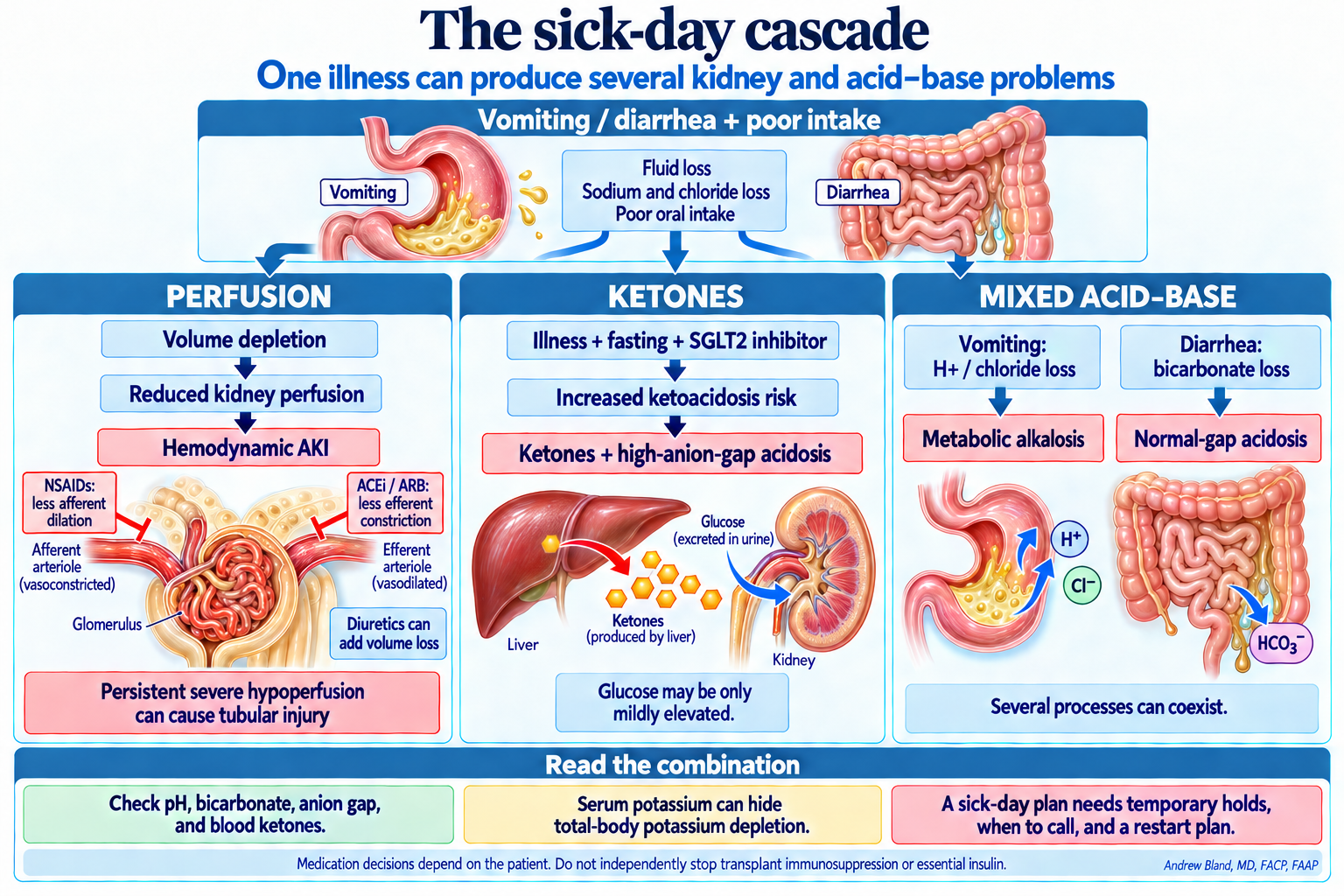
Follow three processes that can occur together: impaired perfusion, ketone production, and gastrointestinal acid–base losses.
Follow three processes that can occur together: impaired perfusion, ketone production, and gastrointestinal acid–base losses.
Text version
Perfusion and medication effects
Volume depletion lowers renal perfusion. NSAIDs reduce prostaglandin-supported afferent dilation; ACE inhibitors and ARBs reduce angiotensin-mediated efferent constriction. Diuretics may add volume loss. Prolonged severe hypoperfusion can progress to tubular injury. These mechanisms explain why a beneficial chronic treatment may require reassessment during an acute illness.
Ketones and a misleading glucose
Illness, reduced intake, and SGLT2 therapy can combine to produce ketoacidosis with only modest glucose elevation. Use blood ketones and the acid–base findings, rather than excluding DKA because glucose is not markedly elevated. Serum potassium can be normal or high despite total-body potassium depletion.
More than one acid–base process
Vomiting can produce chloride-depletion alkalosis, while diarrhea produces bicarbonate loss and normal-gap acidosis. Ketone accumulation adds an anion-gap process. Read pH, bicarbonate, anion gap, and expected respiratory compensation together. A personalized sick-day plan specifies temporary holds, when to call, and how treatment will restart; transplant immunosuppression and essential insulin need specific clinical direction.
Can a near-normal pH or a mildly elevated glucose exclude a serious sick-day problem?
No. Mixed acid–base processes can partly offset one another, and SGLT2-associated ketoacidosis may occur without marked hyperglycemia. Review the full pattern, ketones, volume status, medication timing, and kidney-function trend.