RAAS + Diuretic + Heat — Orthostasis in the Exercising Patient
The summer cardiac-rehab stack: lisinopril + furosemide + sweat loss. Recognize, intervene, teach.
Visual reference
Open the visual review after completing the case
Browse the visual reference library · Download lesson Markdown
🔗 Cross-Linked Track 1 Handouts, Lectures, and Cases
This case is where every Track 1 module converges. The stack is realistic — HFrEF polypharmacy + outdoor summer rehab — and every earlier handout has a hook here.
💧 Hydration PT handout
The "push fluids" question lives here. Plain water is wrong for this patient — tonicity and volume need to move together.
🧂 High-Salt Foods / Tonicity handout
Broth, pickle juice, salt tabs, pretzels. Sodium matters when you're leaking it out faster than water.
💊 NSAIDs PT handout
Triple-whammy AKI. In this case, the ibuprofen in her purse is the next landmine.
🫀 Case 26 (Beta Blockers) + 🫘 Case 27 (SGLT2i) + 💧 Case 28 (Diuretics) + 🔬 Case 29 (ACEi/ARB/ARNI)
The GDMT stack that makes this patient great for her heart AND vulnerable to every exercise-session hit.
🎯 Lecture Alignment & the Class-Stacking Physiology
This case reinforces two existing UDPA lectures plus the Module 2 hydration handout:
2025_UDPA_Lectures_Live/hypertension/orthostatic-hypotension.html— full differential and diagnostic workup.2025_UDPA_Lectures_Live/cardiorenal-disease/hf-diuretic-resistance.html— why HFrEF patients live on a narrow volume tightrope.student-resources/foundations/hydration-pt-handout.html— "push water" is wrong often enough that you need a framework, not a reflex.
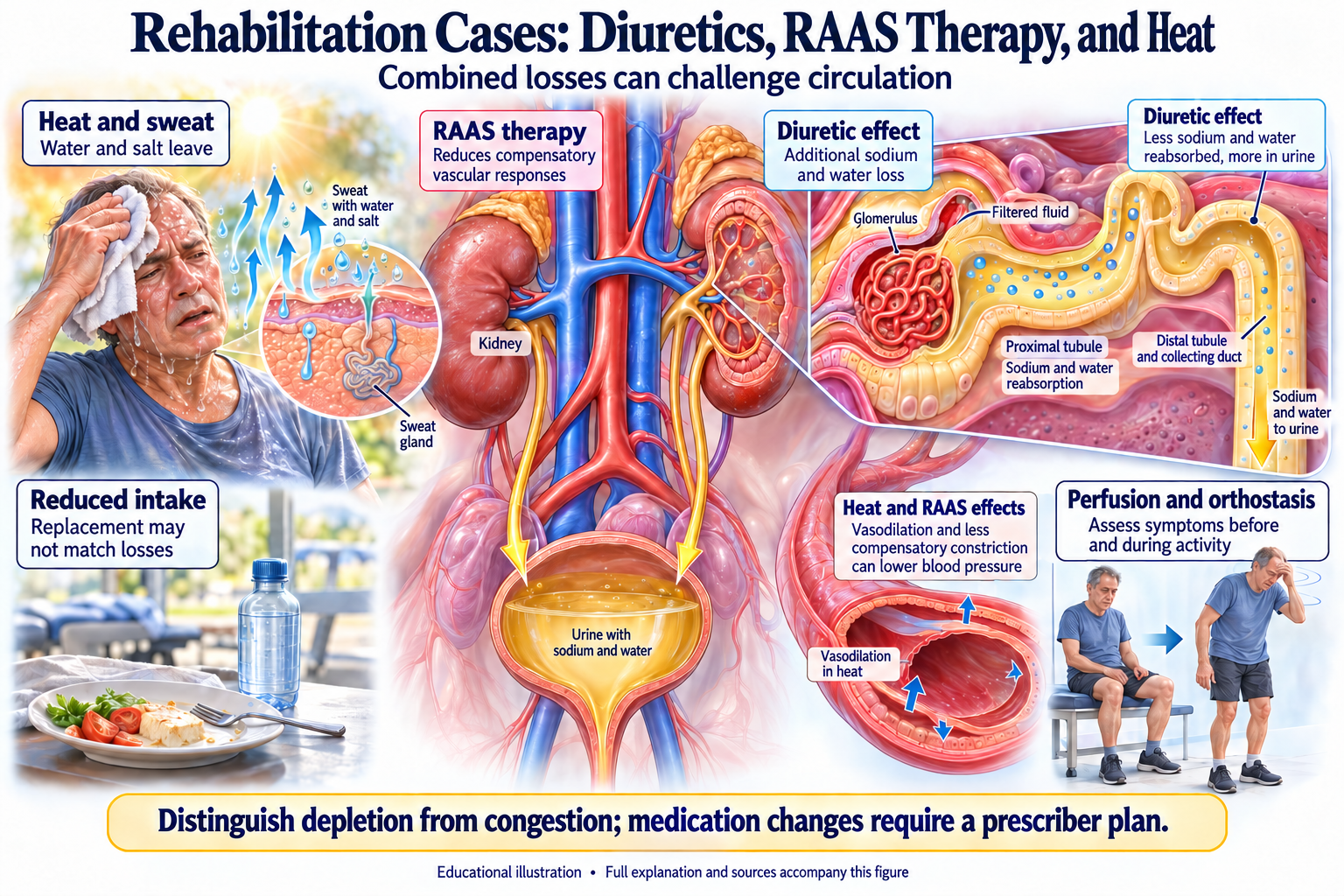
The triad that drops her BP at minute 15
| Mechanism | Class on board | What it does | What happens with exercise + heat |
|---|---|---|---|
| RAAS blockade | Lisinopril (ACEi) | Blocks angiotensin-II–mediated efferent arteriolar and systemic vasoconstriction. Normally, this is the reflex that keeps BP up when you stand or start exercising. | The reflexive BP rise at exercise onset is blunted. Systemic vasodilation persists as muscle beds open up. No compensatory squeeze from the splanchnic circulation. |
| Loop diuretic | Furosemide | Blocks Na⁺/K⁺/2Cl⁻ cotransporter in the thick ascending limb. Drops total body Na⁺ and water. Patient often runs 1–2 L "dry" at steady state. | Preload is already low. Any additional volume loss (sweat, skipped fluids) tips her over the edge fast. Less intravascular volume to fill a vasodilated bed. |
| Beta blockade | Metoprolol succinate | Blocks β1 → blunts HR rise, modest cardiac output limit at peak exercise. See Case 26. | Cannot compensate for falling BP by raising HR and output. The usual exercise tachycardia rescue is gone. |
| Sweat loss in heat | (Environmental) | Sweat Na⁺ 20–60 mEq/L; sweat rate approximately 1 L/hr in temperate conditions, up to 2–3 L/hr in heat for acclimatized athletes; typical cardiac-rehab patient approximately 0.5–1 L/hr.[1] | Hypotonic sweat loss = both water and sodium leaving, but more water than sodium. Volume drops. Without salt replacement, pure water replacement worsens tonicity. |
Core PT idea: four hits stack simultaneously during summer outdoor rehab — vasodilation (RAAS), volume depletion (diuretic), blunted HR rescue (beta blocker), sweat loss (heat). No single one fails her. The stack fails her. This is why she was fine yesterday in the air-conditioned gym and gait-unstable today outdoors at minute 15.
The counter-intuitive point — BP lowering is NOT the culprit here
Juraschek et al. (2020) found slightly lower odds of measured orthostatic hypotension with intensive versus standard blood-pressure treatment in hypertension trials (OR 0.93, 95% CI 0.86–0.99). This population result does not rule out medication-related orthostasis in an individual. In this patient, assess volume loss, exercise and heat exposure, diuretic timing, autonomic dysfunction, and the full medication regimen.
PT implication: do not blame the lisinopril in isolation. Blame the stack, the timing, and the environment.
🎯 Learning Objectives
By the end of this case, the DPT student will be able to:
- Recognize the stacked-mechanism physiology of orthostasis in the RAAS-blocked + diuretic + sweating patient — vasodilation + volume deficit + blunted HR rescue + hypotonic sweat loss.
- Execute a structured pre-session assessment before outdoor summer cardiac rehab: dose timing, overnight weight, last fluid intake, heat index, carried fluids and snack.
- Intervene mid-session when orthostasis appears — pause, supine, legs up, cool environment, isotonic fluids with sodium, NOT plain water.
- Distinguish when to call the prescriber for medication timing changes (dose-to-session interval) vs when to troubleshoot at the session level.
- Apply the sick-day rule to heat exposure — hot humid days function as "sick days" for volume-sensitive patients and may warrant temporary diuretic dose review.
- Teach the patient sweat-math: 1 L/hr out, 0.5–1 g Na⁺/L of sweat, and why broth or a salt tab matters more than 32 oz of plain water.
- Identify the escalation threshold — recurrent orthostasis, fall, syncope, new confusion, HR <50 with symptoms — and the communication script.
- Connect this scenario back to Module 2 (Hydration) and the High-Salt Foods handout — this is the clinical case the handouts were built to prevent.
🧪 Pre-Case Assessment — Test Your Baseline
Click an answer to see the explanation. You can change your answer anytime.
A 72-year-old HFrEF patient on lisinopril + furosemide + metoprolol succinate becomes lightheaded at minute 15 of outdoor treadmill work on the first 90°F humid day. BP sitting is 94/58, standing drops to 82/54. HR 64 sitting, 66 standing. Mentation is intact, no syncope, patient remains stable on feet with handrail support. Your FIRST action is:
Learning Point: Beta-blocked patients blunt the HR rise that would normally signal distress — the "normal" HR is misleading. The stacked RAAS + diuretic + heat + exertion creates near-perfect conditions for orthostatic collapse. Stop, cool, supine with legs up, replace with sodium-containing fluid. 911 is reserved for syncope, chest pain, altered mentation, or symptoms that don't resolve with positional/volume rescue.
📚 Reference: See Visit 1 on heat-plus-RAAS rescue.
Same patient, after recovery, asks whether she should skip her morning furosemide on hot days so this doesn't happen again. The PT's correct response is:
Learning Point: Many HF clinics DO have sick-day/hot-day hold protocols — but authorship belongs to the HF team, not the PT. The PT's two moves: (1) escalate same-day to the HF clinic for a written hot-day plan, and (2) negotiate dose-timing within the PT's lane (moving the peak diuretic effect away from the session window). Never "you'll be fine, skip it" or "never skip it" — both overstep.
📚 Reference: See Visit 2 on sick-day rules.
Which of the following best explains why plain water is the wrong sole intervention for this patient mid-session?
Learning Point: Sweat contains approximately 40–60 mEq/L Na. Replacing volume with plain water alone dilutes serum sodium (mild hyponatremia risk) and, in a RAAS-blocked patient with impaired water excretion, preferentially expands the extracellular space without restoring vascular tone. The intervention is isotonic/sodium-containing fluids. This is the single most misunderstood mid-session rescue in outdoor cardiac-rehab settings.
📚 Reference: See Visit 3 on fluid composition.
🧑⚕️ Patient Presentation
Mrs. T. is a 72-year-old retired postal carrier with HFrEF (LVEF 35%, ischemic etiology after inferior STEMI 2 years ago). CKD stage 3a (eGFR 51). T2DM on metformin. She is 4 weeks into a 12-week outpatient cardiac rehab program that runs in a partial outdoor facility during summer months. Today is July 8 — forecast high 93°F, heat index 101°F, humidity 70%. Her rehab session is scheduled for 10:00 AM outdoor.
| Medication | Dose | Timing | Indication |
|---|---|---|---|
| Lisinopril | 20 mg daily | 7:00 AM | HFrEF GDMT (see Case 29) |
| Furosemide | 40 mg daily | 8:00 AM (peaks 1–2 hr) | HF congestion control (see Case 28) |
| Metoprolol succinate | 100 mg daily | 7:00 AM | HFrEF GDMT (see Case 26) |
| Spironolactone | 25 mg daily | AM | HFrEF GDMT |
| Empagliflozin | 10 mg daily | AM | HFrEF + T2DM + CKD (see Case 27) |
| Metformin | 1,000 mg BID | AM / PM | T2DM |
| Atorvastatin, ASA, clopidogrel | Routine doses | — | ASCVD secondary prevention |
She carries a 20 oz water bottle. No sodium-containing snack. She mentions she "didn't sleep great" and skipped breakfast "because the heat killed my appetite." She took all meds as scheduled with a small glass of water.
Intake vitals (10:00 AM, seated, indoors pre-session):
| Measure | Value | Context |
|---|---|---|
| BP (seated, 5 min) | 106 / 62 mmHg | Low-normal; lisinopril + diuretic trough-ish |
| BP (standing, 1 min) | 98 / 58 mmHg | −8 mmHg drop; asymptomatic; within normal range |
| HR (seated / standing) | 62 / 66 bpm | Metoprolol-blunted rise |
| Weight | 62.3 kg | Down 0.8 kg from yesterday's 63.1 kg — volume status trending dry |
| Self-reported fluid intake last 24 h | approximately 1.2 L | Below her usual (mild under-hydration) |
| Skin turgor / mucosa | Slightly dry mucosa, skin normal | Early volume depletion signal |
| RPE (Borg) | Target 11–13 | HR-based prescription is not reliable on metoprolol |
🚩 Red flags before the session even starts
- Morning weight down 0.8 kg overnight — volume losing faster than she's replacing.
- Low 24-hour intake, skipped breakfast (no solid food = no dietary sodium).
- Diuretic peaked approximately 2 hours ago — she is at her driest point.
- Outdoor session, heat index 101°F, session start 10 AM trending to solar noon.
- Dry mucosa on exam.
The session should not start outdoors at full intensity today.
🔄 Visit 1 — Pre-Session Recognition: Do We Even Go Outside?
Scenario 1A — The pre-session pause
Before starting, you review her overnight weight, intake, and look at the heat index. Her intake vitals are technically "normal." She says she feels fine and is eager to go. Your gut says something is off.
Modify the plan. Move indoor. Delay is secondary.
- Move the session indoor to air-conditioned space. Heat index 101°F with this medication stack is a high-risk environment. Outdoor rehab is a good goal — but not today.
- Hydrate first, exercise second. Offer her 250–500 mL of an electrolyte-containing fluid with approximately 500 mg Na (examples: Pedialyte, Liquid IV, a cup of broth, or salted crackers + water). She needs tonicity replacement, not just water. See High-Salt Foods / Tonicity PT handout.
- Extend the warm-up. Start at RPE 9–10 (very light) for 5–10 minutes, only progress if BP and symptoms are stable.
- Check dose-to-session timing. Furosemide peaks 1–2 hours after oral dosing. Her 8 AM dose is peaking at session start. Flag this to the HF clinic: can the diuretic be moved to evening on rehab days, or the rehab session moved to later in the day?
- Talk to the patient. Explain what you're doing and why. "Today isn't a day to push — the heat, your meds, and the morning weight loss all line up. We're going to keep the exercise but change where and how."
PT script: "I need to adjust today's plan. Your meds peak right now, the heat index outside is 101, and your morning weight is down a pound. None of those alone would stop us, but the three together mean we're working indoors today. Let's get some fluid with salt in it first, warm up gently, and see how your body responds before we push."
🔄 Visit 2 — Mid-Session: Gait Instability at Minute 15
Scenario 2A — She starts to sway on the treadmill
(Counterfactual pathway: suppose the session began outdoor before you intervened.) At minute 15 of outdoor treadmill work at target intensity, you notice her shoulders drop and her gait wobbles side-to-side. She catches the handrails. Face is flushed. Speech is still clear. She says: "I'm OK — I'm just hot." You stop the treadmill.
Vitals right there:
| BP (standing on treadmill) | 82 / 50 mmHg |
| HR | 64 bpm (no rescue tachycardia — metoprolol) |
| RPE | She says "12" but you see "15" |
| Skin | Flushed, sweating, slightly sticky |
Stop, cool, position, rehydrate with sodium, reassess. Do NOT try to "walk it off."
- Stop the session immediately. The treadmill is off. She's stable on her feet with handrails, but a fall is the dominant risk here.
- Move indoor to cool environment. Shade minimum, A/C ideal.
- Positional change — carefully. Sit or supine with legs elevated. Do NOT have her bend forward to sit fast — that can drop cerebral perfusion further. Guard the transfer.
- Loosen restrictive clothing, give a cool damp cloth to neck/head, fan or A/C airflow.
- Offer an oral fluid with sodium. This is the key step. Options, best to worst:
- Oral rehydration solution (Pedialyte, Liquid IV) — balanced Na and carbohydrate.
- Chicken or vegetable broth (500–900 mg Na per cup) — excellent if available.
- Salted pretzels or crackers + water — if no sodium drink on hand.
- Pickle juice (approximately 900 mg Na per ounce) — known sports-medicine rescue for exercise cramps and hypotonic dehydration.[3]
- Commercial sports drink (e.g., Gatorade) — lower Na than ORS (approximately 110 mg per 8 oz) but better than plain water.
- Plain water alone — wrong choice here. Will worsen hypotonicity without restoring volume efficiently.
- Recheck vitals at 10 and 20 minutes. Target: BP recovering toward her baseline, HR stable, symptoms resolving.
- Document. Time, symptoms, vitals, what you did, response. HF clinic gets a message today.
🚩 When to call 911 instead
- Loss of consciousness or near-syncope that doesn't resolve in 1–2 minutes supine.
- Chest pain, new arrhythmia (palpitations with irregular pulse), dyspnea out of proportion.
- Confusion, altered mental status.
- Core body temperature >104°F or hot, dry, non-sweating skin (heat stroke — medical emergency).
- Fall with injury.
Scenario 2B — Twenty minutes later, recovered
She's had 500 mL of oral rehydration solution and is sitting up. BP 102/64 sitting, 96/62 standing after 1 min (−6 mmHg, asymptomatic). She feels "much better." She asks: "Was it my blood pressure medicine?"
Teach the stack, not the single drug. Counter the "it's the lisinopril" simplification.
PT script: "Good question, but the answer is more than one thing. Your lisinopril opens up your blood vessels so your heart has an easier job — that's why it's good for you. Your furosemide pulls extra fluid off so your lungs stay clear. Your metoprolol slows your heart to protect it. Every one of those drugs is good for your heart on its own. But on a hot day like today, those same effects mean you have less volume, more open blood vessels, and no heart-rate rescue. Add sweat, and your body can't keep pressure up during exercise. That's what just happened. We don't stop any of those medications — we change HOW we exercise on hot days."
The counter-intuition to emphasize: in long-term BP trials, intensive BP treatment actually reduced orthostatic hypotension risk slightly — better BP control does not cause chronic orthostasis.[2] The orthostasis you saw today was acute and environmental, not chronic and drug-caused.
🔄 Visit 3 — Two Days Later: Building the Heat Protocol
Scenario 3A — Adherence patient-teaching session
Mrs. T. returns for her next scheduled session, forecast high today is 88°F, heat index 95°F. She brings a list of questions she typed up: "When should I call vs handle? When is it OK to exercise outside? How do I know if I'm dry?"
Six-rule framework. Laminate it.
1. The morning self-check — three minutes before you leave the house
- Weigh yourself. Same time, same clothes. Down >2 lb overnight or >5 lb over a week is a signal. Going up fast is also a signal (congestion). See Case 28.
- Check your fluid intake yesterday. If it was under your usual or you skipped meals, say so at intake.
- Check the heat index. Not the temperature — the heat index. >90 needs a plan; >100 is "indoor today."
2. Dose-to-session timing
- Furosemide peaks 1–2 hours after you take it. If your session is 10 AM and you take furosemide at 8 AM, you are at peak diuresis during warm-up.
- Solutions to ask your HF clinic about: move the diuretic to evening on rehab days, or schedule the session 3+ hours post-dose, or bring the exact timing to the clinic and let them adjust.
- Do NOT move the dose yourself. Every HF regimen has reasons for timing we don't always know — your clinic decides.
3. The "salt + water" rule, not the "push water" rule
- Sweat loses both sodium and water. Replacing only water makes your blood more dilute (low sodium), not more hydrated.[1]
- Carry a sodium-containing drink (ORS, Liquid IV, Pedialyte, or a large glass of broth before you leave). Or eat a salted snack with water.
- A 32-oz water chug after exercise is actually worse than a salted broth + small water — especially if you're on furosemide. Exercise-associated hyponatremia kills runners; it can hurt patients like you too.[4],[5]
- See High-Salt Foods / Tonicity handout for exact targets and food lists.
4. Sick-day rule applies to hot days too
- On a day with vomiting, diarrhea, fever, OR a heat-index->95 outdoor-rehab day where you're not eating/drinking well — call your HF clinic BEFORE taking the diuretic.
- They may hold the dose or reduce it that day. That is their call.
- Do NOT skip lisinopril, metoprolol, empagliflozin, or spironolactone without a specific prescriber instruction — those decisions are more nuanced. See Case 26 (never stop metoprolol abruptly), Case 27 (sick-day SGLT2i rule), Case 29 (ACEi sick-day).
5. What to carry to every session
- Electrolyte-containing fluid (not plain water alone). Minimum 16 oz for a 30–45 min session; more for heat.
- Salted snack — pretzels, salted crackers, a small broth packet.
- Towel, fan access, cool water for wipe-downs.
- Med list (for emergencies).
- NO ibuprofen / Advil / Motrin / Aleve. Topical gel or lidocaine patch OK for local soreness. See NSAIDs PT handout.
6. When to call us vs when to call 911
| Situation | Action |
|---|---|
| Mild lightheaded on standing, resolves with sitting | Note it. Tell your PT at next session. |
| Orthostasis that recurs across multiple days despite rehydration and cooler conditions | Call HF clinic that day |
| Morning weight down >2 lb overnight or >5 lb in a week; OR up >2 lb overnight | Call HF clinic that day |
| Fall; loss of consciousness; chest pain; new shortness of breath; confusion | Call 911 |
| New palpitations + muscle weakness (possible hyperkalemia in RAAS-blocked patient) | Call HF clinic same day; see Case 29 |
| Hot, dry skin, no sweating, confusion (heat stroke) | Call 911 |
🔄 Visit 4 — The Class-Stacking Insight Applied to the Next Patient
Scenario 4A — Generalizing the pattern
Your rehab program has five more HFrEF patients on similar GDMT stacks. Your program director asks you to present a one-page summary to the rehab staff: "What did we learn from Mrs. T. that applies to everyone else?"
The one-page "Summer HFrEF Rehab Protocol."
Pre-session (intake, every session, every patient on RAAS + diuretic + beta blocker):
- Overnight weight change
- 24-hour fluid + meal intake
- Heat index (not temperature)
- Medication times — when was the diuretic dose?
- Sitting and 1-minute-standing BP (orthostatic screen)
- Visible hydration check (mucosa, skin)
Environment rules:
- Heat index <85: outdoor session OK with standard warm-up.
- Heat index 85–95: outdoor OK with extended warm-up, front-loaded hydration, shade breaks.
- Heat index >95: indoor only for HFrEF + GDMT patients.
- Heat index >100: indoor + reduced intensity + ORS pre-session.
Hydration rules (apply to HFrEF with HF-appropriate intake goals):
- ORS or electrolyte drink available at every station.
- Salted snacks available.
- NEVER push free water to a patient on loop diuretic + RAAS — it worsens hypotonicity. See Hydration PT handout.
Monitoring rules (because HR and BP are both partly unreliable):
- RPE (Borg 6–20, target 11–13) is the primary dose-of-exercise metric.
- Talk-test is a secondary check.
- HR is supplemental — metoprolol blunts it.
- BP at rest pre-session + recheck if any symptom.
Escalation triggers for the program director / HF clinic:
- Recurrent orthostasis across sessions despite optimization.
- Morning weight drift >5 lb in a week (dry or wet).
- New NSAID use reported.
- Any fall or near-syncope.
This is the program-level payoff of Case 2e: one patient teaches a whole summer rehab cohort.
🧠 Key Teaching Points
Pearl 1 — Orthostasis in the GDMT patient is a stack, not a drug
ACEi vasodilation + loop diuretic volume deficit + beta blocker HR-rescue blunting + sweat loss on a hot day. No single one explains it; together, they do. Teaching the stack reframes the whole conversation for the patient.
Pearl 2 — Sweat math: 1 L/hr out, 0.5–1 g Na⁺/L
A typical cardiac-rehab patient loses approximately 0.5–1 L/hr in heat, trained endurance athletes >2 L/hr. Sweat sodium runs 20–60 mEq/L (approximately 460–1380 mg/L).[1] Replacing only water is wrong. Replacement must include sodium proportional to the sweat-sodium loss. See High-Salt Foods / Tonicity handout.
Pearl 3 — Chronic BP control does NOT cause chronic orthostasis
Juraschek 2020 individual-participant meta-analysis of 18,466 patients across 5 major BP trials (SPRINT, ACCORD, AASK, SPS3, ONTARGET/TRANSCEND) found intensive BP treatment reduced orthostatic hypotension risk (OR 0.93, 95% CI 0.86–0.99). The orthostasis in your session is acute, environmental, stack-driven — not chronic-drug-driven.[2] Do not blame the lisinopril in isolation.
Pearl 4 — Dose-to-session timing is the easiest modifiable variable
Furosemide peaks 1–2 hours post-oral-dose. A morning dose with a late-morning rehab session = peak diuresis during warm-up. Flag this to the HF clinic. Options: move the diuretic to evening, or move the session to later in the day. Do NOT adjust the dose unilaterally.
Pearl 5 — Sick-day rules apply to hot days
Vomiting, diarrhea, and fever all trigger temporary diuretic / SGLT2i review. A 100+ heat-index day with under-eating or under-drinking is physiologically similar — volume-loss risk is the same principle. Encourage patients to call on such days. See Case 27, Case 28.
Pearl 6 — Plain water alone is the wrong intervention mid-session
Hypotonic sweat loss + free water replacement = worsening hyponatremia and inefficient volume restoration. The Hydration PT handout "push water" critique was written for this exact patient. ORS, broth, salted snack + water, or pickle juice beats 32 oz of plain water.[3]
Pearl 7 — Exercise-associated hyponatremia is a real pattern
The Boston Marathon 2002 EAH cases (Almond 2005) demonstrated endurance athletes collapsing from over-drinking plain water.[4] The 2015 consensus statement (Hew-Butler) formalized the "drink to thirst, include sodium" approach.[5] Cardiac-rehab patients are not marathoners, but the physiology overlaps when a loop diuretic is on board and the sweat rate is high.
Pearl 8 — Triple whammy is one NSAID away
Add ibuprofen to a RAAS + diuretic regimen → AKI risk jumps 31% overall, 82% in the first 30 days (Lapi 2013).[6] This patient has ibuprofen in her purse "for the knee." Redirect to topical diclofenac, lidocaine patches, acetaminophen within limits. See NSAIDs PT handout.
Pearl 9 — HR-based exercise prescription fails; RPE wins
Metoprolol blunts HR rise; lisinopril blunts the BP rise. The only remaining reliable intensity metric is subjective effort. Borg RPE 6–20 (target 11–13 "moderate") and the talk-test drive prescription. This applies across all RAAS + beta-blocker stacks. See Case 26.
🚩 Red Flag Summary Table
Any of these → pause the session, act, and escalate or route to ED per severity.
| Finding | PT action |
|---|---|
| Morning weight down >2 lb overnight or >5 lb over a week | Hold intensity; reassess volume status; escalate to HF clinic same day |
| Heat index >95 for an outdoor HFrEF GDMT session | Move indoor. Extended warm-up. Pre-hydrate with ORS. |
| Heat index >100 | Indoor only. Reduced intensity. Mandatory ORS. |
| Orthostatic drop >20 mmHg SBP with symptoms | Stop session. Supine. Legs up. Cool environment. ORS. Reassess in 10–15 min. |
| Gait instability / near-fall during exercise | Immediate stop. Guard transfer. Supine. Same-session HF clinic call. |
| Hot, dry, non-sweating skin OR confusion OR core temp >104°F | 911 — heat stroke |
| Syncope / loss of consciousness | 911 |
| New chest pain / new dyspnea disproportionate to workload | 911 |
| New palpitations + muscle weakness (hyperkalemia concern) | Same-day labs + HF clinic |
| Patient reports recent ibuprofen / naproxen use | Counsel stop immediately; flag triple-whammy risk; escalate to HF clinic same day if AKI symptoms |
| Diuretic peaks during session every time | Propose timing change to HF clinic (do not adjust dose yourself) |
| Patient asking to stop a GDMT drug "just on hot days" | Redirect — HF clinic call, never self-adjust |
🗣️ Patient Teaching Scripts
The "stack, not a single drug" script
"What happened today wasn't one medication — it was the combination plus the heat. Your lisinopril opens blood vessels, your furosemide keeps fluid off your lungs, your metoprolol protects your heart, and your sweat today took both water and salt. Every one of those is good for you. Together, on a 101-degree day, they mean we exercise differently — not less."
The "salt and water together" script
"Plain water alone isn't what your body needs after sweating. Your sweat has salt in it, and if you replace only water, your blood gets dilute — that's actually worse. Carry a drink with electrolytes. A cup of broth is free, tastes good, and has more salt than Gatorade. Salted pretzels with water work too."
The "never skip, always call" script
"Don't skip or change any of your heart medications on your own, even on a hot day. Each one has a reason. If you think you need to change something — hot day, sick day, you're not eating — call your HF clinic before you take the dose. They'll tell you what to hold. That's their job, not yours."
The "morning self-check" script
"Three minutes every morning: step on the scale, count your fluids from yesterday, and check the heat index on your phone. If anything looks off — weight down two pounds, didn't drink much, heat index over 90 — tell me at intake. That's how we keep you safe without keeping you home."
The "no NSAIDs" script (reinforce from Case 29)
"No Advil, ibuprofen, Motrin, Aleve, or naproxen while you're on Entresto, lisinopril, furosemide, or similar. They can shut your kidneys down and push your potassium up. Topical gels and patches are fine — the tablet form is the problem. Call me before taking anything new."
The "call vs 911" script
"Lightheaded once that passes — tell me next time. Lightheaded two or three days in a row, OR a weight change over two pounds — call the HF clinic that day. Fall, passed out, chest pain, can't breathe, confused, hot skin with no sweat — that's 911. When in doubt, call us. Nobody's mad at being called too early."
📚 References
- Sawka MN, Burke LM, Eichner ER, Maughan RJ, Montain SJ, Stachenfeld NS. American College of Sports Medicine position stand. Exercise and fluid replacement. Med Sci Sports Exerc 2007;39(2):377–90. PMID: 17277604. PubMed — ACSM position stand on exercise hydration; sweat-rate and sweat-sodium physiology; "drink to thirst" vs "push fluids" framework.
- Juraschek SP, Hu JR, Cluett JL, Ishak A, Mita C, Lipsitz LA, Appel LJ, Beckett NS, Coleman RL, Cushman WC, Davis BR, Grandits G, Holman RR, Miller ER 3rd, Peters R, Staessen JA, Taylor AA, Thijs L, Wright JT Jr, Mukamal KJ. Effects of Intensive Blood Pressure Treatment on Orthostatic Hypotension: A Systematic Review and Individual Participant-based Meta-analysis. Ann Intern Med 2021;174(1):58–68. PMID: 32909814. PubMed — 18,466 participants across 5 RCTs. Intensive BP treatment reduced orthostatic hypotension risk (OR 0.93, 95% CI 0.86–0.99). Key counter-intuition: chronic BP control does not create chronic orthostasis — dispels the "the lisinopril is the problem" reflex.
- Miller KC, Mack GW, Knight KL, Hopkins JT, Draper DO, Fields PJ, Hunter I. Reflex inhibition of electrically induced muscle cramps in hypohydrated humans. Med Sci Sports Exerc 2010;42(5):953–61. PMID: 19997012. PubMed — pickle juice for exercise cramps; reflex-mediated mechanism (not just sodium replacement); anchors the "pickle juice works" clinical pearl.
- Almond CSD, Shin AY, Fortescue EB, Mannix RC, Wypij D, Binstadt BA, Duncan CN, Olson DP, Salerno AE, Newburger JW, Greenes DS. Hyponatremia among runners in the Boston Marathon. N Engl J Med 2005;352(15):1550–6. PMID: 15829535. PubMed — prospective analysis of 488 Boston Marathon 2002 runners; 13% incidence of EAH; overconsumption of hypotonic fluid was the dominant risk factor. Foundational paper behind the Hydration handout and Case 2f sports-drinks case.
- Hew-Butler T, Rosner MH, Fowkes-Godek S, Dugas JP, Hoffman MD, Lewis DP, Maughan RJ, Miller KC, Montain SJ, Rehrer NJ, Roberts WO, Rogers IR, Siegel AJ, Stuempfle KJ, Winger JM, Verbalis JG. Statement of the 3rd International Exercise-Associated Hyponatremia Consensus Development Conference, Carlsbad, California, 2015. Clin J Sport Med 2015;25(4):303–20. PMID: 26227507. PubMed — 2015 EAH consensus statement; formalizes "drink to thirst," sodium-containing fluids, recognition and management.
- Lapi F, Azoulay L, Yin H, Nessim SJ, Suissa S. Concurrent use of diuretics, angiotensin converting enzyme inhibitors, and angiotensin receptor blockers with non-steroidal anti-inflammatory drugs and risk of acute kidney injury: nested case-control study. BMJ 2013;346:e8525. PMID: 23299844. PubMed — triple-whammy paper; rate ratio 1.31 (1.12–1.53) overall and 1.82 (1.35–2.46) in the first 30 days in 487,372 users. Cross-cite from Modules 1, 3, and Cases 26–29.
- Freeman R, Wieling W, Axelrod FB, Benditt DG, Benarroch E, Biaggioni I, Cheshire WP, Chelimsky T, Cortelli P, Gibbons CH, Goldstein DS, Hainsworth R, Hilz MJ, Jacob G, Kaufmann H, Jordan J, Lipsitz LA, Levine BD, Low PA, Mathias C, Raj SR, Robertson D, Sandroni P, Schatz I, Schondorf R, Stewart JM, van Dijk JG. Consensus statement on the definition of orthostatic hypotension, neurally mediated syncope and the postural tachycardia syndrome. Clin Auton Res 2011;21(2):69–72. PMID: 21431947. PubMed — operational definition of orthostatic hypotension (≥20 mmHg systolic or ≥10 mmHg diastolic drop within 3 minutes of standing). Drives the measurement protocol used in the red-flag table.
- Heidenreich PA, Bozkurt B, Aguilar D, Allen LA, Byun JJ, Colvin MM, Deswal A, Drazner MH, Dunlay SM, Evers LR, Fang JC, Fedson SE, Fonarow GC, Hayek SS, Hernandez AF, Khazanie P, Kittleson MM, Lee CS, Link MS, Milano CA, Nnacheta LC, Sandhu AT, Stevenson LW, Vardeny O, Vest AR, Yancy CW. 2022 AHA/ACC/HFSA Guideline for the Management of Heart Failure: A Report of the American College of Cardiology/American Heart Association Joint Committee on Clinical Practice Guidelines. Circulation 2022;145(18):e895–e1032. PMID: 35363499. PubMed — GDMT framework; ACEi/ARB/ARNI + beta blocker + MRA + SGLT2i for HFrEF; diuretic titration for congestion. The "four-pillar + loop" therapy this patient is on.
Andrew Bland, MD, FACP, FAAP
Medical Associates Department of Nephrology · University of Illinois College of Medicine at Peoria · University of Dubuque PA & DPT Programs · Butler College of Osteopathic Medicine
Interactive PT teaching case · Track 2 · Case 2e
© 2026 · urinenephrology.org