1 · Approach
Read the opening framework and urgent-threat checkpoint.
Session 2 · Required self-study · 8 questions
Andrew Bland, MD, FACP, FAAP · October 2026
All teaching, figures and lecture links for this case →
Browse all self-study cases · Start with the visual approach
Follow the history, examination, workup, and clinical course. Commit to each decision before opening the explanation.
Classroom pathway · Pause at each stage for discussion.
Review each medicine by indication, clearance, dose and exposure. Look for accumulated toxicity, interacting drugs and procedure-related risks.
Read the opening framework and urgent-threat checkpoint.
Build the pattern as the history, examination and results arrive.
Use the mechanism to explain the blood, urine or imaging findings.
Connect the treatment with the response, risks and follow-up.
Read the short lesson before each question. Commit to an answer, explain your reasoning, then reveal the explanation and revisit the mechanism.
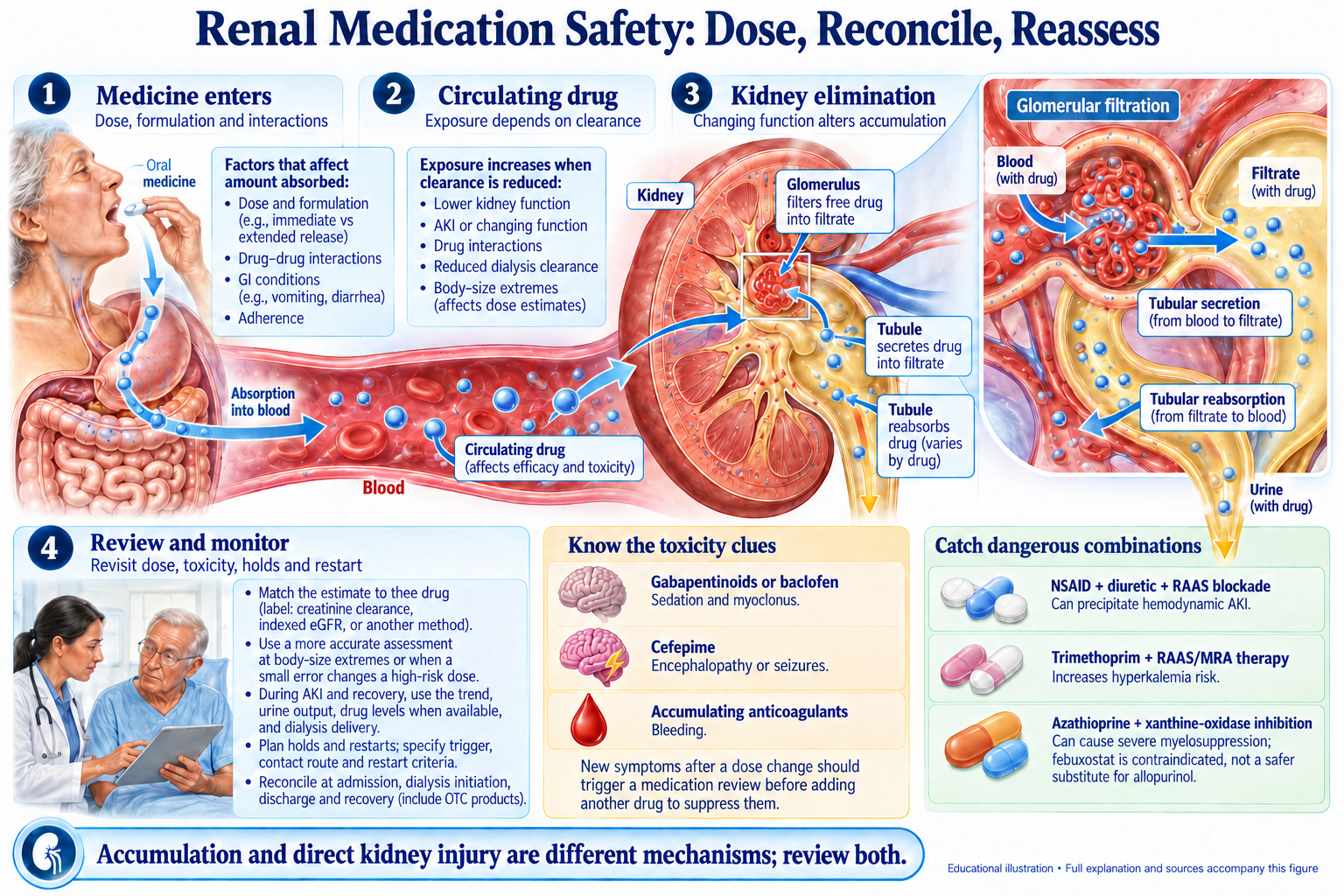
Use the visual framework with the case findings and the linked lecture.
Session S2 · 2026-10-27 · supplementary · 20 min Anchor: Chronic kidney disease — drug dosing, nephrotoxins and sick-day rules in CKD G4 · Integrates: PPI hypomagnesemia, contrast and gadolinium rules, phosphate bowel preps, metformin thresholds, DOAC and gabapentin dosing, the sick-day card in the patient's words One-line hook: Every drug on this man's list was started by someone with a good reason, most of them years ago, when his kidneys were twice as good. The visit that saves him is the one where somebody reads the whole bag against today's kidney function.
Self-study case. Commit to an answer before you open each folded callout.
The adult gabapentin label provides a renal-dose table in creatinine clearance. In a patient with stable kidney function, which estimate does that label describe?
Indexed CKD-EPI eGFR alone, without checking the drug label
Cockcroft–Gault clearance, using age, weight and creatinine
Serum creatinine alone, using the same cutoff for every adult
A urine dipstick protein category, using A1 through A3
Show answer and explanation · Link to this question
Learning point: The gabapentin label describes Cockcroft–Gault estimation of creatinine clearance in stable kidney function. Use the estimate and patient characteristics specified by each drug label: metformin uses eGFR, while apixaban for atrial fibrillation uses its own age, weight and creatinine criteria. No single dosing rule applies to every medicine. Why not the others: A ignores the specified measure; C ignores body size and age; D measures proteinuria, not drug clearance. Concept link: structural-18, ckd-18 · Question evidence and course reading
Back to W1 · All answers in this case
Renal pharmacology lecture — 1. Drug Dosing in CKD: Principles of Renal Clearance
Which three-drug combination is the "triple whammy" for acute kidney injury?
ACE inhibitor plus spironolactone plus potassium chloride
Aminoglycoside plus vancomycin plus iodinated contrast
NSAID plus aspirin plus proton pump inhibitor
ACE inhibitor or ARB plus diuretic plus NSAID
Show answer and explanation · Link to this question
Learning point: Each drug removes one of the kidney's defenses of filtration when volume falls: the diuretic lowers volume, the ACE inhibitor or ARB removes the angiotensin squeeze on the outflow (efferent) arteriole that holds glomerular pressure up, and the NSAID removes the prostaglandin dilation of the inflow (afferent) arteriole. Risk depends on the patient and the clinical state; even two can be hazardous during volume depletion. The three-drug combination is particularly concerning. Why not the others: A is the hyperkalemia stack; B is a stack of direct tubular toxins; C is a stomach-bleeding stack. Concept link: aki-13, structural-19, structural-20 · Question evidence and course reading
Back to W2 · All answers in this case
Renal pharmacology lecture — 2. Nephrotoxic Medication Avoidance
Mr. Harold Brandt, 74, comes to his primary care clinic with his daughter and a grocery bag of pill bottles. He needs a colonoscopy after a positive stool screening test, and an ultrasound done for suspected gallstones found a 2-cm liver lesion that radiology wants characterized with a contrast MRI. The GI office has mailed him sodium phosphate tablets for the prep. His daughter's concern is different: "He's sleepy all day, and he's fallen twice this month."
He has type 2 diabetes for 22 years, hypertension, chronic kidney disease, atrial fibrillation, painful diabetic neuropathy in both feet, and knee osteoarthritis. His heartburn began during a hospital stay eight years ago and has not bothered him since, but the omeprazole never stopped. Since his wife died last year he has lived alone and, his daughter says, "on tea, toast and canned soup." He does not drink alcohol.
The bag
Dose: 1,000 mg
Route: PO
Frequency: twice daily
Indication: Type 2 diabetes
Dose: 50 mg
Route: PO
Frequency: daily
Indication: Hypertension; albuminuria
Dose: 20 mg
Route: PO
Frequency: daily
Indication: Ankle edema
Dose: 50 mg
Route: PO
Frequency: daily
Indication: Atrial fibrillation rate control
Dose: 20 mg
Route: PO
Frequency: daily with supper
Indication: Stroke prevention, atrial fibrillation
Dose: 900 mg
Route: PO
Frequency: three times daily
Indication: Painful diabetic neuropathy
Dose: 20 mg
Route: PO
Frequency: daily, for 8 years
Indication: Heartburn
Dose: 220–440 mg
Route: PO
Frequency: most days
Indication: Knee pain
Dose: 40 mg
Route: PO
Frequency: nightly
Indication: Cardiovascular risk
Dose: per GI instructions
Route: PO
Frequency: evening before and morning of colonoscopy
Indication: Bowel prep
| Drug | Dose | Route | Frequency | Indication |
|---|---|---|---|---|
| Metformin | 1,000 mg | PO | twice daily | Type 2 diabetes |
| Losartan | 50 mg | PO | daily | Hypertension; albuminuria |
| Furosemide | 20 mg | PO | daily | Ankle edema |
| Metoprolol succinate | 50 mg | PO | daily | Atrial fibrillation rate control |
| Rivaroxaban | 20 mg | PO | daily with supper | Stroke prevention, atrial fibrillation |
| Gabapentin | 900 mg | PO | three times daily | Painful diabetic neuropathy |
| Omeprazole | 20 mg | PO | daily, for 8 years | Heartburn |
| Naproxen (over the counter) | 220–440 mg | PO | most days | Knee pain |
| Atorvastatin | 40 mg | PO | nightly | Cardiovascular risk |
| Sodium phosphate tablets | per GI instructions | PO | evening before and morning of colonoscopy | Bowel prep |
What would you reconcile from the bag of medicines and the procedure instructions?
Verify every prescription, nonprescription medicine, dose and indication, including sedating drugs, analgesics, bowel preparation and planned contrast. Ask about adherence, meals, falls and who helps manage the medicines.
Return to the lecture: Contrast AKI lecture — Risk Assessment Framework · Drug dosing quick reference (site) — Part 1: Principles of Drug Dosing in CKD
Vitals. BP 128/72 seated, 122/70 standing · Pulse 72, irregularly irregular · Resp 14 · SpO₂ 96% on room air · T 36.6 °C · Weight 80 kg · Height 175 cm.
Exam. Drowsy but oriented; slow to answer. Wide-based, unsteady gait. Bruise on the left forearm from the second fall. Trace ankle edema. No asterixis, no tremor, reflexes normal and symmetric. No focal deficit.
Which findings should be compared with baseline before assigning a cause to the falls?
Describe alertness, gait, orthostatic vitals, bruising, reflexes and focal findings. Compare with the daughter's account and the medication timeline; avoid labeling all neurologic symptoms as uremia.
Return to the lecture: Renal pharmacology lecture — 2. Nephrotoxic Medication Avoidance · Renal pharmacology lecture — 7. Sick Day Rules
Use what you know from the history and examination. Select an initial workup, name the question each test answers, and decide what can wait. Discuss urgent bedside assessment and treatment in parallel.
Some results in this case occur later, after new findings. Selecting a test does not imply that it is needed now.
Your selections last while this page is open. This is a discussion activity, not a scored MCQ. Results remain at their original points in the case; tests without supplied results are identified after you commit.
His creatinine today is 2.7 mg/dL, eGFR 24 mL/min/1.73 m² (CKD-EPI 2021); three months ago it was 2.6, eGFR 25 — CKD G4, stable. The full panel is in Part 2.
Mr. Brandt is 74, weighs 80 kg, and his creatinine is 2.7 mg/dL (eGFR 24 by CKD-EPI 2021). He takes rivaroxaban 20 mg daily for atrial fibrillation. What is the right decision about the rivaroxaban?
Keep 20 mg daily, because rivaroxaban is cleared by the liver alone
Stop it, because every DOAC is contraindicated below an eGFR of 30
Reduce to 15 mg daily; his Cockcroft–Gault clearance is about 27 mL/min
Switch to dabigatran 150 mg twice daily, the least kidney-dependent DOAC
Show answer and explanation · Link to this question
Learning point: Cockcroft–Gault gives (140 − 74) × 80 / (72 × 2.7) = 27.2 mL/min. For nonvalvular atrial fibrillation, the US rivaroxaban label uses 15 mg once daily with the evening meal when CrCl is 50 or below. Patients below 30 were not enrolled in the pivotal AF trial, so this advanced-CKD patient needs an individualized anticoagulation review and close bleeding/kidney monitoring. Why not the others: A ignores renal elimination; B incorrectly treats all DOACs as one class-wide cutoff; D gives an unsuitable dabigatran dose for this clearance. Apixaban has different US label criteria and should not be assigned rivaroxaban's renal rule. Concept link: structural-18, ckd-18 · Question evidence and course reading
Back to Q3 · All answers in this case
Drug dosing quick reference (site) — Direct Oral Anticoagulants
Same visit. Mr. Brandt takes metformin 1,000 mg twice daily, gabapentin 900 mg three times daily and naproxen most days, alongside losartan and furosemide. He is sleepy and unsteady and has fallen twice. His eGFR is 24 and his clearance 27 mL/min. Which set of changes is right?
Stop metformin; taper gabapentin to 300 mg nightly; swap naproxen for acetaminophen
Metformin down to 500 mg twice daily; gabapentin unchanged; naproxen only with meals
Stop metformin; keep gabapentin, which is not nephrotoxic; switch naproxen to celecoxib
Keep metformin with monthly labs; gabapentin 600 mg three times daily; less naproxen
Show answer and explanation · Link to this question
Learning point: Stop metformin at eGFR below 30 and stop oral naproxen. His CrCl is approximately 27 mL/min: gabapentin 2,700 mg/day is excessive and likely contributes to sedation and falls. Its label range at CrCl >15–29 is 200–700 mg once daily; 300 mg nightly is a cautious patient-specific proposal, not the ceiling for all patients below eGFR 30. Assess toxicity promptly and individualize holding/reduction and withdrawal precautions with the prescriber; reassess whether gabapentin is still needed. Why not the others: B — 500 mg twice daily is the 30–45 band, and food protects the stomach, not the kidney; C — "not nephrotoxic" is the wrong test, since renally cleared drugs accumulate, and celecoxib is still an NSAID; D — monitoring does not make a contraindicated drug safe, 1,800 mg a day is still far above his band, and less NSAID is still NSAID. Concept link: structural-18, structural-19, structural-23, ckd-18 · Question evidence and course reading
Back to Q4 · All answers in this case
Renal pharmacology lecture — 6. NSAID Alternatives for Pain Management in CKD
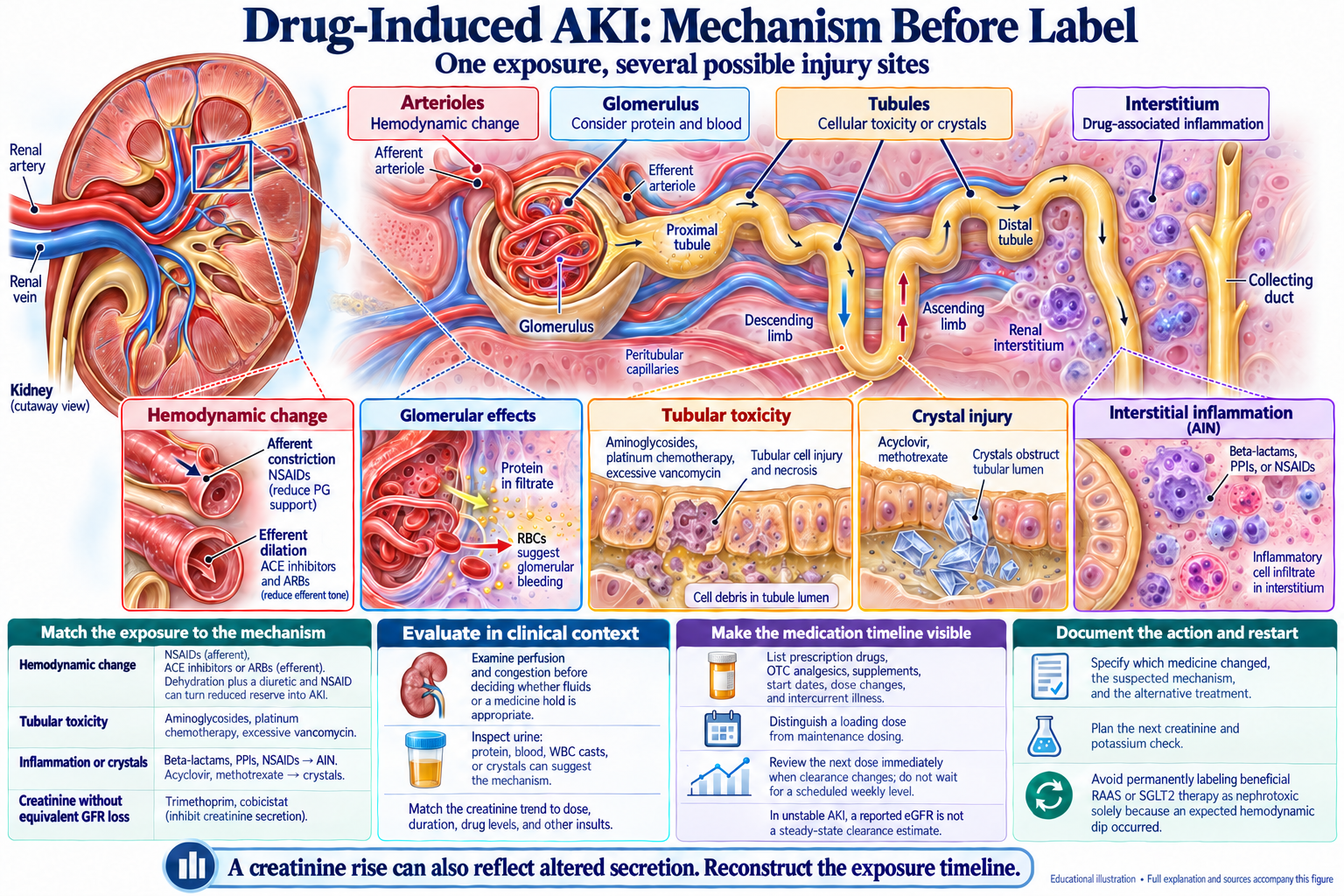
Use the visual framework with the case findings and the linked lecture.
Apply this general guide to the patient: what fits, what changes the next action, and what must you reassess?
Metformin was replaced with linagliptin 5 mg daily, which needs no kidney dose change; an SGLT2 inhibitor (started at eGFR 20 or above, for kidney protection) will wait until the procedures are done.
Today's panel, with his values from 3 months ago
How does sodium compare with the supplied range or prior value? Explain what it adds to the pattern, whether the timing or specimen matters, and whether it changes your next step.
Drug dosing quick reference (site) — Part 1: Principles of Drug Dosing in CKD
How does potassium compare with the supplied range or prior value? Explain what it adds to the pattern, whether the timing or specimen matters, and whether it changes your next step.
Drug dosing quick reference (site) — Part 1: Principles of Drug Dosing in CKD
How does chloride compare with the supplied range or prior value? Explain what it adds to the pattern, whether the timing or specimen matters, and whether it changes your next step.
Drug dosing quick reference (site) — Part 1: Principles of Drug Dosing in CKD
How does bicarbonate compare with the supplied range or prior value? Explain what it adds to the pattern, whether the timing or specimen matters, and whether it changes your next step.
Drug dosing quick reference (site) — Part 1: Principles of Drug Dosing in CKD
How does anion gap compare with the supplied range or prior value? Explain what it adds to the pattern, whether the timing or specimen matters, and whether it changes your next step.
Drug dosing quick reference (site) — Part 1: Principles of Drug Dosing in CKD
How does bun compare with the supplied range or prior value? Explain what it adds to the pattern, whether the timing or specimen matters, and whether it changes your next step.
Drug dosing quick reference (site) — Part 1: Principles of Drug Dosing in CKD
How does creatinine compare with the supplied range or prior value? Explain what it adds to the pattern, whether the timing or specimen matters, and whether it changes your next step.
Drug dosing quick reference (site) — Part 1: Principles of Drug Dosing in CKD
How does egfr (ckd-epi 2021) compare with the supplied range or prior value? Explain what it adds to the pattern, whether the timing or specimen matters, and whether it changes your next step.
Drug dosing quick reference (site) — Part 1: Principles of Drug Dosing in CKD
How does glucose (fasting) compare with the supplied range or prior value? Explain what it adds to the pattern, whether the timing or specimen matters, and whether it changes your next step.
Drug dosing quick reference (site) — Part 1: Principles of Drug Dosing in CKD
How does hemoglobin a1c compare with the supplied range or prior value? Explain what it adds to the pattern, whether the timing or specimen matters, and whether it changes your next step.
Drug dosing quick reference (site) — Part 1: Principles of Drug Dosing in CKD
How does calcium compare with the supplied range or prior value? Explain what it adds to the pattern, whether the timing or specimen matters, and whether it changes your next step.
Drug dosing quick reference (site) — Part 1: Principles of Drug Dosing in CKD
How does albumin compare with the supplied range or prior value? Explain what it adds to the pattern, whether the timing or specimen matters, and whether it changes your next step.
Drug dosing quick reference (site) — Part 1: Principles of Drug Dosing in CKD
How does phosphorus compare with the supplied range or prior value? Explain what it adds to the pattern, whether the timing or specimen matters, and whether it changes your next step.
Drug dosing quick reference (site) — Part 1: Principles of Drug Dosing in CKD
How does magnesium compare with the supplied range or prior value? Explain what it adds to the pattern, whether the timing or specimen matters, and whether it changes your next step.
How does hemoglobin compare with the supplied range or prior value? Explain what it adds to the pattern, whether the timing or specimen matters, and whether it changes your next step.
Drug dosing quick reference (site) — Part 1: Principles of Drug Dosing in CKD
How does urine albumin-to-creatinine ratio compare with the supplied range or prior value? Explain what it adds to the pattern, whether the timing or specimen matters, and whether it changes your next step.
Drug dosing quick reference (site) — Part 1: Principles of Drug Dosing in CKD
| Test | Today | 3 months ago | Reference range |
|---|---|---|---|
| Sodium | 139 | 140 | 135–145 mEq/L |
| Potassium | 4.8 | 4.7 | 3.5–5.0 mEq/L |
| Chloride | 107 | 106 | 98–107 mEq/L |
| Bicarbonate | 21 | 22 | 22–29 mEq/L |
| Anion gap | 11 | 12 | 8–12 mEq/L (Na − [Cl + HCO₃]) |
| BUN | 42 | 40 | 7–20 mg/dL |
| Creatinine | 2.7 | 2.6 | 0.7–1.3 mg/dL |
| eGFR (CKD-EPI 2021) | 24 | 25 | ≥60 mL/min/1.73 m² |
| Glucose (fasting) | 136 | 141 | 70–99 mg/dL |
| Hemoglobin A1c | 7.4 | — | <5.7 % |
| Calcium | 8.7 | 9.0 | 8.5–10.5 mg/dL |
| Albumin | 3.9 | 4.0 | 3.5–5.0 g/dL |
| Phosphorus | 4.4 | 4.3 | 2.5–4.5 mg/dL |
| Magnesium | 1.2 | not checked | 1.8–2.4 mg/dL |
| Hemoglobin | 11.0 | 11.3 | 13.5–17.5 g/dL |
| Urine albumin-to-creatinine ratio | 380 | 410 | <30 mg/g |
Apply your interpretation in Q5
Revisit the framework: Drug dosing quick reference (site) — Part 1: Principles of Drug Dosing in CKD
ECG: rate-controlled atrial fibrillation at 72/min; normal QRS and QT. He reports no cramps, tremor or palpitations.
Mr. Brandt (eGFR 24, on losartan and furosemide) is booked for a colonoscopy with a sodium phosphate tablet prep, and for a contrast MRI to characterize a 2-cm liver lesion. Which plan is safest?
Keep both exactly as ordered, and drink at least 3 liters of fluid the day before the prep
A polyethylene glycol prep; if contrast is needed, a group II gadolinium agent at the lowest diagnostic dose
A magnesium citrate prep, which also treats his low magnesium; MRI without any contrast
The phosphate prep at half the dose; a contrast CT instead of the MRI, after holding metformin
Show answer and explanation · Link to this question
Learning point: Oral sodium phosphate can cause acute phosphate nephropathy — calcium phosphate deposits in the tubules, often permanent — and it is avoided in CKD of any stage and in older patients on an ARB or a diuretic; all four describe him , so polyethylene glycol is the prep. The gadolinium agents that caused nephrogenic systemic fibrosis were group I; group II agents have a very low NSF risk. When MRI contrast is clinically needed, radiology uses a group II agent at a dose sufficient for diagnosis; reducing below diagnostic quality is not a safety strategy. Why not the others: A — fluid does not make sodium phosphate safe in CKD; C — a magnesium citrate prep is a laxative-sized magnesium load that risks hypermagnesemia below eGFR 30, because renal excretion is central to magnesium balance, and a needed contrast study should not be dropped by reflex; D — there is no safe half-dose phosphate prep, and iodinated contrast brings its own list: hold NSAIDs (metformin is already gone) and consider isotonic fluid below eGFR 30 . Concept link: structural-15, structural-19 · Question evidence and course reading
Back to Q5 · All answers in this case
Renal labs and imaging handout (site) — Section 4: Contrast Considerations
The magnesium. His heartburn has been quiet for years, so omeprazole was switched to famotidine at a kidney-reduced dose. He has no symptoms and a normal ECG, potassium and calcium, so oral replacement fits (IV magnesium is for severe or symptomatic deficiency). Because his kidneys clear magnesium poorly, a clinician selected an oral magnesium preparation by its elemental magnesium content and arranged a prompt repeat level within several days; the furosemide was left alone. The dose must distinguish elemental magnesium from the mass of the salt. His daughter's view: "It's the tea and toast."
Concordance-style practice: there is no expert panel behind this key, the teaching explanation. "Unchanged" means the finding does not move the hypothesis — not "I'm not sure."
If you were thinking "his magnesium of 1.2 is dietary — a widower living on tea and toast," and you then learn that 10 days after omeprazole was switched to famotidine his magnesium is 1.9 mg/dL — with the same furosemide dose, the same diet (his daughter confirms), and the magnesium chloride bottle still sealed in the bag — this hypothesis becomes:
Much less likely
Less likely
Unchanged
More likely
Much more likely
Show answer and explanation · Link to this question
Learning point: Magnesium normalized after PPI withdrawal without taking the supplement, while the reported diet and diuretic were unchanged. That dechallenge makes a PPI contribution more likely and a diet-only explanation less convincing. It does not prove one exclusive cause or a specific molecular mechanism; ongoing follow-up checks that the response persists. Why not the others: B is also defensible if the learner explains that diet and urinary losses may still contribute; C misses the withdrawal response; D and E point in the wrong direction. The degree of change is formative, not expert-panel scored. Concept link: lytes-18 · Question evidence and course reading
Back to Q6 · All answers in this case
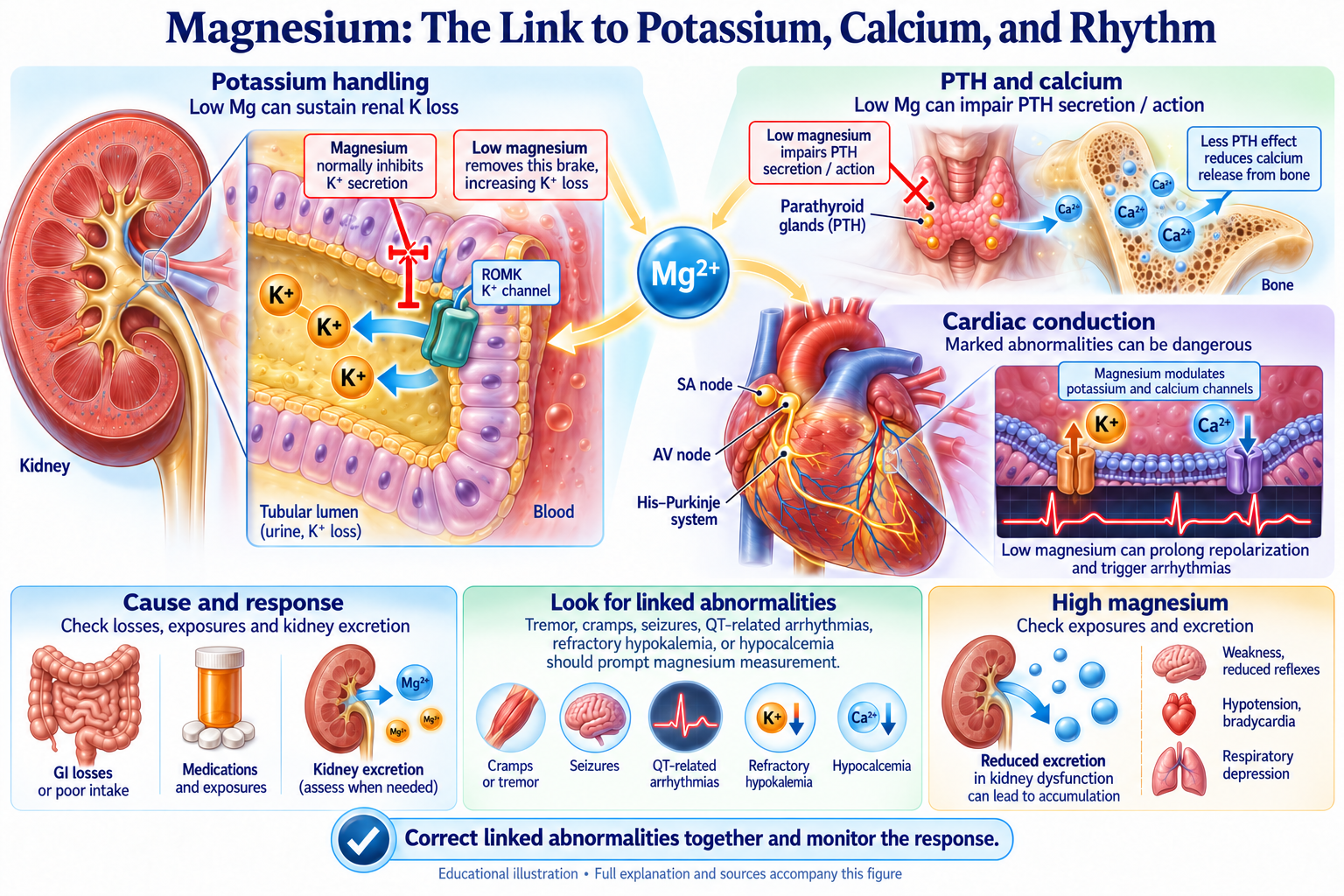
Use the visual framework with the case findings and the linked lecture.
Apply this general guide to the patient: what fits, what changes the next action, and what must you reassess?
The colonoscopy, with a polyethylene glycol prep and the rivaroxaban paused on the endoscopist's instructions, removed two small polyps. The MRI, with a group II agent at its diagnostic dose, showed a benign hemangioma. Gabapentin was tapered over two weeks to 300 mg at bedtime; the sleepiness lifted, and there have been no more falls. The unopened magnesium was cancelled, because off the PPI he no longer needed it. Empagliflozin 10 mg was started once the procedures were done. Creatinine 2.6, potassium 4.9, magnesium 2.0.
Mr. Brandt has CKD G4, atrial fibrillation and a written plan for a vomiting illness with poor fluid intake. Which instruction best combines temporary holds with safe reassessment?
Pause furosemide only; continue losartan and empagliflozin; seek advice only if vomiting lasts a week
Pause all medicines including anticoagulation; restart the entire list after the first meal
Pause losartan and empagliflozin; double rivaroxaban after any vomited dose to preserve stroke protection
Pause the agreed losartan, furosemide and empagliflozin doses; contact the care team promptly for the rest and restart advice
Show answer and explanation · Link to this question
Learning point: The written plan temporarily holds medicines that can worsen dehydration-related kidney problems or ketoacidosis risk. CKD G4 and rivaroxaban make prompt clinical advice important: inability to take the anticoagulant with food, bleeding, hypotension or suspected AKI requires individualized review. Do not stop beta-blockers or anticoagulation reflexively, double missed doses, or restart all held drugs automatically; document recovery, laboratory assessment when indicated and the restart plan. Why not the others: A delays review and omits agreed holds; B risks unplanned withdrawal and premature restart; C invents a dangerous catch-up anticoagulant dose. Concept link: ckd-20, aki-15, htn-cardiorenal-25, structural-19 · Question evidence and course reading
Back to Q7 · All answers in this case
Renal pharmacology lecture — 7. Sick Day Rules: Medications to Hold During Acute Illness
A patient with advanced CKD takes magnesium-containing laxative repeatedly, then develops lethargy, reduced tendon reflexes and bradycardia. Magnesium is markedly elevated. What is the safest next step?
Continue the laxative and repeat magnesium at the next routine visit
Treat this as isolated depression because magnesium is not renally cleared
Add another magnesium dose to prevent a withdrawal syndrome
Stop magnesium and arrange urgent monitored assessment and specialist treatment
Show answer and explanation · Link to this question
Learning point: Reduced kidney clearance allows magnesium to accumulate. Neuromuscular depression and bradycardia are warning signs of toxicity, so stop the source and arrange urgent monitored care. Severe cases may need IV calcium for physiologic antagonism and dialysis for removal; those decisions depend on symptoms, ECG and kidney function. Why not the others: A delays care; B ignores renal clearance and objective toxicity; C worsens the excess. Concept link: lytes-18 · Question evidence and course reading
Back to Q8 · All answers in this case
Low clearance, interacting medicines, nephrotoxins, and multiple adverse effects.
Mr. Brandt's card is taped to the refrigerator, and the pharmacy flags his chart so that no one refills naproxen or sodium phosphate. His neuropathic pain is tolerable on the lower gabapentin dose with nightly foot care, and acetaminophen and topical diclofenac cover the knees. His daughter now brings the bag, not a list, to every visit. A nephrology referral went out the same week: an eGFR below 30 and a UACR above 300 mg/g are each a referral trigger on their own. Medication review continues at follow-up, transitions of care, acute illness and meaningful kidney-function changes; it does not wait until eGFR reaches 15.
Clinical Pearl — Dose by the label's number Check the specific medicine and indication. Gabapentin and rivaroxaban use CrCl; metformin uses eGFR; apixaban for atrial fibrillation uses its own age, weight and creatinine criteria. Neither CrCl nor eGFR is reliable as a static estimate during rapidly changing creatinine.
Clinical Pearl — The CKD G4 stop list Below eGFR 30: no metformin, no NSAIDs (COX-2 drugs included), no magnesium-containing laxatives or antacids, and no group I gadolinium — and no oral sodium phosphate prep, which is avoided in CKD of any stage. Gabapentin and DOACs stay, dosed by the label's clearance.
Clinical Pearl — Contrast is a dose decision, not a veto A needed contrast study is done, not cancelled: a group II gadolinium agent at the lowest diagnostic dose for MRI below eGFR 30; for iodinated contrast, hold NSAIDs and metformin and consider isotonic fluid when the eGFR is below 30 or there is AKI .
Clinical Pearl — A low magnesium has a drug list Long-term PPIs block intestinal magnesium absorption; loop diuretics and thiazides waste it in the urine. Consider magnesium monitoring during prolonged PPI use, especially with diuretics, and investigate refractory hypokalemia or hypocalcemia. Stopping the PPI (famotidine is the swap) is often the treatment; in CKD G4, any oral replacement is low-dose and rechecked within about a week.
Clinical Pearl — A sick-day card has three parts Specify agreed temporary holds, when to call or seek urgent care, and a clinician-supported restart plan. Medicines such as beta-blockers and anticoagulants need individual instructions if there is hypotension, bleeding, AKI or inability to eat; they should not be stopped reflexively.
Pitfall — Reading the bag against the old kidney Doses that were right at eGFR 50 are wrong at 24. Re-dose every renally cleared drug each time the eGFR crosses 60, 45, 30 or 15.
Pitfall — Replacing the magnesium without finding it A supplement alone leaves the PPI in place, and in CKD G4 every dose needs a recheck, because renal excretion is central to magnesium balance; a magnesium-citrate bowel prep is a laxative-sized load, not a treatment. Find the drug, replace gently, recheck.
Assigned reading: the explanations in this case and the question-linked course evidence guide. The objective map distinguishes tested decisions from concepts taught in explanations.
Concepts: aki-13, aki-15, aki-22, ckd-18, ckd-19, ckd-20, htn-cardiorenal-25, lytes-18, structural-15, structural-18, structural-19, structural-20, structural-23.
Drug dosing quick reference (site) — Part 1: Principles of Drug Dosing in CKD
Renal pharmacology lecture — 2. Nephrotoxic Medication Avoidance
Renal pharmacology lecture — 1. Drug Dosing in CKD: Principles of Renal Clearance
Drug dosing quick reference (site) — Part 5: Antidiabetic Medications
First choices and optional confidence stay in this browser and are not sent to the website. Opening an explanation first is recorded. Revisiting an unchanged case preserves the first response; revised cases receive a new version. Website visit analytics are separate. On a shared device, export and clear the history when finished.