1 · Approach
Use the opening diagram and short lessons before the patient.
Session 2 · Classroom case · 11 questions
Andrew Bland, MD, FACP, FAAP · October 2026
Metformin question and infographics — choose an answer, then select “Show answer, explanation and infographics.”
Open all teaching, infographics and lecture links for this case →
Follow the history, examination, workup, and clinical course. Commit to each decision before opening the explanation.
Classroom pathway · Pause at each stage for discussion.
Stage diabetic kidney disease, identify protective-treatment opportunities, and connect each drug to potassium, volume and follow-up.
Use the opening diagram and short lessons before the patient.
Revisit urgency as history, examination and initial data arrive.
Use the urine, blood or imaging guide at the relevant decision.
Connect the management plan with response, monitoring and follow-up.
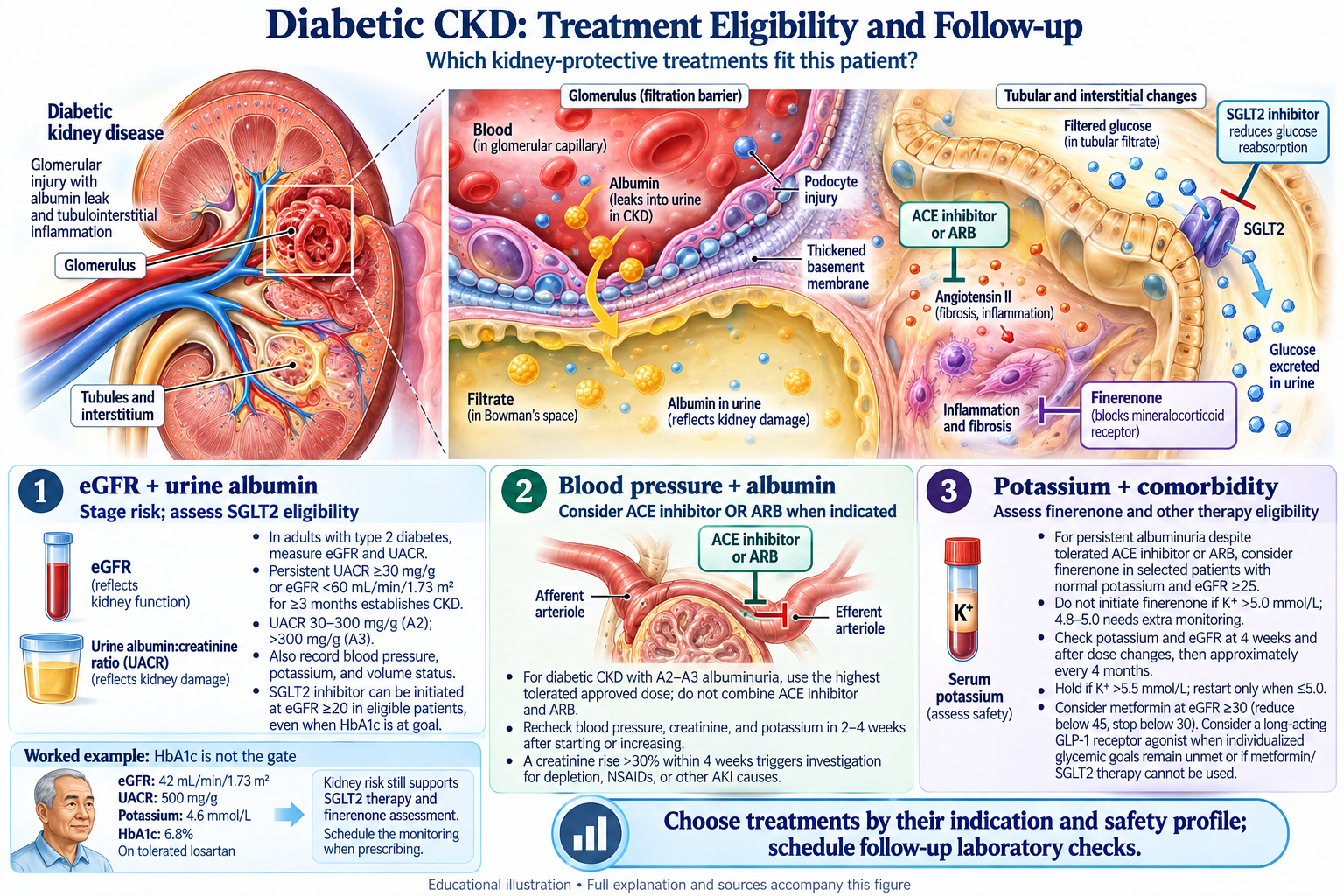
Use the diagram with the teaching text, then apply it to the case findings.
[!abstract] Session S2 · 2026-10-27 · in-session · 37 min Anchor: Diabetic CKD, accessible protective therapy and medication safety. One-line hook: A new PA must distinguish a plausible hemodynamic dip, reversible potassium contributors and an acute illness that requires urgent care. Fictional teaching case.
A 64-year-old man with type 2 diabetes has an eGFR below 60 on two tests more than three months apart (creatinine 1.8 mg/dL, eGFR 42 mL/min/1.73 m², fourteen months ago; 1.9 mg/dL, eGFR 39, today) and a urine albumin-to-creatinine ratio (UACR) of 900 mg/g. His KDIGO category is:
G3a A2 — moderately increased risk (yellow)
G3b A3 — very high risk (red)
G3b A2 — high risk (orange)
G4 A3 — very high risk (red)
Show answer and explanation · Link to this question
Learning point: eGFR 30–44 is G3b. UACR above 300 mg/g is A3 — "severely increased" albuminuria, the same range as the old word "macroalbuminuria." Two values more than three months apart make it chronic. On the KDIGO heat map G3b with A3 is the red cell: very high risk of progression and of cardiovascular events, and a referral trigger on its own. Why not the others: A and C put him in A2, but 900 mg/g is three times the A3 cut-off; D needs an eGFR below 30. Concept link: ckd-02 · Question evidence and course reading
Back to Q1 · All answers in this case
The same man takes metformin 1,000 mg twice daily. At stable eGFR 39 mL/min/1.73 m², which plan best fits current FDA labeling and ADA/KDIGO dose guidance?
Reduce to 500 mg twice daily; reassess benefit/risk and follow the FDA discontinuation boundary below eGFR 30
Stop it today — it is contraindicated below an eGFR of 45
Continue 1,000 mg twice daily while eGFR stays above 30
Replace it with glyburide, which is safer at this eGFR
Show answer and explanation · Link to this question
Learning point: He is already taking metformin. FDA labeling calls for benefit/risk review below eGFR 45 and discontinuation below 30; ADA/KDIGO recommends reducing to 1,000 mg/day at eGFR 30–44. The concern is accumulation and lactic acidosis, not direct nephrotoxicity. New observational CKD 4 evidence informs specialist discussion but has not changed the label. If a stable patient already has a deliberate specialist plan outside labeling, clarify that plan rather than automatically stopping treatment.
Why not the others: B confuses an initiation precaution with a contraindication. C ignores dose reduction in this eGFR range. D introduces a substantial prolonged-hypoglycemia risk from glyburide in CKD.
Concept link: structural-23
U.S. metformin prescribing information · ADA/KDIGO diabetes–CKD consensus · Lambourg et al., Scottish target trial emulation (2025) · Yang et al., Hong Kong target trial emulation and safety cohort (2024) · FDA: menopausal hormone-therapy label changes, February 12, 2026 · FDA: scope of requested hormone-therapy label revisions
Metformin does not directly injure the kidney. Kidney dysfunction matters because it reduces drug clearance. Accumulation, especially during AKI, sepsis or hypoxia, can contribute to impaired lactate handling and lactic acidosis. Severe and fatal cases occur; stable CKD and acute illness are different clinical settings.
Current FDA labeling: assess eGFR before treatment and at least annually, more often with increased risk. Initiation at eGFR 30–45 is not recommended; if an established user's eGFR falls below 45, reassess benefit and risk. Below 30 it is contraindicated and the label directs discontinuation. ADA/KDIGO separately recommends reducing the dose to 1,000 mg/day at eGFR 30–44. In this patient, that means 500 mg twice daily. Hold during dehydration, AKI or hypoxic illness. For iodinated contrast, FDA advises holding at eGFR 30–60, with liver disease, alcoholism or heart failure, or for intra-arterial contrast; recheck at 48 hours and restart if stable.
Evidence can move before labeling. The Scottish study emulated a trial in 4,278 adults with T2D and incident CKD 4. Continued versus discontinued metformin was associated with 3-year survival of 70.5% versus 63.7%: an estimated 6.8 percentage-point difference, not a randomized treatment effect or a causal NNT. Stopping versus continuing had a mortality HR of 1.26 (95% CI 1.10–1.44). MACE did not differ clearly. This study did not report a lactic-acidosis safety endpoint.
Severe and fatal lactic acidosis: read the actual safety evidence. In the separate Hong Kong register cohort of 3,235 people (median follow-up 4.3 years), any lactic acidosis occurred in 62/2,413 continuing users (2.6%) and 29/822 discontinuing users (3.5%). The crude difference was 0.9 percentage points; follow-up and confounding prevent interpreting it as a treatment benefit or NNT. The adjusted HR for continuing versus stopping was 0.94 (95% CI 0.53–1.64). The interval does not exclude clinically important harm. Among 24 reviewed events after the first six months in continuing users, competing causes included cardiogenic shock and sepsis; two had no other identified cause and both survived. Plasma metformin concentrations were unavailable. Neither study supplies a separate comparative estimate for severe or fatal lactic acidosis. Do not turn “no clear excess detected” or “those two survived” into “metformin cannot cause fatal acidosis.”
The PA's role in a specialist-directed exception. A stable patient may have a documented nephrologist-directed decision to continue metformin below eGFR 30, outside current U.S. labeling. Recognize the evidence and clarify the rationale, dose, follow-up and sick-day plan with that clinician; do not reflexively discontinue an intentional plan just because an alert fires. This is not instruction for routine independent initiation below 30 or reassurance during acute illness. New AKI, dehydration, hypoxia, sepsis or suspected acidosis requires prompt reassessment and an appropriate temporary hold.
An example from estrogen labeling. FDA began requesting menopausal hormone-therapy label revisions in November 2025 and approved the first six revised product labels on February 12, 2026. Cardiovascular-disease, breast-cancer and probable-dementia statements were removed from those boxed warnings after reassessment of the evidence and its applicability. The requested changes distinguish systemic from vaginal treatment and retain the endometrial-cancer boxed warning for systemic estrogen alone. This illustrates that labeling can change after a prolonged evidence reassessment; it does not mean all hormone-therapy risks disappeared or that metformin's label has changed. Know the current product label and the specialist's reasoning.

Not directly nephrotoxic. Reduced kidney clearance → metformin accumulation. During AKI, hypoxia or sepsis: impaired lactate handling → lactic acidosis risk. Stable CKD is different from acute illness. CKD 4: what newer evidence shows Scottish target trial emulation: 4,278 adults with T2D and CKD 4. Three-year survival: continued 70.5%; stopped 63.7%. Stopping vs continuing: mortality HR 1.26 (95% CI 1.10–1.44). Hong Kong safety cohort: 3,235 people; lactic acidosis HR 0.94 (95% CI 0.53–1.64), continued vs stopped. No clear difference detected; meaningful harm is not excluded. Observational evidence challenges blanket stopping. It does not prove safety below eGFR 30 or change FDA labeling. Sources: Lambourg 2025, PMID 39521399; Yang 2024, PMID 38586590.
Lambourg et al., Scottish target trial emulation (2025) · Yang et al., Hong Kong target trial emulation and safety cohort (2024) · U.S. metformin prescribing information

eGFR in mL/min/1.73 m² 45 or higher: kidney function generally permits use; assess other risks. 30 to below 45: do not routinely initiate. If already taking it, reassess benefit and risk of continuing. Below 30: contraindicated — discontinue. Monitor eGFR at least yearly; more often when risk is higher. Dose note: ADA/KDIGO recommends 1,000 mg/day at eGFR 30–44. This dose cap is consensus guidance, not an FDA dose-band rule. Hold during AKI, dehydration or hypoxic illness. Iodinated contrast: FDA advises holding with eGFR 30–60, liver disease, alcoholism, heart failure, or intra-arterial contrast. Recheck eGFR after 48 hours; restart if stable. Case 5: eGFR 39, already taking metformin → reduce to 500 mg twice daily with monitoring. Sources: U.S. metformin prescribing information; ADA/KDIGO consensus 2022.
U.S. metformin prescribing information · ADA/KDIGO diabetes–CKD consensus

Metformin-associated lactic acidosis can be severe or fatal. The label warning remains relevant during AKI, hypoxia, sepsis and drug accumulation. Scottish target trial emulation: studied mortality and cardiovascular outcomes. It did not provide a lactic-acidosis safety endpoint. Hong Kong companion safety cohort: 3,235 people with advanced CKD; median follow-up 4.3 years. Any lactic acidosis: continued metformin 62/2,413 (2.6%); stopped metformin 29/822 (3.5%). Adjusted HR 0.94 (95% CI 0.53–1.64), continued vs stopped. Among 24 reviewed events after the first 6 months in continuing users, major competing causes included cardiogenic shock and sepsis. Two had no other cause identified; both survived. Metformin levels were unavailable. What remains unknown: no separate comparative estimate for severe or fatal lactic acidosis was reported. These findings cannot establish zero fatal risk. PA takeaway: clarify a stable patient's nephrologist-directed plan rather than automatically stopping it. Confirm dose, monitoring and sick-day holds. Acute illness still requires prompt reassessment. Sources: Lambourg 2025, PMID 39521399; Yang 2024, PMID 38586590; U.S. metformin label.
Lambourg et al., Scottish target trial emulation (2025) · Yang et al., Hong Kong target trial emulation and safety cohort (2024) · U.S. metformin prescribing information
Question evidence · Back to Q2

Studies and guidance: Scottish target-trial emulation — Lambourg et al., 2025 · PubMed · Hong Kong study — Yang et al., 2024 · PubMed · HERS — Hulley et al., 1998 · PubMed · WHI breast outcomes — Chlebowski et al., 2020 · PubMed · WHI endometrial outcomes — Chlebowski et al., 2016 · PubMed · WHI gynecologic outcomes — Anderson et al., 2003 · PubMed · FDA: warnings, contraindications and boxed warnings · FDA Glucophage medical review: phenformin history · FDA 2016 metformin kidney-label revision · FDA November 2025 hormone-label request and retained warnings · FDA February 2026: first six hormone-label approvals
Core discussion: a boxed warning is a regulatory risk statement, not a grade of evidence certainty. A serious risk can merit a warning before its frequency or causal relationship is settled. The warning can change as evidence accumulates. That is a reason to understand the evidence, patient and specialist plan—not to disregard the current label. FDA labeling guidance distinguishes serious risk communication from definitive causal proof.
Phenformin explains the historical caution. It was withdrawn in 1977 after lactic acidosis, including deaths. That harm was real. Metformin is a different biguanide: it is not directly nephrotoxic, but reduced clearance during AKI, hypoxia or sepsis can contribute to dangerous accumulation. FDA broadened kidney eligibility in 2016 by replacing creatinine cutoffs with eGFR. Current U.S. labeling still contraindicates use below eGFR 30; initiation at 30–45 is not recommended. A nephrologist's deliberate exception needs clarification, documentation and a monitoring plan.
What changed in CKD 4 evidence? Scottish and Hong Kong observational studies associate continuation with better outcomes, but cannot establish that continuation caused the benefit. The Scottish study did not evaluate lactic acidosis. Hong Kong reported no statistically significant difference in any lactic acidosis in its separate safety cohort (HR 0.94, 95% CI 0.53–1.64); that interval does not establish equivalence. Neither provides a reliable comparative estimate for severe or fatal lactic acidosis. Two otherwise unexplained late events in the Hong Kong review survived; this does not classify all events as nonfatal. These findings support a more informed discussion, not a claim that acidosis is impossible in CKD 4.
HERS and WHI asked different questions. HERS studied oral combined hormones in women with established coronary disease (mean age 66.7). Its lack of overall coronary benefit and increased thromboembolism matter. Applying that secondary-prevention result to every younger symptomatic menopausal patient is a separate inference. HERS was not a definitive trial of every cancer risk or of all hormone formulations.
Spell out the regimen. CEE = conjugated equine estrogens (Premarin); MPA = medroxyprogesterone acetate, a progestin. WHI tested CEE plus MPA in women with a uterus and CEE alone in women after hysterectomy. These were separate placebo-controlled trials, not a head-to-head comparison.
| Cancer outcome | What the randomized evidence supports | What to avoid claiming |
|---|---|---|
| Breast, CEE + MPA | Long-term incidence was higher: 0.45% versus 0.36% annually; HR 1.28 (1.13–1.45). Breast-cancer mortality was not significantly different. | A modest absolute increase is not an absent signal; a nonsignificant mortality result does not prove no mortality effect. |
| Breast, CEE alone after hysterectomy | Long-term breast-cancer incidence and mortality were lower than placebo. | This does not establish the same effect for every estrogen, route or population, or make hormone therapy a cancer-prevention prescription. |
| Endometrial, continuous CEE + MPA | Extended follow-up found lower incidence: HR 0.65 (0.48–0.89). | The result does not apply to unopposed systemic estrogen in a woman with an intact uterus. |
| Cervical and vaginal | Gynecologic events were sparse; the early WHI report had only 13 cervical cancers and seven other gynecologic cancers overall. | No convincing trial signal is not proof of no risk, and these sites should not be grouped with the breast result. |
What the FDA change means. FDA requested revised menopausal hormone labeling in November 2025 and approved the first six revised labels in February 2026. Breast-cancer, cardiovascular and probable-dementia statements were removed from the box for those approved revisions. Other risk counseling remains relevant, and the endometrial-cancer boxed warning for systemic estrogen alone remains. This example illustrates revision of risk communication; it does not show that all original concerns were imaginary or that every product label changed at once.
Apply the distinction to the PA's job. A stable patient says, “My nephrologist told me to stay on metformin.” Check the dose, kidney trend, rationale and monitoring plan with that team instead of reflexively canceling the prescription. New dehydration, AKI, sepsis, hypoxia or suspected acidosis changes the situation and requires prompt reassessment. Ask what is known, what remains uncertain and what today's label says.
Discussion prompts (6–8 minutes): Which concern is mechanistic, which is an observed clinical outcome, and which is a regulatory instruction? Why does absence of statistical significance not establish safety? What would you clarify with the specialist today?
Which drug class is NOT one of the four pillars of therapy for diabetic kidney disease?
ACE inhibitor or ARB
SGLT2 inhibitor
GLP-1 receptor agonist
Beta-blocker
Show answer and explanation · Link to this question
Learning point: The four pillars of diabetic kidney disease are RAAS blockade (one ACE inhibitor or ARB), an SGLT2 inhibitor, the nonsteroidal mineralocorticoid receptor antagonist finerenone, and a GLP-1 receptor agonist. Their indications, outcome evidence and albuminuria effects differ; select and combine them according to phenotype, eligibility and tolerability. Beta-blockers are a pillar of heart-failure therapy, not of kidney protection — a common mix-up because "four pillars" is used in both fields. Why not the others: A, B and C are three of the four; the one missing from the list is finerenone. Concept link: ckd-11, ckd-12, ckd-13 · Question evidence and course reading
Back to Q3 · All answers in this case
Day 0 — primary care clinic, scheduled visit. Mr. Dale Hinrichs is a 64-year-old retired rural mail carrier who comes in with his wife for his diabetes follow-up. He feels fine. He has had type 2 diabetes for 12 years and hypertension for 10. Last year's eye exam found mild non-proliferative ("background") diabetic retinopathy — small retinal hemorrhages and microaneurysms, no new vessels, no treatment needed yet. He has gout, two flares in the past three years, the last one eight months ago. He has never smoked and drinks two beers on a weekend. His father had diabetes and "died on dialysis." He has no urinary symptoms, no edema, no foamy urine that he has noticed, and he has never seen blood in his urine.
His creatinine has drifted up slowly: 1.7 mg/dL two years ago (eGFR 45), 1.8 fourteen months ago (eGFR 42). Nobody has yet called it chronic kidney disease out loud.
Dose: 100 mg
Route: PO
Frequency: once daily
Indication: Hypertension; albuminuric diabetic kidney disease (RAAS blockade)
Dose: 1,000 mg
Route: PO
Frequency: twice daily
Indication: Type 2 diabetes
Dose: 40 mg
Route: PO
Frequency: once daily at bedtime
Indication: Cardiovascular risk reduction (type 2 diabetes with CKD)
| Drug | Dose | Route | Frequency | Indication |
|---|---|---|---|---|
| Losartan | 100 mg | PO | once daily | Hypertension; albuminuric diabetic kidney disease (RAAS blockade) |
| Metformin | 1,000 mg | PO | twice daily | Type 2 diabetes |
| Atorvastatin | 40 mg | PO | once daily at bedtime | Cardiovascular risk reduction (type 2 diabetes with CKD) |
What longitudinal and medication history is needed at this first kidney-focused visit?
Review prior creatinine and albuminuria, diabetes duration, retinopathy, family history and current medicines. Ask explicitly about gout treatments, supplements and salt substitutes at each later visit rather than carrying forward an old medication list.
Return to the lecture: DKD handout — Biomarkers & Monitoring · Drug-induced AKI handout — Function/Damage 2x2 grid (the KDIGO 2026 draft figure)
Vitals: BP 138/84 mmHg seated after 5 minutes of rest, repeated 136/84 · pulse 76 regular · afebrile · weight 96 kg · height 176 cm · BMI 31.0 kg/m².
Exam: Comfortable. No jugular venous distension. Lungs clear. Heart regular, no murmur. Abdomen soft, no bruit. No leg edema. Diminished vibration sense at both great toes; monofilament intact. Feet without ulcers.
What does today's examination establish, and what will need reassessment after treatment changes?
Record the repeated blood pressure, weight, neck veins, lungs, edema and foot findings. These are baseline observations to compare with later dizziness, weight loss or fluid accumulation.
Return to the lecture: Cardiorenal lecture — Managing GDMT (guideline-directed medical therapy) Complications: Practical Solutions · DKD handout — Biomarkers & Monitoring
Use what you know from the history and examination. Select an initial workup, name the question each test answers, and decide what can wait. Discuss urgent bedside assessment and treatment in parallel.
Some results in this case occur later, after new findings. Selecting a test does not imply that it is needed now.
Your selections last while this page is open. This is a discussion activity, not a scored MCQ. Results remain at their original points in the case; tests without supplied results are identified after you commit.
No over-the-counter products or supplements at this visit. No potassium supplement. No NSAID "except for a gout flare, and that was months ago."
Today's labs (fasting, drawn before the visit; all values steady state):
How does sodium compare with the supplied range or prior value? Explain what it adds to the pattern, whether the timing or specimen matters, and whether it changes your next step.
How does potassium compare with the supplied range or prior value? Explain what it adds to the pattern, whether the timing or specimen matters, and whether it changes your next step.
Hyperkalemia lecture — Find the mechanism and reversible contributors
How does chloride compare with the supplied range or prior value? Explain what it adds to the pattern, whether the timing or specimen matters, and whether it changes your next step.
How does bicarbonate compare with the supplied range or prior value? Explain what it adds to the pattern, whether the timing or specimen matters, and whether it changes your next step.
How does anion gap (na − [cl + hco₃]) compare with the supplied range or prior value? Explain what it adds to the pattern, whether the timing or specimen matters, and whether it changes your next step.
How does bun compare with the supplied range or prior value? Explain what it adds to the pattern, whether the timing or specimen matters, and whether it changes your next step.
How does creatinine compare with the supplied range or prior value? Explain what it adds to the pattern, whether the timing or specimen matters, and whether it changes your next step.
Drug-induced AKI handout — Function/Damage 2x2 grid (the KDIGO 2026 draft figure)
How does egfr (ckd-epi 2021, race-free) compare with the supplied range or prior value? Explain what it adds to the pattern, whether the timing or specimen matters, and whether it changes your next step.
How does bun:creatinine compare with the supplied range or prior value? Explain what it adds to the pattern, whether the timing or specimen matters, and whether it changes your next step.
Drug-induced AKI handout — Function/Damage 2x2 grid (the KDIGO 2026 draft figure)
How does glucose (fasting) compare with the supplied range or prior value? Explain what it adds to the pattern, whether the timing or specimen matters, and whether it changes your next step.
How does hemoglobin a1c compare with the supplied range or prior value? Explain what it adds to the pattern, whether the timing or specimen matters, and whether it changes your next step.
How does calcium compare with the supplied range or prior value? Explain what it adds to the pattern, whether the timing or specimen matters, and whether it changes your next step.
How does phosphorus compare with the supplied range or prior value? Explain what it adds to the pattern, whether the timing or specimen matters, and whether it changes your next step.
How does albumin compare with the supplied range or prior value? Explain what it adds to the pattern, whether the timing or specimen matters, and whether it changes your next step.
How does uric acid compare with the supplied range or prior value? Explain what it adds to the pattern, whether the timing or specimen matters, and whether it changes your next step.
How does ldl cholesterol compare with the supplied range or prior value? Explain what it adds to the pattern, whether the timing or specimen matters, and whether it changes your next step.
How does hemoglobin compare with the supplied range or prior value? Explain what it adds to the pattern, whether the timing or specimen matters, and whether it changes your next step.
How does urine albumin-to-creatinine ratio (uacr) compare with the supplied range or prior value? Explain what it adds to the pattern, whether the timing or specimen matters, and whether it changes your next step.
Drug-induced AKI handout — Function/Damage 2x2 grid (the KDIGO 2026 draft figure)
| Test | Result | Reference range |
|---|---|---|
| Sodium | 139 mEq/L | 135–145 |
| Potassium | 4.6 mEq/L | 3.5–5.0 |
| Chloride | 104 mEq/L | 98–107 |
| Bicarbonate | 23 mEq/L | 22–29 |
| Anion gap (Na − [Cl + HCO₃]) | 12 | 8–12 |
| BUN | 27 mg/dL | 7–20 |
| Creatinine | 1.9 mg/dL | 0.7–1.3 |
| eGFR (CKD-EPI 2021, race-free) | 39 mL/min/1.73 m² | ≥60 |
| BUN:creatinine | 14:1 | 10–20:1 |
| Glucose (fasting) | 162 mg/dL | 70–99 |
| Hemoglobin A1c | 7.6 % | <5.7 |
| Calcium | 9.2 mg/dL | 8.5–10.2 |
| Phosphorus | 3.9 mg/dL | 2.5–4.5 |
| Albumin | 4.0 g/dL | 3.5–5.0 |
| Uric acid | 8.4 mg/dL | 3.5–7.2 |
| LDL cholesterol | 88 mg/dL | <100 (lower in high-risk patients) |
| Hemoglobin | 13.1 g/dL | 13.5–17.5 |
| Urine albumin-to-creatinine ratio (UACR) | 900 mg/g | <30 |
Apply your interpretation in Q4
Revisit the framework: DKD handout — Biomarkers & Monitoring
Urinalysis (dipstick + microscopy): specific gravity 1.015 · pH 5.5 · protein 2+ · glucose trace · blood negative · leukocyte esterase negative · nitrite negative. Microscopy: 0–2 RBC/hpf, 0–2 WBC/hpf, no casts, no crystals. A bland sediment with proteinuria.
Renal ultrasound (14 months ago, ordered for the first creatinine of 1.8): right kidney 11.2 cm, left 11.5 cm, mildly increased cortical echogenicity, no hydronephrosis, no stones, no masses.
A word on the arithmetic before the questions. The eGFR of 39 is what CKD-EPI 2021 gives for a creatinine of 1.9 in a 64-year-old man. The slope is 45 → 42 → 39 over two years, about 3 mL/min per year — a slow decline, not a rapid one (rapid is more than 5 mL/min per year). The BUN:creatinine ratio of 14:1 is what CKD looks like at steady state. The anion gap is 12, so there is no hidden acid-base story. Hemoglobin 13.1 is a whisker under the line — iron studies at the next visit; CKD anemia is the Tired Teacher's case (Case 04), not this one.
His picture is 12 years of type 2 diabetes, background retinopathy, UACR 900 mg/g with a bland sediment, symmetric kidneys and an eGFR falling about 3 mL/min per year. Which finding, if it were present instead, would most make you look for a cause other than diabetes?
The background retinopathy on last year's eye exam
An eGFR slope of about 3 mL/min per year
Red-cell casts on urine microscopy
A UACR of 900 mg/g with a bland sediment
Show answer and explanation · Link to this question
Learning point: Diabetes damages the glomerulus (the filter) slowly and symmetrically: protein leaks, the filter does not bleed, and the decline is measured in a few mL/min a year. Retinopathy is the same small-vessel disease seen in the one organ you can look into, so its presence supports diabetes as the cause. Red-cell casts mean red cells were inside the tubules — a glomerulonephritis, which is a different disease and a same-week referral. The other atypical features to know: no retinopathy at all after a long diabetes duration, a rapid fall in eGFR, or heavy proteinuria appearing within a few years of diagnosis. Why not the others: A supports typical DKD; B is the expected slow slope; D is exactly the diabetic pattern — heavy albuminuria with nothing else in the urine. Concept link: ckd-06 · Question evidence and course reading
Back to Q4 · All answers in this case
Pause — commit before the reveal
He is on losartan 100 mg daily, metformin 1,000 mg twice daily and atorvastatin 40 mg. eGFR 39, UACR 900 mg/g, potassium 4.6 mEq/L, A1c 7.6%. What is the best plan today?
Start dapagliflozin and stop losartan pre-emptively; BMP in two weeks
Start generic dapagliflozin 10 mg daily, reduce metformin to 500 mg twice daily, keep losartan and the statin; BMP in two weeks
Start finerenone today and defer the SGLT2 inhibitor solely until nephrology sees him
Change nothing and refer; let nephrology set the entire plan
Show answer and explanation · Link to this question
Learning point: Add indicated SGLT2 inhibition now while maintaining tolerated losartan and fixing the metformin dose. Generic dapagliflozin 10 mg daily is the faculty choice for access and affordability; confirm the actual pharmacy price and availability. His eGFR 39 is above the U.S. dapagliflozin CKD/HF initiation threshold of 25. Review volume status, adverse effects and sick-day holds; a two-week BMP is planned for this medication change.
Why not the others: A abandons an effective ARB before a potassium problem exists. C delays an indicated accessible therapy solely for a specialist visit; sequencing is individualized. D unnecessarily delays primary-care kidney and heart protection.
Concept link: ckd-12, structural-23, structural-24
DAPA-CKD, Heerspink et al. (2020) · ADA/KDIGO diabetes–CKD consensus · Cost Plus Drugs: dapagliflozin product listing
Choose an accessible SGLT2 inhibitor. Start dapagliflozin 10 mg orally once daily, the generic drug sold under the brand name Farxiga. Farxiga itself is the brand. The patient's eGFR 39 meets the U.S. dapagliflozin CKD/HF initiation threshold of 25; the broader KDIGO class recommendation reaches eGFR 20. This is treatment for kidney and heart protection even when the glucose effect diminishes at lower GFR.
Cost Plus Drugs discussion: compare the generic dapagliflozin cash price with the patient's insurance copay and local pharmacy. Select the exact strength and 30- or 90-day quantity; calculate the monthly cost including applicable pharmacy and shipping charges, and confirm availability and delivery time before prescribing. Faculty has encountered approximately $5/month pricing; this is an example, not a guaranteed current price. The live Cost Plus quote could not be independently verified on October 24, 2026. Use the linked listing for the current total. Affordability matters because a prescription only helps if the patient can obtain and continue it.
What you tell him before he leaves. Mr. Hinrichs asks why he takes a cholesterol pill when "my cholesterol is fine." The honest answer is the CKM frame — cardiovascular-kidney-metabolic syndrome, the 2026 guideline's name for the fact that his blood pressure, his glucose, his lipids and his kidney are one disease with shared plumbing. Type 2 diabetes plus hypertension is CKM stage 2; very-high-risk CKD (his red cell on the heat map) is a risk equivalent that moves him to stage 3. Stage 3 means he is treated as if he already had cardiovascular disease: the statin continues whatever the LDL says, the BP target is below 130/80 by the 2025 AHA/ACC guideline (KDIGO 2021 suggests a standardized systolic below 120 when tolerated — same patient, different measurement method), and the kidney drugs are also heart drugs. One problem, four dials.
He also gets three practical instructions: sodium under 2 g/day without potassium salt substitutes; dapagliflozin may cause an early functional eGFR dip, which still needs clinical review; and a written sick-day plan. During vomiting, diarrhea, dehydration or inability to eat and drink, hold dapagliflozin, losartan and metformin and contact the clinic for assessment and a restart plan.
Use the macula densa and early eGFR-dip graphics after Q6 to explain the case results. State what fits, what does not, and which finding changes the next action.
Day 14 — the 2-week lab check. He feels well. He has been "really good about the salt": his neighbor, whose wife is a nurse, told him that the way to cut salt is to switch to NoSalt, so he has been using it on everything for 12 days — "the kids love it on the popcorn." Nine days ago his left big toe flared. He took what he always takes for gout, naproxen sodium 220 mg, two tablets twice a day, and it has mostly settled; he is still taking it "to be safe." Neither item is in his chart. He has not been sick, is eating and drinking normally, and has not missed a dose of anything.
Vitals: BP 128/78 mmHg · pulse 74 · weight 94.5 kg (down 1.5 kg).
How does sodium compare with the supplied range or prior value? Explain what it adds to the pattern, whether the timing or specimen matters, and whether it changes your next step.
How does potassium compare with the supplied range or prior value? Explain what it adds to the pattern, whether the timing or specimen matters, and whether it changes your next step.
Hyperkalemia lecture — Find the mechanism and reversible contributors
How does chloride compare with the supplied range or prior value? Explain what it adds to the pattern, whether the timing or specimen matters, and whether it changes your next step.
How does bicarbonate compare with the supplied range or prior value? Explain what it adds to the pattern, whether the timing or specimen matters, and whether it changes your next step.
How does anion gap compare with the supplied range or prior value? Explain what it adds to the pattern, whether the timing or specimen matters, and whether it changes your next step.
How does bun compare with the supplied range or prior value? Explain what it adds to the pattern, whether the timing or specimen matters, and whether it changes your next step.
How does creatinine compare with the supplied range or prior value? Explain what it adds to the pattern, whether the timing or specimen matters, and whether it changes your next step.
Drug-induced AKI handout — Function/Damage 2x2 grid (the KDIGO 2026 draft figure)
How does egfr (ckd-epi 2021) compare with the supplied range or prior value? Explain what it adds to the pattern, whether the timing or specimen matters, and whether it changes your next step.
How does bun:creatinine compare with the supplied range or prior value? Explain what it adds to the pattern, whether the timing or specimen matters, and whether it changes your next step.
Drug-induced AKI handout — Function/Damage 2x2 grid (the KDIGO 2026 draft figure)
How does glucose (day 0 fasting; later random) compare with the supplied range or prior value? Explain what it adds to the pattern, whether the timing or specimen matters, and whether it changes your next step.
| Test | Day 0 | Day 14 | Reference range |
|---|---|---|---|
| Sodium | 139 | 138 mEq/L | 135–145 |
| Potassium | 4.6 | 5.7 mEq/L (repeat on a non-hemolyzed sample: 5.6) | 3.5–5.0 |
| Chloride | 104 | 105 mEq/L | 98–107 |
| Bicarbonate | 23 | 21 mEq/L | 22–29 |
| Anion gap | 12 | 12 | 8–12 |
| BUN | 27 | 31 mg/dL | 7–20 |
| Creatinine | 1.9 | 2.2 mg/dL (+0.3, a 16 % rise) | 0.7–1.3 |
| eGFR (CKD-EPI 2021) | 39 | 33 mL/min/1.73 m² — lab-printed; see note | ≥60 |
| BUN:creatinine | 14:1 | 14:1 | 10–20:1 |
| Glucose (Day 0 fasting; later random) | 162 (fasting) | 148 mg/dL | 70–99 fasting; 70–140 random |
Apply your interpretation in Q6
Revisit the framework: DKD handout — Biomarkers & Monitoring
Urinalysis (Day 14): specific gravity 1.012 · protein 2+ · glucose 3+ · blood negative. Microscopy bland.
ECG (Day 14): sinus rhythm 74/min, PR 160 ms, QRS 88 ms, normal T waves, no peaking. Read side by side with the Day 0 tracing — unchanged.
Three notes on the numbers. Glucosuria is expected with dapagliflozin. The lab-printed eGFR of 33 is not a new CKD stage while creatinine is changing. A hemodynamic dip is plausible, but naproxen can also impair perfusion; the trend and bedside assessment must distinguish them. Mild normal-gap acidosis with hyperkalemia in a diabetic patient on an ARB and an NSAID is compatible with reduced aldosterone effect. Naproxen impairs potassium excretion, while the salt substitute adds potassium.
Two weeks after dapagliflozin was added to losartan, creatinine is 2.2 from 1.9 mg/dL (+16%). He feels well, but K is 5.6 on repeat and he has been taking naproxen. How should you interpret this?
This proves dapagliflozin has injured the kidney; stop it permanently
This proves losartan toxicity; halve it without assessing other contributors
Obstruction is established; obtain an ultrasound before addressing potassium
A hemodynamic dip is plausible; review contributors, treat potassium and repeat BMP within three days while continuing tolerated protective therapy
Show answer and explanation · Link to this question
Learning point: A modest early change is compatible with a hemodynamic dip, but cannot prove the absence of injury. Assess volume, symptoms, BP, NSAIDs, potassium and serial kidney function. Remove naproxen and the potassium salt substitute and implement Q7’s potassium plan, with a BMP within three days. Dapagliflozin has trial-level kidney and survival benefits; the presence or size of a dip is not an individual survival test.
Why not the others: A and B assign causation from one creatinine value and abandon therapy without reassessment. C invents obstruction from a finding that has several plausible explanations and delays potassium management.
Concept link: aki-14, htn-cardiorenal-09
Jongs et al., DAPA-CKD acute eGFR-change analysis (2022) · DAPA-CKD, Heerspink et al. (2020)
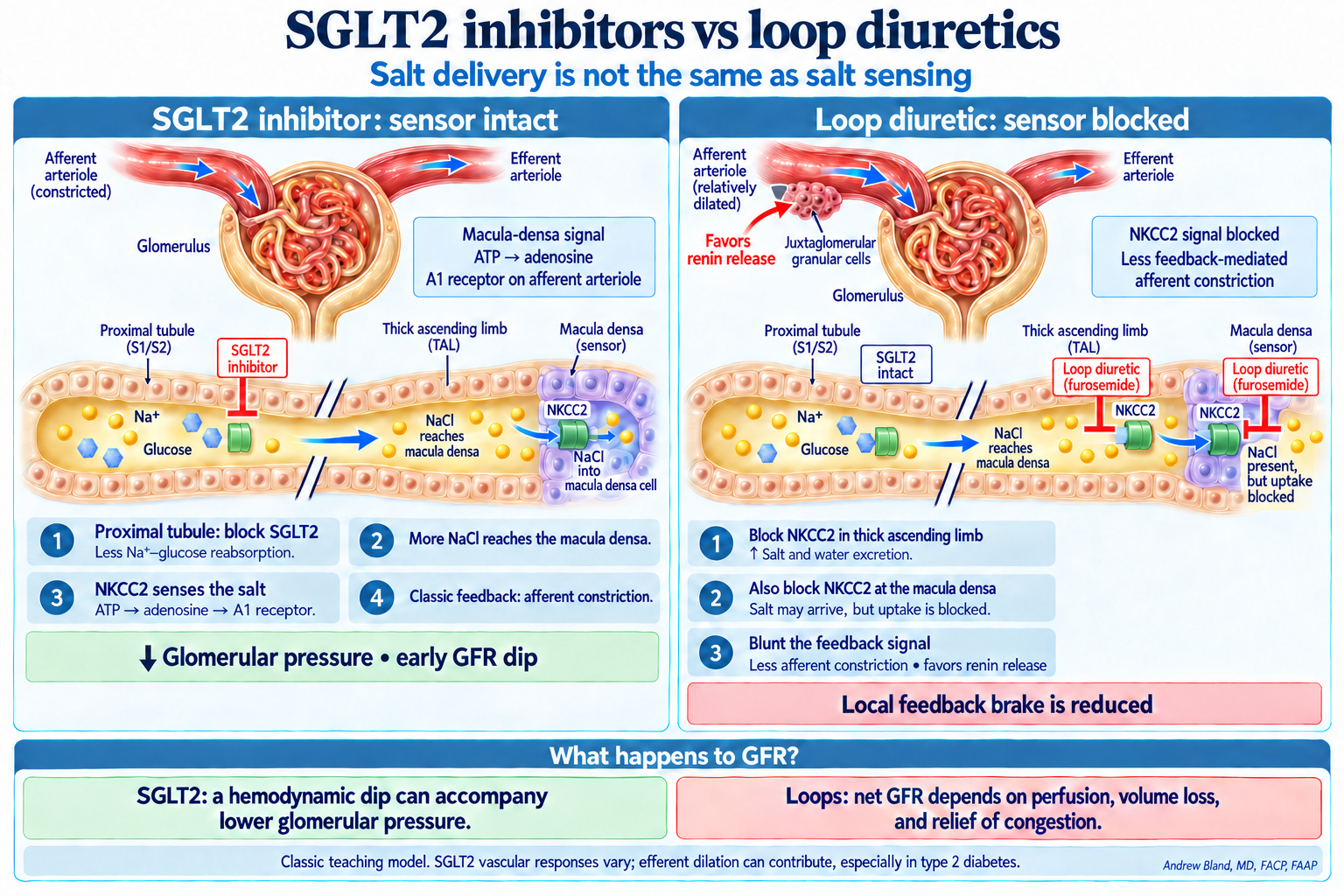
Use the diagram with the teaching text, then apply it to the case findings.
An early eGFR fall can reflect lower intraglomerular pressure rather than structural damage. DAPA-CKD's acute-change analysis found that an early dip in treated patients was not associated with higher CKD-progression rates. Dip groups were not randomized, and a dip is neither required for benefit nor a validated individual survival test. The >30% creatinine threshold is a reassessment trigger after starting or increasing ACEi/ARB, not a universal guarantee that smaller changes are safe.
In DAPA-CKD (4,304 adults; median follow-up 2.4 years), dapagliflozin versus placebo reduced the primary composite of sustained eGFR decline ≥50%, kidney failure, or kidney/CV death: 9.2% versus 14.5%, HR 0.61, absolute reduction 5.3 percentage points, NNT 19. All-cause death was 4.7% versus 6.8%, HR 0.69, absolute reduction 2.1 percentage points, approximate NNT 48. These are trial-level benefits, not a prediction from this patient's 16% creatinine increase.
A meaningful individual response is assessed over time: tolerability and access, BP and volume, serial eGFR slope and UACR, and avoidance of kidney failure and heart-failure events. In this case K 5.6 and naproxen exposure require active treatment and a BMP within three days; waiting 2–4 weeks would miss the potassium issue.

Early: lower intraglomerular pressure can lower eGFR. Later: kidney function often declines more slowly. A small, stable dip can be compatible with protection. A dip is not required for benefit and does not prove an individual's survival response. DAPA-CKD: 4,304 adults with CKD; median 2.4 years. Dapagliflozin vs placebo, both with standard care. Primary kidney/CV-death composite: 9.2% vs 14.5%; HR 0.61; ARR 5.3%; NNT 19. All-cause death: 4.7% vs 6.8%; HR 0.69; ARR 2.1%; NNT about 48. Meaningful follow-up: serial eGFR and UACR, BP, volume status, symptoms, adherence and adverse effects. Case 5: creatinine 1.9 → 2.2 (+16%) plus K 5.6 and naproxen exposure. Review the whole patient, stop the NSAID, treat potassium and recheck within 3 days. Sources: DAPA-CKD, PMID 32970396; dip analysis, PMID 35977807.
DAPA-CKD, Heerspink et al. (2020) · Jongs et al., DAPA-CKD acute eGFR-change analysis (2022)
Pause — commit before the reveal
K is 5.7 mEq/L, repeat 5.6, with an unchanged ECG and no symptoms. He is eating and drinking normally and can return promptly. He used a potassium-chloride salt substitute and naproxen on top of losartan and dapagliflozin. What is the faculty-selected plan?
Stop the salt substitute and naproxen; give Lokelma 10 g orally daily for three days, repeat BMP within three days and review continued losartan/dapagliflozin
Send every stable patient with K 5.6 for IV calcium and insulin solely because of this number
Stop losartan permanently and wait one week for a BMP
Start a binder but allow the salt substitute and naproxen to continue
Show answer, explanation and infographics · Link to this question
Learning point: Act on both the potassium load and impaired excretion: remove the contributors and add the faculty-selected Lokelma regimen of 10 g orally once daily for three days. Repeat BMP within three days, earlier if symptoms or the clinical course worsen; adjust further therapy to the result. This differs from labeled initial 10 g three-times-daily dosing for up to 48 hours. Preserve beneficial therapy when potassium can be controlled and close follow-up is reliable.
Why not the others: B treats all patients identically; calcium addresses cardiac toxicity and does not remove potassium. C prematurely discards a protective drug and delays monitoring. D leaves reversible contributors in place. A normal ECG never excludes hyperkalemic danger.
Concept link: ckd-17, lytes-14
U.S. Lokelma prescribing information
For this clinically stable patient with confirmed K 5.6 and reliable follow-up, stop naproxen and the potassium-chloride salt substitute and add Lokelma 10 g orally once daily for three days, then recheck BMP within three days. This is the faculty-selected regimen for the case. It differs from the U.S. labeled initial regimen of 10 g three times daily for up to 48 hours; label maintenance dosing is individualized. Continue losartan and dapagliflozin if tolerated, with reassessment of perfusion, kidney function and potassium response.
Lokelma binds potassium in the gut for fecal removal. Separate other oral medicines by at least two hours unless a specific exception is established. Each 10 g contains approximately 800 mg sodium, so review edema and sodium burden; watch for hypokalemia and significant bowel-motility disorders. It is not emergency rescue therapy. A normal ECG does not establish safety. Symptoms, oliguria, acute illness, worsening kidney function or rising potassium require earlier urgent assessment.

Case 5: K 5.7, repeat 5.6 mmol/L; clinically stable; ECG unchanged. 1 Remove contributors: stop naproxen and potassium-chloride salt substitute. 2 Lower potassium: faculty-selected case regimen — Lokelma (sodium zirconium cyclosilicate) 10 g orally once daily for 3 days. 3 Recheck BMP within 3 days: potassium and creatinine; earlier if worsening. Adjust further treatment to the result. Preserve losartan and dapagliflozin if tolerated, with close review. Different from U.S. labeled initial dosing: 10 g three times daily for up to 48 hours. Individualize the regimen. Binds potassium in the gut → potassium leaves in stool. Separate other oral medicines by at least 2 hours unless an exception is established. Watch for edema and low potassium; each 10 g contains about 800 mg sodium. Not emergency rescue. New weakness, palpitations, acute illness, oliguria or a rising potassium needs urgent reassessment. A normal ECG does not exclude danger. Sources: U.S. Lokelma label; UK Kidney Association hyperkalemia guideline.
The gout. Naproxen is out for good — any NSAID in a man with eGFR in the 30s on an ARB is the "triple whammy" waiting for its third partner (a diuretic or a stomach bug). For the next flare he gets colchicine at a dose reduced for his eGFR or a short prednisone taper, and the clinic plans urate-lowering therapy once the acute problem settles. Two small gifts: losartan is mildly uricosuric (it helps the kidney excrete uric acid), and SGLT2 inhibitors lower uric acid a little too.
His wife asks about "the new kidney pill" a neighbor takes — finerenone. With potassium 5.7 mEq/L today, eGFR in the 30s, BMI 31 and A1c 7.6 %, which statement is correct?
Start finerenone today alongside the potassium fixes — the sooner the kidney is protected, the better
Start spironolactone now instead — it is the cheaper equivalent and does the same job for the kidney
Defer finerenone until the potassium is 5.0 or lower on a recheck; consider a GLP-1 receptor agonist once the acute medication review is complete
Start finerenone in place of losartan, so the potassium problem solves itself and the pillar count holds
Show answer and explanation · Link to this question
Learning point: Finerenone is a nonsteroidal mineralocorticoid receptor antagonist: it blocks aldosterone at the collecting duct, so it raises potassium by design. The label says do not start it if potassium is above 5.0; at 4.8–5.0 start with extra monitoring; eGFR must be 25 or more (10 mg daily for eGFR 25 to under 60); check potassium at 4 weeks; hold if it exceeds 5.5. Today he fails the entry rule, so the third pillar waits for the recheck. The fourth pillar does not depend on potassium: a GLP-1 receptor agonist (semaglutide 0.25 mg weekly, titrated slowly) lowers glucose, weight, cardiovascular events and — in the FLOW trial — kidney events in people like him. Start low for the nausea; this case starts semaglutide at the Day 28 visit. Vomiting and poor intake trigger the sick-day plan (Part 3). Why not the others: A ignores the potassium entry criterion the drug carries on its label; B is the wrong drug for this indication — spironolactone is a heart-failure drug, is generally avoided at eGFR below 30 or potassium above 5, and raises potassium more; D misunderstands the pillars — finerenone is added on top of a tolerated ACE inhibitor or ARB, never in place of one. Concept link: ckd-13, htn-cardiorenal-24 · Question evidence and course reading
Back to Q8 · All answers in this case
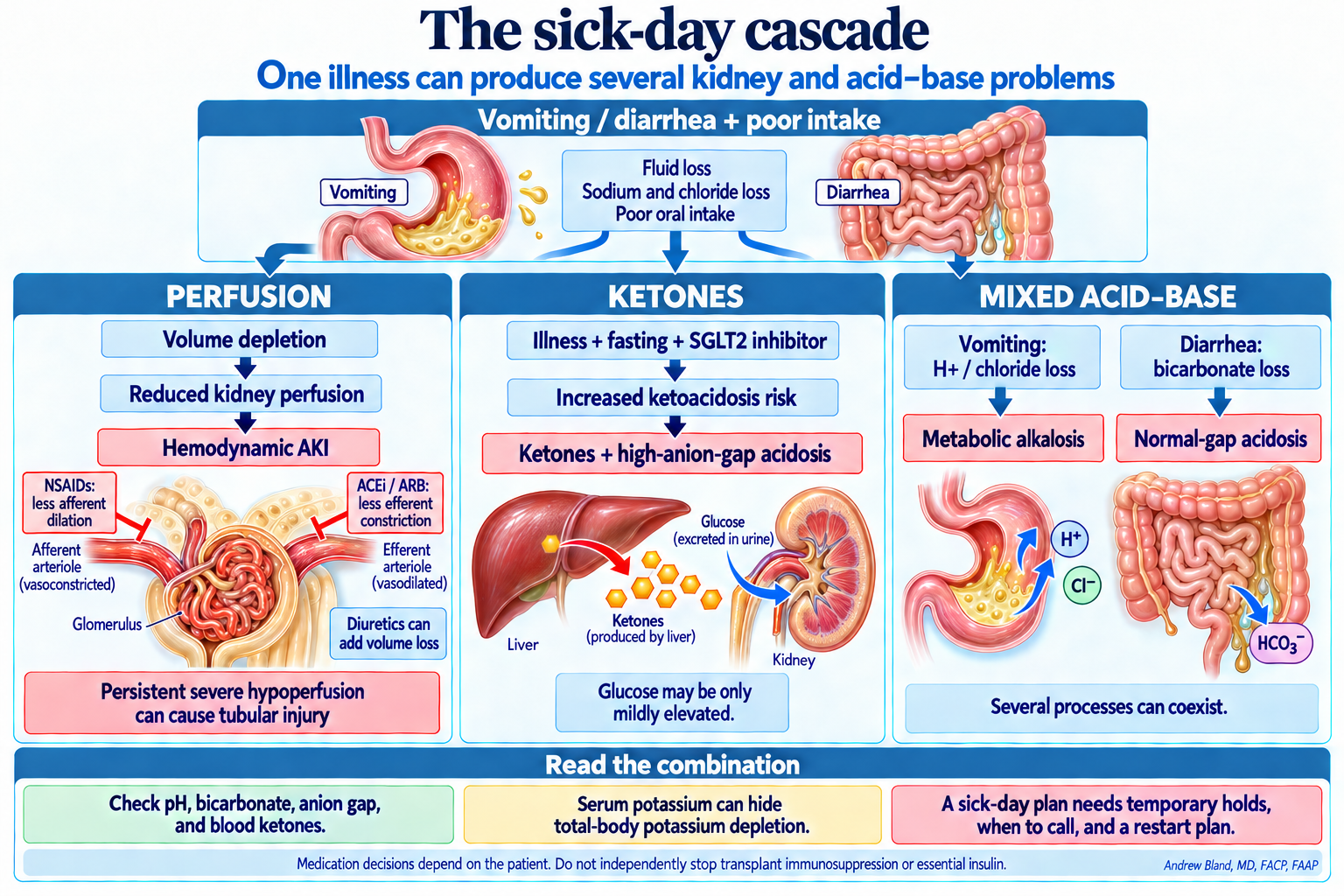
Use the diagram with the teaching text, then apply it to the case findings.
Explain the intended effect, the major treatment risk and the observation that will tell you whether the plan is working.
Day 28 — four weeks on dapagliflozin, two weeks off NoSalt and naproxen. The requested three-day safety BMP was reviewed promptly after the Lokelma course; a new pre-visit BMP is now back.
Concordance-style practice. There is no expert panel behind the key, the teaching explanation. "Unchanged" means the finding does not move the hypothesis — not "I am not sure."
One creatinine at Day 14 could not tell a dip from early injury. If you were thinking "the SGLT2 inhibitor has injured the kidney," and you then learn that at Day 28, still on the drug and two weeks off the salt substitute and naproxen, the creatinine is 2.0 mg/dL and the potassium 4.9 mEq/L, this hypothesis becomes:
Much less likely
Less likely
Unchanged
More likely
Much more likely
Show answer and explanation · Link to this question
Learning point: Improvement toward baseline while the SGLT2 inhibitor continues makes a sustained toxic injury caused by that drug less likely. It is compatible with an early hemodynamic change plus removal of NSAID and potassium-related contributors. It does not prove that no kidney injury occurred: mixed and recovering AKI remain possible. Continue follow-up using symptoms, volume status, serial kidney function and potassium. The preferred formative direction is much less likely; a justified less-likely answer is acceptable. Concept link: aki-14 · Question evidence and course reading
Back to Q9 · All answers in this case
Drug-induced AKI handout — Function/Damage 2x2 grid (the KDIGO 2026 draft figure)
Follow-up results after Q9. The Day 17 safety BMP showed potassium 4.9 mEq/L and creatinine 2.1 mg/dL after the three daily Lokelma doses; further binder treatment was reassessed rather than continued automatically. Day 28 potassium is 4.9, creatinine 2.0 (eGFR 37), bicarbonate 23 and BP 126/76. Semaglutide 0.25 mg subcutaneously weekly starts now, titrated at four-week steps. Finerenone remains a later option when potassium and eGFR permit. The sick-day and restart plan is reviewed.
Month 3 — a phone call, then a same-day slot. His wife calls. Their grandson brought a stomach bug home; Mr. Hinrichs has had vomiting and watery diarrhea for three days, has kept down "a little broth and some crackers," and feels dizzy when he stands. He has taken all of his pills every day, "because the doctor said they protect my kidneys." He has not urinated since early morning. Nobody looked at the sick-day card.
Vitals in the clinic: seated BP 112/68 mmHg, pulse 94 · standing at 1 minute BP 92/58, pulse 112, lightheaded · temperature 37.6 °C · weight 93 kg (down 3 kg from Day 28). Dry mucous membranes, no jugular venous distension, lungs clear, abdomen soft and mildly tender diffusely, no edema.
How does sodium compare with the supplied range or prior value? Explain what it adds to the pattern, whether the timing or specimen matters, and whether it changes your next step.
How does potassium compare with the supplied range or prior value? Explain what it adds to the pattern, whether the timing or specimen matters, and whether it changes your next step.
Hyperkalemia lecture — Find the mechanism and reversible contributors
How does chloride compare with the supplied range or prior value? Explain what it adds to the pattern, whether the timing or specimen matters, and whether it changes your next step.
How does bicarbonate compare with the supplied range or prior value? Explain what it adds to the pattern, whether the timing or specimen matters, and whether it changes your next step.
How does anion gap compare with the supplied range or prior value? Explain what it adds to the pattern, whether the timing or specimen matters, and whether it changes your next step.
How does bun compare with the supplied range or prior value? Explain what it adds to the pattern, whether the timing or specimen matters, and whether it changes your next step.
How does creatinine compare with the supplied range or prior value? Explain what it adds to the pattern, whether the timing or specimen matters, and whether it changes your next step.
Drug-induced AKI handout — Function/Damage 2x2 grid (the KDIGO 2026 draft figure)
How does egfr compare with the supplied range or prior value? Explain what it adds to the pattern, whether the timing or specimen matters, and whether it changes your next step.
How does bun:creatinine compare with the supplied range or prior value? Explain what it adds to the pattern, whether the timing or specimen matters, and whether it changes your next step.
Drug-induced AKI handout — Function/Damage 2x2 grid (the KDIGO 2026 draft figure)
How does glucose (random) compare with the supplied range or prior value? Explain what it adds to the pattern, whether the timing or specimen matters, and whether it changes your next step.
| Test | Day 28 | Month 3 (sick) | Reference range |
|---|---|---|---|
| Sodium | 139 | 135 mEq/L | 135–145 |
| Potassium | 4.9 | 5.9 mEq/L | 3.5–5.0 |
| Chloride | 105 | 103 mEq/L | 98–107 |
| Bicarbonate | 23 | 20 mEq/L | 22–29 |
| Anion gap | 11 | 12 | 8–12 |
| BUN | 26 | 58 mg/dL | 7–20 |
| Creatinine | 2.0 | 2.9 mg/dL (+45 % in weeks; +53 % above Day 0) | 0.7–1.3 |
| eGFR | 37 | not valid — creatinine is moving | — |
| BUN:creatinine | 13:1 | 20:1 | 10–20:1 |
| Glucose (random) | 150 | 128 mg/dL | 70–140 random |
Apply your interpretation in Q10
Revisit the framework: Renal pharmacology lecture — 7. Sick Day Rules
Urinalysis: specific gravity 1.024 · glucose 3+ · protein 2+ · blood negative · ketones trace. Microscopy: hyaline casts, otherwise bland. ECG: sinus tachycardia 108/min, normal intervals, no T-wave peaking.
Read it in order. Creatinine is 2.9 from 2.0 at Day 28, in a patient with new dehydration and oliguria. This is clinically concerning for AKI, but the timing of prior measurements does not itself document a ≥0.3 mg/dL rise within 48 hours; obtain urgent repeat measurements and assess urine output. The ratio of 20 and concentrated bland urine fit reduced perfusion but are not diagnostic alone. Hyperkalemia, orthostasis, poor intake and oliguria determine urgency. A normal anion gap and near-normal glucose do not safely exclude evolving SGLT2-associated ketoacidosis; obtain venous gas and serum beta-hydroxybutyrate.
Pause — commit before the reveal
Creatinine 2.9 mg/dL (from 2.0), potassium 5.9 mEq/L with a normal ECG, bicarbonate 20, orthostatic with a 3-kg weight loss, poor intake for three days, no urine since morning, still taking losartan, dapagliflozin, metformin and semaglutide. Where does he go?
Home: hold the sick-day drugs, oral rehydration, BMP in 48–72 hours
Same-day ED: IV fluid, monitored potassium, drugs held, DKA screen
Home: patiromer for the potassium, oral fluids, BMP in a week
Direct admission: nephrology consult to arrange urgent dialysis
Show answer and explanation · Link to this question
Learning point: Outpatient creatinine-bump triage runs on four things: the potassium, the symptoms, the urine output and the trajectory. A 48–72-hour recheck is for the patient who is eating and drinking, has a potassium below 5.5, is making urine and whose creatinine rise is small and plausibly hemodynamic. He fails all four — potassium 5.9 and climbing, symptomatic orthostasis, oliguria, a 45 % rise in days — and he is on a drug (dapagliflozin) that can turn this exact story into euglycemic ketoacidosis. Same-day means IV fluid with reassessment, a repeat potassium within hours on a monitor, calcium only if the ECG changes, a venous gas, and every SADMANS drug held. A normal ECG at 5.9 is allowed and is not reassurance about the next six hours. Why not the others: A is the right plan for the wrong patient — the K is 5.9 and he is not keeping fluid down; C treats one number slowly while the cause (volume) goes untreated; D skips the step that fixes him — prerenal AKI with a normal ECG and no uremic symptoms is treated with fluids and drug holds, and dialysis is nowhere in this picture. Concept link: aki-27, aki-15 · Question evidence and course reading
Evidence and objective for Q10
Back to Q10 · All answers in this case
What he should have done, and what the card said. SADMANS: Sulfonylureas, ACE inhibitors, Diuretics, Metformin, ARBs (and ARNI), NSAIDs, SGLT2 inhibitors — the drugs to pause during vomiting, diarrhea, fever or a day without eating and drinking; the mineralocorticoid antagonists (spironolactone, eplerenone, finerenone) are held too. Each has a mechanism: the SGLT2 inhibitor continues to dump sodium and glucose into the urine when he cannot replace them and adds ketoacidosis risk; the ARB blocks the angiotensin his kidney needs to hold filtration when volume is low; metformin accumulates as clearance falls; an NSAID takes away the afferent dilation that protects the glomerulus when perfusion is poor. The GLP-1 receptor agonist is not on the mnemonic, but a weekly injection that already makes him queasy is worth discussing before the next dose. What he should not stop: his statin, and — had he been on one — a beta-blocker. The restart rule is Q11.
One week after the ED visit he has eaten and drunk normally for 48 hours, orthostasis has resolved, creatinine is 2.1 mg/dL and potassium 4.8 mEq/L. His medicines have been on hold. Which restart plan is best?
Restart all drugs today without reviewing the creatinine trend or documenting further laboratory follow-up
Metformin first, because glucose control is the priority; losartan and dapagliflozin at the next check
Dapagliflozin and metformin now at the previous doses; losartan never again — it caused the injury
Document an individualized restart after recovery; confirm stable eGFR ≥30 for metformin 500 mg twice daily and arrange follow-up BMP
Show answer and explanation · Link to this question
Learning point: There is no guideline-mandated ARB-first, SGLT2-next, metformin-last sequence. Confirm that volume depletion and AKI are resolving, review potassium and the creatinine trend, and restore indicated treatment with a written follow-up plan. The SGLT2 inhibitor requires adequate intake and no ongoing ketosis risk. Metformin requires recovered, stable kidney function with eGFR at least 30 and an appropriate reduced dose here. A staged restart can help attribute recurrent changes, but the order is individualized. Why not the others: A omits recovery assessment and monitoring. B arbitrarily prioritizes glucose control without the renal safety review. C abandons losartan permanently despite a reversible acute illness. D restores benefits while explicitly checking recovery and dosing. Concept link: ckd-20, htn-cardiorenal-25, structural-23 · Question evidence and course reading
Evidence and objective for Q11
Back to Q11 · All answers in this case
Kidney-protective treatment, potassium contributors, hemodynamic changes, and intercurrent illness.
Follow three processes that can occur together: impaired perfusion, ketone production, and gastrointestinal acid–base losses.
No. Mixed acid–base processes can partly offset one another, and SGLT2-associated ketoacidosis may occur without marked hyperglycemia. Review the full pattern, ketones, volume status, medication timing, and kidney-function trend.
In the ED he received 2 L of isotonic crystalloid over four hours; the potassium fell to 5.2 mEq/L with fluid alone, the venous gas and beta-hydroxybutyrate were normal, and he was discharged that night with every SADMANS drug on hold and a BMP at 48 hours (creatinine 2.5, potassium 5.0). At one week — creatinine 2.1, potassium 4.8, eating normally — losartan 100 mg was restarted. At two weeks dapagliflozin came back. At three weeks the creatinine was 2.0 mg/dL (eGFR 37) on two draws, and metformin returned at 500 mg twice daily. Semaglutide resumed at 0.25 mg and was titrated to 0.5 mg a month later.
The nephrology visit that was requested on Day 0 landed in month 4. Three things happened there that a new PA should be able to do in primary care. First, the kidney failure risk equation (KFRE) was run — a calculator that uses age, sex, eGFR and UACR to give two numbers: the chance of needing dialysis or a transplant within 2 years and within 5 years. Run with his steady-state eGFR of 37 and his UACR of 900 mg/g, his 4-variable result was about 6 % at 2 years and about 18 % at 5 years (North American calibration of the 4-variable equation — the calculator has two calibrations; use the North American one here). KDIGO uses a 5-year risk of 3–5 % as the nephrology-referral threshold, a 2-year risk above 10 % for multidisciplinary kidney care, and a 2-year risk above 40 % to start dialysis education and access planning. He clears the referral line comfortably — and he already qualified on the heat map alone (G3b with A3) and would also have qualified for a decline of more than 5 mL/min a year had he had one. The referral is co-management, not a hand-off. Second, the dietitian gave the counsel in plain numbers: sodium under 2 g (2,000 mg) a day without a potassium salt substitute; potassium individualized — no blanket ban on fruit and vegetables now that the level is 4.8, but no NoSalt, no "lite" salt, and labels read on reduced-sodium broths; protein about 0.8 g per kilogram a day — about 75 g on his actual weight, closer to 65 g if the dietitian uses an adjusted weight for his BMI — reassessed as the semaglutide takes weight off (a very-low-protein diet is specialist territory, not a goal); and phosphorus additives ("phos-" on an ingredient list) avoided before natural phosphorus is restricted. Third, with the potassium 4.7 on two checks, finerenone 10 mg daily was started with a potassium check at 4 weeks.
His gout has not flared since the naproxen stopped; colchicine at a reduced dose is in the cabinet for the next one, and allopurinol was started low and titrated. A new sick-day card is in his wallet. His wife has one in her purse.
Clinical Pearl — The 30 % rule has two halves The >30% creatinine threshold belongs to reassessment after starting or increasing ACEi/ARB (KDIGO 2024, 3.6.4); it is not proof that every smaller rise is harmless. SGLT2-related initial eGFR dips are commonly reversible. Review volume, NSAIDs, potassium and serial values before changing protective therapy.
Clinical Pearl — Hyperkalemia on RAAS blockade is a work-up, not a reflex Before touching the ARB, hunt for the reversible contributors: potassium-chloride salt substitutes and "lite" salt, NSAIDs, trimethoprim, potassium supplements, potassium-sparing diuretics, and uncontrolled glucose. Then the ladder: diet, loop diuretic if volume-expanded, binder (patiromer or sodium zirconium cyclosilicate). Stopping the ARB is the bottom rung.
Clinical Pearl — Metformin has three bands and one hold rule FDA: initiation at eGFR 30–45 is not recommended; reassess continuation below 45; discontinue below 30. ADA/KDIGO: reduce to 1,000 mg/day at eGFR 30–44. Clarify a documented specialist exception rather than reflexively stopping a stable patient’s plan. Separately, hold it during any illness that threatens filtration — vomiting, diarrhea, dehydration, IV iodinated contrast with AKI or eGFR <30 under the ACR approach; the FDA label and some local policies are stricter — whatever the baseline band.
Clinical Pearl — The four pillars are sequenced by potassium and indication, not by enthusiasm ARB (or ACE inhibitor) and SGLT2 inhibitor first, together or within weeks. Finerenone only when potassium is 5.0 or lower (extra monitoring at 4.8–5.0) and eGFR 25 or more. A GLP-1 receptor agonist whenever glucose, weight or cardiovascular risk calls for it — it does not wait for the potassium.
Clinical Pearl — Triage a creatinine bump on four things Triage by potassium and its trajectory, ECG, symptoms, volume, intake, urine output and reliable follow-up. Stable mild hyperkalemia may be managed with prompt outpatient remeasurement; acute illness, oliguria, hypotension or a rising potassium requires same-day assessment. IV fluid is appropriate for depletion, not for every creatinine rise.
Pitfall — Stopping the pillar for the dip Avoid reflex withdrawal for a modest stable hemodynamic dip, but do not call every creatinine rise protective. Review perfusion, concurrent illness, nephrotoxins, potassium and repeat values. Continue, reduce or temporarily hold treatment according to that assessment.
Pitfall — A sick-day card with no restart line Half the harm of sick-day rules comes from patients who stop the ARB during a stomach bug and never start it again. Every hold comes with a restart trigger (eating and drinking 24–48 hours, BMP checked) and an individualized restart plan, written down and followed up with a lab.
Assigned reading: the explanations in this case and the question-linked course evidence guide. The objective map distinguishes tested decisions from concepts taught in explanations.
Concepts: aki-14, aki-15, aki-27, ckd-02, ckd-06, ckd-11, ckd-12, ckd-13, ckd-17, ckd-20, htn-cardiorenal-07, htn-cardiorenal-09, htn-cardiorenal-24, htn-cardiorenal-25, lytes-14, structural-23, structural-24.
Hyperkalemia lecture — Find the mechanism and reversible contributors
Drug-induced AKI handout — Function/Damage 2x2 grid (the KDIGO 2026 draft figure)
Renal pharmacology lecture — 2. Nephrotoxic Medication Avoidance
Hyperkalemia lecture — Find the mechanism and reversible contributors
Comorbidity management lecture — Paradigm Shift: CKM Syndrome
Drug dosing quick reference — Part 5: Antidiabetic Medications
First choices and optional confidence stay in this browser and are not sent to the website. Opening an explanation first is recorded. Revisiting an unchanged case preserves the first response; revised cases receive a new version. Website visit analytics are separate. On a shared device, export and clear the history when finished.