Bring the lecture to the bedside · Day 2
Open all teaching, infographics and lecture links for this case →
Bring the lecture to the bedside
Follow the history, examination, workup, and clinical course. Commit to each decision before opening the explanation.
Lecture topics for this case
CKD lecture — CKD Definition (KDIGO 2024)CKD staging handout (site) — KDIGO 2024 Heat MapCKD staging handout (site) — UACR & 24-Hour Urine Protein InterpretationCreatinine & GFR lecture — Limitations of eGFR / Evolution of eGFR EquationsCKD overview handout (site) — Identifying the True Cause of CKDCKD overview handout (site) — The Challenge: "Hypertensive Nephropathy"CKD management pathways (site) — Part 3: Blood Pressure Management in CKDCKD anemia handout (site) — Diagnostic ApproachCKD-MBD handout (site) — Diagnostic Approach: CKD-MBD ScreeningNephrology textbook — Chapter 9 CKD, Complications of CKDRenal pharmacology lecture — Nephrotoxic Medication Avoidance / NSAID AlternativesCKD staging handout (site) — Referral Criteria SummaryBP measurement handout (site) — Sources of Measurement ErrorHome BP monitoring lecture — Critical HBPM Implementation PointsBP targets lecture — Population-Specific Target RecommendationsLifestyle interventions lecture — Quantified BP Reduction SummaryDiuretic selection lecture — Thiazide vs Thiazide-Like DiureticsResistant HTN lecture — Definition / Systematic Evaluation / SpironolactoneHypertensive nephropathy student handout (site) — Clinical Approach and BP ManagementNSAID-induced nephrotoxicity lecture — Risk Factors for NSAID-Induced Kidney InjuryClassroom pathway · Pause at each stage for discussion.
Before the patient: retrieve the essentials
Before the patient · CKD Diagnosis and Staging: Cause, GFR, Albuminuria
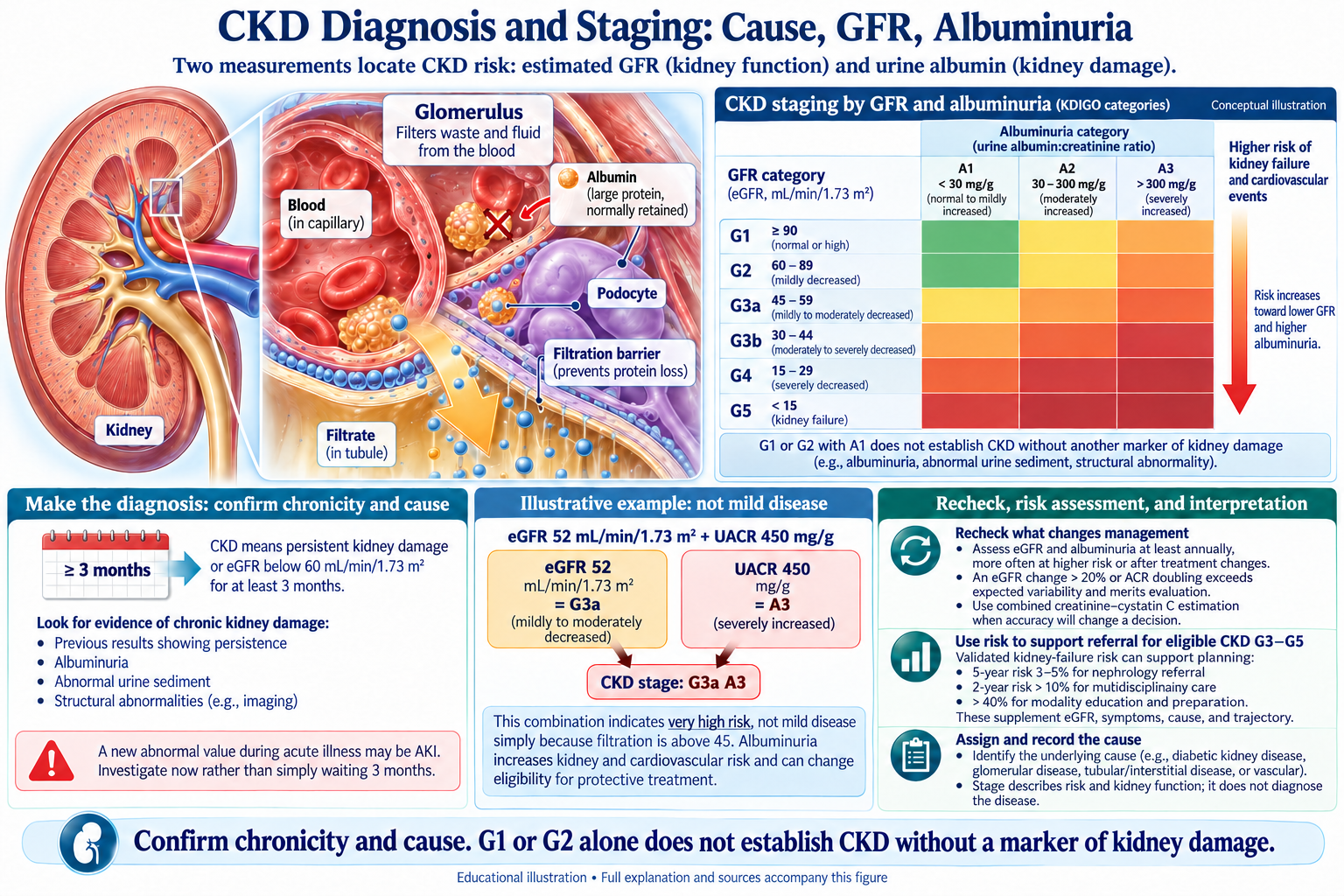
Use the diagram with the teaching text, then apply it to the case findings.
Assigned pre-learning: BP technique and urine-testing diagrams. Use the short lessons before each question.
Learning objectives
- Measure office and home BP correctly, then select therapy that addresses albuminuric diabetic CKD as well as BP.
- Explain dipstick, UACR and UPCR; use chronicity, eGFR and UACR to classify CKD G3b A3.
- Recognize the clinical pattern of diabetic kidney disease and identify features that would prompt another explanation.
- Investigate anemia and iron deficiency before attributing fatigue entirely to CKD or starting an ESA.
- Interpret bicarbonate 20, PTH 400 and normal phosphate without treating an isolated laboratory number as an automatic drug indication.
- Stop NSAIDs; plan ARB and SGLT2 therapy, possible finerenone, monitoring and nephrology referral.
Q1When eGFR is unreliable
Which patient’s reported creatinine-based eGFR is least reliable because kidney function is not at steady state?
A.
A 58-year-old woman whose creatinine has remained 1.6–1.7 mg/dL for two years
B.
A 70-year-old man whose creatinine rose from 1.0 to 2.4 mg/dL in 48 hours
C.
A 45-year-old man with stable creatinine 1.1 mg/dL and BMI 31
D.
A 62-year-old woman taking lisinopril with stable creatinine 1.2 mg/dL
Show answer and explanation · Link to this question
Correct answer: B
Learning point: A rapidly changing creatinine violates the steady-state assumption. In evolving AKI, follow the clinical picture, urine output and creatinine trajectory rather than treating the printed eGFR as a precise measurement.
Why not the others: A, C and D describe stable creatinine. Other limitations, including unusual muscle mass, can still affect an estimate; stability does not make an estimate perfect.
Concept link: ckd-04
Evidence and objective for Q1 · Back to Q1 · All answers in this case
Q2The reading you can act on
Which office BP technique provides the best basis for a routine treatment decision?
A.
156/92: measured while she talks immediately after sitting down
B.
150/90: two readings with an undersized cuff and her arm hanging down
C.
148/88: one reading after rest, with legs crossed and feet unsupported
D.
144/86: average of two readings after five minutes of quiet rest, with a correctly sized cuff, back and feet supported and arm at heart level
Show answer and explanation · Link to this question
Correct answer: D
Learning point: D uses standardized preparation, position, cuff and repeat measurements. In the case her proper repeat is 144/88. Do not apply a fixed numerical correction to a poorly obtained reading.
Why not the others: A lacks rest and includes talking; B has cuff and arm-position errors; C has unsupported posture and no repeated measurement.
Concept link: htn-cardiorenal-01
AHA: Home Blood Pressure Monitoring
Evidence and objective for Q2 · Back to Q2 · All answers in this case
Q3Dipstick, albumin ratio or protein ratio?
In a separate practice specimen, a dipstick shows trace protein and UACR is 180 mg/g. Which interpretation is best?
A.
Trace protein excludes clinically important albuminuria
B.
UACR identifies A2 albuminuria; confirm persistence with an appropriate repeat sample
C.
The results can only be resolved by a 24-hour total-protein collection
D.
UPCR and UACR measure exactly the same proteins and are interchangeable
Show answer and explanation · Link to this question
Correct answer: B
Learning point: UACR 180 mg/g is in A2. A dipstick measures concentration, responds mainly to albumin and can miss albuminuria. Quantitative ratios reduce dilution effects. This warm-up example is not Carol’s result: her UACR will be 1,000 mg/g.
Why not the others: A overinterprets a screening strip. C adds a difficult collection without a routine indication. D confuses albumin with total protein. A complete timed collection still has selected uses; spot ratios are preferred for routine assessment, not universally more accurate.
Concept link: ckd-03
KDIGO 2024 CKD guideline · NIDDK: Assess Urine Albumin
Evidence and objective for Q3 · Back to Q3 · All answers in this case
History: which details change your thinking?
Ms. Carol Jensen, 58, teaches seventh-grade science. “I’m tired all the time, and it’s October.”
History of present illness. Four months of worsening fatigue, breathlessness climbing the two flights to her classroom, and restless legs at night. She now sits between classes. No chest pain, orthopnea, gross hematuria, dysuria or flank pain. No recognized melena or hematochezia. She has been postmenopausal for five years. Appetite and weight are stable.
Past medical history. Type 2 diabetes for 12 years, with mild nonproliferative diabetic retinopathy documented by ophthalmology; hypertension for 15 years; CKD recognized in 2024; knee osteoarthritis and hyperlipidemia. No known heart failure, kidney stones or recurrent urinary infections.
Family and social history. Her mother developed kidney disease late in life; no early familial kidney failure or polycystic kidney disease. Never smoked. Two or three glasses of wine weekly. Knee pain limits activity; cafeteria lunches and prepared foods are common.
Medication history. Lisinopril was stopped six months ago because of persistent dry cough. There was no angioedema, hyperkalemia or acute kidney injury. It was never replaced with an ARB. She has never taken an SGLT2 inhibitor or finerenone.
| Medication | Current dose and route | Purpose |
|---|---|---|
| Amlodipine | 10 mg PO daily | Hypertension |
| Hydrochlorothiazide | 25 mg PO daily | Hypertension |
| Linagliptin | 5 mg PO daily | Type 2 diabetes |
| Atorvastatin | 20 mg PO daily | Cardiovascular risk reduction |
| OTC products | Intake form says “nothing regular” | Reconcile directly with the patient |
Drug intolerance: lisinopril-associated cough. No known drug allergy. Her diabetes regimen is also reviewed at follow-up; do not assume that glucose control alone supplies kidney and cardiovascular protection.
History questions
Which diabetes, bleeding, medication and prior kidney-test details change your assessment?
Facilitator discussion points
Clarify diabetes duration, retinopathy, trajectory, ACE-inhibitor intolerance, OTC analgesics, possible bleeding and iron intake. Do not assume every symptom has one cause.
Return to the lecture: CKD overview handout (site) — Identifying the True Cause of CKD · NSAID-induced nephrotoxicity lecture — Risk Factors for NSAID-Induced Kidney Injury
Examination: measure BP and assess the patient
Arrival BP: 158/94 mmHg. She hurried from the parking lot and was talking about the science fair. The reading was taken on the exam table with feet dangling, within two minutes of arrival, using a standard adult cuff on a 35-cm arm.
Proper repeat: after quiet rest, with supported back and feet, arm at heart level and a cuff matched to her arm, two readings average 144/88 mmHg. HR 88/min, RR 14/min, temperature 36.8 °C, SpO₂ 98% on room air. Weight 84 kg, height 165 cm, BMI 30.9 kg/m².
Examination: pale conjunctivae; no JVD, crackles, S3 or orthostasis. Trace chronic ankle edema on amlodipine. Knee crepitus without inflammation. ECG shows sinus rhythm with LVH by voltage. The examination does not establish clinical heart failure; future heart-failure risk is part of the treatment discussion.
Examination questions
Which aspects of today's blood-pressure measurement and examination would you reassess?
Facilitator discussion points
Review rest, conversation, position and cuff size before interpreting the pressure. Note conjunctival pallor, neck veins, lung findings and edema; separate the measurement problem from the fatigue workup.
Return to the lecture: CKD management pathways (site) — Part 3: Blood Pressure Management in CKD · BP measurement handout (site) — Sources of Measurement Error
What labs would you like to order?
Use what you know from the history and examination. Select an initial workup, name the question each test answers, and decide what can wait. Discuss urgent bedside assessment and treatment in parallel.
Some results in this case occur later, after new findings. Selecting a test does not imply that it is needed now.
Your selections last while this page is open. This is a discussion activity, not a scored MCQ. Results remain at their original points in the case; tests without supplied results are identified after you commit.
Initial findings: make the first decisions
Chart trajectory: creatinine 1.60 mg/dL with eGFR 38 in August 2024; 1.68 mg/dL with eGFR 35 six months ago. UACR was 800 mg/g six months ago. Today creatinine is 1.72 mg/dL, eGFR 34 mL/min/1.73 m², potassium 4.6 mmol/L, and first-morning UACR 1,000 mg/g. She is clinically stable and not volume depleted.
Urinalysis shows 2+ protein, no blood, 0–2 RBC/hpf, and no cellular casts. Ultrasound shows kidneys measuring 10.2 and 10.0 cm, mildly increased echogenicity, and no obstruction. These results support a chronic albuminuric process; neither diabetes nor an ultrasound alone proves its cause.
Discussion: the properly measured BP is still elevated. Review therapies for long-term kidney and cardiovascular protection while also obtaining a home BP log. A home log should not postpone evaluation of an already established albuminuric CKD indication.
Q4Choose kidney and heart protection
Carol has a properly measured BP of 144/88, type 2 diabetes, eGFR 34, potassium 4.6 and persistent marked albuminuria (UACR 1,000 mg/g today). She takes amlodipine and hydrochlorothiazide but no ACE inhibitor, ARB or SGLT2 inhibitor. What is the best next treatment direction?
A.
Add a beta-blocker solely to lower the office BP and leave the kidney-protective medication review for next year
B.
Restart lisinopril despite the prior persistent cough and add an ARB to suppress albuminuria further
C.
Evaluate and initiate appropriate ARB and SGLT2-inhibitor therapy, with safety monitoring and continued home BP assessment
D.
Make no medication changes because the properly repeated BP is lower than the arrival reading
Show answer and explanation · Link to this question
Correct answer: C
Learning point: She has a treatment opportunity beyond the BP number. An ARB is appropriate to evaluate after ACE-inhibitor cough; it treats BP and albuminuria. An SGLT2 inhibitor can slow kidney progression and reduce heart-failure events even without diagnosed heart failure. Review eligibility, volume status, costs and preferences, then plan monitoring. Q11 makes the regimen concrete.
Why not the others: A overlooks established albuminuric CKD indications. B combines ACE inhibitor and ARB, adding harm without an appropriate role here. D mistakes an improved measurement for adequate long-term treatment. A home log informs BP management but need not delay evaluating kidney-protective therapy.
Concept link: ckd-10, ckd-11, ckd-12
KDIGO 2024 CKD guideline · Farxiga US prescribing information · Benicar US prescribing information
Evidence and objective for Q4 · Back to Q4 · All answers in this case
After Q4 · Protect the kidney and the heart
Connect the two populations: the mortality model above concerns HFrEF. Carol’s kidney-protection choices below follow her diabetic CKD indications; she does not have established HFrEF.
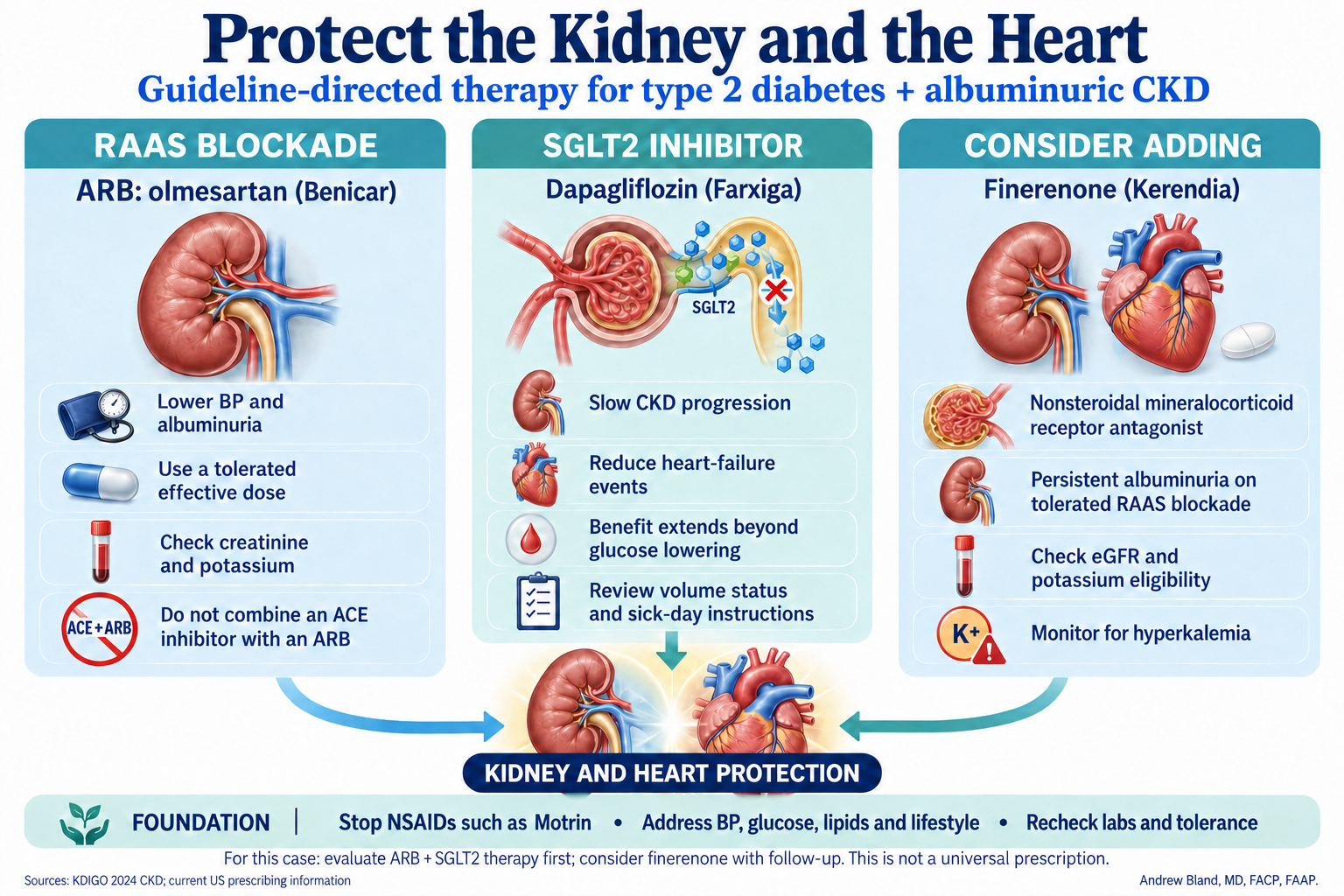
Read diagram text and sources
For type 2 diabetes with albuminuric CKD, evaluate ACE-inhibitor or ARB therapy, add an appropriate SGLT2 inhibitor, and consider finerenone for persistent albuminuria with eligible eGFR and potassium. Carol’s proposed ARB is olmesartan (Benicar); her SGLT2 inhibitor is dapagliflozin (Farxiga). RAAS blockade lowers BP and albuminuria; SGLT2 therapy slows CKD progression and reduces heart-failure events. Finerenone is a nonsteroidal mineralocorticoid receptor antagonist with kidney and cardiovascular outcome evidence in diabetic CKD. Do not combine ACE inhibitor and ARB. Stop NSAIDs, address BP, glucose, lipids and lifestyle, and monitor labs and tolerance. Each agent has its own indications and precautions; these are complementary therapies, not interchangeable drugs.
KDIGO 2024 CKD guideline · Benicar US prescribing information · Farxiga US prescribing information · Kerendia US prescribing information
Q5Where is she on the heat map?
Creatinine is 1.72 mg/dL, eGFR 34 and UACR 1,000 mg/g; abnormalities were already present more than three months ago. What is the correct CKD category?
A.
G3a A3
B.
G3b A2
C.
G3b A3
D.
AKI without established CKD
Show answer and explanation · Link to this question
Correct answer: C
Learning point: G3b is eGFR 30–44; A3 is UACR above 300 mg/g. Prior results establish chronicity. G3b A3 is a very-high-risk category on the KDIGO heat map, which supports closer follow-up and risk-reduction treatment.
Why not the others: A uses the wrong GFR band. B uses the wrong albuminuria band. D ignores documented chronic abnormalities; CKD does not prevent a future superimposed AKI.
Concept link: ckd-01, ckd-02
Evidence and objective for Q5 · Back to Q5 · All answers in this case
Q6Recognize diabetic kidney disease
Which explanation best fits 12 years of type 2 diabetes, documented diabetic retinopathy, persistent A3 albuminuria, gradual loss of filtration and a bland urine sediment?
A.
Diabetic kidney disease is the leading clinical explanation; continue surveillance for atypical features
B.
Active rapidly progressive glomerulonephritis is established by albuminuria alone
C.
Obstructive uropathy is the leading cause despite an ultrasound without obstruction
D.
An isolated elevated office BP establishes the cause of CKD
Show answer and explanation · Link to this question
Correct answer: A
Learning point: The combination of diabetes duration, another microvascular complication, albuminuria and a gradual course supports a clinical diagnosis of diabetic kidney disease. Hypertension may contribute. Sudden decline, active sediment or a discordant clinical course would prompt reassessment; biopsy is not required solely to label this typical teaching presentation.
Why not the others: B lacks a rapid decline or active sediment. C conflicts with the imaging and clinical pattern. D confuses a risk factor with proof of cause. This item teaches diabetic CKD recognition, not the expert-level debate over hypertensive nephrosclerosis.
Concept link: ckd-05, ckd-06
Evidence and objective for Q6 · Back to Q6 · All answers in this case
Further results: investigate the complications
| Test | Result | Example laboratory reference interval |
|---|---|---|
| Sodium | 139 mmol/L | 135–145 |
| Potassium | 4.6 mmol/L | 3.5–5.0 |
| Chloride | 108 mmol/L | 98–107 |
| Bicarbonate / total CO₂ | 20 mmol/L | 22–29 |
| BUN | 26 mg/dL | 7–20 |
| Creatinine / eGFR | 1.72 mg/dL / 34 mL/min/1.73 m² | Interpret trend |
| Glucose / HbA1c | 146 mg/dL / 7.4% | Individualize glycemic target |
| Calcium / albumin | 9.1 mg/dL / 4.1 g/dL | 8.6–10.2 / 3.5–5.0 |
| Phosphate | 3.8 mg/dL | 2.5–4.5 |
| Intact PTH | 400 pg/mL | 15–65; assay dependent |
| 25-OH vitamin D | 17 ng/mL | Interpret with local assay and clinical context |
| Hemoglobin / hematocrit | 9.6 g/dL / 29.8% | 12–16 / 36–46 |
| MCV / RDW | 78 fL / 16.9% | 80–100 / 11.5–14.5 |
| Reticulocytes | 0.9% | Interpret against the degree of anemia |
| B12 / folate | Within laboratory range | — |
Read the data in order. The low hemoglobin can contribute to fatigue and exertional symptoms. Microcytosis raises concern for iron deficiency rather than isolated erythropoietin deficiency. Iron studies and the bleeding evaluation are still pending. The anion gap is 139 − (108 + 20) = 11 mmol/L. Repeat bicarbonate remains 20; there is no diarrhea or acute illness. PTH was 260 pg/mL six months ago and is now 400, with normal calcium and phosphate and low vitamin D.
Q7Investigate the fatigue before prescribing an ESA
Hemoglobin is 9.6 g/dL with MCV 78 fL and restless legs. Iron studies are pending. What is the best next step?
A.
Start an erythropoiesis-stimulating agent immediately because hemoglobin is below 10
B.
Transfuse solely because hemoglobin is below the laboratory reference interval
C.
Attribute the symptoms to diabetes and ignore the microcytosis
D.
Check ferritin and TSAT and evaluate reversible causes, including blood loss, before considering an ESA
Show answer and explanation · Link to this question
Correct answer: D
Learning point: Anemia can explain much of her fatigue, but CKD does not establish its sole mechanism. Microcytosis makes iron deficiency an important possibility. Evaluate iron status and bleeding, then treat reversible causes before an individualized ESA discussion.
Why not the others: A skips reversible causes. B has no symptomatic instability or other transfusion indication in this stem. C ignores a clinically important anemia. Ferritin alone cannot exclude iron deficiency in an inflammatory setting.
Concept link: ckd-14
KDIGO 2026 Anemia in CKD guideline
Evidence and objective for Q7 · Back to Q7 · All answers in this case
After Q7 · Interpret iron studies and the hepcidin response
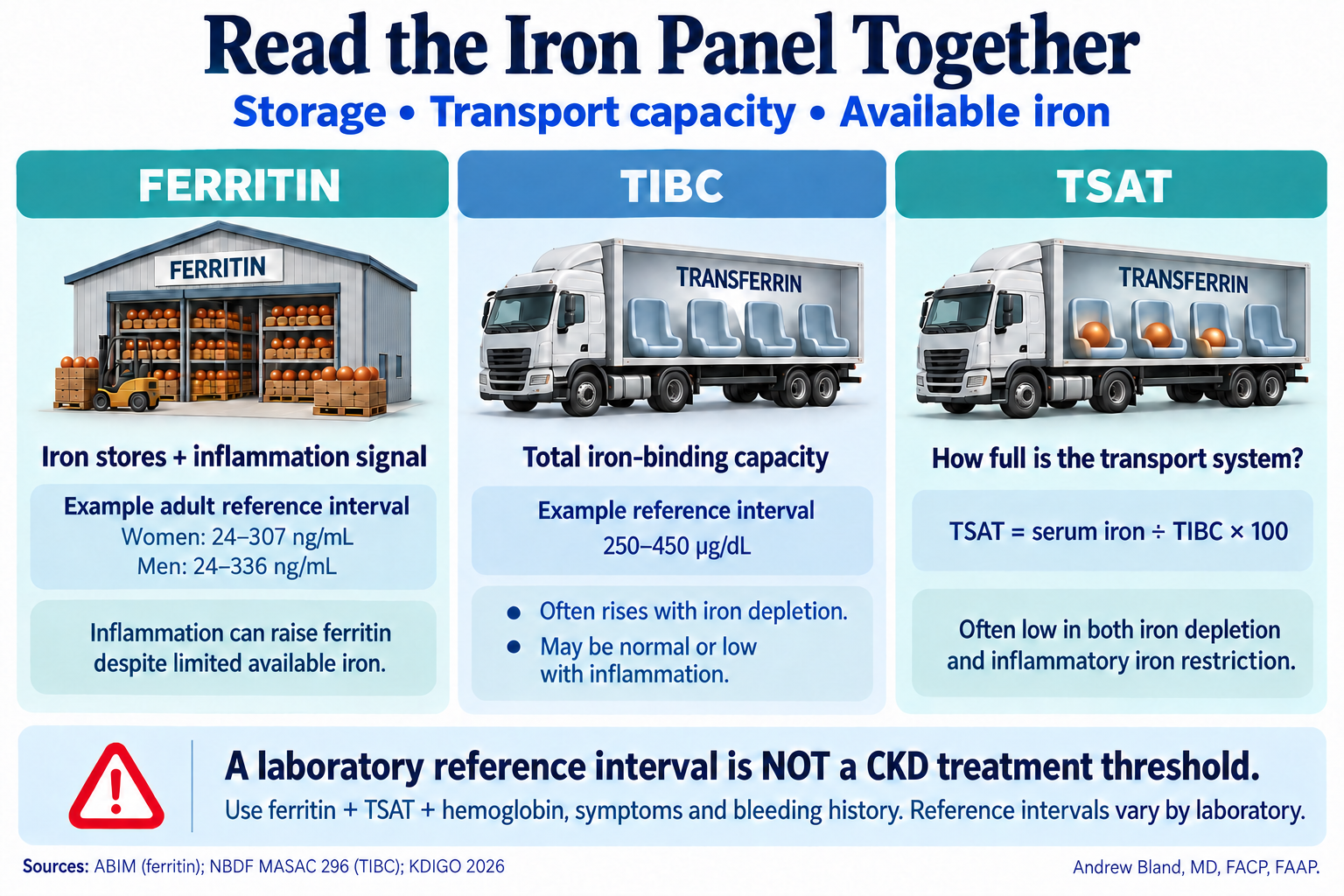
Read diagram text and sources
Ferritin reflects iron stores and is also raised by inflammation. Example adult reference intervals from ABIM are 24–307 ng/mL for women and 24–336 ng/mL for men. An example TIBC interval from NBDF MASAC 296 is 250–450 µg/dL. TIBC often rises in iron depletion and may be normal or low with inflammation. TSAT = serum iron ÷ TIBC × 100; use matching concentration units. A laboratory reference interval is not a CKD treatment threshold. Interpret ferritin and TSAT together with hemoglobin, symptoms and bleeding history; use the reporting laboratory’s intervals.
ABIM laboratory reference ranges, January 2026 · NBDF MASAC Document 296: laboratory screening of iron deficiency · KDIGO 2026 Anemia in CKD guideline
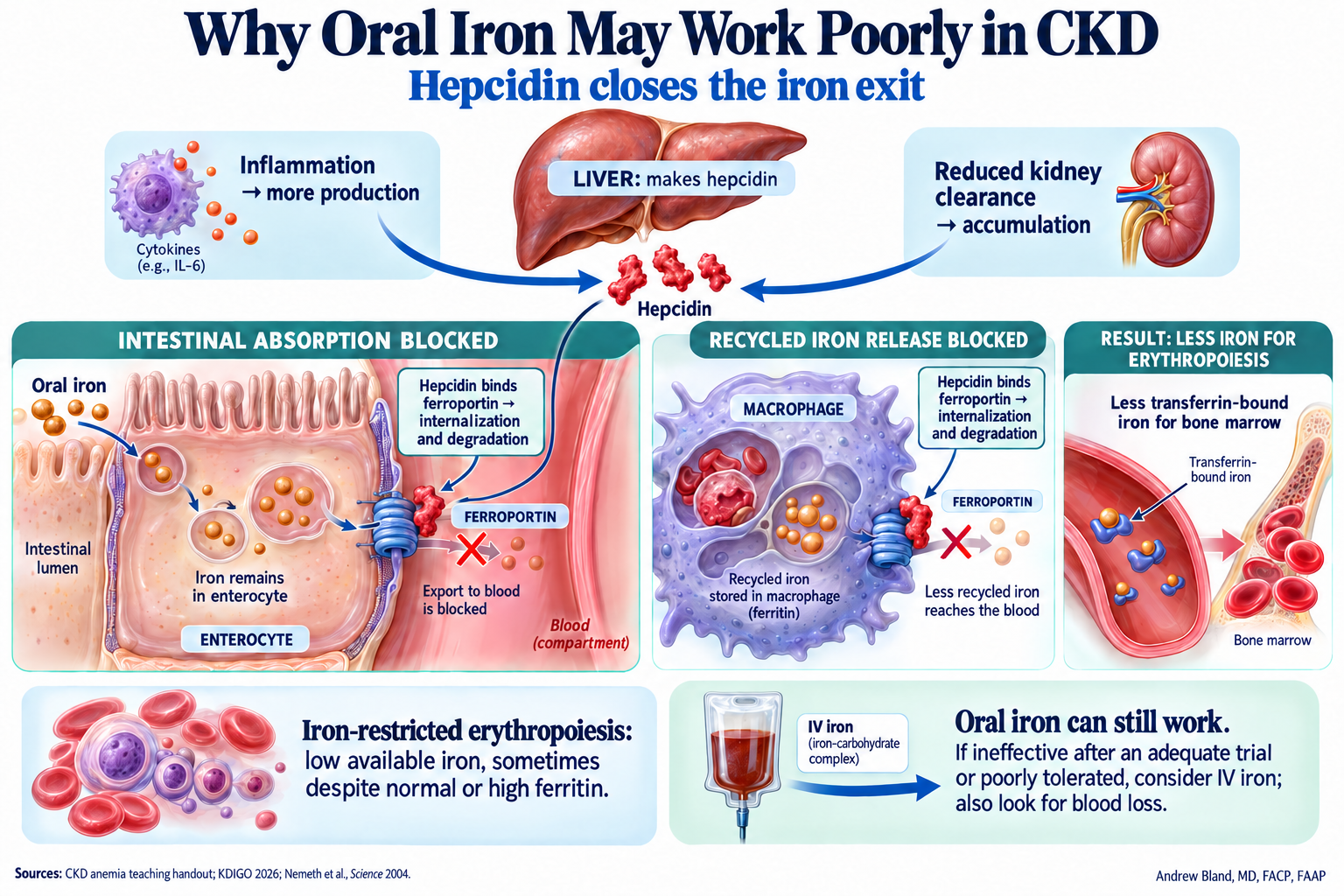
Read diagram text and sources
The liver makes hepcidin. Inflammation increases production, and reduced kidney clearance can increase circulating hepcidin. Hepcidin binds ferroportin, causing its internalization and degradation. Less iron leaves intestinal cells for blood, and less recycled iron leaves macrophages. The marrow receives less transferrin-bound iron even when ferritin is normal or high. Oral iron can still work; treatment response varies. IV iron bypasses intestinal absorption but does not remove all effects of inflammation. Investigate blood loss and consider IV iron when an adequate oral trial is ineffective or not tolerated.
Course CKD anemia student handout · KDIGO 2026 Anemia in CKD guideline · Nemeth et al. Hepcidin regulates cellular iron efflux by binding to ferroportin and inducing its internalization. Science, 2004.
Q8Bicarbonate 20: treat the patient or the number?
Bicarbonate is 20 mmol/L on repeat testing, with a normal anion gap and no acute illness. Which plan best matches the evidence discussed in this course?
A.
Start bicarbonate automatically because every value below 22 has proven clinical-outcome benefit from treatment
B.
Monitor and evaluate persistent acidosis; do not add bicarbonate solely to normalize 20, and individualize treatment if acidosis becomes more significant
C.
Ignore all future bicarbonate values because acidosis never matters in CKD
D.
Start urgent dialysis for bicarbonate 20 alone
Show answer and explanation · Link to this question
Correct answer: B
Learning point: Improved patient-important outcomes from routine bicarbonate treatment at 20 have not been established. KDIGO 2024 gives bicarbonate below 18 as an example of clinically important acidosis that may warrant intervention; it does not mandate treatment of every value below 22. Faculty practice here is usually to treat persistent values of 18 or less, with attention to sodium load, BP, edema, potassium and follow-up.
Why not the others: A overstates trial evidence. C misses progressive or clinically significant acidosis. D has no emergency indication. BiCARB studied older adults with more advanced CKD than Carol, so it is contextual evidence rather than a direct trial of this exact patient.
Concept link: ckd-16
KDIGO 2024 CKD guideline · BiCARB randomized trial, BMC Medicine 2020
Evidence and objective for Q8 · Back to Q8 · All answers in this case
Q9PTH 400 with normal phosphate
PTH has risen from 260 to 400 pg/mL. Calcium is 9.1 mg/dL, phosphate 3.8 mg/dL and 25-OH vitamin D 17 ng/mL. What is the best next step?
A.
Correct vitamin D deficiency and assess modifiable factors and the PTH trend, with nephrology review; do not automatically add calcitriol or a phosphate binder
B.
Start a phosphate binder to push her normal phosphate below the reference interval
C.
Start calcitriol solely because a numerical PTH target of 150–300 has been exceeded
D.
Apply the dialysis PTH target range to this nondialysis G3b patient
Show answer and explanation · Link to this question
Correct answer: A
Learning point: The optimal PTH target in nondialysis CKD is unknown. A marked, rising value deserves evaluation and follow-up, including nutritional vitamin D repletion. Lowering a moderately elevated PTH to a chosen range has not been shown to improve patient-important outcomes. PTH 400 is not an automatic calcitriol threshold. KDIGO reserves routine consideration of active vitamin D for selected severe, progressive cases, particularly G4–G5, rather than routine use in G3b.
Why not the others: B treats a normal phosphate and adds unnecessary burden. C invents an outcome-validated target. D imports a dialysis recommendation into a different population. A normal serum phosphate does not rule out all dietary phosphate contribution, but it does not justify a binder by itself.
Concept link: ckd-15
KDIGO CKD-MBD 2017 update: official synopsis
Evidence and objective for Q9 · Back to Q9 · All answers in this case
After Q9 · PTH, vitamin D and the treatment evidence
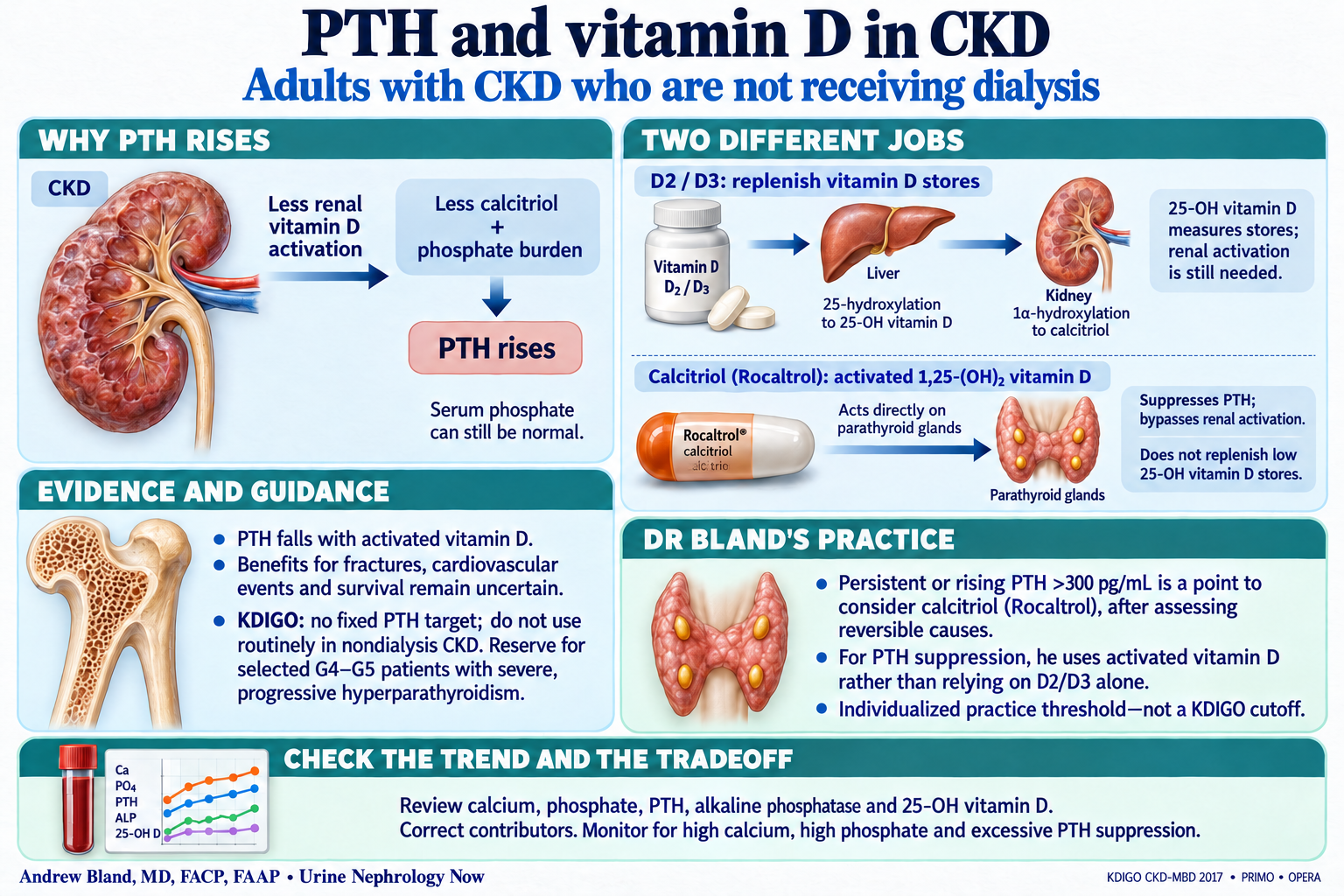
Nondialysis CKD: distinguish nutritional vitamin D repletion, activated vitamin D for PTH suppression, the clinical-outcome evidence gap and Dr Bland’s individualized practice threshold.
Faculty practice and the evidence gap: Dr Bland considers calcitriol (Rocaltrol) when PTH remains above about 300 pg/mL or rises persistently after evaluating reversible contributors. This is an individualized practice threshold, not a KDIGO cutoff. Calcitriol suppresses PTH but does not replenish low 25-OH vitamin D stores; nutritional deficiency still needs correction. Clinical-outcome benefits remain uncertain. In Carol’s G3b CKD, the deficient 25-OH vitamin D and trend require attention before an automatic calcitriol prescription.
Clinical course: new evidence and a treatment plan
Before opening the next results: the working hypothesis is “CKD-related erythropoietin deficiency alone explains her anemia.” Decide how the new evidence changes that hypothesis in Q10. The iron-study and hepcidin diagrams explain the concepts; they do not supply Carol’s pending results.
Q10Evidence update: is CKD alone enough?
Working hypothesis: “Reduced erythropoietin from CKD alone explains the anemia.” New information: ferritin 48 ng/mL (this laboratory’s adult-female interval 24–307), TSAT 13% and a positive stool guaiac. How does this change the hypothesis?
A.
Much less likely
B.
Somewhat less likely
C.
Unchanged
D.
Somewhat more likely
E.
Much more likely
Show answer and explanation · Link to this question
Correct answer: A
Learning point: The combined results strongly argue against CKD-related erythropoietin deficiency as the sole explanation. Ferritin within a general laboratory range does not establish adequate iron availability in CKD. Low TSAT plus this ferritin supports an iron-deficient component; investigate the possible blood loss. CKD can still contribute to the anemia.
Why not the others: B understates the change in the sole-cause hypothesis; C ignores relevant evidence; D and E reverse its direction. The positive stool result is a reason to evaluate, not proof of a specific bleeding lesion.
Concept link: ckd-14
KDIGO 2026 Anemia in CKD guideline · ABIM laboratory reference ranges, January 2026 · NBDF MASAC Document 296: laboratory screening of iron deficiency · Nemeth et al. Hepcidin regulates cellular iron efflux by binding to ferroportin and inducing its internalization. Science, 2004.
Evidence and objective for Q10 · Back to Q10 · All answers in this case
After the Q10 commitment: ferritin is 48 ng/mL, serum iron 36 µg/dL and TIBC 277 µg/dL; TSAT = 36 ÷ 277 × 100 = 13%. Ferritin is within this case laboratory’s adult-female reference interval (24–307 ng/mL), but that does not exclude clinically important iron deficiency in CKD. The stool guaiac is positive. Pursue the cause of iron deficiency and appropriate GI evaluation; a stool test alone neither localizes nor excludes significant GI disease.
The OTC call. Asked to bring every bottle, she reports Motrin (ibuprofen) 600 mg most mornings, sometimes a second dose, for three years. This had not appeared on the intake list. Ibuprofen can worsen BP and kidney perfusion and contribute to GI injury or bleeding.
Home BP: two readings each morning and evening for seven days average 144/88 mmHg. Medication reconciliation supports adherence. Repeat first-morning UACR three weeks later is 950 mg/g, consistent with persistent A3 albuminuria.
Q11Build a protective regimen
Home BP averages 144/88. Carol has G3b A3 diabetic CKD, potassium 4.6, prior ACE-inhibitor cough, and newly disclosed daily Motrin use. Which medication plan best addresses kidney and cardiovascular risk?
A.
Continue Motrin and only double hydrochlorothiazide
B.
Use finerenone alone and omit ARB and SGLT2 therapy because all three classes are interchangeable
C.
Stop Motrin; initiate an appropriate ARB such as Benicar and an SGLT2 inhibitor such as Farxiga, then consider Kerendia with eligibility review and monitoring
D.
Combine lisinopril and Benicar, and withhold Farxiga because it has no benefit without heart failure
Show answer and explanation · Link to this question
Correct answer: C
Learning point: Stop the nephrotoxin and choose complementary protective therapies. In this stable case, olmesartan and dapagliflozin are reasonable agents to evaluate. Consider finerenone after establishing tolerated RAAS blockade and checking persistent albuminuria, eGFR and potassium. An ACE-inhibitor cough is not an automatic ARB contraindication. Monitoring and education are part of the prescription.
Why not the others: A retains a contributor to kidney, BP and GI problems. B treats different evidence-based classes as substitutes. D combines ACE inhibitor and ARB and incorrectly restricts SGLT2 benefit to established heart failure.
Concept link: ckd-11, ckd-12, ckd-13, ckd-19, structural-20
KDIGO 2024 CKD guideline · Benicar US prescribing information · Farxiga US prescribing information · Kerendia US prescribing information
Evidence and objective for Q11 · Back to Q11 · All answers in this case
Q12Make follow-up part of the prescription
After starting olmesartan and dapagliflozin, which follow-up plan is best?
A.
Wait a year to check kidney function because the medicines protect the kidney
B.
Reassess BP, volume, creatinine and potassium soon; titrate as tolerated and arrange nephrology follow-up for marked albuminuria and complications
C.
Stop both medicines for any small asymptomatic creatinine increase
D.
Start finerenone without checking potassium and omit further lab monitoring
Show answer and explanation · Link to this question
Correct answer: B
Learning point: For this case, check BP, creatinine and potassium at about two weeks after the ARB starts and after dose changes. Assess symptoms and volume rather than interpreting a creatinine change alone. Marked albuminuria and anemia/mineral-bone issues support nephrology referral even while eGFR is relatively stable. Finerenone requires potassium/eGFR assessment and a four-week potassium check after initiation.
Why not the others: A and D omit necessary monitoring. C confuses an expected hemodynamic change with proof of injury. A large or progressive rise, volume depletion, hyperkalemia or other warning signs requires evaluation; no threshold replaces clinical judgment.
Concept link: ckd-11, ckd-13, ckd-21
KDIGO 2024 CKD guideline · Kerendia US prescribing information · Farxiga US prescribing information
Evidence and objective for Q12 · Back to Q12 · All answers in this case
Self-study checkpoint — after class
Q13 is outside the 37-minute live block.
Q13After class: cardiovascular prevention
Carol has diabetes and CKD but no known atherosclerotic cardiovascular disease. While evaluating possible GI blood loss, which prevention plan is most appropriate?
A.
Stop her statin because she has CKD
B.
Automatically add aspirin for every adult with CKD
C.
Continue appropriate statin-based prevention and individualize the overall risk plan; do not reflexively add aspirin in this bleeding evaluation
D.
Replace statin treatment with an over-the-counter supplement
Show answer and explanation · Link to this question
Correct answer: C
Learning point: Statin-based prevention is appropriate in this age and CKD setting. Aspirin for primary prevention requires weighing cardiovascular benefit against bleeding risk; it is not automatic, particularly while evaluating possible GI blood loss.
Why not the others: A and D discard proven risk-reduction treatment. B ignores bleeding risk and the difference between primary and secondary prevention.
Concept link: ckd-26
Evidence and objective for Q13 · Back to Q13 · All answers in this case
Debrief: connect the patient back to the lecture
The plan. Stop oral ibuprofen and arrange a safer knee-pain plan, including physical therapy and individualized non-NSAID analgesia. Begin olmesartan (Benicar) 20 mg PO daily, titrating toward 40 mg if BP, creatinine and potassium permit. Initiate dapagliflozin (Farxiga) 10 mg PO daily after reviewing volume status, contraindications, genital infection risk, ketoacidosis warning symptoms and sick-day instructions. Continue the other BP agents initially; adjust the diuretic or amlodipine if hypotension or volume depletion develops. Avoid ACE inhibitor plus ARB.
Recheck BP, creatinine and potassium in approximately two weeks after ARB initiation and again after titration; KDIGO allows a 2–4-week window depending on clinical risk. An unexpected decline, symptoms, hyperkalemia or a creatinine rise above 30% requires assessment for contributing causes. Withhold dapagliflozin during serious acute illness or prolonged fasting and for at least three days before major surgery or procedures involving prolonged fasting; restart when clinically stable and eating. Review which other medicines need temporary adjustment during dehydrating illness.
Possible next layer: after the ARB is at a tolerated dose and follow-up labs are stable, consider finerenone (Kerendia) 10 mg PO daily for persistent albuminuria. At eGFR 34 this is the labeled CKD/T2D starting dose; do not initiate if potassium is above 5.0 mmol/L. Check potassium/eGFR at four weeks and use the label’s titration and withholding rules. This is an option to evaluate, not a mandatory third prescription at the first visit.
Treat the iron deficiency and investigate its cause. One oral option is ferrous sulfate 325 mg (about 65 mg elemental iron) PO daily, with tolerability-based adjustment. Reassess symptoms and hemoglobin within several weeks. Choose oral versus IV iron according to severity, preferences, response and tolerance; consider IV iron if an adequate oral trial is ineffective after 1–3 months or poorly tolerated. Do not start an ESA before addressing reversible causes. GI assessment in this fictional course identifies erosive gastritis after appropriate upper and lower evaluation; do not assume Motrin is the only possible cause before evaluating her.
At bicarbonate 20, monitor and evaluate the trend; do not prescribe bicarbonate solely to normalize this number. Faculty practice in this course is usually to treat persistent bicarbonate 18 mmol/L or lower, individualized to the clinical setting. Correct vitamin D deficiency with nutritional vitamin D and recheck calcium, phosphate, PTH and vitamin D; obtain nephrology input for the marked, rising PTH. There is no phosphate-binder indication from a phosphate of 3.8 alone.
Twelve-week illustration, not a guaranteed treatment effect: home BP is 128/78, creatinine 1.80 mg/dL, potassium 4.7, and UACR 700 mg/g. Hemoglobin has risen to 10.9 g/dL with improved fatigue, but the anemia and iron response still require follow-up. Bicarbonate remains 20 without alkali; phosphate is normal. Finerenone remains a shared next-step decision after review of persistent albuminuria, potassium, medication interactions and patient preferences. Nephrology follow-up is arranged because of marked albuminuria, CKD complications and therapy planning.
Return to the lecture topics
Assigned reading: the explanations in this case and the question-linked course evidence guide. The objective map distinguishes tested decisions from concepts taught in explanations.
Concepts: ckd-01, ckd-02, ckd-03, ckd-04, ckd-05, ckd-07, ckd-10, ckd-14, ckd-15, ckd-16, ckd-19, ckd-21, ckd-26, htn-cardiorenal-01, htn-cardiorenal-02, htn-cardiorenal-04, htn-cardiorenal-06, htn-cardiorenal-10, htn-cardiorenal-16, structural-20.
KDIGO G/A staging & heat map (ckd-02)
UACR vs dipstick vs UPCR (ckd-03)
CKD staging handout (site) — UACR & 24-Hour Urine Protein Interpretation
eGFR: CKD-EPI 2021 and its limits (ckd-04)
Creatinine & GFR lecture — Limitations of eGFR / Evolution of eGFR Equations
Causes of CKD & first-line work-up (ckd-05)
CKD overview handout (site) — Identifying the True Cause of CKD
Hypertensive nephrosclerosis as a diagnosis of exclusion (ckd-07)
CKD overview handout (site) — The Challenge: "Hypertensive Nephropathy"
Blood pressure in CKD (ckd-10)
CKD management pathways (site) — Part 3: Blood Pressure Management in CKD
Anemia of CKD (ckd-14)
CKD-MBD: phosphorus, PTH, vitamin D, calcium (ckd-15)
CKD-MBD handout (site) — Diagnostic Approach: CKD-MBD Screening
Metabolic acidosis of CKD (ckd-16)
Nephrotoxins to avoid (ckd-19)
Renal pharmacology lecture — Nephrotoxic Medication Avoidance / NSAID Alternatives
When to refer to nephrology (ckd-21)
Standardized office BP measurement (htn-cardiorenal-01)
BP measurement handout (site) — Sources of Measurement Error
Home BP (HBPM) and ABPM; white-coat vs masked HTN (htn-cardiorenal-02)
Home BP monitoring lecture — Critical HBPM Implementation Points
BP targets and individualization (htn-cardiorenal-04)
BP targets lecture — Population-Specific Target Recommendations
Lifestyle modification with expected mmHg (htn-cardiorenal-05)
Lifestyle interventions lecture — Quantified BP Reduction Summary
First-line classes, thiazide choice, combinations (htn-cardiorenal-06)
Diuretic selection lecture — Thiazide vs Thiazide-Like Diuretics
Resistant hypertension (htn-cardiorenal-10)
Resistant HTN lecture — Definition / Systematic Evaluation / Spironolactone
Hypertensive nephrosclerosis (htn-cardiorenal-16)
Hypertensive nephropathy student handout (site) — Clinical Approach and BP Management
NSAIDs and the kidney (structural-20)
NSAID-induced nephrotoxicity lecture — Risk Factors for NSAID-Induced Kidney Injury
Question and answer links
- Q1: When eGFR is unreliable · Answer and explanation
- Q2: The reading you can act on · Answer and explanation
- Q3: Dipstick, albumin ratio or protein ratio? · Answer and explanation
- Q4: Choose kidney and heart protection · Answer and explanation
- Q5: Where is she on the heat map? · Answer and explanation
- Q6: Recognize diabetic kidney disease · Answer and explanation
- Q7: Investigate the fatigue before prescribing an ESA · Answer and explanation
- Q8: Bicarbonate 20: treat the patient or the number? · Answer and explanation
- Q9: PTH 400 with normal phosphate · Answer and explanation
- Q10: Evidence update: is CKD alone enough? · Answer and explanation
- Q11: Build a protective regimen · Answer and explanation
- Q12: Make follow-up part of the prescription · Answer and explanation
- Q13: After class: cardiovascular prevention · Answer and explanation
Save and export your first responses
First choices and optional confidence stay in this browser and are not sent to the website. Opening an explanation first is recorded. Revisiting an unchanged case preserves the first response; revised cases receive a new version. Website visit analytics are separate. On a shared device, export and clear the history when finished.