1 · Approach
Use the opening diagram and short lessons before the patient.
Session 2 · Classroom case · 11 questions
Andrew Bland, MD, FACP, FAAP · October 2026
Open all teaching, infographics and lecture links for this case →
Follow the history, examination, workup, and clinical course. Commit to each decision before opening the explanation.
Classroom pathway · Pause at each stage for discussion.
Assess congestion and perfusion together, judge the response to diuretics, then preserve disease-modifying treatment when it remains appropriate.
Use the opening diagram and short lessons before the patient.
Revisit urgency as history, examination and initial data arrive.
Use the urine, blood or imaging guide at the relevant decision.
Connect the management plan with response, monitoring and follow-up.
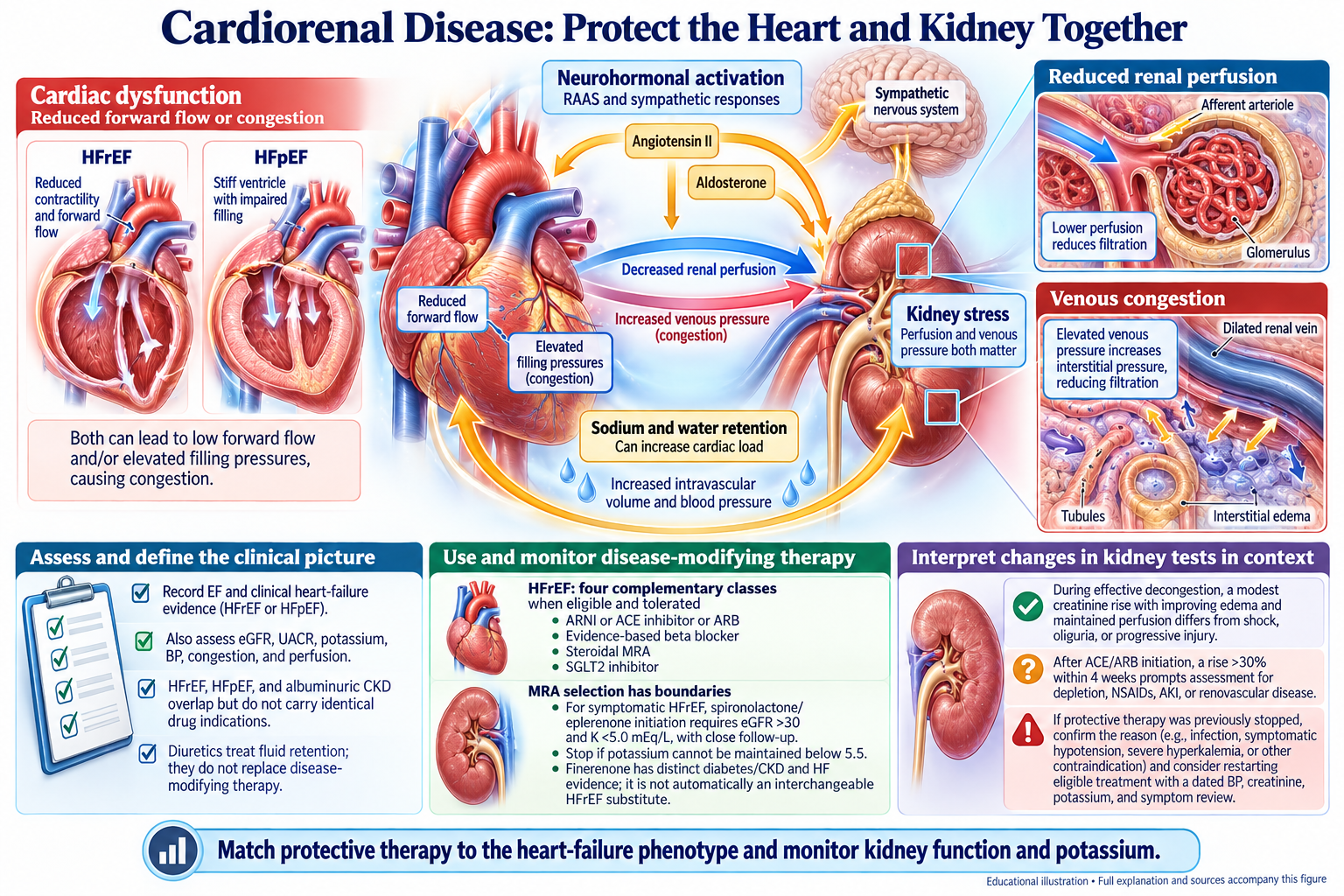
Use the diagram with the teaching text, then apply it to the case findings.
Session S2 · 2026-10-27 · in-session · 37 min Anchor: Chronic kidney disease — cardiorenal: heart failure with CKD and diuretics · Integrates: AKI (cardiorenal type 1), electrolytes (hypervolemic hyponatremia, loop-diuretic signature, hyperkalemia), GDMT and how CKD changes it, apixaban dosing, NSAIDs, "renalism" One-line hook: The night team saw a creatinine of 3.1 and wrote two orders. A new PA who can read the volume exam, judge a diuretic dose at two hours, and decide which heart-failure drugs keep running through a creatinine bump decides whether this man goes home or comes back.
A 71-year-old man with heart failure arrives short of breath. Which single bedside finding most reliably tells you he is congested (volume overloaded)?
Crackles at both lung bases that have not cleared with two hours of oxygen
Jugular venous pressure of 12 cm with hepatojugular reflux
Poor skin turgor on the back of the hand with dry mucous membranes
A BUN-to-creatinine ratio above 20 on the admission chemistry panel
Show answer and explanation · Link to this question
Learning point: A raised JVP supports elevated right-sided filling pressure and, among these choices, is the strongest bedside congestion clue. Interpret it with symptoms, lungs, edema, weight and perfusion. It does not prove total-body volume by itself, and hepatojugular reflux adds support rather than absolute confirmation. Why not the others: A — crackles are often absent in chronic heart failure because the lung lymphatics adapt, so clear lungs do not clear the patient; C — turgor is unreliable in older adults and tests the skin, not the veins; D — BUN:Cr rises in heart failure from neurohormonal urea handling and cannot separate congestion from depletion. Concept link: lytes-01 · Question evidence and course reading
Back to Q1 · All answers in this case
Which list names the four pillars of guideline-directed medical therapy (GDMT) for heart failure with reduced ejection fraction (HFrEF)?
Loop diuretic, digoxin, hydralazine with isosorbide dinitrate, ivabradine
ACE inhibitor, amlodipine, low-dose aspirin, high-intensity statin
Loop diuretic, beta-blocker, potassium chloride supplement, warfarin
ARNI or ACEi/ARB, beta-blocker, mineralocorticoid receptor antagonist, SGLT2 inhibitor
Show answer and explanation · Link to this question
Learning point: The four classes with outcome evidence in HFrEF are a RAAS strategy (sacubitril-valsartan, or an ACEi/ARB when ARNI is not feasible), one of three beta-blockers (carvedilol, metoprolol succinate, bisoprolol), a steroidal MRA (spironolactone or eplerenone) and an SGLT2 inhibitor (dapagliflozin or empagliflozin). All four are started early at tolerated doses rather than maximizing one first, and the monitoring labs are the BMP and potassium. Why not the others: A — loop diuretics relieve congestion, but adequately powered randomized trials have not established a survival benefit; digoxin, hydralazine-nitrate and ivabradine are add-ons for selected patients; B — amlodipine and aspirin are not heart-failure drugs; C — potassium supplements and warfarin treat other problems. Concept link: htn-cardiorenal-22 · Question evidence and course reading
Back to Q2 · All answers in this case
A patient with heart failure on a loop diuretic and sacubitril-valsartan takes ibuprofen for back pain. By which mechanism does the ibuprofen lower his glomerular filtration rate?
It blocks prostaglandin synthesis, so the afferent arteriole constricts and filtration pressure falls
It constricts the efferent arteriole directly, raising the pressure inside the glomerulus until it scars
It is directly toxic to proximal tubular cells and causes acute tubular necrosis within hours of a dose
It precipitates as crystals in the collecting ducts and obstructs urine flow out of the nephron
Show answer and explanation · Link to this question
Learning point: In a kidney that is already under-perfused (heart failure, diuretics, volume depletion, cirrhosis), prostaglandins keep the afferent arteriole open. NSAIDs inhibit cyclooxygenase, prostaglandin production falls, the afferent arteriole constricts, and filtration pressure drops — a hemodynamic (functional) AKI with a bland urine. Add a RAAS blocker, which prevents the efferent arteriole from compensating, and a diuretic, and you have the "triple whammy." Why not the others: B — efferent constriction is angiotensin II's job; NSAIDs act on the afferent side; C — NSAIDs can cause interstitial nephritis over days to weeks, but the common injury is hemodynamic, not tubular necrosis; D — crystal nephropathy belongs to acyclovir, methotrexate and uric acid. Concept link: structural-20 · Question evidence and course reading
Back to Q3 · All answers in this case
Mr. V., 71, dairy farmer from a township north of Dubuque, arrives by ambulance at 21:40 on a Monday in late October. Chief complaint: "I can't lie down. I've been sleeping in the recliner for five nights." He has been more short of breath for two weeks, first on the walk to the milking parlor, now crossing the kitchen. His legs are "like fence posts." He has gained weight; the scale at the heart-failure clinic read 84 kg in August and he is 91 kg tonight.
History. Ischemic cardiomyopathy after an anterior MI with two stents (2019); heart failure with reduced ejection fraction, EF 30 % on an echo three months ago (dilated left ventricle, moderate mitral regurgitation, RV systolic pressure 48 mmHg). Permanent atrial fibrillation, rate-controlled, on apixaban. Type 2 diabetes for 18 years with background retinopathy. Chronic kidney disease G4 A3 attributed to diabetic kidney disease: creatinine 2.6 mg/dL and eGFR 26 mL/min/1.73 m² (CKD-EPI 2021) three months ago, urine albumin-to-creatinine ratio 880 mg/g. Metformin was stopped two years ago when his eGFR fell below 30. Hypertension. No prior hospital admission for heart failure.
Social. Milks 60 cows twice a day with his son; lifts 50-lb feed sacks. Wife manages his pill box. No alcohol, no tobacco. Eats "what the wife cooks" — ham, cheese, canned soup in winter. Fluid intake "a lot of coffee and a lot of water — the clinic told me to drink."
Review of systems. Orthopnea, three-pillow then recliner. No chest pain. No fever, cough or dysuria. Low back pain for three weeks after a fall from a hay wagon; "took something for it from the farm store." Urinating "less than usual" for a week.
Home medications (reconciled with the wife at 22:10).
Dose: 40 mg
Route: PO
Frequency: once daily
Indication: HFrEF — volume control
Dose: 49/51 mg
Route: PO
Frequency: twice daily
Indication: HFrEF (ARNI pillar)
Dose: 12.5 mg
Route: PO
Frequency: twice daily
Indication: HFrEF (beta-blocker pillar); AF rate control
Dose: 25 mg
Route: PO
Frequency: once daily
Indication: HFrEF (MRA pillar) — started 4 years ago when eGFR was 38
Dose: 10 mg
Route: PO
Frequency: once daily
Indication: HFrEF, CKD and type 2 diabetes (SGLT2i pillar)
Dose: 5 mg
Route: PO
Frequency: twice daily
Indication: Stroke prevention, atrial fibrillation
Dose: 40 mg
Route: PO
Frequency: nightly
Indication: Secondary prevention after MI; CKD
Dose: 18 units
Route: SC
Frequency: nightly
Indication: Type 2 diabetes
| Drug | Dose | Route | Frequency | Indication |
|---|---|---|---|---|
| Furosemide | 40 mg | PO | once daily | HFrEF — volume control |
| Sacubitril-valsartan | 49/51 mg | PO | twice daily | HFrEF (ARNI pillar) |
| Carvedilol | 12.5 mg | PO | twice daily | HFrEF (beta-blocker pillar); AF rate control |
| Spironolactone | 25 mg | PO | once daily | HFrEF (MRA pillar) — started 4 years ago when eGFR was 38 |
| Empagliflozin | 10 mg | PO | once daily | HFrEF, CKD and type 2 diabetes (SGLT2i pillar) |
| Apixaban | 5 mg | PO | twice daily | Stroke prevention, atrial fibrillation |
| Atorvastatin | 40 mg | PO | nightly | Secondary prevention after MI; CKD |
| Insulin glargine | 18 units | SC | nightly | Type 2 diabetes |
Which questions connect the breathlessness to the medication and dietary timeline?
Clarify orthopnea, weight gain, exertional tolerance, salt and fluid intake, diuretic adherence and the nonprescription pain medicine. Compare this week with his usual heart-failure status.
Return to the lecture: HF lecture — Spot Urine Sodium: Guiding Diuretic Response · HF lecture — Escalation Strategy for Diuretic Resistance
Vitals. Blood pressure 118/72 mmHg, heart rate 88 and irregularly irregular, respiratory rate 24 breaths/min, SpO₂ 90 % on room air → 94 % on 2 L nasal cannula, temperature 36.8 °C, weight 91.0 kg (clinic dry weight 84 kg).
Exam. Sitting bolt upright, speaking in short sentences. JVP 12 cm H₂O at 45° with a positive hepatojugular reflux. S3 gallop; irregular rhythm; 2/6 apical holosystolic murmur. Crackles to the mid-lung fields bilaterally. Liver edge 3 cm below the costal margin, mildly tender. 3+ pitting edema to the knees, 2+ sacral edema. Hands and feet warm; capillary refill brisk. Alert and fully oriented.
Which findings would you use to judge congestion and immediate respiratory severity?
Describe oxygen requirement, breathing effort, JVP, hepatojugular reflux, crackles, heart sounds, edema and weight change. Explain the pattern before deciding what a creatinine change means.
Return to the lecture: HF lecture — Guideline-Directed Medical Therapy in Cardiorenal Disease · ACE Inhibitors vs ARBs — Renal Effects ("Acceptable rise: 30 % creatinine")
Use what you know from the history and examination. Select an initial workup, name the question each test answers, and decide what can wait. Discuss urgent bedside assessment and treatment in parallel.
Some results in this case occur later, after new findings. Selecting a test does not imply that it is needed now.
Your selections last while this page is open. This is a discussion activity, not a scored MCQ. Results remain at their original points in the case; tests without supplied results are identified after you commit.
The wife says he takes "nothing else." Nobody asks about the farm store yet.
First results at 22:30 (full table in Part 2): Na 127, K 5.3, HCO₃ 20, BUN 52, creatinine 2.6 (his baseline), glucose 148. ECG: atrial fibrillation at 88, no peaked T waves, QRS 96 ms. Chest film: cardiomegaly, pulmonary vascular congestion, small bilateral pleural effusions.
The ED resident writes: "BUN:Cr 20, Na 127, on Lasix and Jardiance — likely prerenal from over-diuresis. Hold diuretics, 500 mL NS bolus." The admitting hospitalist pauses the order and asks the student what she thinks.
Pause — commit before the reveal
Creatinine 2.6 is his baseline; BUN 52 gives a ratio of 20:1. Sodium is 127, weight is 7 kg above dry weight, JVP 12 cm with hepatojugular reflux, S3 and edema. Which statement is correct?
The ratio proves volume depletion and he needs isotonic fluid
All heart failure requires an inotrope before any diuretic
He is congested; impaired effective perfusion can coexist with excess fluid, so treat heart failure and decongest with monitoring
The low sodium proves salt depletion and requires salt tablets
Show answer and explanation · Link to this question
Learning point: Low effective renal perfusion can occur in either volume depletion or heart failure. In CHF, impaired arterial filling and raised renal venous pressure may coexist. His examination supports congestion, with no admission creatinine rise to establish AKI yet. The ratio cannot distinguish dehydration from CHF or increased urea production. Treat the heart failure while reassessing perfusion and kidney function.
Why not the others: A over-interprets a nonspecific ratio. B assumes shock despite warm extremities and preserved BP. D confuses water excess relative to sodium with a deficit that needs salt tablets.
Concept link: aki-19, htn-cardiorenal-19
AHA cardiorenal scientific statement (2019) · Mullens et al., venous congestion (2009) · Clinical Methods: BUN and Creatinine
Pre-renal physiology means inadequate effective kidney perfusion; it does not specify the patient's total-body fluid volume. Volume depletion reduces arterial delivery. Heart failure can reduce effective arterial filling while elevated renal venous pressure reduces the pressure gradient across the kidney. A patient can therefore be fluid overloaded and still have perfusion-related kidney dysfunction. The exam and trajectory determine whether the useful intervention is volume replacement or treatment of congestion.
BUN:creatinine is supportive context, not a reliable stand-alone discriminator. Upper GI bleeding, high protein intake or feeds, steroids, fever/infection, trauma and other catabolic states can increase urea production; low effective perfusion in CHF or depletion increases urea reabsorption; low muscle mass lowers creatinine. His ratio is 52/2.6 = 20, but weight gain, JVP and edema support congestion. Admission creatinine is at baseline, so the available creatinine does not yet establish AKI.

The kidney needs an adequate arterial-to-venous pressure gradient. Volume depletion: low circulating volume → less arterial delivery. Clues: weight loss, orthostasis, low JVP. Replace volume when depletion is confirmed. Heart failure: reduced effective arterial filling and/or raised renal venous pressure → impaired kidney perfusion and filtration. Total body fluid may be excessive. Clues: weight gain, raised JVP, edema, orthopnea. Treat heart failure and congestion. The same low-perfusion signal can appear in a dry patient or a fluid-overloaded patient. Pre-renal does not automatically mean give saline. Case 6: 7 kg above dry weight, JVP 12 cm, edema; admission creatinine remains at baseline. Congestion is present; AKI is not yet established from that creatinine. Source: AHA cardiorenal statement, PMID 30852913; venous congestion study, PMID 19215833.
AHA cardiorenal scientific statement (2019) · Mullens et al., venous congestion (2009)

BUN and creatinine in mg/dL. A ratio around 20:1 does not diagnose dehydration. More urea production: upper GI bleeding (digested blood protein); high protein intake or feeds; glucocorticoids; catabolism from fever, infection, burns or trauma. More urea reabsorption: low effective perfusion in volume depletion OR heart failure. Less creatinine production: low muscle mass or frailty can raise the ratio without extra urea. Use the ratio with the history, medications, JVP, edema, weight, BP, urine output and serial labs. Case 6: BUN 52 / creatinine 2.6 = 20. His high JVP and weight gain support congestion; the ratio alone does not justify saline. Source: Clinical Methods, BUN and Creatinine; AHA cardiorenal statement.
Clinical Methods: BUN and Creatinine · AHA cardiorenal scientific statement (2019)
He is alert and oriented without headache, nausea or confusion. Measured serum osmolality is 283 mOsm/kg, urine osmolality 380 and urine sodium 22 mmol/L before IV diuretic. What is the correct plan?
Give 1 L of normal saline because the ratio proves dehydration
Treat heart failure with an IV loop diuretic and limit total fluid to no more than 2,000 mL/day; monitor sodium and clinical response
Give repeated 3% saline boluses solely because sodium is 127
Start tolvaptan before treating congestion
Show answer and explanation · Link to this question
Learning point: Effective tonicity is 2 × 127 + 148/18 ≈262 mOsm/kg; urea explains why measured osmolality appears near normal. Heart failure stimulates non-osmotic ADH release despite fluid excess. Treat the underlying heart failure and congestion, with a total-fluid allowance ≤2,000 mL/day for this admission and serial sodium monitoring. Avoid framing this as an isolated free-water problem.
Why not the others: A adds fluid to a congested patient. C is not the routine approach without attributable neurologic symptoms. D prioritizes a selected specialist treatment over addressing the underlying congestion.
Concept link: lytes-07
AHA cardiorenal scientific statement (2019) · ESC heart failure guideline (2021)
His heart failure produces non-osmotic ADH release: water is retained despite low tonicity because effective arterial filling is reduced. Treat the heart failure and remove congestion with an IV loop diuretic. Use a total fluid allowance of no more than 2,000 mL/day for this admission, counting oral and IV inputs; explain this as the patient's fluid plan, not a vague “free-water restriction.” Individualize it to thirst, sodium trend and response. Restriction is supportive, not the main treatment of the failing heart.
He has no attributable neurologic symptoms requiring immediate hypertonic saline. Follow serum sodium during decongestion, generally every 6–12 hours while it is changing, and prevent an excessive rise; use a conservative ceiling of 8 mEq/L in any 24 hours, with a lower target when risk is higher. Escalate monitoring if aquaresis or a rapid rise develops.
The saline order is cancelled. He is admitted to telemetry with total fluid allowance ≤2,000 mL/day, 2 g sodium diet, strict intake and output, daily standing weight, and furosemide 40 mg IV once, then 40 mg IV twice daily — the same milligrams as his home oral dose. Renal ultrasound is ordered for the morning.
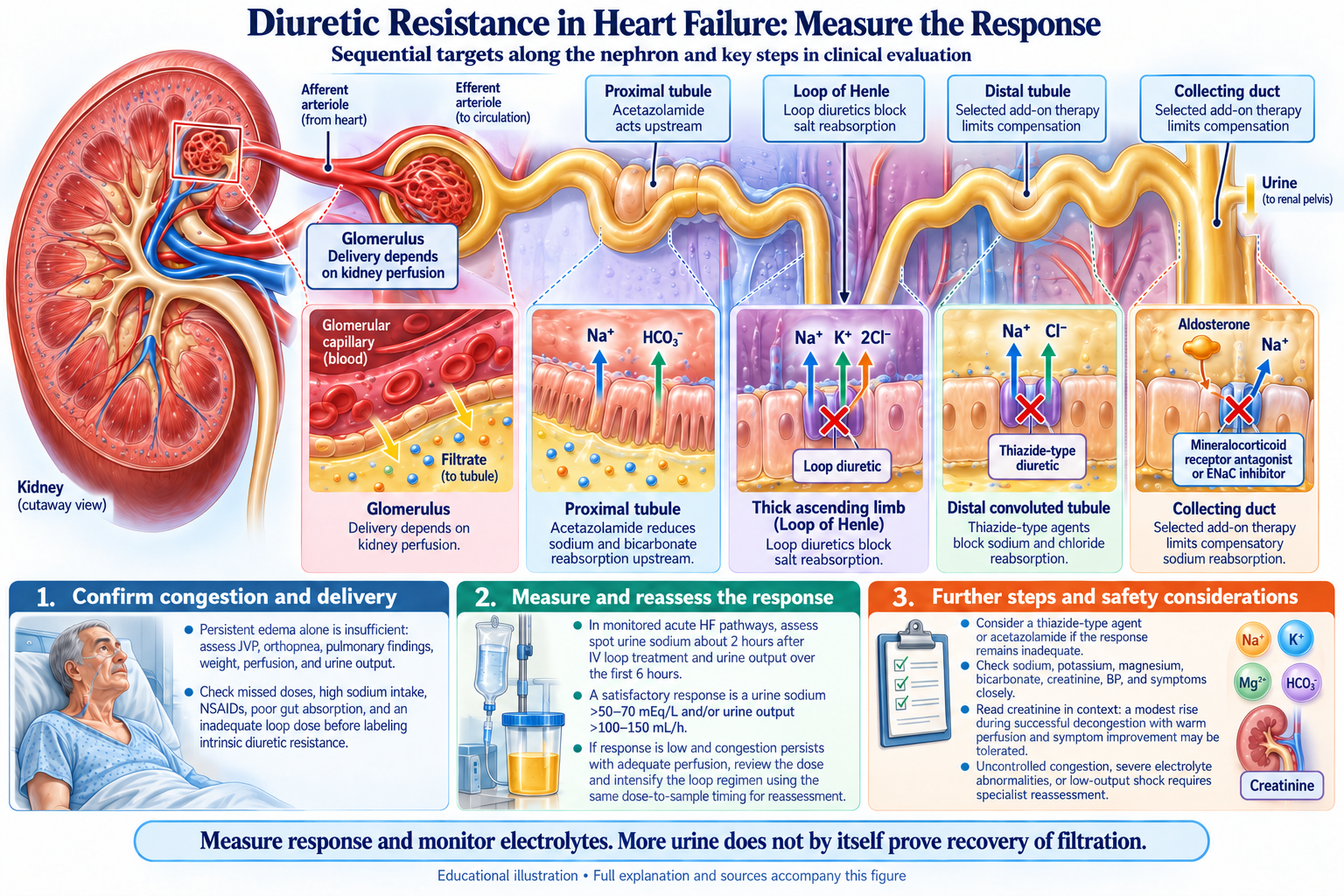
Use the diagram with the teaching text, then apply it to the case findings.
Use this general framework to explain the case results. State what fits, what does not, and which finding changes the next action.
Overnight (Day 1 → Day 2). Urine output 400 mL in the six hours after the 40 mg IV dose. He sleeps two hours in the recliner position.
Day 2, 05:15. The morning BMP is back: creatinine 3.1 and sodium 129. At 05:30 the night resident writes “AKI — hold furosemide” and orders a 1 L normal-saline bolus.
Day 2, 06:00. Weight 90.4 kg (down 0.6 kg). JVP 12 cm. Still orthopneic.
Day 2, 07:00 — handoff. The day hospitalist suspends both the hold order and the saline bolus pending the pharmacist's reconciliation and a 2-hour spot urine sodium after the 08:00 dose, so the 08:00 furosemide 40 mg IV dose is given as scheduled.
Day 2, 08:00 — the pharmacist's call. Reconciling with the farm-store receipt the wife brought in: ibuprofen 400 mg, three to four times a day for three weeks for the back pain. It was never on the medication list.
Day 2, 10:00. A spot urine sodium drawn two hours after the 08:00 furosemide 40 mg IV dose returns 28 mmol/L; urine output in those two hours was 180 mL.
Renal ultrasound. Right kidney 9.8 cm, left 9.6 cm, increased cortical echogenicity (chronic disease), no hydronephrosis, no stones. Bladder scan after voiding: 40 mL.
How does sodium compare with the supplied range or prior value? Explain what it adds to the pattern, whether the timing or specimen matters, and whether it changes your next step.
How does potassium compare with the supplied range or prior value? Explain what it adds to the pattern, whether the timing or specimen matters, and whether it changes your next step.
Hyperkalemia — Find the mechanism and reversible contributors
How does chloride compare with the supplied range or prior value? Explain what it adds to the pattern, whether the timing or specimen matters, and whether it changes your next step.
ACE Inhibitors vs ARBs — Renal Effects ("Acceptable rise: 30 % creatinine")
How does bicarbonate compare with the supplied range or prior value? Explain what it adds to the pattern, whether the timing or specimen matters, and whether it changes your next step.
ACE Inhibitors vs ARBs — Renal Effects ("Acceptable rise: 30 % creatinine")
How does anion gap (na − cl − hco₃) compare with the supplied range or prior value? Explain what it adds to the pattern, whether the timing or specimen matters, and whether it changes your next step.
ACE Inhibitors vs ARBs — Renal Effects ("Acceptable rise: 30 % creatinine")
How does bun compare with the supplied range or prior value? Explain what it adds to the pattern, whether the timing or specimen matters, and whether it changes your next step.
ACE Inhibitors vs ARBs — Renal Effects ("Acceptable rise: 30 % creatinine")
How does creatinine compare with the supplied range or prior value? Explain what it adds to the pattern, whether the timing or specimen matters, and whether it changes your next step.
ACE Inhibitors vs ARBs — Renal Effects ("Acceptable rise: 30 % creatinine")
How does egfr (ckd-epi 2021) compare with the supplied range or prior value? Explain what it adds to the pattern, whether the timing or specimen matters, and whether it changes your next step.
How does bun:cr compare with the supplied range or prior value? Explain what it adds to the pattern, whether the timing or specimen matters, and whether it changes your next step.
ACE Inhibitors vs ARBs — Renal Effects ("Acceptable rise: 30 % creatinine")
How does glucose compare with the supplied range or prior value? Explain what it adds to the pattern, whether the timing or specimen matters, and whether it changes your next step.
ACE Inhibitors vs ARBs — Renal Effects ("Acceptable rise: 30 % creatinine")
How does calcium compare with the supplied range or prior value? Explain what it adds to the pattern, whether the timing or specimen matters, and whether it changes your next step.
ACE Inhibitors vs ARBs — Renal Effects ("Acceptable rise: 30 % creatinine")
How does magnesium compare with the supplied range or prior value? Explain what it adds to the pattern, whether the timing or specimen matters, and whether it changes your next step.
ACE Inhibitors vs ARBs — Renal Effects ("Acceptable rise: 30 % creatinine")
How does phosphorus compare with the supplied range or prior value? Explain what it adds to the pattern, whether the timing or specimen matters, and whether it changes your next step.
ACE Inhibitors vs ARBs — Renal Effects ("Acceptable rise: 30 % creatinine")
How does albumin compare with the supplied range or prior value? Explain what it adds to the pattern, whether the timing or specimen matters, and whether it changes your next step.
ACE Inhibitors vs ARBs — Renal Effects ("Acceptable rise: 30 % creatinine")
How does serum osmolality (measured) compare with the supplied range or prior value? Explain what it adds to the pattern, whether the timing or specimen matters, and whether it changes your next step.
ACE Inhibitors vs ARBs — Renal Effects ("Acceptable rise: 30 % creatinine")
How does effective (tonic) osmolality, calculated compare with the supplied range or prior value? Explain what it adds to the pattern, whether the timing or specimen matters, and whether it changes your next step.
ACE Inhibitors vs ARBs — Renal Effects ("Acceptable rise: 30 % creatinine")
How does hemoglobin compare with the supplied range or prior value? Explain what it adds to the pattern, whether the timing or specimen matters, and whether it changes your next step.
ACE Inhibitors vs ARBs — Renal Effects ("Acceptable rise: 30 % creatinine")
How does nt-probnp (used instead of bnp because sacubitril raises bnp) compare with the supplied range or prior value? Explain what it adds to the pattern, whether the timing or specimen matters, and whether it changes your next step.
ACE Inhibitors vs ARBs — Renal Effects ("Acceptable rise: 30 % creatinine")
How does high-sensitivity troponin t compare with the supplied range or prior value? Explain what it adds to the pattern, whether the timing or specimen matters, and whether it changes your next step.
ACE Inhibitors vs ARBs — Renal Effects ("Acceptable rise: 30 % creatinine")
How does hba1c compare with the supplied range or prior value? Explain what it adds to the pattern, whether the timing or specimen matters, and whether it changes your next step.
ACE Inhibitors vs ARBs — Renal Effects ("Acceptable rise: 30 % creatinine")
How does ldl cholesterol compare with the supplied range or prior value? Explain what it adds to the pattern, whether the timing or specimen matters, and whether it changes your next step.
ACE Inhibitors vs ARBs — Renal Effects ("Acceptable rise: 30 % creatinine")
| Test | Admission 22:30 (Day 1) | Day 2 06:00 | Reference range |
|---|---|---|---|
| Sodium | 127 mEq/L | 129 mEq/L | 135–145 mEq/L |
| Potassium | 5.3 mEq/L | 5.4 mEq/L | 3.5–5.0 mEq/L |
| Chloride | 98 mEq/L | 99 mEq/L | 98–107 mEq/L |
| Bicarbonate | 20 mEq/L | 20 mEq/L | 22–28 mEq/L |
| Anion gap (Na − Cl − HCO₃) | 9 | 10 | 8–12 |
| BUN | 52 mg/dL | 64 mg/dL | 7–20 mg/dL |
| Creatinine | 2.6 mg/dL (= baseline) | 3.1 mg/dL (+19 %) | 0.7–1.2 mg/dL |
| eGFR (CKD-EPI 2021) | 26 mL/min/1.73 m² (steady state, = baseline) | not valid — creatinine is moving | ≥60 |
| BUN:Cr | 20 | 21 | 10–20 |
| Glucose | 148 mg/dL | 132 mg/dL | 70–99 mg/dL (fasting) |
| Calcium | 8.8 mg/dL (albumin-corrected 9.1) | — | 8.5–10.2 mg/dL |
| Magnesium | 1.9 mg/dL | 1.8 mg/dL | 1.7–2.4 mg/dL |
| Phosphorus | 4.6 mg/dL | — | 2.5–4.5 mg/dL |
| Albumin | 3.6 g/dL | — | 3.5–5.0 g/dL |
| Serum osmolality (measured) | 283 mOsm/kg (calculated 2×127 + 148/18 + 52/2.8 = 281) | — | 275–295 mOsm/kg |
| Effective (tonic) osmolality, calculated | 262 mOsm/kg (2×127 + 148/18; urea crosses cell membranes and is not counted) — hypotonic; the measured 283 is misleading | — | 275–295 mOsm/kg |
| Hemoglobin | 10.8 g/dL | 10.9 g/dL | 13.5–17.5 g/dL |
| NT-proBNP (used instead of BNP because sacubitril raises BNP) | 9,800 pg/mL | — | <125 pg/mL (age-adjusted higher) |
| High-sensitivity troponin T | 34 ng/L → 36 ng/L at 3 h (flat) | — | <14 ng/L |
| HbA1c | 7.4 % | — | <5.7 % |
| LDL cholesterol | 68 mg/dL | — | <70 mg/dL (very high risk) |
Apply your interpretation in Q6
Revisit the framework: ACE Inhibitors vs ARBs — Renal Effects ("Acceptable rise: 30 % creatinine")
Urine studies
How does urine osmolality (admission, pre-diuretic) compare with the supplied range or prior value? Explain what it adds to the pattern, whether the timing or specimen matters, and whether it changes your next step.
How does urine sodium (admission, pre-diuretic) compare with the supplied range or prior value? Explain what it adds to the pattern, whether the timing or specimen matters, and whether it changes your next step.
How does spot urine sodium, 2 h after furosemide 40 mg iv (day 2) compare with the supplied range or prior value? Explain what it adds to the pattern, whether the timing or specimen matters, and whether it changes your next step.
ACE Inhibitors vs ARBs — Renal Effects ("Acceptable rise: 30 % creatinine")
How does urine creatinine (day 2 spot) compare with the supplied range or prior value? Explain what it adds to the pattern, whether the timing or specimen matters, and whether it changes your next step.
ACE Inhibitors vs ARBs — Renal Effects ("Acceptable rise: 30 % creatinine")
How does fena compare with the supplied range or prior value? Explain what it adds to the pattern, whether the timing or specimen matters, and whether it changes your next step.
ACE Inhibitors vs ARBs — Renal Effects ("Acceptable rise: 30 % creatinine")
How does urine albumin-to-creatinine ratio compare with the supplied range or prior value? Explain what it adds to the pattern, whether the timing or specimen matters, and whether it changes your next step.
ACE Inhibitors vs ARBs — Renal Effects ("Acceptable rise: 30 % creatinine")
| Test | Result | Reference / comment |
|---|---|---|
| Urine osmolality (admission, pre-diuretic) | 380 mOsm/kg | 50–1,200 mOsm/kg (random); 380 = ADH is "on" |
| Urine sodium (admission, pre-diuretic) | 22 mmol/L | varies with intake; <20 mmol/L = avid retention — 22 on a daily loop diuretic is still low |
| Spot urine sodium, 2 h after furosemide 40 mg IV (Day 2) | 28 mmol/L | varies with intake; after an IV loop dose, <50–70 mmol/L = inadequate natriuretic response |
| Urine creatinine (Day 2 spot) | 48 mg/dL | 20–320 mg/dL (random) |
| FENa | not interpretable — he is on a loop diuretic | would be falsely high |
| Urine albumin-to-creatinine ratio | 880 mg/g | A3 (>300 mg/g); unchanged from clinic |
Apply your interpretation in Q6
Revisit the framework: ACE Inhibitors vs ARBs — Renal Effects ("Acceptable rise: 30 % creatinine")
Urinalysis (admission). Specific gravity 1.012, pH 5.5, protein 2+, glucose 2+ (expected on empagliflozin — the drug works by putting glucose in the urine), blood negative, leukocyte esterase negative, nitrite negative, ketones negative. Microscopy: 0–2 RBC/hpf, 0–2 WBC/hpf, occasional hyaline casts, no granular or muddy-brown casts, no cellular casts, no crystals.
Reading the data in order. Organ → function → mechanism → labs: the heart cannot empty, venous pressure rises, the kidney is congested and the neurohormonal system is on full (urea retained, water retained, sodium avidly reabsorbed). The sediment is bland and the ultrasound shows no obstruction, which reduces support for obstruction and some intrinsic causes without excluding them; hemodynamic dysfunction is the leading explanation — cardiorenal syndrome type 1, acute heart failure driving acute kidney injury — and the ibuprofen has been pushing on the same lever for three weeks. The anion gap is normal (9–10), the bicarbonate of 20 is the mild non-gap acidosis of CKD G4 that also pushes his potassium up. The hemoglobin of 10.8 is the anemia of CKD; watch it — it should rise as he decongests.
The 2-hour rule. IV furosemide acts promptly; assess the early response at about two hours, although its action can continue beyond that point. Judge every IV dose at about two hours by urine output and a spot urine sodium: above 70–100 mmol/L is a good response, 50–70 is mild resistance, 20–50 moderate, and below 20 severe. His 28 mmol/L after a dose equal to his home oral dose says the dose never cleared the threshold. In CKD the threshold is higher (less drug reaches the tubule because loop diuretics enter the urine by proximal tubular secretion, which falls with GFR), gut edema makes oral furosemide unreliable (bioavailability 10–100 %), and the NSAID blunts the response further.
Two hours after furosemide 40 mg IV, urine output is 180 mL and urine sodium 28 mmol/L. He remains 6 kg above dry weight with JVP 12 cm. What is the best next step?
Wait 24–48 hours before judging whether the same IV dose works
Switch immediately to oral furosemide 80 mg twice daily
Add spironolactone 50 mg and leave the loop dose unchanged
Give furosemide 80 mg IV now and reassess urine output and urine sodium at about two hours
Show answer and explanation · Link to this question
Learning point: Urine output 90 mL/hour and urine sodium 28 indicate a weak response in this context. Double the IV loop dose and reassess alongside perfusion, symptoms, weight and net balance. Oral bumetanide is more predictably absorbed than oral furosemide, but severe congestion can still require IV therapy. Both IV drugs bypass gut edema; use an appropriate equivalent dose and judge the response.
Why not the others: A delays needed decongestion. B switches to a potentially unreliable oral route before establishing inpatient response. C increases potassium risk in a patient with K 5.4 and advanced CKD and does not provide suitable rapid rescue diuresis.
Concept link: htn-cardiorenal-20
Ellison, Clinical Pharmacology in Diuretic Use (2019) · ESC heart failure guideline (2021)
Gut edema can delay oral furosemide absorption and reduce the time above the natriuretic threshold. Oral bumetanide has higher, more predictable bioavailability (about 80–100%, versus furosemide's broad 10–100% range) and may be more reliable when an oral drug is appropriate. That is an absorption advantage, not proof of better survival or a guarantee of response during severe congestion.
IV furosemide and IV bumetanide both bypass the gut and can be effective at appropriate equivalent doses; their milligram doses are not interchangeable. Both must reach the tubular lumen to inhibit NKCC2. CKD and NSAIDs can increase the effective dose needed. Reassess urine output and approximately two-hour urine sodium, along with symptoms, perfusion and net balance. A poor response to 40 mg IV furosemide supports doubling to 80 mg IV and reassessing.

Oral furosemide (Lasix): variable absorption, about 10–100%. Gut edema may delay absorption and weaken the response. Oral bumetanide (Bumex): more predictable absorption, about 80–100%. May be more reliable when oral therapy is appropriate; severe congestion can still require IV treatment. IV furosemide and IV bumetanide: both bypass the gut. Either can work at an appropriate equivalent dose. Bumex is not inherently superior IV, and milligram doses are not equal. Both act at NKCC2 in the thick ascending limb. In CKD, less drug reaches the tubular site; a higher effective dose may be needed. Judge response early: urine output, about 2-hour urine sodium, symptoms and perfusion. Follow weight, fluid balance, BMP and magnesium. Case 6: poor response after 40 mg IV furosemide → double to 80 mg IV and reassess. Sources: Clinical Pharmacology in Diuretic Use, PMID 30936153; ESC heart failure guideline 2021.
Ellison, Clinical Pharmacology in Diuretic Use (2019) · ESC heart failure guideline (2021)
Pause — commit before the reveal
At 05:30 on Day 2, before the pharmacist's call, the night resident saw creatinine 3.1 (up 19 % from 2.6), wrote "AKI — hold furosemide" and ordered a 1 L normal-saline bolus. At the 07:00 handoff the day hospitalist suspended both orders pending the pharmacist's reconciliation and the 2-hour spot urine sodium, so the bolus has not been hung; it is now 10:00 and the decision is yours. Weight 90.4 kg (dry weight 84), JVP 12 cm. You now also know about the ibuprofen and the spot urine sodium of 28. What do you do?
Cancel the saline, stop the ibuprofen, continue the doubled IV loop dose, and reassess perfusion, urine output and BMP/magnesium during active escalation
Hang the saline bolus, hold the diuretic for 24 hours, and recheck the creatinine at 18:00 before deciding on more fluid
Hold the diuretic without fluids for 24 hours as a "diuretic holiday" so the kidney can recover before it restarts
Send a FENa to settle prerenal versus ATN before changing either the diuretic or the saline order
Show answer and explanation · Link to this question
Learning point: Persistent congestion and little weight loss favor continuing monitored decongestion while stopping ibuprofen and checking perfusion and electrolytes. Modest creatinine rises can accompany effective decongestion without structural injury, but no universal 30% rule proves that a rise is benign. Intrinsic injury can coexist. Reassess hypotension, urine output, exposures and the trend; monitor potassium more promptly when it is rising and obtain BMP and magnesium at least twice daily during intensive combination diuresis. Why not the others: B adds fluid despite persistent congestion and no convincing evidence of depletion; it risks worsening pulmonary edema. C pauses decongestion without identifying hypotension, depletion or another reason to hold therapy. D delays a clinically supported decision for a test confounded by the loop diuretic. Bland sediment and normal ultrasound reduce support for some alternative causes but do not exclude intrinsic injury; perfusion, urine output and the creatinine trend still require reassessment. Concept link: htn-cardiorenal-20, aki-19 · Question evidence and course reading
Back to Q7 · All answers in this case
Day 2 plan as written at 10:30. Saline cancelled. Ibuprofen stopped; acetaminophen 650 mg every 8 h as needed; topical diclofenac gel to the lumbar area. Furosemide 80 mg IV now, then 80 mg IV twice daily, response judged at two hours each dose. Total fluid allowance ≤2,000 mL/day continues. Spironolactone held (K⁺ 5.4, eGFR <30). Sacubitril-valsartan, carvedilol and empagliflozin continued. BMP and magnesium at least twice daily during active escalation; ECG if K⁺ ≥5.5. Day 2 urine output 2.2 L — the doubled dose starting to clear the threshold.
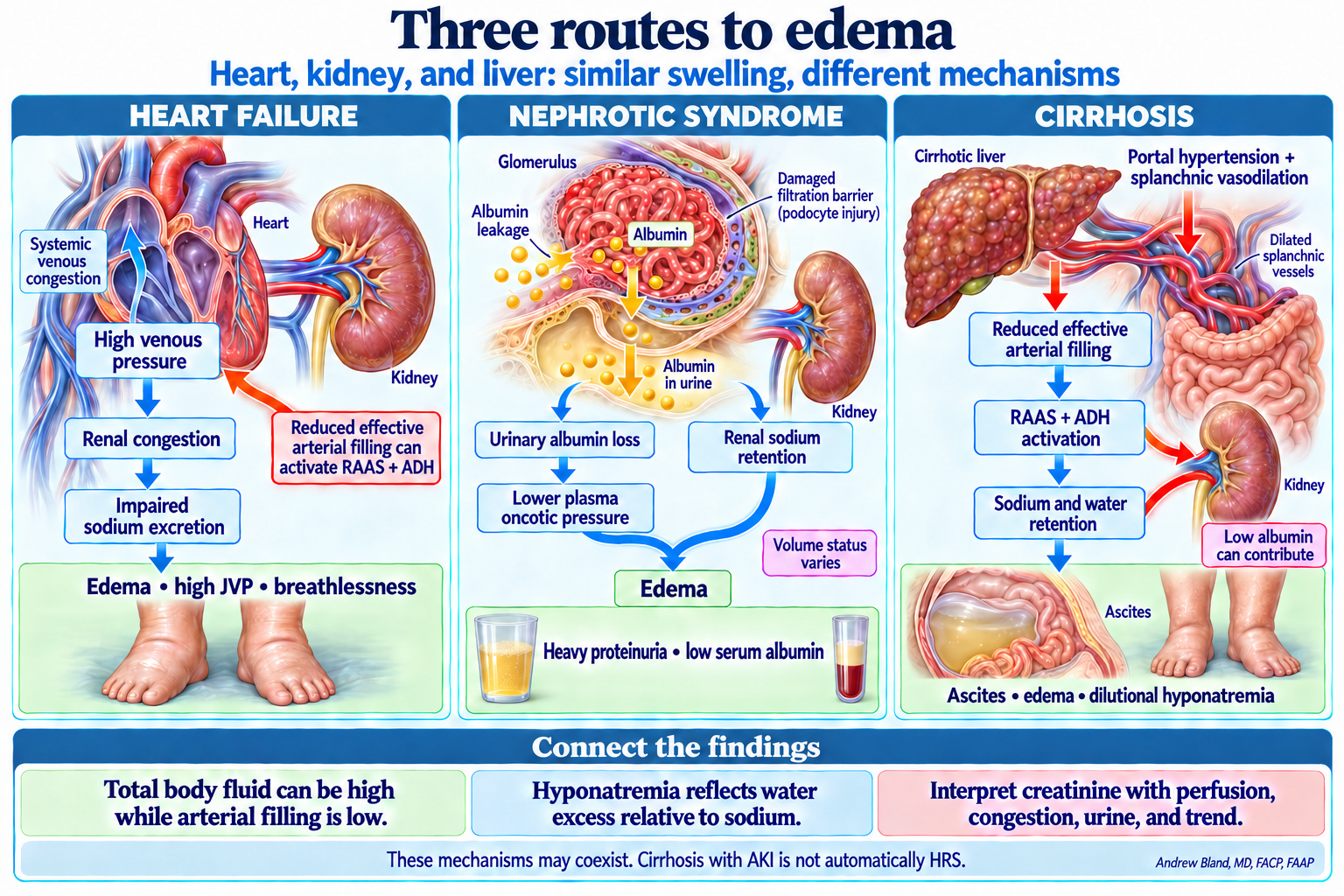
Use the diagram with the teaching text, then apply it to the case findings.
Explain the intended effect, the major treatment risk and the observation that will tell you whether the plan is working.
Day 3, 06:00. Weight 89.0 kg, still 5 kg above dry weight; JVP 12 cm, hepatojugular reflux positive, S3 and leg edema persist. He slept nearly flat. Creatinine 3.2 (+23%), BUN 66, K 5.6, Na 135, bicarbonate 21, Mg 1.7. Sodium was 127 on admission, 129 on Day 2 at 06:00, 132 at 18:00 and 133 at 22:30; the monitored rise stayed within 8 mEq/L in any 24 hours. ECG remains AF at 84 without peaking, QRS 96 ms. After furosemide 160 mg IV, two-hour urine sodium is 44 mmol/L and urine output 150 mL.
The resident who ordered the saline, now off nights, writes on the sign-out: "Cr still climbing on high-dose Lasix — think we are over-diuresing him into prerenal AKI."
If you were thinking "the IV furosemide is causing prerenal (volume-depletion) injury," and you then learn that on Day 3 his weight is still 5 kg above his dry weight and his JVP is 12 cm, this hypothesis becomes:
Much less likely
Less likely
Unchanged
More likely
Much more likely
Show answer and explanation · Link to this question
Learning point: Persistent weight excess and a raised JVP make simple whole-body volume depletion from over-diuresis less likely. They support continuing a careful assessment for residual congestion. They do not exclude impaired arterial perfusion, excessive plasma-volume reduction during diuresis or another AKI mechanism. The decision must also use blood pressure, symptoms, urine output and the creatinine trajectory. A is the preferred formative direction; a well-justified adjacent response is acceptable. Concept link: lytes-01, aki-19 · Question evidence and course reading
Back to Q8 · All answers in this case
Day 3: still 5 kg above dry weight, JVP 12 cm, urine sodium 44 mmol/L two hours after furosemide 160 mg IV. Sodium is now 135 mEq/L after monitored correction; K 5.6, Mg 1.7, creatinine 3.2. Ibuprofen is stopped. Which is an appropriate next diuretic step?
Stop the loop and give 1 L normal saline solely because creatinine is still elevated
Switch to torsemide 40 mg orally before establishing an adequate IV response
With the supervising team, add metolazone to IV furosemide and closely monitor BMP, magnesium, volume and perfusion
Commit immediately to ultrafiltration because two loop doses were insufficient
Show answer and explanation · Link to this question
Learning point: He remains congested despite an escalated IV loop, and sodium is now 135. Combination diuresis with metolazone is an acceptable team-directed option with close electrolyte monitoring. A specialist may instead optimize loop delivery with a continuous infusion, including selected high-intensity regimens, especially when persistent hyponatremia makes thiazide addition less attractive. There is no mandatory one-size-fits-all ladder.
Why not the others: A treats the creatinine number with fluid despite congestion. B abandons an effective IV strategy prematurely. D makes ultrafiltration automatic before a supervised pharmacologic plan has been exhausted.
Concept link: htn-cardiorenal-21, lytes-27
ESC heart failure guideline (2021) · DOSE trial (2011)
Sodium at this decision is 135 mEq/L, after a monitored gradual rise from 127. Persistent congestion and inadequate response to 160 mg IV furosemide support discussing combination diuresis with the supervising heart-failure or nephrology team. Metolazone is an acceptable option here; check BMP and magnesium at least twice daily, earlier for rising potassium or sodium changes, and follow BP, urine output and net balance. Normal sodium now does not remove the subsequent hyponatremia risk.
Specialist alternative: nephrology may use continuous IV furosemide, sometimes as high as 40 mg/hour in selected severe diuretic resistance. That is 960 mg/day, a high-intensity regimen requiring specialist supervision and close assessment of perfusion, urine output, sodium, potassium, magnesium, kidney function and ototoxicity risk. If sodium remains low, further loop optimization can be preferable to adding a thiazide-like drug that may worsen hyponatremia. DOSE did not establish routine superiority of infusion over bolus, and did not validate 40 mg/hour as a standard starting dose. The rate is a faculty practice example, not a universal next step. Acetazolamide is another team-selected option; ultrafiltration is not automatic.
Pause — commit before the reveal
K⁺ 5.6 mEq/L, ECG unchanged (AF at 84, no peaked T waves, QRS 96 ms), baseline eGFR 26, creatinine 3.2 and expected to fall as he decongests. Spironolactone was held yesterday; the NSAID is stopped. Which medication plan is correct?
IV calcium gluconate 1 g now, then stop sacubitril-valsartan and empagliflozin until the potassium is below 5.0
Keep spironolactone held, start a potassium binder and a low-potassium diet, continue the other three pillars, recheck K⁺ and ECG in the morning
Stop carvedilol today — he is in decompensated heart failure, his heart rate is only 84, and the beta-blocker is holding his output down
Stop all four GDMT drugs until the creatinine is back to 2.6 and the potassium is below 5.0, then restart them one at a time
Show answer and explanation · Link to this question
Learning point: K 5.6 needs active evaluation, treatment and prompt remeasurement; a normal ECG does not exclude danger. Stop potassium-raising contributors and keep the steroidal MRA held because eGFR is below 30 and potassium is elevated. Continue or adjust ARNI according to perfusion, potassium response and renal trajectory, using a binder when appropriate. Continue empagliflozin only if he is stable, eating and without ketosis risk; withhold during critical illness or prolonged fasting. Preserve the beta-blocker when possible, but shock, marked bradycardia or symptomatic hypotension can require adjustment. Drug benefit does not replace bedside reassessment. Why not the others: A — calcium is for ECG changes (or K⁺ ≥6.5), not for the number alone, and stopping the two drugs that protect his heart and kidneys for a manageable potassium is the wrong trade; C — carvedilol is continued through decompensation unless there is hypotension or bradycardia; withdrawal is dangerous; D — stopping GDMT "until the creatinine normalizes" is how patients leave hospital on a diuretic alone and come back in six weeks; the creatinine of 3.2 is expected and reversible. Concept link: ckd-17, htn-cardiorenal-23 · Question evidence and course reading
Evidence and objective for Q10
Back to Q10 · All answers in this case
Hyperkalemia lecture — Find the mechanism and reversible contributors
Day 3 plan as written at 10:30. Metolazone 5 mg orally 30 minutes before the morning furosemide; furosemide 160 mg IV twice daily continues, judged at two hours each dose; spironolactone stays held; potassium binder started, low-potassium diet, no salt substitutes; sacubitril-valsartan, carvedilol and empagliflozin continue; BMP and magnesium at least twice daily during active escalation; ECG in the morning. Nephrology consulted for diuretic resistance (spot urine sodium 44 after 160 mg IV, K⁺ 5.6, creatinine 3.2).
Days 3–6.
How does weight (kg) compare with the supplied range or prior value? Explain what it adds to the pattern, whether the timing or specimen matters, and whether it changes your next step.
ACE Inhibitors vs ARBs — Renal Effects ("Acceptable rise: 30 % creatinine")
How does urine output (l/24 h) compare with the supplied range or prior value? Explain what it adds to the pattern, whether the timing or specimen matters, and whether it changes your next step.
ACE Inhibitors vs ARBs — Renal Effects ("Acceptable rise: 30 % creatinine")
How does jvp (cm h₂o) compare with the supplied range or prior value? Explain what it adds to the pattern, whether the timing or specimen matters, and whether it changes your next step.
ACE Inhibitors vs ARBs — Renal Effects ("Acceptable rise: 30 % creatinine")
How does na (meq/l) compare with the supplied range or prior value? Explain what it adds to the pattern, whether the timing or specimen matters, and whether it changes your next step.
ACE Inhibitors vs ARBs — Renal Effects ("Acceptable rise: 30 % creatinine")
How does k⁺ (meq/l) compare with the supplied range or prior value? Explain what it adds to the pattern, whether the timing or specimen matters, and whether it changes your next step.
ACE Inhibitors vs ARBs — Renal Effects ("Acceptable rise: 30 % creatinine")
How does hco₃ (meq/l) compare with the supplied range or prior value? Explain what it adds to the pattern, whether the timing or specimen matters, and whether it changes your next step.
ACE Inhibitors vs ARBs — Renal Effects ("Acceptable rise: 30 % creatinine")
How does bun (mg/dl) compare with the supplied range or prior value? Explain what it adds to the pattern, whether the timing or specimen matters, and whether it changes your next step.
ACE Inhibitors vs ARBs — Renal Effects ("Acceptable rise: 30 % creatinine")
How does creatinine (mg/dl) compare with the supplied range or prior value? Explain what it adds to the pattern, whether the timing or specimen matters, and whether it changes your next step.
ACE Inhibitors vs ARBs — Renal Effects ("Acceptable rise: 30 % creatinine")
How does mg (mg/dl) compare with the supplied range or prior value? Explain what it adds to the pattern, whether the timing or specimen matters, and whether it changes your next step.
ACE Inhibitors vs ARBs — Renal Effects ("Acceptable rise: 30 % creatinine")
How does hemoglobin (g/dl)* compare with the supplied range or prior value? Explain what it adds to the pattern, whether the timing or specimen matters, and whether it changes your next step.
ACE Inhibitors vs ARBs — Renal Effects ("Acceptable rise: 30 % creatinine")
| Day 3 | Day 4 | Day 5 | Day 6 (discharge) | Reference | |
|---|---|---|---|---|---|
| Weight (kg) | 89.0 | 87.2 | 85.6 | 84.6 (dry 84) | — |
| Urine output (L/24 h) | 2.6 | 3.1 | 2.4 | 1.9 | — |
| JVP (cm H₂O) | 12 | 9 | 7 | 6 | 2–8 |
| Na (mEq/L) | 135 | 136 | 136 | 136 | 135–145 |
| K⁺ (mEq/L) | 5.6 | 4.8 | 4.3 | 4.4 | 3.5–5.0 |
| HCO₃ (mEq/L) | 21 | 23 | 24 | 24 | 22–28 |
| BUN (mg/dL) | 66 | 62 | 56 | 50 | 7–20 |
| Creatinine (mg/dL) | 3.2 | 3.1 | 2.9 | 2.8 | baseline 2.6 |
| Mg (mg/dL) | 1.7 | 1.6 → 2 g IV magnesium sulfate | 1.9 | 1.9 | 1.7–2.4 |
| Hemoglobin (g/dL)* | 10.9 | 11.3 | 11.7 | 11.6 | 13.5–17.5 |
Apply your interpretation in Q11
Revisit the framework: ACE Inhibitors vs ARBs — Renal Effects ("Acceptable rise: 30 % creatinine")
*A hemoglobin that rises during diuresis is hemoconcentration — the plasma volume shrinking around the same red cells — and is a sign of effective decongestion, not of new red-cell production.
The hemoconcentration, the falling JVP and the falling NT-proBNP (9,800 → 3,900 pg/mL on Day 5) all say the same thing: decongestion worked, and the creatinine turned the corner as it did. Metolazone is stopped on Day 5 at 85.6 kg. On Day 6 he is converted to torsemide 40 mg orally once daily — a maintenance dose, deliberately far below the decongestion dose now that he is at dry weight and off the NSAID, about twice the potency of the home furosemide 40 mg that failed him, with more predictable absorption; the heart-failure clinic titrates it against daily weights. Room air saturation 95 %, sleeping on one pillow.
Discharge planning conference, Day 6. The hospitalist: "His eGFR is 26 and he'll be on dialysis within a couple of years. I'd simplify — stop the Entresto and the Jardiance, keep the torsemide, and let nephrology sort the rest out."
Which response to the hospitalist is correct?
Agree — GDMT has no proven benefit once eGFR is below 30, and the fewer drugs the better in a man heading toward dialysis
Stop empagliflozin only, because an eGFR of 26 is below the level at which the drug is still allowed to continue
Switch sacubitril-valsartan to lisinopril tomorrow because ACE inhibitors are safer for the kidney in advanced CKD
Continue sacubitril-valsartan, empagliflozin and carvedilol, BMP in one week — withholding them for CKD is "renalism"
Show answer and explanation · Link to this question
Learning point: "Renalism" is the reflex to deny kidney patients the heart therapies everyone else gets — because the trials "didn't include them," because the creatinine might move, because "he'll be on dialysis anyway" — and the CKD patient is the one with the most to lose. Cardiovascular death risk climbs steeply as eGFR falls and albuminuria rises — several-fold at G4 A3, 10–20 times once on dialysis — and most CKD patients die of their hearts before they ever reach dialysis, so the four pillars protect both organs. The rule is to adjust and monitor, not eliminate: SGLT2 inhibitor — start at eGFR ≥20; once started, continue even below 20 until dialysis unless not tolerated (KDIGO 2024), and the eGFR dip it causes is protective, not injury; the ARNI is continued in advanced CKD with potassium and creatinine monitoring; the beta-blocker needs no renal adjustment; only the steroidal MRA fails the numbers (eGFR >30, K⁺ <5.0) and stays off. CKD is also an atherosclerotic cardiovascular disease (ASCVD) risk equivalent — his statin stays, and his LDL of 68 says it is doing its job. Why not the others: A — SGLT2 inhibitor trials enrolled to eGFR 20 and the benefit held; ACEi/ARB benefit extends into advanced CKD; the ARNI below eGFR 30 is continued on label guidance with potassium and creatinine monitoring (a new start at eGFR <30 would begin at 24/26 mg), not on trial data — adjust and monitor, do not abandon; B — empagliflozin is not stopped for eGFR 26 — or for 19; it runs to dialysis unless not tolerated; C — switching ARNI to an ACE inhibitor requires a 36-hour washout, gives up the ARNI's advantage over enalapril, and ACE inhibitors are not safer for the kidney — same creatinine and potassium physiology. Concept link: htn-cardiorenal-22, htn-cardiorenal-23 · Question evidence and course reading
Evidence and objective for Q11
Back to Q11 · All answers in this case
CKD Comprehensive Management Pathways — Part 5 · HF lecture — GDMT in Cardiorenal Disease
Heart failure, venous congestion, hyponatremia, diuretic response, and creatinine trajectory.
Compare the mechanisms behind a swollen patient before deciding what the creatinine rise means.
Interstitial fluid, venous congestion, and effective arterial filling describe different compartments and pressures. Decide which mechanisms are present using the examination, urine, laboratory trends, and response to treatment.
Mr. V. went home on Day 6 at 84.6 kg with a written plan: weigh every morning before breakfast and call the heart-failure clinic if the weight rises by 1 kg overnight, by more than 2 kg across a week, or if he needs the recliner again. Torsemide 40 mg daily, sacubitril-valsartan 49/51 mg twice daily, carvedilol 12.5 mg twice daily, empagliflozin 10 mg daily, apixaban 5 mg twice daily, atorvastatin 40 mg nightly, insulin glargine 16 units nightly (eating less salt and less in general), acetaminophen and topical diclofenac for the back. Spironolactone is off the list, with the reason written on it. Ibuprofen is on the "never again" line with the mechanism in one sentence. BMP and magnesium in one week; heart-failure clinic in seven days; nephrology in three weeks.
Apixaban. With a CrCl in the 25–30 mL/min range, a student will ask whether the apixaban dose changes. The handout's table retains apixaban 5 mg twice daily at eGFR 15–29 (with caution) and avoids it below 15; the label's own dose-reduction rule (2.5 mg twice daily) turns on patient criteria — age ≥80, weight ≤60 kg, serum creatinine ≥1.5 mg/dL, two of three required — and he meets only the creatinine criterion, so 5 mg twice daily stands. Pharmacy confirms it at discharge. Apixaban is the direct oral anticoagulant (DOAC) least dependent on the kidney (about 25 % renal clearance), which is why it is the usual choice in CKD G4.
Sick-day rules (SADMANS: Sulfonylureas, ACE inhibitors, Diuretics, Metformin, ARBs and ARNI, NSAIDs, SGLT2 inhibitors, plus the mineralocorticoid antagonists spironolactone, eplerenone and finerenone), written for the farmer and his wife. On a day of vomiting, diarrhea, fever or not eating: hold the SGLT2 inhibitor, ARNI, diuretic and (if ever restarted) MRA; never take an NSAID; call the clinic the same day; restart when eating and drinking normally and the clinic has checked a BMP. The beta-blocker is never stopped on his own. The statin continues.
Three weeks later at nephrology: weight 84.2 kg, creatinine 2.7, K⁺ 4.6, Na 136, Mg 2.0, Hgb 11.4. Back pain settled with physical therapy and the topical gel. The dialysis conversation is started — as education, not as a reason to take away a single heart-failure drug.
Clinical Pearl — The volume exam outranks the BUN:Cr ratio JVP, hepatojugular reflux, S3, weight against a known dry weight, and edema decide whether a creatinine rise means congestion or depletion. A ratio of 20 shows up in both. Decide from the neck, not the ratio.
Clinical Pearl — Judge a loop diuretic at two hours, and dose above the threshold IV furosemide is working or not by two hours: urine output and a spot urine sodium below 50–70 mmol/L mean the dose did not clear the threshold — double it. In CKD G4 start at about twice the home oral dose, IV, because gut edema makes oral furosemide unreliable and less drug reaches the tubule at low GFR.
Clinical Pearl — A creatinine rise during decongestion is a cost, not a stop sign Modest creatinine rises can occur during successful decongestion. The percentage alone cannot establish safety or exclude tubular injury; judge perfusion, congestion, urine output and the continuing trend.
Clinical Pearl — Metolazone requires close electrolyte monitoring Loop plus thiazide-like diuretic breaks the braking phenomenon and still works at low GFR, but potassium, magnesium and sodium fall fast. BMP and magnesium at least twice daily during active escalation while on it; replace magnesium below 1.7; stop it at dry weight.
Clinical Pearl — GDMT in CKD is adjusted, not abandoned Continue indicated heart-failure treatment as tolerated, with explicit potassium, renal and hemodynamic monitoring. Temporarily withhold SGLT2 inhibitors during critical illness, fasting or ketosis risk. Initiate steroidal MRA only with eGFR >30 and K <5.0. This patient has established ASCVD from his prior MI and needs secondary prevention; CKD by itself is not the same diagnosis.
Pitfall — Saline for a high creatinine in a patient with a JVP of 12 The single most common wrong move in cardiorenal syndrome. It adds congestion, drops the sodium (the serum-sodium response depends on electrolyte-free water balance, not urine osmolality alone), and delays treatment of congestion; creatinine response still requires reassessment.
Pitfall — The medicine that is not on the list Three weeks of over-the-counter ibuprofen explained the extra creatinine, the blunted diuretic response and part of the potassium. Ask every heart-failure and CKD patient, by name, about NSAIDs from the farm store, the gas station and the medicine cabinet — and write the alternatives (acetaminophen, topical NSAID) on the discharge sheet.
Assigned reading: the explanations in this case and the question-linked course evidence guide. The objective map distinguishes tested decisions from concepts taught in explanations.
Concepts: aki-19, ckd-17, ckd-26, htn-cardiorenal-09, htn-cardiorenal-19, htn-cardiorenal-20, htn-cardiorenal-21, htn-cardiorenal-22, htn-cardiorenal-23, lytes-01, lytes-07, lytes-27, structural-20.
ACE Inhibitors vs ARBs — Renal Effects ("Acceptable rise: 30 % creatinine")
HF, Diuretic Resistance and Volume Management — Cardiorenal Syndrome: Classification
HF lecture — Guideline-Directed Medical Therapy in Cardiorenal Disease
Diuretic Selection and Optimization — Structured Monitoring and Risk Mitigation
Hyperkalemia — Find the mechanism and reversible contributors · Potassium and Your Kidneys — binders
CKD Comprehensive Management Pathways — Part 5: Progression Prevention Checklist
NSAID-Induced Nephrotoxicity — Risk Factors · Renal Pharmacology — 6. NSAID Alternatives; 7. Sick Day Rules
First choices and optional confidence stay in this browser and are not sent to the website. Opening an explanation first is recorded. Revisiting an unchanged case preserves the first response; revised cases receive a new version. Website visit analytics are separate. On a shared device, export and clear the history when finished.