1 · Approach
Read the opening framework and urgent-threat checkpoint.
Session 5 · Additional case · 8 questions
Andrew Bland, MD, FACP, FAAP · October 2026
All teaching, figures and lecture links for this case →
Browse all self-study cases · Start with the visual approach
Follow the history, examination, workup, and clinical course. Commit to each decision before opening the explanation.
Classroom pathway · Pause at each stage for discussion.
Read the laboratory numbers through frailty, muscle mass, medicines and patient preferences. Treat acute toxicity before deciding what chronic kidney care should look like.
Read the opening framework and urgent-threat checkpoint.
Build the pattern as the history, examination and results arrive.
Use the mechanism to explain the blood, urine or imaging findings.
Connect the treatment with the response, risks and follow-up.
Read the short lesson before each question. Commit to an answer, explain your reasoning, then reveal the explanation and revisit the mechanism.
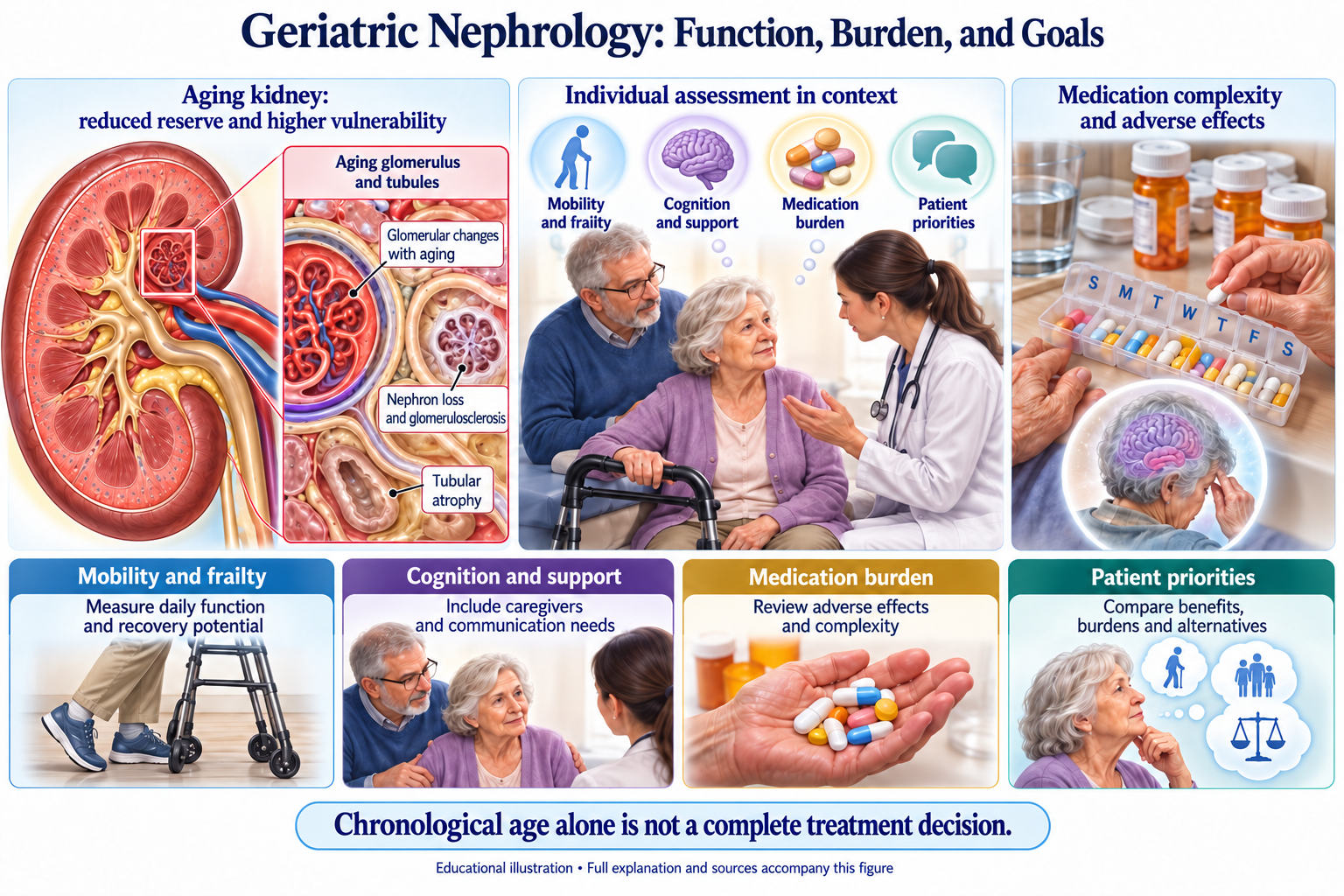
Use the visual framework with the case findings and the linked lecture.
Session S5 · 2026-11-03 · optional-30 · 30 min Anchor: Integrative review — geriatric and palliative nephrology basics · Integrates: eGFR interpretation in the elderly and drug dosing by kidney function (DOAC, sulfonylurea, TMP-SMX), trimethoprim hyperkalemia and the creatinine it raises without lowering GFR, hypermagnesemia from a laxative, frailty-adjusted blood pressure, outpatient triage of a potassium of 6.1, conservative kidney management and shared decision-making Runs 10:00–10:30 only if the full 150-minute block is available. One-line hook: An 88-year-old's patient portal says "Stage 4 kidney failure," and his son wants dialysis planned. The PA in the room has to decide which of today's numbers is the emergency, and what an eGFR can and cannot say at 88.
Fictional patient. Every name, date and number in this case is invented for teaching.
An 88-year-old man who weighs 58 kg has a creatinine of 2.4 mg/dL at a routine visit; the laboratory reports an eGFR of 25 (CKD-EPI 2021). Which statement about that number is correct?
It is the creatinine clearance that drug labels use, so doses can be read straight off it
His low muscle mass lowers his creatinine, so the eGFR may overstate his true filtration
An eGFR in the 20s is normal aging at 88, so it is not chronic kidney disease
The equation subtracts so much for age that his true filtration is probably close to normal
Show answer and explanation · Link to this question
Learning point: Low muscle mass can make creatinine-based eGFR overestimate filtration. Consider cystatin C and a combined estimate when accuracy will change care, while recognizing non-GFR determinants of both markers. Use the kidney-function measure and other criteria specified by each drug label; labels may use Cockcroft–Gault clearance, eGFR or age/weight/creatinine rules. Reassess during changing kidney function.
Why not the others: A treats different estimates and product labels as interchangeable. C dismisses severe impairment as normal aging. D reverses the low-muscle-mass problem. B correctly identifies a possible overestimate, not a proven measured GFR.
Concept link: ckd-04 · Question evidence and course reading
Back to W1 · All answers in this case
A patient with an eGFR of 25 asks which over-the-counter laxative is safest for long-term use. What do you recommend?
Milk of magnesia (magnesium hydroxide) at bedtime
Magnesium citrate, one bottle whenever it is needed
Sodium phosphate, as an enema or by mouth
Polyethylene glycol (PEG 3350) powder in water
Show answer and explanation · Link to this question
Learning point: Magnesium-containing laxatives can accumulate when renal clearance is impaired, especially with repeated doses or altered bowel transit. Advanced CKD raises risk but does not make toxicity inevitable below a single eGFR threshold. Avoid routine unsupervised use, review all over-the-counter products and choose a safer bowel regimen. Weakness, absent reflexes, bradycardia or altered consciousness require urgent assessment.
Why not the others: A and B are the products the hypermagnesemia lecture names for CKD stage 4–5; C — phosphate preparations are avoided below an eGFR of 30 because of the phosphate load.
Concept link: lytes-18 · Question evidence and course reading
Back to W2 · All answers in this case
Hypermagnesemia lecture — Magnesium-Containing Laxatives in CKD
Mr. Walter Kruse, 88, a retired dairy farmer, is brought to his primary-care clinic on a Monday morning by his son, Dennis, who runs the farm now. For a week Walter has been weak — "his legs won't hold him" — and constipated, and on Saturday he nearly fainted standing up from the kitchen table. Dennis has a second worry. On the patient portal his father's last result reads "eGFR 25 — Stage 4 kidney failure." "When does the dialysis start? Shouldn't we get it planned before his kidneys shut down?"
Walter has atrial fibrillation, type 2 diabetes for 25 years, hypertension, arthritis in both hips, and chronic kidney disease noted "for years." He walks with a cane, needs help to bathe, and fills his own pill box. Two weeks ago, more constipated than usual, he doubled his nightly milk of magnesia. Ten days ago an urgent care drained an abscess on his left forearm (culture: methicillin-resistant Staphylococcus aureus, MRSA) and started trimethoprim-sulfamethoxazole (TMP-SMX); nobody checked his kidney function at that visit. His wife died in an intensive-care unit after a long illness, and he has told Dennis more than once, "No machines for me."
Medications
Dose: 5 mg
Route: PO
Frequency: twice daily
Indication: Atrial fibrillation — stroke prevention
Dose: 5 mg
Route: PO
Frequency: twice daily
Indication: Type 2 diabetes
Dose: 10 mg
Route: PO
Frequency: daily
Indication: Hypertension
Dose: 440 mg
Route: PO
Frequency: twice daily
Indication: Hip arthritis
Dose: 20 mg
Route: PO
Frequency: daily — for 6 years
Indication: Stomach upset on naproxen
Dose: 30 mL (2 tablespoons)
Route: PO
Frequency: nightly — doubled 2 weeks ago
Indication: Constipation
Dose: 160/800 mg
Route: PO
Frequency: twice daily — started 10 days ago
Indication: MRSA forearm abscess
| Drug | Dose | Route | Frequency | Indication |
|---|---|---|---|---|
| Apixaban | 5 mg | PO | twice daily | Atrial fibrillation — stroke prevention |
| Glipizide | 5 mg | PO | twice daily | Type 2 diabetes |
| Amlodipine | 10 mg | PO | daily | Hypertension |
| Naproxen (over the counter) | 440 mg | PO | twice daily | Hip arthritis |
| Omeprazole | 20 mg | PO | daily — for 6 years | Stomach upset on naproxen |
| Milk of magnesia | 30 mL (2 tablespoons) | PO | nightly — doubled 2 weeks ago | Constipation |
| TMP-SMX double strength | 160/800 mg | PO | twice daily — started 10 days ago | MRSA forearm abscess |
Which recent exposures and personal priorities matter beyond the portal's eGFR label?
Ask about doubled milk of magnesia, TMP-SMX, other medicines, intake, falls, function and the patient's stated goals. Establish the kidney-function trajectory before attributing new symptoms to progression.
Return to the lecture: Creatinine and GFR lecture — Limitations of eGFR · Understanding dialysis (patient handout) — Choosing not to do dialysis: conservative care
Vitals (10:30): Temp 36.6 °C · Pulse 46, irregular · BP 126/68 seated → 104/60 standing at 1 minute, with lightheadedness (pulse 46 → 48) · Resp 14 · SpO₂ 95% on room air · Weight 58.0 kg (60.0 kg six weeks ago) · Height 175 cm.
Exam: Thin; slow to answer but oriented. Dry mucous membranes; neck veins flat; lungs clear. Irregularly irregular rhythm, no murmur. Abdomen soft, mildly distended. A healing 2-cm wound on the left forearm without surrounding redness. Hip-flexor strength 4/5. Biceps, knee and ankle reflexes absent (his chart from last spring records 1+ knee reflexes). No asterixis, no edema.
Which findings require attention before a long-term kidney-care discussion?
Identify the slow pulse, symptomatic orthostatic change, weakness and loss of reflexes. Describe the pattern and its timing, then use the laboratory workup to test possible medication and electrolyte contributors.
Return to the lecture: Palliative nephrology handout — II. Goals-of-Care Conversations and Shared Decision-Making · Dialysis initiation handout — Shared Decision-Making Framework
Use what you know from the history and examination. Select an initial workup, name the question each test answers, and decide what can wait. Discuss urgent bedside assessment and treatment in parallel.
Some results in this case occur later, after new findings. Selecting a test does not imply that it is needed now.
Your selections last while this page is open. This is a discussion activity, not a scored MCQ. Results remain at their original points in the case; tests without supplied results are identified after you commit.
Fingerstick glucose: 58 mg/dL. He drinks juice and eats crackers; 15 minutes later it is 96. His last hemoglobin A1c was 6.3%. Glipizide is stopped on the spot: sulfonylureas cause more hypoglycemia as kidney function falls, and the geriatric deprescribing list replaces them in frail older adults. A stat chemistry panel was drawn at 10:45, before the juice, and a 12-lead ECG is requested for the slow, irregular pulse; while you wait, you go through his medication list.
Pause — commit before the reveal
Walter takes apixaban 5 mg twice daily for atrial fibrillation. He is 88, weighs 58 kg, and his creatinine four months ago was 2.4 mg/dL (eGFR 25; Cockcroft–Gault clearance about 17 mL/min). He has never had a stroke or a major bleed. Which change is correct?
Keep 5 mg twice daily; apixaban needs no change until the eGFR falls below 15
Stop the anticoagulant entirely; DOACs are contraindicated once the eGFR is below 30
Reduce to 2.5 mg twice daily; he meets the label's age, weight and creatinine rule
Switch to dabigatran 150 mg twice daily, which is better suited to weaker kidneys
Show answer and explanation · Link to this question
Learning point: The apixaban label for atrial fibrillation lowers the dose to 2.5 mg twice daily when two of three are present — age 80 or older, weight 60 kg or less, creatinine 1.5 mg/dL or more ([[01-Clinical-Medicine/Nephrology/Dialysis-Renal-Replacement/Hemodialysis/atrial-fibrillation-anticoagulation-hemodialysis-review#3.3 Apixaban 5 mg or 2.5 mg twice daily — the dose question|AF anticoagulation review §3.3]]) — and Walter meets all three. Dose by the label's own measure (here age, weight and creatinine; for other drugs, the renal metric specified by that product label), not by the eGFR on the portal. Whether to anticoagulate at all is a separate stroke-versus-bleeding decision.
Why not the others: A ignores the age-weight-creatinine rule; B — apixaban remains usable at his eGFR with the label's dose; D — dabigatran is the DOAC most dependent on the kidney (about 80% renal) and is reduced or avoided below a clearance of 30.
Concept link: ckd-18, structural-18, structural-25 · Question evidence and course reading
Back to Q3 · All answers in this case
Renal pharmacology lecture — 1. Drug Dosing in CKD: Principles of Renal Clearance
Walter's pressure is 126/68 seated and 104/60 standing at one minute, with lightheadedness, on amlodipine 10 mg daily; two days ago he nearly fainted. He is 88, frail, diabetic, with CKD. What is the blood-pressure plan?
Reduce the amlodipine and set the dose by his standing pressure and symptoms
Keep amlodipine 10 mg, since his seated 126/68 already meets the CKD goal
Add lisinopril to push his seated systolic under 120, the target for CKD
Start midodrine for the orthostatic drop and continue the amlodipine 10 mg
Show answer and explanation · Link to this question
Learning point: A systolic fall of 22 mmHg on standing, with symptoms, is orthostatic hypotension (a fall of 20 systolic or 10 diastolic within 3 minutes [5]), and in a frail 88-year-old the falls it causes outweigh a few mmHg of seated pressure. Over 80 the target is individualized — according to frailty, symptoms, standing pressure and patient priorities — and symptomatic orthostasis calls for less medication, not another drug. Amlodipine is the one to cut (to 5 mg, or held while he is this dry), with standing pressures at every visit.
Why not the others: B treats the seated number and ignores the near-faint; C applies a target meant for robust patients measured under standardized conditions to a man who cannot tolerate the pressure he has; D adds a drug to treat the side effect of another drug.
Concept link: htn-cardiorenal-04, structural-25 · Question evidence and course reading
Back to Q4 · All answers in this case
Blood pressure targets lecture — Population-Specific Target Recommendations
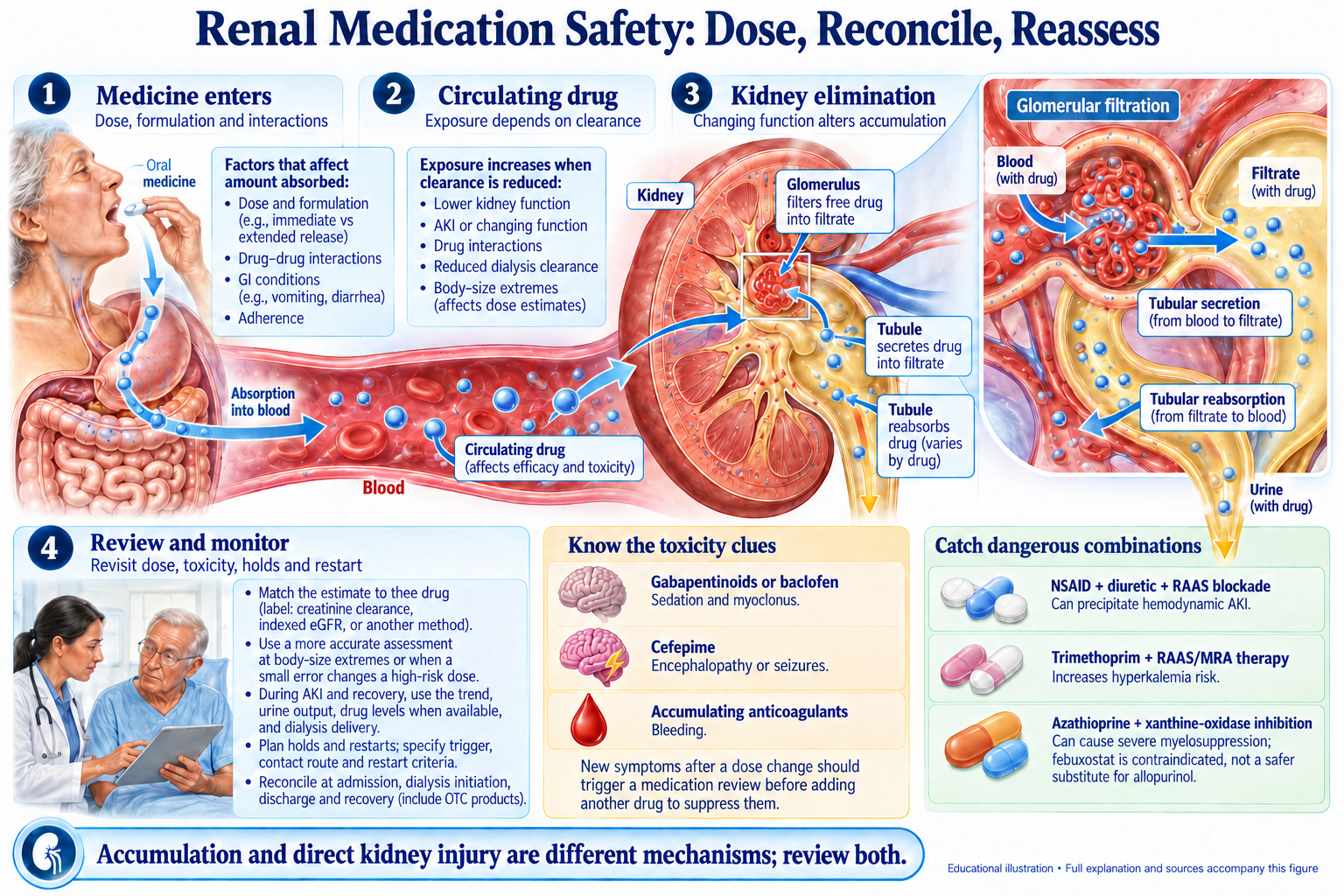
Use the visual framework with the case findings and the linked lecture.
Apply this general guide to the patient: what fits, what changes the next action, and what must you reassess?
Because his reflexes are gone and he takes a magnesium laxative, you add a magnesium level to the stat panel. Results return at 11:20; the 12-lead ECG is done in the exam room, and a bladder scan after he voids shows 60 mL.
How does sodium compare with the supplied range or prior value? Explain what it adds to the pattern, whether the timing or specimen matters, and whether it changes your next step.
Geriatric nephrology handout — V. Polypharmacy and Deprescribing in Elderly CKD
How does potassium compare with the supplied range or prior value? Explain what it adds to the pattern, whether the timing or specimen matters, and whether it changes your next step.
Hyperkalemia lecture — Find the mechanism and reversible contributors
How does chloride compare with the supplied range or prior value? Explain what it adds to the pattern, whether the timing or specimen matters, and whether it changes your next step.
Geriatric nephrology handout — V. Polypharmacy and Deprescribing in Elderly CKD
How does bicarbonate compare with the supplied range or prior value? Explain what it adds to the pattern, whether the timing or specimen matters, and whether it changes your next step.
Geriatric nephrology handout — V. Polypharmacy and Deprescribing in Elderly CKD
How does anion gap (na − [cl + hco₃]) compare with the supplied range or prior value? Explain what it adds to the pattern, whether the timing or specimen matters, and whether it changes your next step.
Geriatric nephrology handout — V. Polypharmacy and Deprescribing in Elderly CKD
How does bun compare with the supplied range or prior value? Explain what it adds to the pattern, whether the timing or specimen matters, and whether it changes your next step.
Geriatric nephrology handout — V. Polypharmacy and Deprescribing in Elderly CKD
How does creatinine compare with the supplied range or prior value? Explain what it adds to the pattern, whether the timing or specimen matters, and whether it changes your next step.
AKI BMP pattern guide — Part 6: BMP-Guided Clinical Decision-Making
How does egfr (ckd-epi 2021) compare with the supplied range or prior value? Explain what it adds to the pattern, whether the timing or specimen matters, and whether it changes your next step.
How does glucose (drawn before the juice) compare with the supplied range or prior value? Explain what it adds to the pattern, whether the timing or specimen matters, and whether it changes your next step.
Geriatric nephrology handout — V. Polypharmacy and Deprescribing in Elderly CKD
How does calcium compare with the supplied range or prior value? Explain what it adds to the pattern, whether the timing or specimen matters, and whether it changes your next step.
Geriatric nephrology handout — V. Polypharmacy and Deprescribing in Elderly CKD
How does magnesium compare with the supplied range or prior value? Explain what it adds to the pattern, whether the timing or specimen matters, and whether it changes your next step.
How does phosphorus compare with the supplied range or prior value? Explain what it adds to the pattern, whether the timing or specimen matters, and whether it changes your next step.
Geriatric nephrology handout — V. Polypharmacy and Deprescribing in Elderly CKD
How does albumin compare with the supplied range or prior value? Explain what it adds to the pattern, whether the timing or specimen matters, and whether it changes your next step.
Geriatric nephrology handout — V. Polypharmacy and Deprescribing in Elderly CKD
How does hemoglobin compare with the supplied range or prior value? Explain what it adds to the pattern, whether the timing or specimen matters, and whether it changes your next step.
Geriatric nephrology handout — V. Polypharmacy and Deprescribing in Elderly CKD
How does urine albumin-to-creatinine ratio compare with the supplied range or prior value? Explain what it adds to the pattern, whether the timing or specimen matters, and whether it changes your next step.
AKI BMP pattern guide — Part 6: BMP-Guided Clinical Decision-Making
How does urinalysis compare with the supplied range or prior value? Explain what it adds to the pattern, whether the timing or specimen matters, and whether it changes your next step.
Geriatric nephrology handout — V. Polypharmacy and Deprescribing in Elderly CKD
| Test | Today (10:45) | 4 months ago | Reference range |
|---|---|---|---|
| Sodium | 137 | 139 | 135–145 mEq/L |
| Potassium | 6.1 | 4.9 | 3.5–5.0 mEq/L |
| Chloride | 108 | 106 | 98–107 mEq/L |
| Bicarbonate | 19 | 23 | 22–29 mEq/L |
| Anion gap (Na − [Cl + HCO₃]) | 10 | 10 | 8–12 mEq/L |
| BUN | 46 | 40 | 7–20 mg/dL |
| Creatinine | 2.9 | 2.4 | 0.7–1.3 mg/dL |
| eGFR (CKD-EPI 2021) | not valid — creatinine has moved | 25 | ≥60 mL/min/1.73 m² |
| Glucose (drawn before the juice) | 60 | 112 | 70–99 mg/dL |
| Calcium | 9.0 | 9.2 | 8.5–10.5 mg/dL |
| Magnesium | 7.4 | — | 1.7–2.2 mg/dL |
| Phosphorus | 4.4 | 4.1 | 2.5–4.5 mg/dL |
| Albumin | 3.5 | 3.7 | 3.5–5.0 g/dL |
| Hemoglobin | 11.2 | 11.5 | 13.5–17.5 g/dL |
| Urine albumin-to-creatinine ratio | — | 280 | <30 mg/g |
| Urinalysis | SG 1.012; protein 1+; blood, leukocyte esterase and nitrite negative; no cells or casts | — | — |
Apply your interpretation in Q5
Revisit the framework: Geriatric nephrology handout — V. Polypharmacy and Deprescribing in Elderly CKD
12-lead ECG: atrial fibrillation, ventricular rate 46; QRS 0.09 s (narrow); tall, peaked T waves in V2–V4.
Anion gap 137 − (108 + 19) = 10, and 11 after correcting for an albumin of 3.5: a mild normal-gap acidosis has appeared alongside the high potassium. BUN:creatinine 16:1. The creatinine is 0.5 mg/dL above his value of four months ago — 1.2 times baseline.
Pause — commit before the reveal
At 11:20: potassium 6.1, magnesium 7.4, creatinine 2.9 (2.4 four months ago), bicarbonate 19, glucose 60 before the juice. The ECG shows atrial fibrillation at 46 with peaked T waves. He is weak, his reflexes are absent, he nearly fainted two days ago, and the bladder scan shows 60 mL. What is the disposition?
Stop TMP-SMX and milk of magnesia; repeat the panel in clinic in 48–72 hours
Give a potassium binder in the clinic, stop TMP-SMX, and recheck the potassium tomorrow
Admit him directly to the hospital for a dialysis catheter and urgent hemodialysis tonight
Send him by monitored ambulance to the emergency department now, with the ECG
Show answer and explanation · Link to this question
Learning point: An unexpected creatinine rise in clinic gets the same moves every time — repeat the chemistry, review drugs and intake, look at the urine, scan the bladder — then a choice between same-day care and a 48–72-hour recheck, made from the potassium, the ECG, the symptoms and the trajectory. Here a potassium of 6.1 comes with ECG changes and a rate of 46, the magnesium has taken his reflexes, and he was hypoglycemic an hour ago: each needs monitored treatment today [6]. The clinic stops the culprits and hands him on.
Why not the others: A triages by the creatinine and misses the ECG; B — a binder lowers potassium over hours and does nothing for the heart or the magnesium; C reaches for dialysis before calcium, a shift and his own kidneys have had a chance.
Concept link: aki-27, lytes-14, lytes-18 · Question evidence and course reading
Back to Q5 · All answers in this case
Hyperkalemia lecture — Recognize risk before choosing a treatment
Forty minutes later, in the emergency department: potassium 6.0, magnesium 7.3, pulse 46, BP 108/62 lying down, glucose 96; the ECG is unchanged.
In the emergency department Walter's potassium is 6.0 with peaked T waves, his magnesium 7.3 with absent reflexes, pulse 46, BP 108/62 lying down, glucose 96 after juice. Which treatment comes first?
Intravenous calcium gluconate to steady the heart against the potassium and the magnesium
Regular insulin 10 units intravenously on its own, so the potassium falls within 15 minutes
A dialysis catheter and urgent hemodialysis to remove the potassium and the magnesium together
A sodium polystyrene sulfonate enema to pull the potassium out through the colon first
Show answer and explanation · Link to this question
Learning point: IV calcium treats the hyperkalemic ECG changes and antagonizes magnesium's cardiac and neuromuscular effects. It lowers neither concentration. In parallel, stop the sources, use insulin with dextrose under close glucose surveillance to shift potassium, and arrange elimination. Correct volume depletion and use a loop only when urine output and volume assessment support it. Early nephrology review is appropriate for symptomatic hypermagnesemia with impaired renal clearance; refractory toxicity may need dialysis.
Why not the others: B — insulin without dextrose, an hour after hypoglycemia, invites a second low and does nothing for the magnesium; C trades minutes for hours; D — sodium polystyrene is slow and risks colonic injury in a constipated man.
Concept link: lytes-13, lytes-18 · Question evidence and course reading
Back to Q6 · All answers in this case
Hyperkalemia lecture — Protect the myocardium when indicated
The emergency team gives calcium gluconate, then a liter of isotonic saline followed by furosemide, sodium zirconium cyclosilicate (a potassium binder), and dextrose with a small insulin dose, checking glucose at baseline, every 30 minutes for 2 hours, then hourly through at least 6 hours, with longer surveillance after recurrent hypoglycemia. TMP-SMX, milk of magnesia and naproxen are stopped (glipizide already was); amlodipine is held. Six hours later: potassium 5.2, magnesium 5.6. By morning: potassium 4.7, magnesium 3.9, knee reflexes back, ventricular rate in the 70s, glucose 110–150 without glipizide. The surgeon checks the forearm — drained, ten days of treatment, healing — and no further antibiotic is needed.
On rounds Dennis stops the hospitalist in the hall: "His creatinine was 2.9 — the worst it's ever been. Is this the kidney failure starting? Should we be planning dialysis now?" The hospitalist pulls three years of clinic results.
If you were thinking "progressive kidney failure requires starting dialysis during this admission," and you then learn that his six clinic values over the past 36 months ran between an eGFR of 24 and 28 (creatinine 2.2–2.5) before this illness, that apart from what the magnesium explained he has had no nausea, itching or confusion, and that his 2-year KFRE is 8% (5-year, 23%), this hypothesis becomes:
Much less likely
Less likely
Unchanged
More likely
Much more likely
Show answer and explanation · Link to this question
Learning point: The serial results show little progression, and the creatinine change followed trimethoprim exposure, which can inhibit creatinine secretion. True AKI still requires assessment; the drug effect cannot be assumed to explain every rise. Symptoms improve as the acute electrolyte and drug problems are treated, so there is no demonstrated need to start dialysis during this admission. His CKD still warrants follow-up and goals-based planning. Either A or B can be justified; the learning target is the reduced likelihood of an immediate dialysis indication, not a validated distinction between the two labels.
Why not the others: A and B can both receive credit when the reasoning matches the new evidence and acknowledges uncertainty. The update supports medication/metabolic contributors; it does not prove that all frailty or cognitive symptoms will reverse. C needs a reason the evidence adds nothing, while movement in the opposite direction needs supporting facts. This is formative discussion, not a validated probability score.
Concept link: ckd-22, ckd-25 · Question evidence and course reading
Back to Q7 · All answers in this case
Creatinine and GFR lecture — Drugs That Raise Creatinine Without Changing GFR
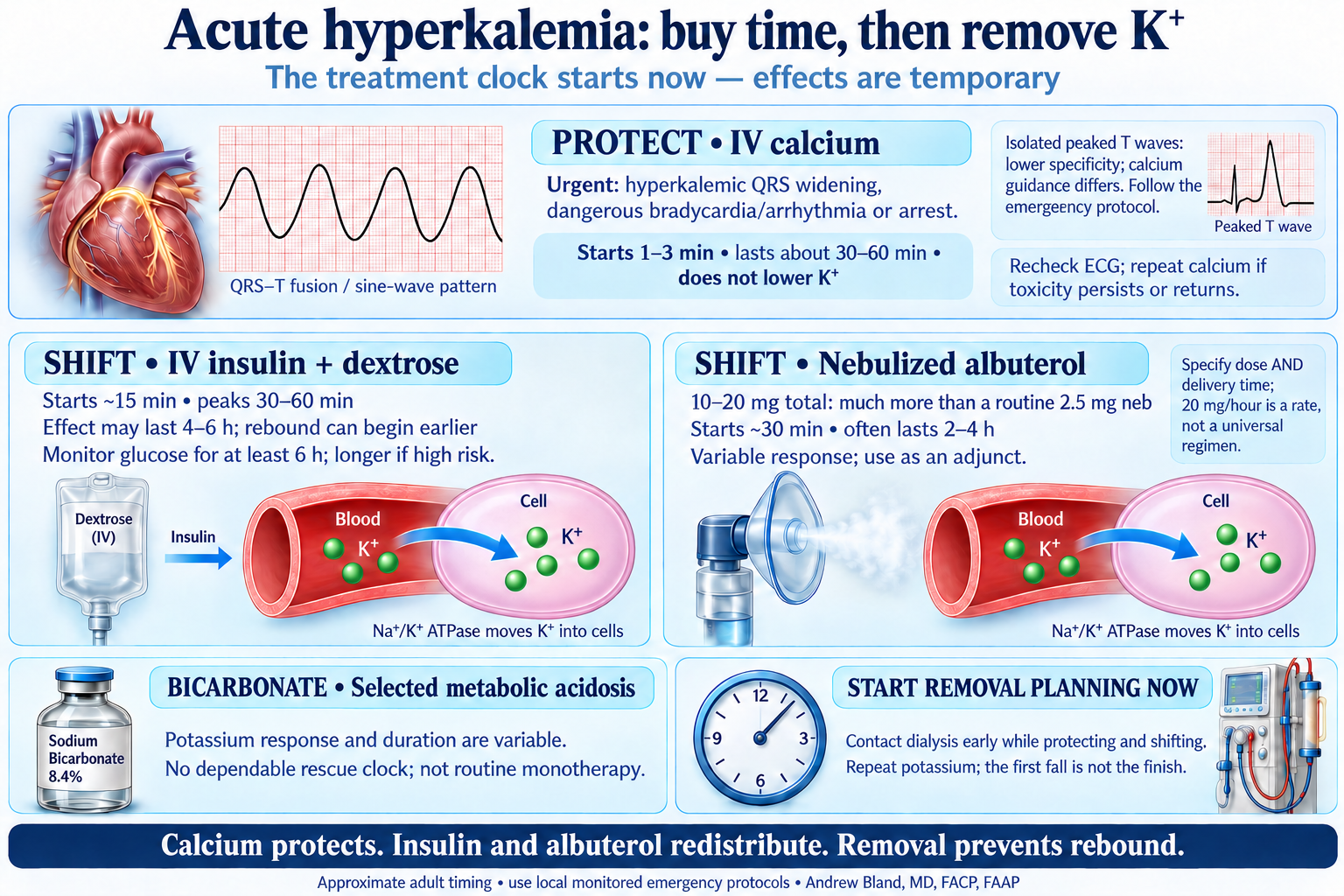
Use the visual framework with the case findings and the linked lecture.
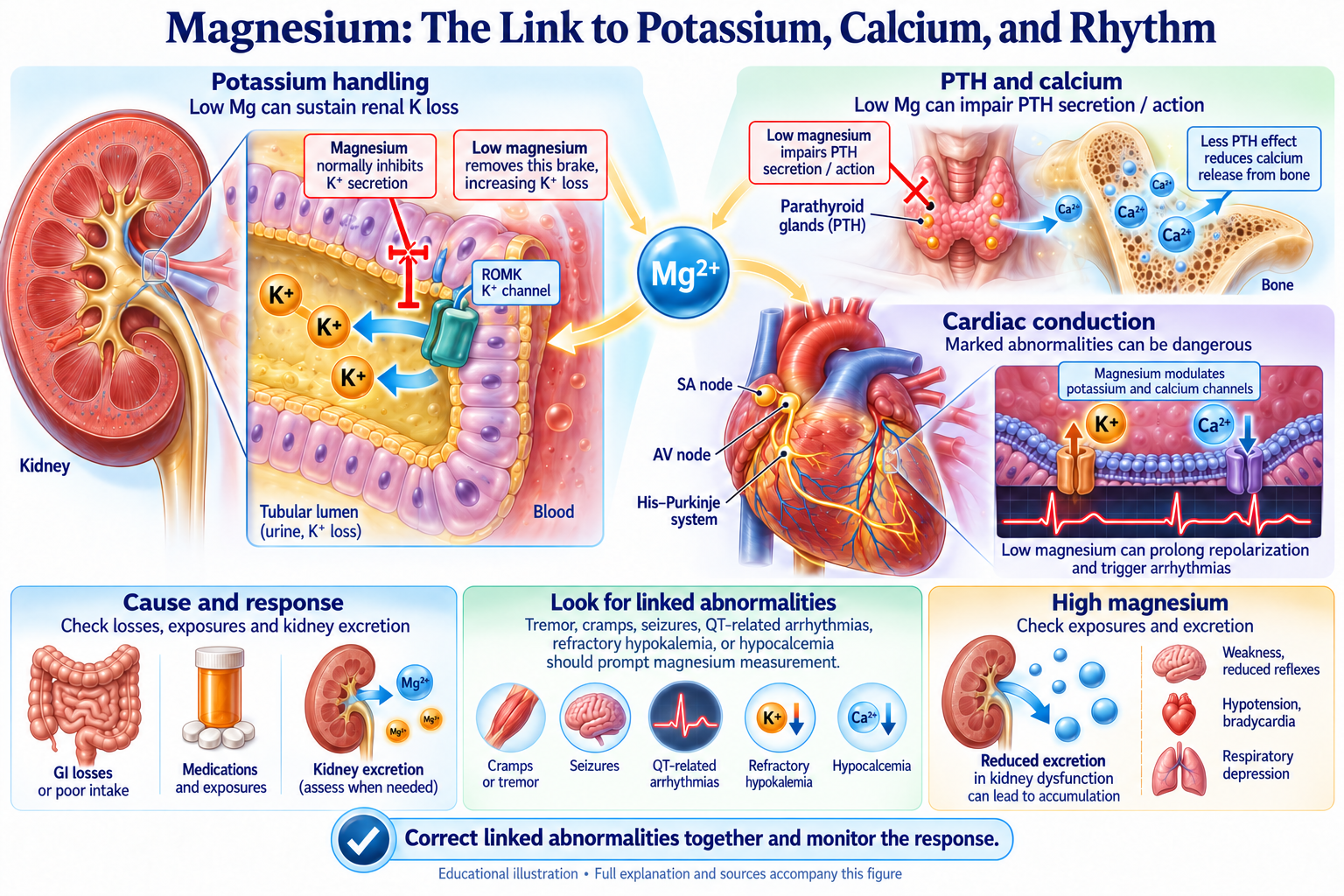
Use the visual framework with the case findings and the linked lecture.
Apply this general guide to the patient: what fits, what changes the next action, and what must you reassess?
Three weeks later, back in clinic: potassium 4.6, magnesium 2.3, creatinine 2.4 (eGFR 25 — back on his line), home glucose readings 104–160 without glipizide, and a blood pressure of 138/74 seated and 130/70 standing on amlodipine 5 mg, with no lightheadedness. Acetaminophen and a topical diclofenac gel have replaced the naproxen, polyethylene glycol has replaced the milk of magnesia, omeprazole is stepping down to every other day on its way off, and apixaban is 2.5 mg twice daily.
Dennis has his question ready: "So what's the plan for when his kidneys do fail?" Walter answers first. "I've told you. No machines. I want to be on the farm with the dog."
Pause — commit before the reveal
You ask yourself the surprise question — "Would I be surprised if Walter died in the next 12 months?" — and the honest answer is no: he is 88, frail, and has just survived a dangerous admission. He has said "no machines" for years; Dennis wants dialysis planned. What do you do with that answer?
Tell them dialysis is not an option at his age, and close the conversation
Refer him to hospice now, because a "no" to the surprise question means hospice
Hold a goals-of-care conversation with both and offer active conservative care
Order vein mapping and a fistula consult so an access is ready if needed
Show answer and explanation · Link to this question
Learning point: The surprise question is a screen the clinician asks privately; a "no" is a reason to talk, not a verdict. Ask Walter what he understands, fears and values most, recommend a plan that fits, and write it down. Conservative kidney management is that plan as active care — symptoms, potassium, acidosis, anemia and fluid still managed, palliative support when needed [7] — and a planning referral at an eGFR under 30 fits inside it, because a referral is not a dialysis start.
Why not the others: A decides by age instead of by the patient; B confuses a prognostic screen with a hospice referral; D prepares for a treatment he has refused, on a slope that may never need it.
Concept link: structural-26, ckd-24, ckd-22 · Question evidence and course reading
Back to Q8 · All answers in this case
Palliative nephrology handout — II. Goals-of-Care Conversations and Shared Decision-Making
Observational evidence in older sulfonylurea users (PMID 24858839) associates co-trimoxazole with increased severe hypoglycemia risk; monitor glucose and reconsider the combination, especially during reduced intake and kidney dysfunction.
US TMP-SMX labeling gives the usual regimen above CrCl 30 mL/min, half the usual regimen at 15–30, and use not recommended below 15. The infection, potassium, glucose and drug interactions still determine whether this is the appropriate antibiotic; a renal adjustment does not remove this patient’s adverse effects.
Frailty, reduced drug clearance, trimethoprim effects, magnesium exposure, and goals of care.
Two weeks later Walter, Dennis and the nephrology nurse practitioner spent an hour together. The plan they signed: no dialysis; keep treating what can be treated; potassium, magnesium and creatinine every three months; a do-not-resuscitate order Walter asked for himself; a call to the clinic for weakness, confusion or a fall. Dennis said afterward that he had been asking for a plan, not for a machine. Four drugs are gone — naproxen, glipizide, milk of magnesia and TMP-SMX — and a fifth, omeprazole, is tapering off; apixaban is 2.5 mg twice daily and amlodipine 5 mg, with acetaminophen and topical diclofenac for his hips and polyethylene glycol for constipation. A year later his eGFR is 24.
Clinical Pearl — At 88, an eGFR is a slope, not a stage Low muscle mass may make creatinine-based eGFR overestimate filtration. Review serial values and consider a combined creatinine–cystatin C estimate when precision matters. KFRE estimates treated kidney-failure risk; it does not replace assessment of frailty, competing mortality, symptoms or patient preference.
Clinical Pearl — Trimethoprim: two effects, one drug It blocks the collecting duct's sodium channel (ENaC) the way amiloride does, so potassium rises with a mild normal-gap acidosis — type 4 RTA physiology — and it blocks the tubule's secretion of creatinine, raising creatinine 0.2–0.5 mg/dL without lowering GFR . The potassium is the dangerous half: check potassium and creatinine soon after starting it in anyone with CKD.
Clinical Pearl — Magnesium out, polyethylene glycol in Milk of magnesia and magnesium citrate accumulate below an eGFR of 30. Reflexes disappear first (above about 7 mg/dL), then come weakness, low blood pressure and slowed conduction. IV calcium antagonizes magnesium within minutes; stopping the source and helping the kidney excrete it do the rest.
Clinical Pearl — Dose by the label's own measure For atrial fibrillation, apixaban is reduced to 2.5 mg twice daily when at least two label criteria are met: age at least 80, weight at most 60 kg and creatinine at least 1.5 mg/dL. Other drugs may use different renal measures; follow their labels. Review sulfonylureas after hypoglycemia, avoid nephrotoxic self-medication and deprescribe a PPI only after checking its indication.
Pitfall — "Stage 4" means dialysis A planning referral is not a dialysis start, and a very old patient with a flat slope may never need one. The question to answer is what the patient wants, not what the portal says.
Pitfall — Insulin without dextrose in a hypoglycemia-prone patient Shifting potassium with insulin in someone on a sulfonylurea with low kidney function invites a second, delayed low. Give dextrose with it and check glucose every hour .
Assigned reading: the explanations in this case and the question-linked course evidence guide. The objective map distinguishes tested decisions from concepts taught in explanations.
Concepts: aki-27, ckd-04, ckd-18, ckd-21, ckd-22, ckd-24, ckd-25, htn-cardiorenal-04, lytes-13, lytes-14, lytes-18, structural-18, structural-25, structural-26.
Geriatric nephrology handout — V. Polypharmacy and Deprescribing in Elderly CKD
Palliative nephrology handout — II. Goals-of-Care Conversations and Shared Decision-Making
Drug dosing quick reference — Part 1: Principles of Drug Dosing in CKD
Renal pharmacology lecture — 1. Drug Dosing in CKD: Principles of Renal Clearance
Dialysis initiation handout — Shared Decision-Making Framework
Understanding dialysis (patient handout) — Choosing not to do dialysis: conservative care
Orthostatic hypotension lecture — The Orthostatic Paradox and management matrix
Hyperkalemia lecture — Find the mechanism and reversible contributors · RTA types — Type 4
AKI BMP pattern guide — Part 6: BMP-Guided Clinical Decision-Making
First choices and optional confidence stay in this browser and are not sent to the website. Opening an explanation first is recorded. Revisiting an unchanged case preserves the first response; revised cases receive a new version. Website visit analytics are separate. On a shared device, export and clear the history when finished.