1 · Approach
Use the opening diagram and short lessons before the patient.
Session 3 · Classroom case · 11 questions
Andrew Bland, MD, FACP, FAAP · October 2026
Open all teaching, infographics and lecture links for this case →
Follow the history, examination, workup, and clinical course. Commit to each decision before opening the explanation.
Classroom pathway · Pause at each stage for discussion.
First decide whether the specimen and symptoms fit. Then separate urinary infection, contamination, medication effects and water-balance disorders.
Use the opening diagram and short lessons before the patient.
Revisit urgency as history, examination and initial data arrive.
Use the urine, blood or imaging guide at the relevant decision.
Connect the management plan with response, monitoring and follow-up.
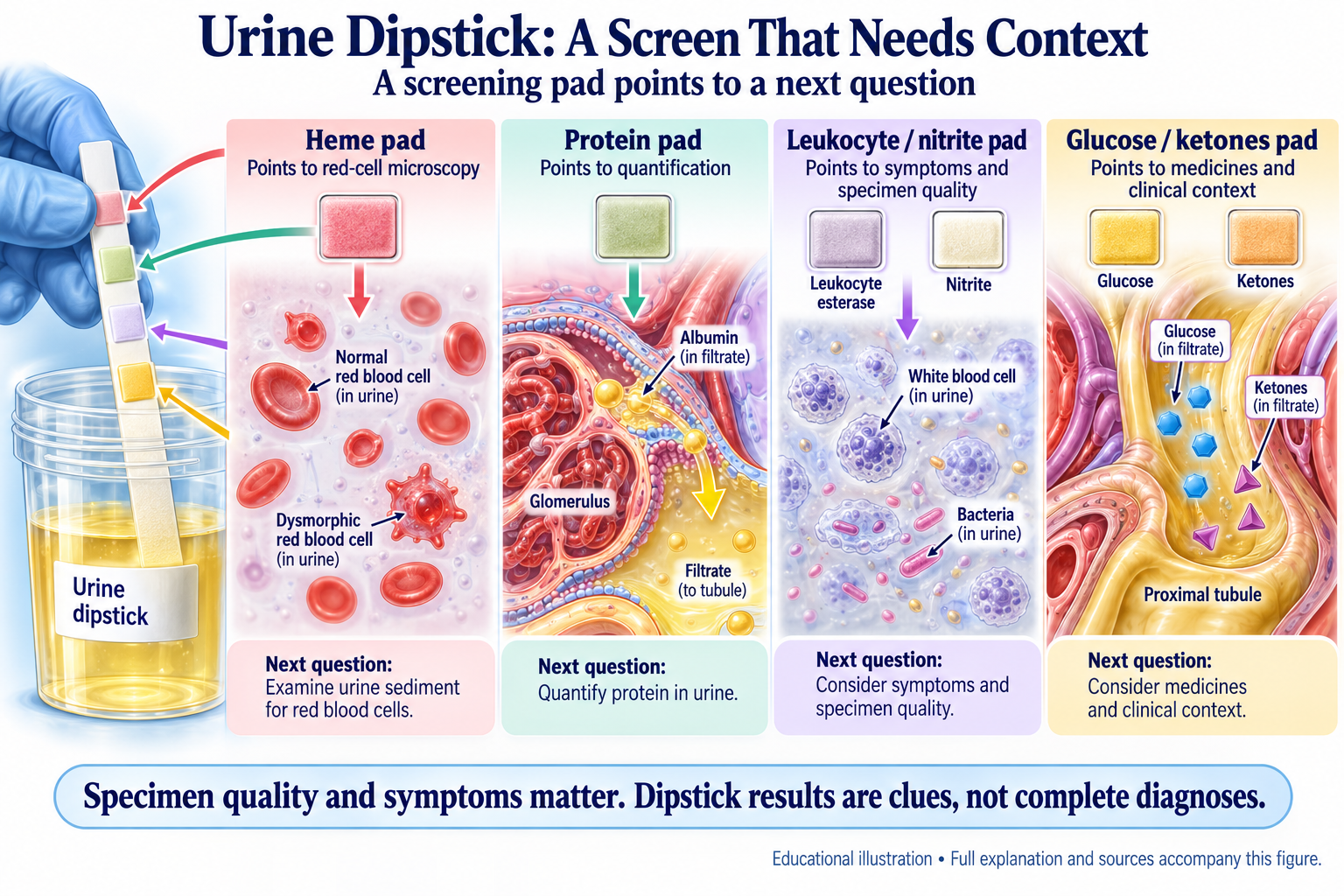
Use the diagram with the teaching text, then apply it to the case findings.
Session S3 · 2026-10-28 · in-session · 37 min Anchor: Urinalysis as the skeleton key — contaminated specimen, UTI vs asymptomatic bacteriuria, pyelonephritis · Integrates: Geriatric confusion work-up (medications, dehydration, thiazide hyponatremia), CKD drug dosing, outpatient creatinine-bump triage, renal imaging choice One-line hook: The most common antibiotic prescription you will be asked to write as a new PA is for a confused older woman with a "positive" urine. This case is about what that cup can and cannot tell you, and where else to look.
Which urine dipstick pad depends on how long the urine sat in the bladder before it was voided?
Leukocyte esterase
Protein
Blood
Nitrite
Show answer, explanation and infographics · Link to this question
Learning point: Nitrite is not made by the body. Gut-type bacteria (E. coli, Klebsiella, Proteus) carry an enzyme, nitrate reductase, that converts dietary nitrate in the urine into nitrite — and that takes about 4 hours of bladder dwell time. A first-morning void is the right specimen; a patient voiding every hour, on a diuretic, can have a florid infection with a blank nitrite pad. Some organisms, including Enterococcus, commonly yield a negative nitrite result. Do not treat nitrite behavior as a perfectly sensitive organism-identification test.
Why not the others: Leukocyte esterase is an enzyme from white cells already in the specimen — no dwell time needed; protein and blood pads react with what is present at the moment of voiding.
Concept link: glom-01 · Question evidence and course reading
Back to W1 · All answers in this case
Visual explanation: Urine Dipstick: A Screen That Needs Context

Illustration updated October 18, 2026. Educational schematic. Imaging and microscopy panels are illustrations, not patient studies. Full teaching text and sources follow.
A screening pad points to a next question. . Specimen quality and symptoms matter. Dipstick results are clues, not complete diagnoses. The infographic uses anatomical illustrations and integrated labels; the complete teaching text and evidence are below.
Andrew Bland, MD, FACP, FAAP
A urine sediment shows white blood cell casts. Where did those white cells come from?
The kidney (upper urinary tract), before the cast formed
The bladder wall (lower-tract cystitis)
The urethra or perineal skin (specimen contamination)
The ureteral wall in isolated ureteritis
Show answer, explanation and infographics · Link to this question
Learning point: Casts form inside renal tubules from a protein matrix; incorporated white cells therefore locate the inflammatory process to the kidney. Pyelonephritis, interstitial nephritis and some glomerulonephritides can produce white-cell casts. The cast does not identify one of these causes by itself.
Why not the others: Cells from isolated inflammation in the bladder, ureter or urethra, or contamination from skin, do not form a true intrarenal tubular cast. A renal source is the single best location; it need not be exclusively interstitial.
Concept link: glom-02, aki-06 · Question evidence and course reading
Back to W2 · All answers in this case
Visual explanation: Urine Sediment: Cells, Casts, and the Source of Hematuria

Illustration updated October 18, 2026. Educational schematic. Imaging and microscopy panels are illustrations, not patient studies. Full teaching text and sources follow.
Urine particles can help localize injury. . Schematic microscopy: findings support a pattern but are not diagnostic alone. Examine a fresh, well-collected specimen. The infographic uses anatomical illustrations and integrated labels; the complete teaching text and evidence are below.
Andrew Bland, MD, FACP, FAAP
Which patient is most likely to develop hyponatremia after a thiazide diuretic is started?
45-year-old man, 102 kg, on chlorthalidone for 2 years
76-year-old woman, 49 kg, started hydrochlorothiazide 3 weeks ago
60-year-old man, 85 kg, on hydrochlorothiazide for 10 years, now training for a marathon
32-year-old woman, 60 kg, started hydrochlorothiazide 6 months ago for kidney stones
Show answer, explanation and infographics · Link to this question
Learning point: Thiazides impair urinary dilution. Older age, low body mass, female sex and a recent start make B the strongest risk cluster here. Hyponatremia often appears early, but can also occur after years when illness, fluid or solute intake, kidney function or interacting medicines change.
Why not the others: A and D have fewer listed risk factors. C is not protected by ten years of use: endurance exercise and altered intake can precipitate late hyponatremia. B remains the best combination of risk factors.
Concept link: lytes-06, structural-25 · Question evidence and course reading
Back to W3 · All answers in this case
Visual explanation: One thiazide, several connected abnormalities
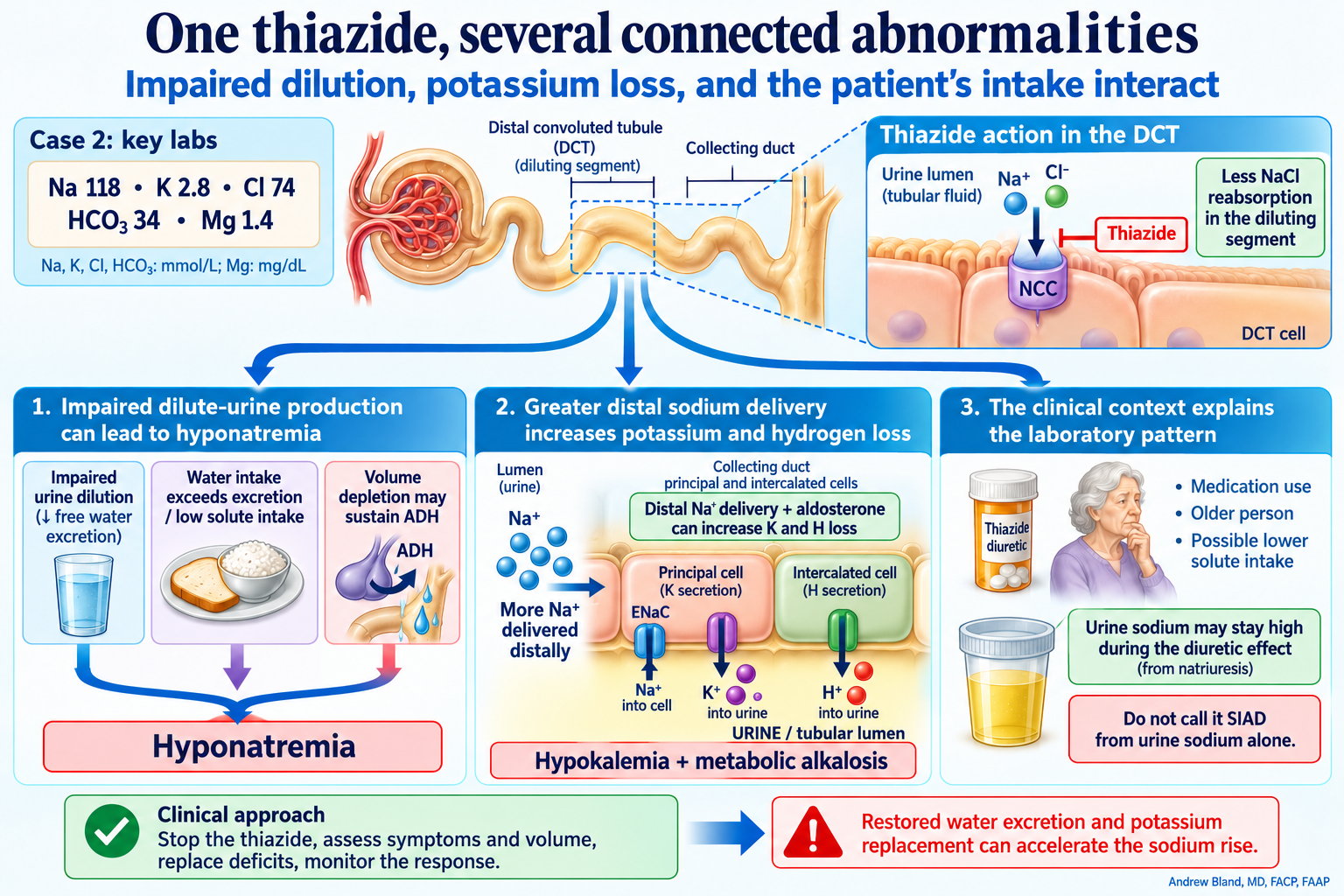
Impaired dilution, potassium loss, and the patient's intake interact
Andrew Bland, MD, FACP, FAAP
Mrs. Marjorie Lund, 84, arrives by wheelchair van from her assisted-living facility at 10:40 on a Tuesday. The transfer sheet says, in the nurse's handwriting: "UTI — please treat. Positive UA attached. Fell last night."
She has lived at the facility for two years. At baseline she walks with a cane, knows the staff by name, manages her own pills from a weekly box, and has mild memory trouble (oriented to person and place, forgets appointments). She has type 2 diabetes for twenty years, hypertension, painful burning in both feet from diabetic neuropathy, and chronic kidney disease — her last clinic labs three months ago showed creatinine 1.4 mg/dL, eGFR 37 mL/min/1.73 m² (CKD-EPI 2021), urine albumin-to-creatinine ratio 210 mg/g, hemoglobin A1c 7.2: CKD G3b A2, diabetic kidney disease.
Two things changed in the last month. Four weeks ago her primary care clinic added hydrochlorothiazide 25 mg for blood pressure readings in the 160s. One week ago, after she called about her feet, her gabapentin was tripled from 300 mg to 900 mg three times daily. For the last five nights the facility has given her a 25-mg diphenhydramine tablet at bedtime from the PRN list because she "couldn't settle."
Three days ago she stopped finishing meals. Two days ago an aide found her "not herself" — sleepy in the afternoon, calling the aide by her daughter's name. The facility nurse collected a urine specimen into a collection bag applied over an incontinence pad (she could not follow the clean-catch instructions) and sent it for urinalysis and culture. Last night she got up to use the toilet, fell, and was found on the floor by her bed. No head strike was witnessed; she has a bruise over the left hip. This morning the urinalysis result came back and generated the transfer.
She is a widow. Her daughter lives two hours away and holds her health-care power of attorney. She does not drink alcohol. She has never had a urinary catheter.
Medications on arrival
Dose: 500 mg
Route: PO
Frequency: twice daily
Indication: Type 2 diabetes
Dose: 10 mg
Route: PO
Frequency: daily
Indication: Hypertension; albuminuria (diabetic kidney disease)
Dose: 25 mg
Route: PO
Frequency: daily — started 4 weeks ago
Indication: Hypertension
Dose: 900 mg
Route: PO
Frequency: three times daily — increased from 300 mg TID 7 days ago
Indication: Painful diabetic neuropathy
Dose: 25 mg
Route: PO
Frequency: at bedtime PRN — given each of the last 5 nights
Indication: Sleep
Dose: 20 mg
Route: PO
Frequency: nightly
Indication: Cardiovascular risk reduction in diabetes
Dose: 650 mg
Route: PO
Frequency: every 6 h PRN
Indication: Knee osteoarthritis pain
| Drug | Dose | Route | Frequency | Indication |
|---|---|---|---|---|
| Metformin | 500 mg | PO | twice daily | Type 2 diabetes |
| Lisinopril | 10 mg | PO | daily | Hypertension; albuminuria (diabetic kidney disease) |
| Hydrochlorothiazide | 25 mg | PO | daily — started 4 weeks ago | Hypertension |
| Gabapentin | 900 mg | PO | three times daily — increased from 300 mg TID 7 days ago | Painful diabetic neuropathy |
| Diphenhydramine | 25 mg | PO | at bedtime PRN — given each of the last 5 nights | Sleep |
| Atorvastatin | 20 mg | PO | nightly | Cardiovascular risk reduction in diabetes |
| Acetaminophen | 650 mg | PO | every 6 h PRN | Knee osteoarthritis pain |
What would you establish before accepting the transfer sheet's UTI diagnosis?
Compare mental status and function with baseline; ask about local urinary symptoms and systemic illness. Reconstruct the gabapentin increase, diphenhydramine exposure, thiazide start and how the urine sample was collected.
Return to the lecture: Dipstick lecture — Dipstick Parameter Deep Dive · Quick-start guide — Part 6: Volume Status Assessment
Vitals (ED, 10:55): T 36.9 °C · Pulse 78 seated → 98 standing · BP 138/74 seated → 110/62 standing · Resp 16 · SpO₂ 96 percent on room air · Weight 52.0 kg (facility weight 4 weeks ago: 54.5 kg) · Height 158 cm. Read the orthostatic change against the table in the quick-start guide, Part 6.
Exam. Drowsy but rousable; oriented to person only; cannot name the month; attention wanders mid-sentence (she cannot recite the months backward past October). Mucous membranes dry. Skin over the forearm tents slowly — remember that turgor is unreliable in the elderly, which is why we took orthostatics. Neck veins flat at 30°. Lungs clear. Heart regular, no murmur. Abdomen soft, no suprapubic fullness, no costovertebral-angle tenderness. No peripheral edema. Occasional brief myoclonic jerks of both hands at rest. No focal weakness, no asterixis (the flapping hand tremor of uremia or liver failure). Left hip bruised, full passive range of motion without pain. No dysuria, frequency or incontinence beyond her baseline nocturia, per the facility.
Which bedside observations help distinguish sedation, depletion and an acute focal problem?
Document alertness, attention, gait if safe, orthostatic findings, mucosa, neck veins, temperature and focal neurologic signs. A positive urine report cannot replace this examination.
Return to the lecture: Quick-start guide — Part 6: Volume Status Assessment · Dipstick lecture — Dipstick Parameter Deep Dive
Use what you know from the history and examination. Select an initial workup, name the question each test answers, and decide what can wait. Discuss urgent bedside assessment and treatment in parallel.
Some results in this case occur later, after new findings. Selecting a test does not imply that it is needed now.
Your selections last while this page is open. This is a discussion activity, not a scored MCQ. Results remain at their original points in the case; tests without supplied results are identified after you commit.
The urinalysis the facility sent (bag specimen, collected 2 days ago)
How does color / clarity compare with the supplied range or prior value? Explain what it adds to the pattern, whether the timing or specimen matters, and whether it changes your next step.
How does specific gravity compare with the supplied range or prior value? Explain what it adds to the pattern, whether the timing or specimen matters, and whether it changes your next step.
How does ph compare with the supplied range or prior value? Explain what it adds to the pattern, whether the timing or specimen matters, and whether it changes your next step.
How does protein compare with the supplied range or prior value? Explain what it adds to the pattern, whether the timing or specimen matters, and whether it changes your next step.
How does glucose compare with the supplied range or prior value? Explain what it adds to the pattern, whether the timing or specimen matters, and whether it changes your next step.
How does ketones compare with the supplied range or prior value? Explain what it adds to the pattern, whether the timing or specimen matters, and whether it changes your next step.
How does blood compare with the supplied range or prior value? Explain what it adds to the pattern, whether the timing or specimen matters, and whether it changes your next step.
How does leukocyte esterase compare with the supplied range or prior value? Explain what it adds to the pattern, whether the timing or specimen matters, and whether it changes your next step.
How does nitrite compare with the supplied range or prior value? Explain what it adds to the pattern, whether the timing or specimen matters, and whether it changes your next step.
How does wbc compare with the supplied range or prior value? Explain what it adds to the pattern, whether the timing or specimen matters, and whether it changes your next step.
How does rbc compare with the supplied range or prior value? Explain what it adds to the pattern, whether the timing or specimen matters, and whether it changes your next step.
How does squamous epithelial cells compare with the supplied range or prior value? Explain what it adds to the pattern, whether the timing or specimen matters, and whether it changes your next step.
Interpretation lecture — Critical Microscopy Findings and Contamination
How does mucus threads compare with the supplied range or prior value? Explain what it adds to the pattern, whether the timing or specimen matters, and whether it changes your next step.
How does bacteria compare with the supplied range or prior value? Explain what it adds to the pattern, whether the timing or specimen matters, and whether it changes your next step.
How does casts compare with the supplied range or prior value? Explain what it adds to the pattern, whether the timing or specimen matters, and whether it changes your next step.
Interpretation lecture — Critical Microscopy Findings and Contamination
How does crystals compare with the supplied range or prior value? Explain what it adds to the pattern, whether the timing or specimen matters, and whether it changes your next step.
Interpretation lecture — Critical Microscopy Findings and Contamination
| Test | Result | Reference |
|---|---|---|
| Color / clarity | Yellow / cloudy | Yellow / clear |
| Specific gravity | 1.015 | 1.005–1.030 |
| pH | 6.5 | 4.5–8.0 |
| Protein | Trace | Negative |
| Glucose | Negative | Negative |
| Ketones | Negative | Negative |
| Blood | Negative | Negative |
| Leukocyte esterase | 1+ | Negative |
| Nitrite | Negative | Negative |
| WBC | 8/hpf | 0–5/hpf |
| RBC | 1/hpf | 0–3/hpf |
| Squamous epithelial cells | Many (>10/lpf) | <5/lpf |
| Mucus threads | Many | None |
| Bacteria | Moderate, mixed morphologies | None |
| Casts | None | None |
| Crystals | None | None |
Apply your interpretation in Q4
Revisit the framework: Dipstick lecture — Dipstick Parameter Deep Dive
Pause — commit before the reveal
The facility asks you to treat her urinary tract infection. The bag-collected urinalysis shows 1+ leukocyte esterase, negative nitrite, 8 WBC/hpf, many squamous epithelial cells, many mucus threads and moderate bacteria of mixed shapes. Mrs. Lund is 84, confused, afebrile, and has no urinary symptoms. What is the best next step?
Start cephalexin now — she is confused and the leukocyte esterase is positive, and waiting risks urosepsis
Start nitrofurantoin 100 mg twice daily for 5 days, the first-line cystitis regimen
Withhold antibiotics and assess delirium, medications and volume; recollect urine only if clinical suspicion of UTI develops
Hold antibiotics until the culture from the bag specimen returns, then treat if it grows 100,000 CFU/mL or more
Show answer, explanation and infographics · Link to this question
Learning point: Confusion without urinary symptoms or systemic signs is not an indication to diagnose or treat UTI or routinely screen for bacteriuria. This poorly collected bag specimen adds little diagnostic value. Follow IDSA 2019 §§IV–V: assess other causes of delirium and observe rather than prescribe an antibiotic. If new localizing or systemic findings create a clinical reason to test, obtain an appropriate specimen; a straight catheter is not routinely required simply to replace an incidental abnormal urinalysis.
Apply the collection clues: the pad/bag technique, many squamous cells and mixed bacterial forms make external carryover plausible. Mucus adds context but is nonspecific. In this afebrile patient without urinary symptoms, the immediate task remains the delirium and medication/volume assessment; a cleaner positive culture would still not, by itself, establish symptomatic UTI. Revisit the clean-catch teaching and graphic.
Why not the others: A and B treat nonspecific delirium and incidental urine findings. D makes culture growth an automatic treatment trigger even without symptoms. C places the clinical syndrome before the laboratory result.
Concept link: structural-04, glom-02 · Question evidence and course reading
Back to Q4 · All answers in this case
Interpretation lecture — Contamination: The Near-Olympic Sport of Clean Collection
Visual explanation: Positive urine does not establish symptomatic UTI
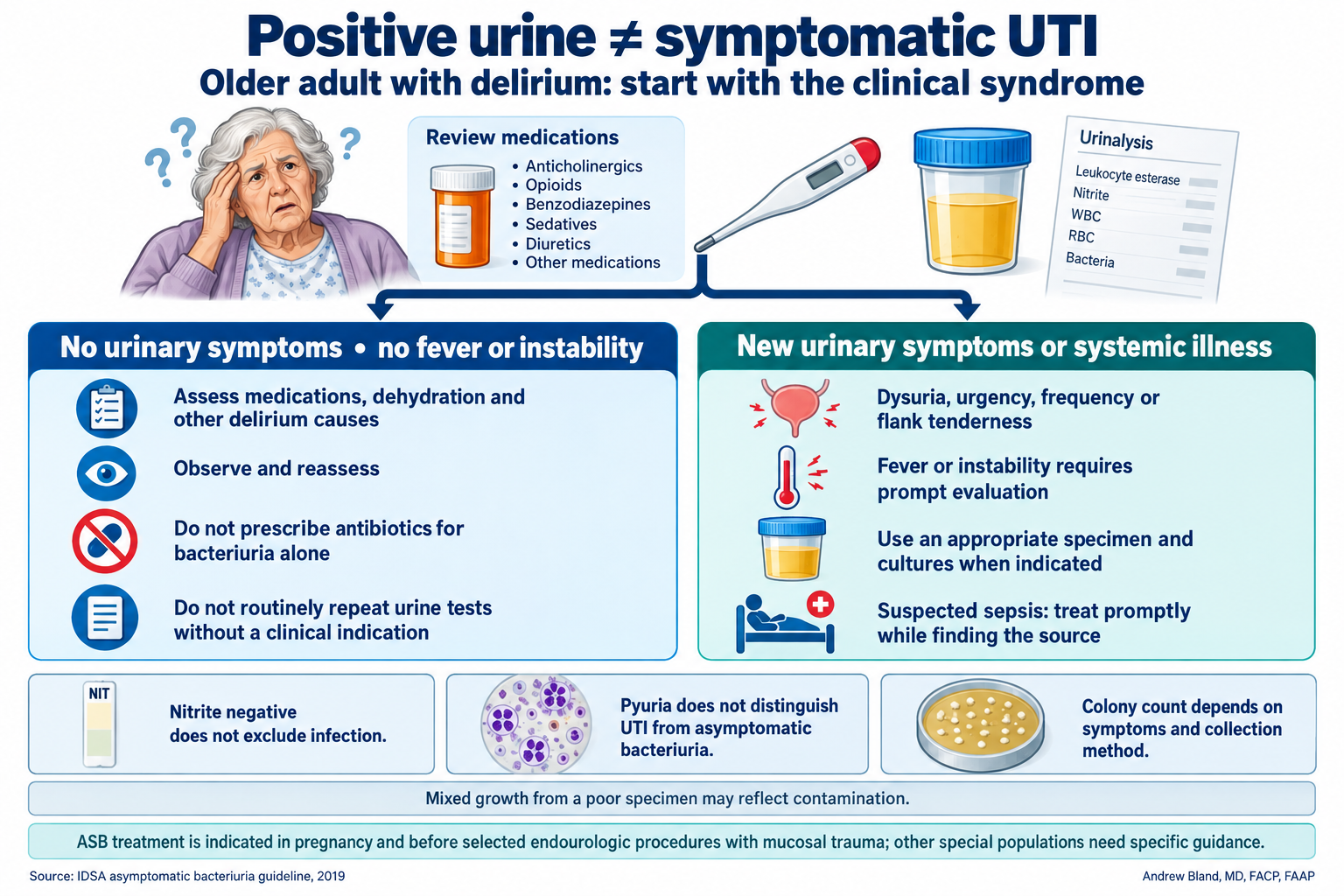
In an older adult with delirium but no urinary symptoms, fever or instability, evaluate other causes and reassess. Incidental bacteriuria or pyuria does not by itself justify antibiotics or repeated urine cultures. New localizing symptoms or systemic illness changes the assessment; suspected sepsis needs prompt treatment while its source is investigated. Interpret the collection method and colony count together. Pregnancy and selected endourologic procedures with mucosal trauma have specific screening/treatment recommendations.
IDSA asymptomatic bacteriuria guidance · IDSA guideline — PubMed
Andrew Bland, MD, FACP, FAAP
Her point-of-care sodium is 127 mEq/L (her value 3 months ago was 138). She started hydrochlorothiazide 4 weeks ago, has eaten little for 3 days, is 2.5 kg below her weight of a month ago, and her systolic pressure falls 28 mmHg on standing with a heart-rate rise of 20. She is drowsy and inattentive but has had no seizure. What is the right first move for the sodium?
Restrict free water to 1 L/day, continue her current medications, and recheck the sodium tomorrow
Give a 150-mL bolus of hypertonic saline now and recheck the sodium in 20 minutes
Continue hydrochlorothiazide and add sodium chloride tablets 1 g three times daily
Stop hydrochlorothiazide, give cautious isotonic saline, and recheck the sodium in 4–6 hours
Show answer, explanation and infographics · Link to this question
Learning point: Hyponatremia is too much water relative to salt, and the first question is always volume status at the bedside — she is hypovolemic (orthostatic drop, heart-rate rise of 20, dry mucosa, flat neck veins, 2.5 kg lost). The thiazide is the cause: it wrecks urinary dilution and wastes salt in exactly her demographic — older woman, 52 kg, started within weeks [10][11] — so the treatment is to stop the drug and replace volume with isotonic saline, slowly. The trap is what happens next: once the drug wears off and volume is restored the kidney dumps free water and the sodium can shoot up, which is why the recheck is every 4–6 hours and why the ceiling is no more than 8 mEq/L in the first 24 hours in a high-risk patient like her (elderly, malnourished; never more than 10), to avoid osmotic demyelination, a brain injury from correcting too fast [12].
Why not the others: A is the SIADH reflex (syndrome of inappropriate antidiuretic hormone — a euvolemic patient retaining water, treated with fluid restriction) applied to a dry patient — fluid restriction in a dehydrated 84-year-old is harmful; B — hypertonic saline is for severe symptoms (seizure, coma, respiratory compromise) and is considered for moderate symptoms only when the hyponatremia is clearly the cause [12]; drowsiness with four other explanations at a sodium of 127 does not earn it; C leaves the cause on board and adds salt she cannot handle while the thiazide blocks dilution.
Concept link: lytes-01, lytes-06 · Question evidence and course reading
Back to Q5 · All answers in this case
Visual explanation: Treat hypotonic hyponatremia
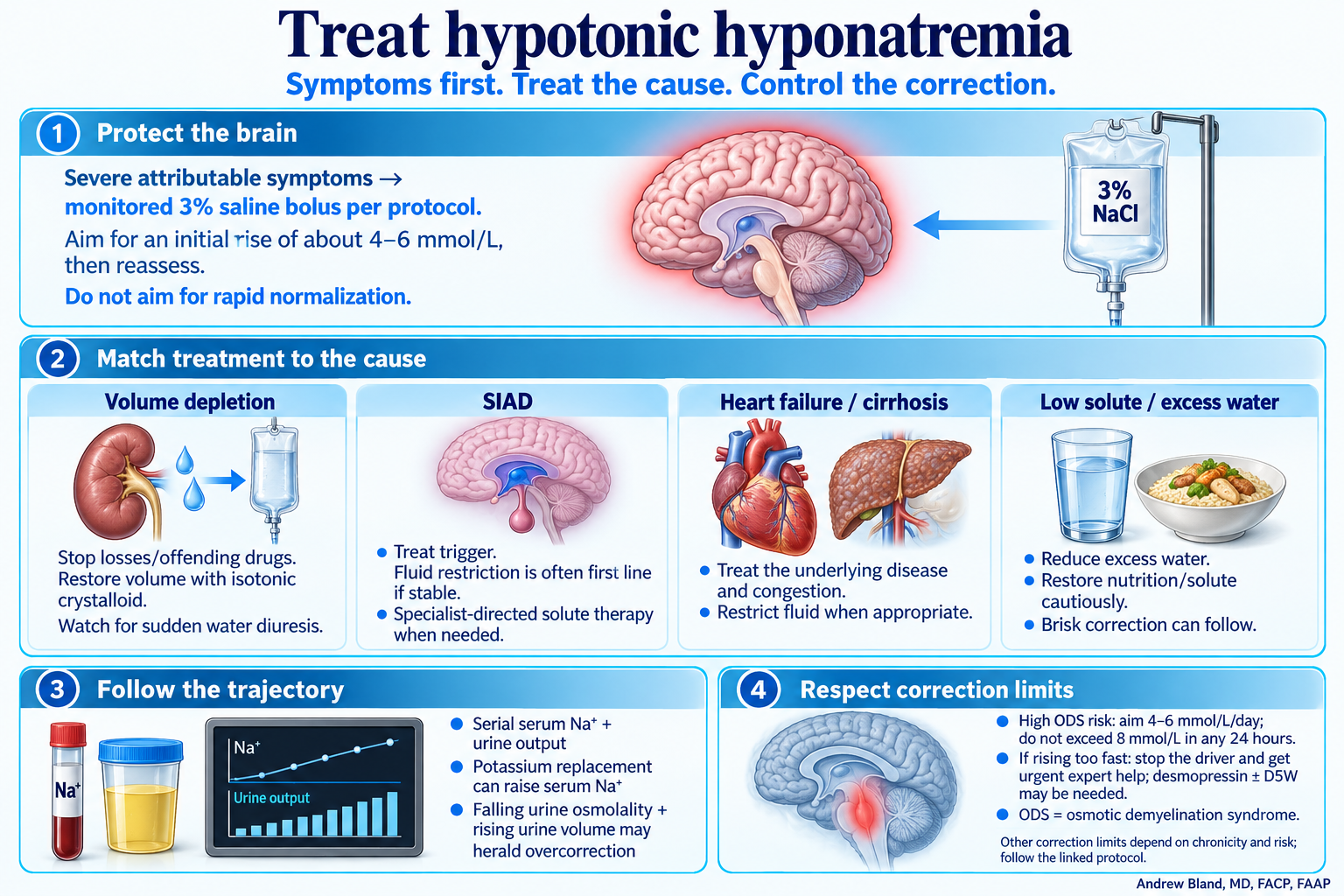
Symptoms first, cause-directed treatment, and control of the correction.
Andrew Bland, MD, FACP, FAAP
Her gabapentin was increased to 900 mg three times daily (2,700 mg/day) one week ago. Her creatinine was 1.4 mg/dL at baseline — eGFR 37 by CKD-EPI 2021, but a Cockcroft–Gault creatinine clearance of about 25 mL/min for an 84-year-old woman weighing 52 kg: (140 − 84) × 52 × 0.85 / (72 × 1.4) = 24.6. She is drowsy with myoclonic jerks of both hands. Which statement is correct?
Hold gabapentin; it is renally cleared and has accumulated — restart later at a fraction of the dose
Continue 900 mg three times daily; her eGFR of 37 is above the 30 mL/min threshold where adjustment begins
Continue it; gabapentin is cleared by the liver and needs no renal adjustment at any eGFR
Switch to pregabalin at an equivalent total daily dose, which does not accumulate in CKD
Show answer, explanation and infographics · Link to this question
Learning point: Her calculated Cockcroft–Gault clearance is about 25 mL/min. Gabapentin accumulation can produce somnolence, myoclonus and falls, so withhold it during assessment of suspected toxicity and review the indication. The label gives 200–700 mg once daily at CrCl >15–29, 100–300 mg/day at 15, and proportionate reduction below 15. A frail patient may need less; the label range is not a target to titrate toward. Reassess alertness and kidney function before a cautious restart.
Why not the others: B is the eGFR-vs-CrCl trap and misreads the threshold — adjustments begin below 60, with the critical steps at 30 and 15; C is simply wrong about the route of elimination; D swaps one renally cleared gabapentinoid for another that also needs dose reduction.
Concept link: ckd-18, structural-18 · Question evidence and course reading
Back to Q6 · All answers in this case
Renal pharmacology lecture — 1. Drug Dosing in CKD: Principles of Renal Clearance
Visual explanation: Drug dosing while creatinine is changing
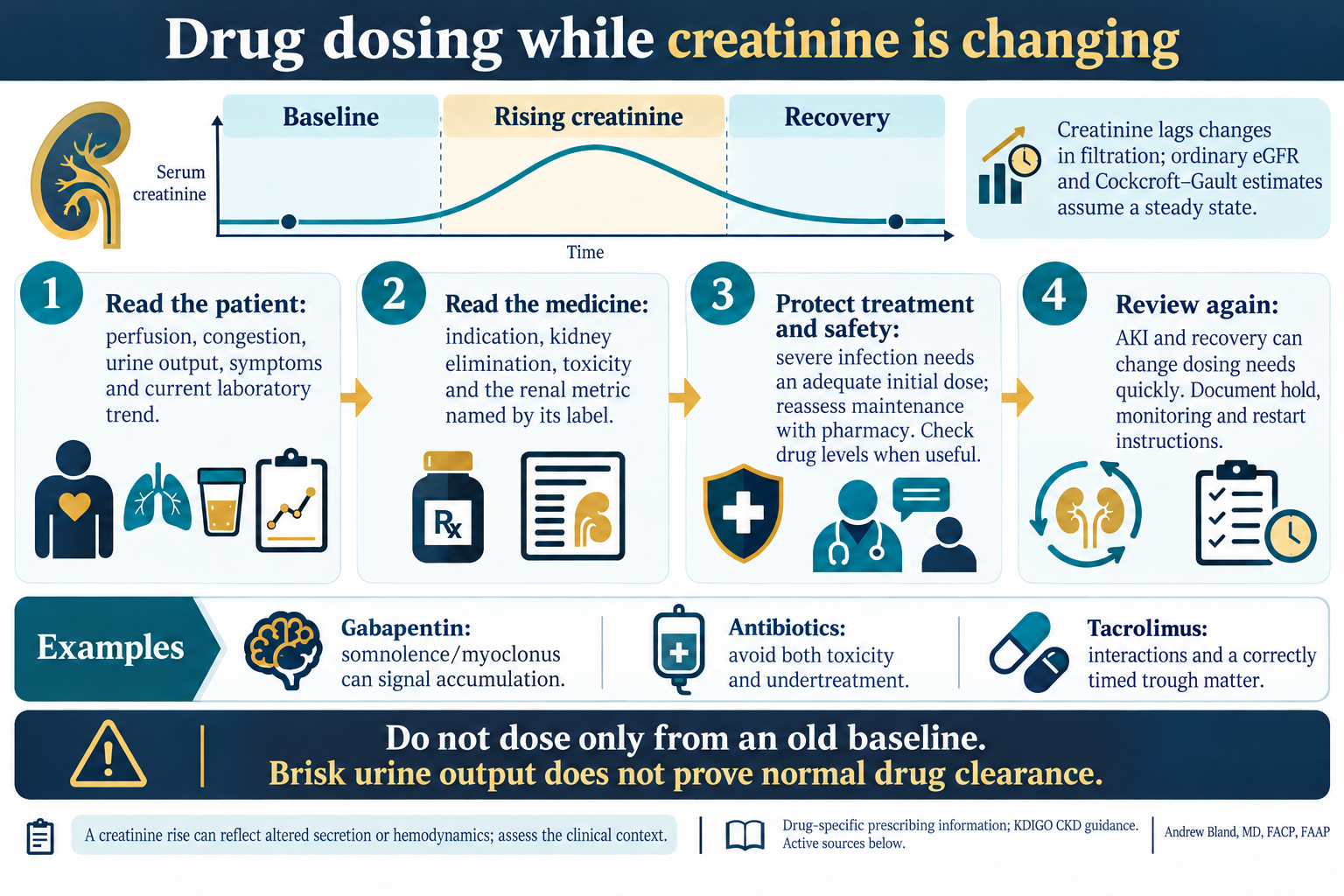
KDIGO 2024 CKD · PROGRAF prescribing information
Creatinine lags changes in filtration; ordinary eGFR and Cockcroft–Gault estimates assume steady state. Read the current trajectory, perfusion, congestion, urine output and symptoms, then the medicine’s indication, kidney elimination, toxicity and label-specific renal metric. Severe infection still requires adequate initial therapy; reassess maintenance doses with pharmacy and measure drug levels when useful. AKI and recovery require repeated review and explicit hold, monitoring and restart plans. Do not dose only from an old baseline. Brisk urine output does not prove normal clearance. Gabapentin accumulation may cause somnolence or myoclonus; tacrolimus needs interaction review and a correctly timed trough. A creatinine rise can also reflect secretion or hemodynamic effects.
Andrew Bland, MD, FACP, FAAP
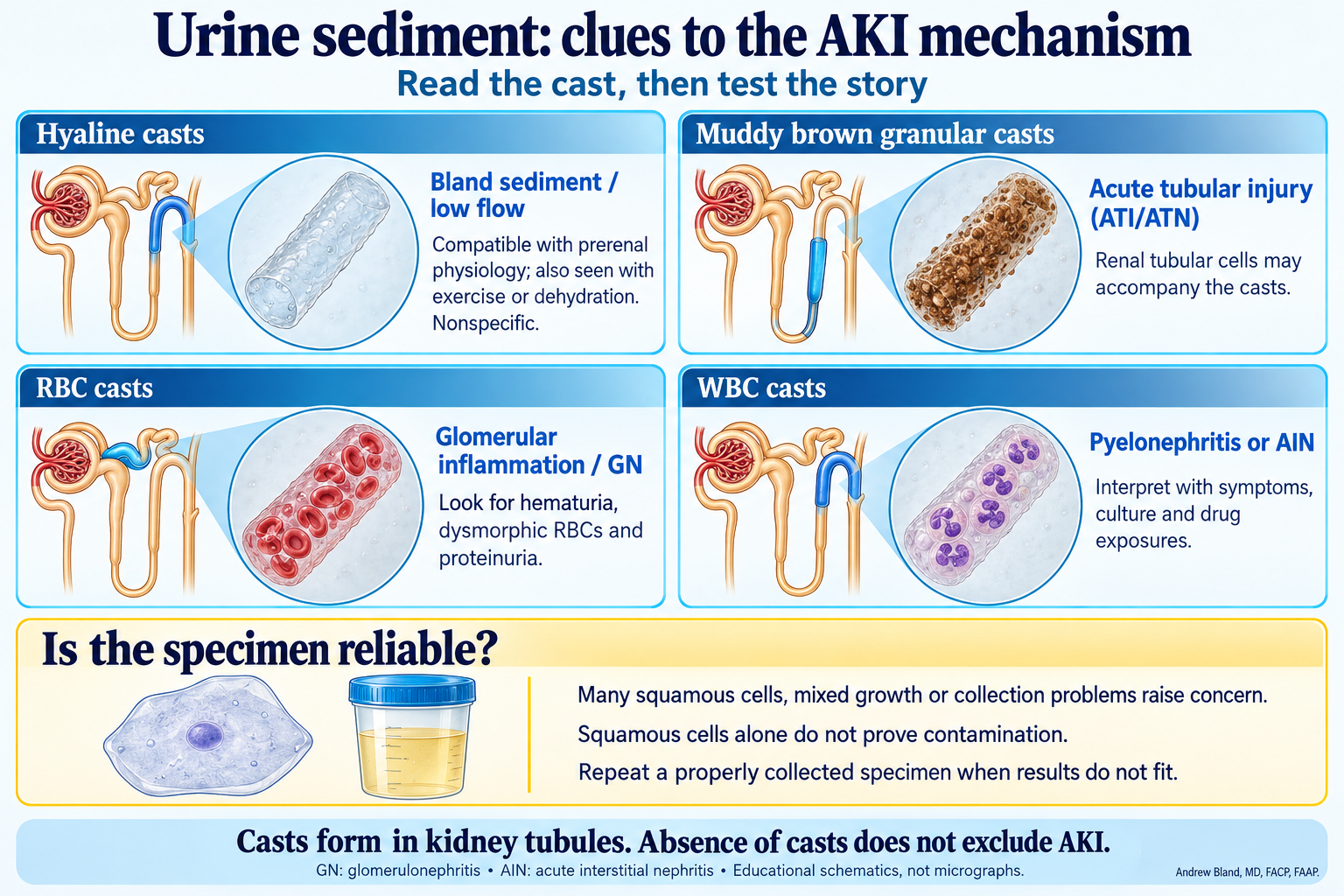
Use the diagram with the teaching text, then apply it to the case findings.
Use this general framework to explain the case results. State what fits, what does not, and which finding changes the next action.
The straight-catheter specimen is obtained at 11:30. The rest of the ED work-up returns over the next two hours.
Blood (ED, 11:10) with her baseline from clinic 3 months ago
How does sodium compare with the supplied range or prior value? Explain what it adds to the pattern, whether the timing or specimen matters, and whether it changes your next step.
Thiazide safety lecture — Risk Factor Analysis and Mitigation Strategies
How does potassium compare with the supplied range or prior value? Explain what it adds to the pattern, whether the timing or specimen matters, and whether it changes your next step.
How does chloride compare with the supplied range or prior value? Explain what it adds to the pattern, whether the timing or specimen matters, and whether it changes your next step.
How does bicarbonate compare with the supplied range or prior value? Explain what it adds to the pattern, whether the timing or specimen matters, and whether it changes your next step.
How does anion gap compare with the supplied range or prior value? Explain what it adds to the pattern, whether the timing or specimen matters, and whether it changes your next step.
How does bun compare with the supplied range or prior value? Explain what it adds to the pattern, whether the timing or specimen matters, and whether it changes your next step.
How does creatinine compare with the supplied range or prior value? Explain what it adds to the pattern, whether the timing or specimen matters, and whether it changes your next step.
AKI BMP pattern guide — Part 6: BMP-Guided Clinical Decision-Making
How does bun:creatinine ratio compare with the supplied range or prior value? Explain what it adds to the pattern, whether the timing or specimen matters, and whether it changes your next step.
AKI BMP pattern guide — Part 6: BMP-Guided Clinical Decision-Making
How does egfr (ckd-epi 2021) compare with the supplied range or prior value? Explain what it adds to the pattern, whether the timing or specimen matters, and whether it changes your next step.
UTI assessment lecture — Evidence-Based UTI Treatment Guidelines
How does glucose compare with the supplied range or prior value? Explain what it adds to the pattern, whether the timing or specimen matters, and whether it changes your next step.
How does calcium compare with the supplied range or prior value? Explain what it adds to the pattern, whether the timing or specimen matters, and whether it changes your next step.
How does magnesium compare with the supplied range or prior value? Explain what it adds to the pattern, whether the timing or specimen matters, and whether it changes your next step.
How does phosphorus compare with the supplied range or prior value? Explain what it adds to the pattern, whether the timing or specimen matters, and whether it changes your next step.
How does albumin compare with the supplied range or prior value? Explain what it adds to the pattern, whether the timing or specimen matters, and whether it changes your next step.
How does serum osmolality (measured) compare with the supplied range or prior value? Explain what it adds to the pattern, whether the timing or specimen matters, and whether it changes your next step.
How does wbc compare with the supplied range or prior value? Explain what it adds to the pattern, whether the timing or specimen matters, and whether it changes your next step.
How does hemoglobin compare with the supplied range or prior value? Explain what it adds to the pattern, whether the timing or specimen matters, and whether it changes your next step.
How does platelets compare with the supplied range or prior value? Explain what it adds to the pattern, whether the timing or specimen matters, and whether it changes your next step.
How does creatine kinase compare with the supplied range or prior value? Explain what it adds to the pattern, whether the timing or specimen matters, and whether it changes your next step.
How does tsh compare with the supplied range or prior value? Explain what it adds to the pattern, whether the timing or specimen matters, and whether it changes your next step.
How does urine albumin-to-creatinine ratio compare with the supplied range or prior value? Explain what it adds to the pattern, whether the timing or specimen matters, and whether it changes your next step.
AKI BMP pattern guide — Part 6: BMP-Guided Clinical Decision-Making
| Test | Today | Baseline (3 mo ago) | Reference range |
|---|---|---|---|
| Sodium | 127 | 138 | 135–145 mEq/L |
| Potassium | 3.4 | 4.0 | 3.5–5.0 mEq/L |
| Chloride | 92 | 102 | 98–107 mEq/L |
| Bicarbonate | 24 | 24 | 22–29 mEq/L |
| Anion gap | 11 | 12 | 8–12 (calculated: Na − [Cl + HCO₃]) |
| BUN | 42 | 24 | 7–20 mg/dL |
| Creatinine | 1.9 | 1.4 | 0.6–1.1 mg/dL |
| BUN:creatinine ratio | 22:1 | 17:1 | 10–20:1 |
| eGFR (CKD-EPI 2021) | not valid — creatinine is moving | 37 | ≥60 mL/min/1.73 m² |
| Glucose | 158 | 142 | 70–99 mg/dL (fasting) |
| Calcium | 9.0 | 9.2 | 8.5–10.5 mg/dL |
| Magnesium | 1.8 | — | 1.7–2.2 mg/dL |
| Phosphorus | 3.9 | — | 2.5–4.5 mg/dL |
| Albumin | 3.6 | 3.8 | 3.5–5.0 g/dL |
| Serum osmolality (measured) | 278 | — | 275–295 mOsm/kg |
| WBC | 8.9 | 7.2 | 4.0–11.0 ×10³/µL |
| Hemoglobin | 11.6 | 11.9 | 12.0–15.5 g/dL |
| Platelets | 232 | — | 150–400 ×10³/µL |
| Creatine kinase | 142 | — | 30–200 U/L |
| TSH | 2.1 | — | 0.4–4.0 mIU/L |
| Urine albumin-to-creatinine ratio | — | 210 | <30 mg/g |
Apply your interpretation in Q7
Revisit the framework: Dipstick lecture — Dipstick Parameter Deep Dive
A note on the osmolality: measured 278 looks normal only because BUN adds 42/2.8 = 15 mOsm/kg. Urea crosses cell membranes and does not pull water, so it is excluded from effective osmolality: 2 × 127 + 158/18 = 263. This is true hypotonic hyponatremia.
A note on the glucose: the glucose-corrected sodium is 127 + 1.6 × (158 − 100)/100 = 128 mEq/L, so glucose is not the explanation for the sodium.
Urine studies (catheter specimen)
How does urine osmolality compare with the supplied range or prior value? Explain what it adds to the pattern, whether the timing or specimen matters, and whether it changes your next step.
How does urine sodium compare with the supplied range or prior value? Explain what it adds to the pattern, whether the timing or specimen matters, and whether it changes your next step.
Thiazide safety lecture — Risk Factor Analysis and Mitigation Strategies
| Test | Result | Reference / note |
|---|---|---|
| Urine osmolality | 310 mOsm/kg | 50–1,200 mOsm/kg (varies with hydration); >300 = not dilute — the thiazide prevents dilution, and volume depletion has ADH (antidiuretic hormone) switched on |
| Urine sodium | 48 mEq/L | Varies with intake; <20 mEq/L suggests volume depletion only OFF diuretics — not interpretable here, and FENa (fractional excretion of sodium) is not calculated after a diuretic |
Apply your interpretation in Q7
Revisit the framework: Dipstick lecture — Dipstick Parameter Deep Dive
If you were thinking "a urinary tract infection explains her confusion," and you then learn that the straight-catheter specimen obtained at the outside facility before your assessment shows 4 WBC/hpf, no bacteria, nitrite negative and leukocyte esterase negative, this hypothesis becomes:
Much less likely
Less likely
Unchanged
More likely
Much more likely
Show answer, explanation and infographics · Link to this question
Learning point: The catheter sample was obtained at the outside facility before your assessment; it is not a recommendation to catheterize or reculture an asymptomatic patient. In this afebrile patient without urinary symptoms, the minimally inflammatory sample further lowers the likelihood of symptomatic UTI. Negative nitrite alone is insensitive; Enterococcus commonly gives a negative result. Neither dipstick nor sediment is an absolute exclusion test. Assess delirium, medications and volume, and reassess if localizing or systemic signs develop.
Why not the others: A is the teaching anchor; B is also acceptable with sound reasoning. C can be defended if the learner explains that UTI was already very unlikely before this sample. D/E need new supporting clinical evidence. This is a formative probability update, not an expert-panel score.
Concept link: structural-04 · Question evidence and course reading
Back to Q7 · All answers in this case
UTI assessment lecture — Evidence-Based UTI Assessment Algorithm
Visual explanation: Positive urine does not establish symptomatic UTI
In an older adult with delirium but no urinary symptoms, fever or instability, evaluate other causes and reassess. Incidental bacteriuria or pyuria does not by itself justify antibiotics or repeated urine cultures. New localizing symptoms or systemic illness changes the assessment; suspected sepsis needs prompt treatment while its source is investigated. Interpret the collection method and colony count together. Pregnancy and selected endourologic procedures with mucosal trauma have specific screening/treatment recommendations.
IDSA asymptomatic bacteriuria guidance · IDSA guideline — PubMed
Andrew Bland, MD, FACP, FAAP
Urinalysis — straight-catheter specimen (ED, 11:30)
How does color / clarity compare with the supplied range or prior value? Explain what it adds to the pattern, whether the timing or specimen matters, and whether it changes your next step.
How does specific gravity compare with the supplied range or prior value? Explain what it adds to the pattern, whether the timing or specimen matters, and whether it changes your next step.
How does ph compare with the supplied range or prior value? Explain what it adds to the pattern, whether the timing or specimen matters, and whether it changes your next step.
How does protein compare with the supplied range or prior value? Explain what it adds to the pattern, whether the timing or specimen matters, and whether it changes your next step.
How does glucose compare with the supplied range or prior value? Explain what it adds to the pattern, whether the timing or specimen matters, and whether it changes your next step.
How does ketones compare with the supplied range or prior value? Explain what it adds to the pattern, whether the timing or specimen matters, and whether it changes your next step.
How does blood compare with the supplied range or prior value? Explain what it adds to the pattern, whether the timing or specimen matters, and whether it changes your next step.
How does leukocyte esterase compare with the supplied range or prior value? Explain what it adds to the pattern, whether the timing or specimen matters, and whether it changes your next step.
How does nitrite compare with the supplied range or prior value? Explain what it adds to the pattern, whether the timing or specimen matters, and whether it changes your next step.
How does wbc compare with the supplied range or prior value? Explain what it adds to the pattern, whether the timing or specimen matters, and whether it changes your next step.
How does rbc compare with the supplied range or prior value? Explain what it adds to the pattern, whether the timing or specimen matters, and whether it changes your next step.
How does squamous epithelial cells compare with the supplied range or prior value? Explain what it adds to the pattern, whether the timing or specimen matters, and whether it changes your next step.
Interpretation lecture — Critical Microscopy Findings and Contamination
How does mucus threads compare with the supplied range or prior value? Explain what it adds to the pattern, whether the timing or specimen matters, and whether it changes your next step.
How does bacteria compare with the supplied range or prior value? Explain what it adds to the pattern, whether the timing or specimen matters, and whether it changes your next step.
How does casts compare with the supplied range or prior value? Explain what it adds to the pattern, whether the timing or specimen matters, and whether it changes your next step.
Interpretation lecture — Critical Microscopy Findings and Contamination
How does crystals compare with the supplied range or prior value? Explain what it adds to the pattern, whether the timing or specimen matters, and whether it changes your next step.
Interpretation lecture — Critical Microscopy Findings and Contamination
| Test | Result | Reference |
|---|---|---|
| Color / clarity | Yellow / clear | Yellow / clear |
| Specific gravity | 1.012 | 1.005–1.030 |
| pH | 6.0 | 4.5–8.0 |
| Protein | Trace | Negative |
| Glucose | Negative | Negative |
| Ketones | Negative | Negative |
| Blood | Negative | Negative |
| Leukocyte esterase | Negative | Negative |
| Nitrite | Negative | Negative |
| WBC | 4/hpf | 0–5/hpf |
| RBC | 0–1/hpf | 0–3/hpf |
| Squamous epithelial cells | 0–1/lpf | <5/lpf |
| Mucus threads | None | None |
| Bacteria | None | None |
| Casts | 1–2 hyaline/lpf | Occasional hyaline acceptable in concentrated urine |
| Crystals | None | None |
Apply your interpretation in Q8
Revisit the framework: Dipstick lecture — Dipstick Parameter Deep Dive
Other results - Bladder scan after voiding: post-void residual 60 mL (no retention). - Non-contrast CT head (for the fall with new confusion): no hemorrhage, no mass; age-appropriate atrophy. - Left hip and pelvis radiographs: no fracture. - 12-lead ECG: sinus rhythm 80/min, normal intervals, no T-wave or QRS change. - The facility's culture (from the bag specimen sent 2 days ago) posts at 13:15: "Mixed urogenital flora, 3 organisms, 10,000–50,000 CFU/mL each — suggests contamination; recollect if clinically indicated."
Pause — commit before the reveal
The facility nurse calls at 13:20: "The original bag-collected culture grew 50,000 CFU/mL of mixed flora. Are you starting the antibiotic?" The catheter specimen shows 4 WBC/hpf, no bacteria, nitrite and leukocyte esterase negative, and no casts. Mrs. Lund is afebrile with a white count of 8.9 and no urinary symptoms. Your answer?
Yes — fosfomycin 3 g once; 50,000 CFU/mL exceeds the 10,000 threshold used for symptomatic women
No — low-count mixed flora from a bag is contamination, and the catheter urine shows no pyuria or bacteria
Not yet — send a culture from the catheter specimen and treat whatever organism grows from it
No antibiotic, but this is sterile pyuria and she needs a work-up for drug-induced acute interstitial nephritis
Show answer, explanation and infographics · Link to this question
Learning point: Mixed low-count growth from a poorly collected bag specimen, no urinary or systemic symptoms and an uninflamed catheter specimen do not support UTI. Do not give antibiotics or repeat cultures reflexively. Colony-count thresholds depend on symptoms and collection method: clinically meaningful infection can occur below 100,000 CFU/mL, and even high counts without compatible symptoms may be asymptomatic bacteriuria.
Why not the others: A imports a threshold from a different symptomatic setting. C would treat asymptomatic culture growth. D calls a specimen with 4 WBC/hpf sterile pyuria without supporting evidence. Pregnancy and endourologic procedures with mucosal trauma are established ASB treatment indications; some other populations have evidence gaps rather than a universal two-exception rule.
Concept link: structural-04 · Question evidence and course reading
Back to Q8 · All answers in this case
UTI assessment lecture — Asymptomatic Bacteriuria: The Great Overtreatment
Visual explanation: Positive urine does not establish symptomatic UTI
In an older adult with delirium but no urinary symptoms, fever or instability, evaluate other causes and reassess. Incidental bacteriuria or pyuria does not by itself justify antibiotics or repeated urine cultures. New localizing symptoms or systemic illness changes the assessment; suspected sepsis needs prompt treatment while its source is investigated. Interpret the collection method and colony count together. Pregnancy and selected endourologic procedures with mucosal trauma have specific screening/treatment recommendations.
IDSA asymptomatic bacteriuria guidance · IDSA guideline — PubMed
Andrew Bland, MD, FACP, FAAP
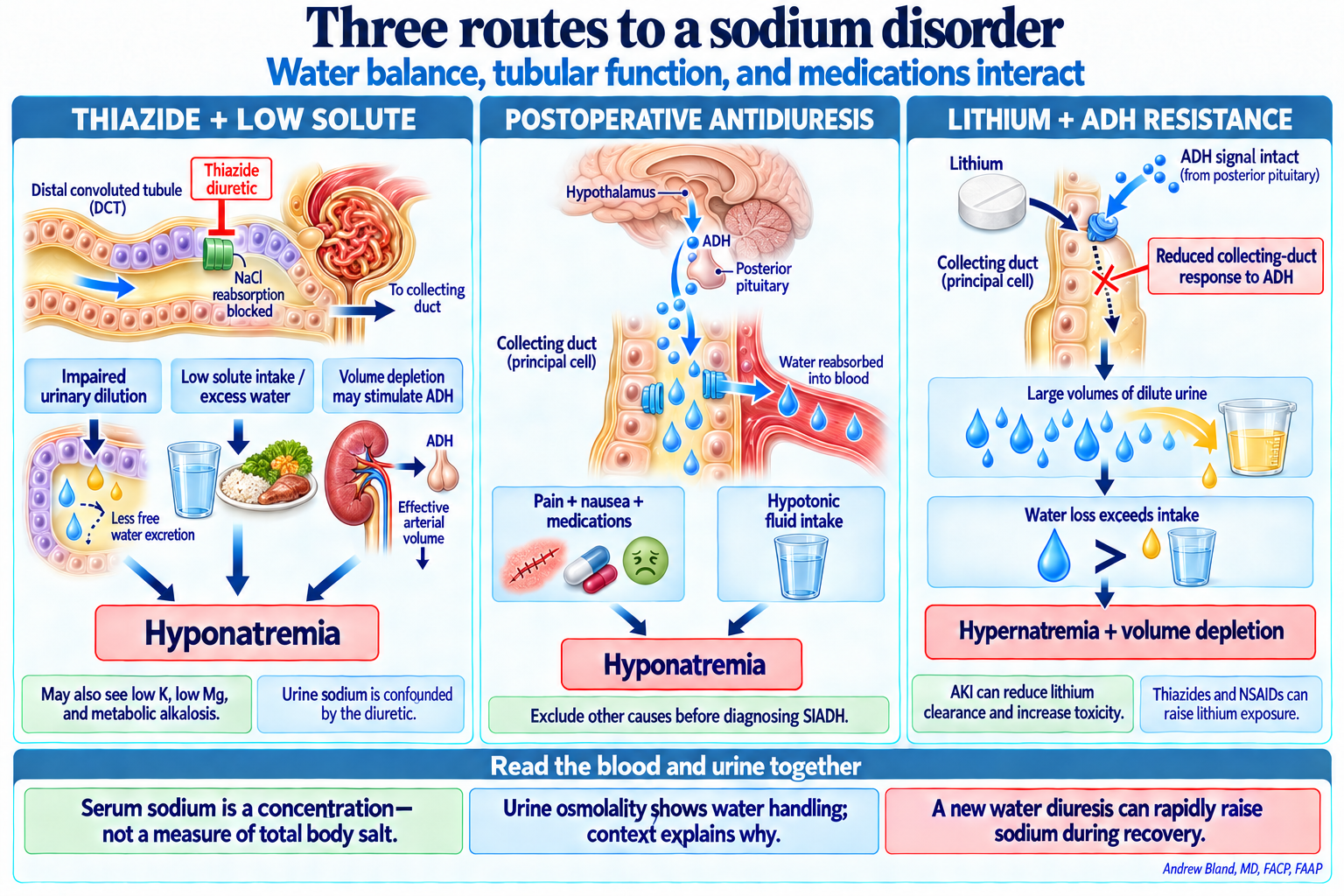
Use the diagram with the teaching text, then apply it to the case findings.
Explain the intended effect, the major treatment risk and the observation that will tell you whether the plan is working.
Her creatinine is 1.9 mg/dL against a baseline of 1.4 three months ago — a rise of 0.5 mg/dL, about a third above baseline, after three days of poor intake, with BUN 42 (ratio 22:1), potassium 3.4, bicarbonate 24, a post-void residual of 60 mL, and a bland catheter urinalysis with a few hyaline casts. She is making urine. She is also delirious and hyponatremic and cannot reliably drink. What is the right disposition?
Return to assisted living with encouragement to drink and a repeat BMP in 48–72 hours; a 0.5 mg/dL rise without hyperkalemia does not need the hospital
Keep her today: isotonic fluids, medication holds, sodium every 4–6 h and a repeat BMP — the delirium and sodium decide this, not the creatinine
Call nephrology today to begin dialysis planning, because the creatinine has risen by more than a third on top of CKD G3b
Order a CT of the abdomen and pelvis with IV contrast today to find the cause of the creatinine rise before anything else
Show answer, explanation and infographics · Link to this question
Learning point: Poor intake, orthostasis and weight loss make reduced effective renal perfusion a leading contributor. BUN:creatinine and hyaline casts are supporting clues, not proof, and mixed injury remains possible. The old baseline does not establish the acute time interval. Delirium, inability to drink and sodium monitoring needs require same-day care. Reassess after cautious isotonic fluid, stop hydrochlorothiazide and offending sedating medicines, and temporarily hold metformin/lisinopril with a recovery plan. Follow serial creatinine, urine output, sodium and potassium; steady-state eGFR is unreliable during change.
Why not the others: A misses her symptoms and monitoring needs. C confuses an acute potentially reversible change with a dialysis indication. D orders contrast CT without a defined question; obtain targeted imaging when the clinical assessment indicates it.
Concept link: aki-27, structural-25 · Question evidence and course reading
Back to Q9 · All answers in this case
FENa diagnostic review, 2022 — PubMed
Visual explanation: BUN:creatinine is a clue, not a diagnosis

BUN and creatinine in mg/dL. A ratio around 20:1 does not diagnose dehydration. More urea production: upper GI bleeding (digested blood protein); high protein intake or feeds; glucocorticoids; catabolism from fever, infection, burns or trauma. More urea reabsorption: low effective perfusion in volume depletion OR heart failure. Less creatinine production: low muscle mass or frailty can raise the ratio without extra urea. Use the ratio with the history, medications, JVP, edema, weight, BP, urine output and serial labs. Case 6: BUN 52 / creatinine 2.6 = 20. His high JVP and weight gain support congestion; the ratio alone does not justify saline. Source: Clinical Methods, BUN and Creatinine; AHA cardiorenal statement.
Clinical Methods: BUN and Creatinine · AHA cardiorenal scientific statement (2019)
Andrew Bland, MD, FACP, FAAP
Mrs. Lund is admitted to the medical floor at 14:30. Orders: hydrochlorothiazide, gabapentin and diphenhydramine stopped; metformin and lisinopril held; isotonic saline 500 mL over one hour, then 75 mL/h; sodium every 6 hours with a hard stop if it rises more than 8 mEq/L in 24 hours; fall precautions; no urinary catheter; no antibiotic. Her daughter arrives at 16:00 and confirms that "Mom was sharp two weeks ago."
Before we follow her, a counterfactual: the same woman, a different cup.
Pause — commit before the reveal
Now suppose the straight-catheter specimen had instead shown 60 WBC/hpf, white-cell casts, nitrite positive and many uniform rod-shaped bacteria — and that she had a temperature of 38.6 °C and tenderness over the right costovertebral angle. Same woman: 84 years old, CKD G3b with a creatinine of 1.9 today, delirious, not drinking, living in assisted living. What is the best plan?
Nitrofurantoin 100 mg twice daily for 5 days, and back to assisted living the same day
Trimethoprim-sulfamethoxazole DS twice daily for 14 days, back to assisted living, BMP in one week
Ciprofloxacin 500 mg twice daily for 7 days, back to assisted living with a next-day phone call
Admit; cultures before the first dose; IV ceftriaxone 1 g daily; renal ultrasound within 24 h
Show answer, explanation and infographics · Link to this question
Learning point: Fever, flank tenderness and inflammatory urine support pyelonephritis; delirium, poor intake and possible AKI favor hospital care. Obtain urine and, when indicated, blood cultures before antibiotics if this does not delay treatment of sepsis. Ceftriaxone is a reasonable initial option depending on local resistance and prior cultures; generally no adjustment is needed for isolated renal impairment at usual doses. Evaluate promptly for obstruction; ultrasound is useful for hydronephrosis, while CT may be needed for stones, abscess or persistent complicated infection. Select and reassess all other drug doses using the current renal trajectory and pharmacy advice, not an old baseline alone.
Why not the others: A: nitrofurantoin does not provide appropriate kidney-tissue treatment for pyelonephritis. B and C propose outpatient treatment for a patient needing inpatient assessment; susceptibility, interactions and renal dosing also matter. During AKI, use current trajectory, drug-specific guidance and pharmacy support rather than the old baseline alone.
Concept link: structural-05 · Question evidence and course reading
Evidence and objective for Q10
Back to Q10 · All answers in this case
Renal labs and imaging handout — Section 3: Renal Imaging Modalities
Visual explanation: Positive urine does not establish symptomatic UTI
In an older adult with delirium but no urinary symptoms, fever or instability, evaluate other causes and reassess. Incidental bacteriuria or pyuria does not by itself justify antibiotics or repeated urine cultures. New localizing symptoms or systemic illness changes the assessment; suspected sepsis needs prompt treatment while its source is investigated. Interpret the collection method and colony count together. Pregnancy and selected endourologic procedures with mucosal trauma have specific screening/treatment recommendations.
IDSA asymptomatic bacteriuria guidance · IDSA guideline — PubMed
Andrew Bland, MD, FACP, FAAP
Back to the real Mrs. Lund. Sodium 127 at 11:10 → 130 at 17:00 → 132 at 23:00 → 134 at 11:00 the next morning: a rise of 7 mEq/L in 24 hours, under the ceiling. The saline is stopped on hospital day 2 once she is drinking. Creatinine 1.9 → 1.7 (day 2) → 1.5 (day 3) → 1.4 (day 4, back to baseline). The myoclonus is gone by the second morning; by the third she knows the month and asks whether anyone has fed her cat. At her clearance gabapentin takes days, not hours, to wash out — the drug was still leaving her on day 3.
On hospital day 4 she is alert and oriented to her baseline, euvolemic, eating, sodium 137, potassium 4.1, creatinine 1.4 (eGFR 37). Blood pressure is 142/78 off all antihypertensives. Which of her home medications should NOT be restarted at discharge?
Lisinopril 10 mg daily
Hydrochlorothiazide 25 mg daily
Metformin 500 mg twice daily
Atorvastatin 20 mg nightly
Show answer, explanation and infographics · Link to this question
Learning point: The thiazide caused a sodium of 127 within four weeks in exactly the patient the risk tables describe — an older woman of low body weight [11] — and rechallenge reproduces it, so it is replaced with a different class (a low-dose dihydropyridine such as amlodipine is a common choice at 84) and goes on her allergy-and-intolerance list. The rest of the list is a restart-when-safe list, not a stop list: lisinopril comes back now that she is euvolemic with the creatinine at baseline, because her albuminuria (UACR 210 mg/g) is the indication and the ACE inhibitor protects the kidney; metformin comes back at 500 mg twice daily, the capped dose for eGFR 30–45, because it was held for the acute illness, not stopped for her CKD; the statin was never the problem. Gabapentin and diphenhydramine are handled separately at discharge — see the Resolution.
Why not the others: A: a transient perfusion-related episode is not a reason to abandon beneficial RAAS blockade permanently; reassess and restart when appropriate. ACEi/ARB is one component of kidney protection alongside an eligible SGLT2 inhibitor and other indicated therapy. C: the illness has resolved and a reduced metformin dose is appropriate at stable eGFR 37. D: atorvastatin generally requires no renal dose adjustment; this is not a claim about every statin.
Concept link: ckd-18, structural-25 · Question evidence and course reading
Evidence and objective for Q11
Back to Q11 · All answers in this case
Geriatric nephrology handout — Explicit Criteria for Medication Deprescribing
KDIGO 2024 CKD · Case 5: metformin evidence, severe/fatal uncertainty and specialist plans
Visual explanation: One thiazide, several connected abnormalities
Impaired dilution, potassium loss, and the patient's intake interact
Andrew Bland, MD, FACP, FAAP
Medication-associated delirium, low sodium, reduced clearance, and misleading urine findings.
Compare thiazide-associated hyponatremia, postoperative antidiuresis, and lithium-associated ADH resistance.
The drug itself changes renal sodium handling. Interpret urine osmolality and electrolytes with volume status, dietary intake, medication timing, and the clinical course. Concentrated urine indicates impaired water excretion but does not identify one unique cause.
Mrs. Lund returns to assisted living on hospital day 4 with amlodipine 2.5 mg daily in place of hydrochlorothiazide, lisinopril and metformin resumed at their prior doses, atorvastatin and PRN acetaminophen unchanged, gabapentin restarted at 100 mg at bedtime, and diphenhydramine removed from her PRN list. The gabapentin plan is to titrate no higher than the label's 200–700 mg/day band for her clearance (a lower patient-specific dose may be preferable because of her prior toxicity) and to reassess whether it helps her feet at all; the diphenhydramine is replaced with non-drug sleep measures, because anticholinergics in older adults mean delirium, falls and urinary retention — which is why they sit on the Beers list of drugs to avoid in older adults . Her discharge letter to the facility says three things in plain language: no bag specimens for urinalysis — a clean catch with an aide's help, or a straight catheter when the question is real; confusion, by itself, is not a urinary symptom; and any new drowsiness, fall or poor intake gets a same-day sodium and creatinine, not an antibiotic. Her primary care clinic rechecks a BMP in one week (sodium 138, creatinine 1.4) and at the visit her daughter asks the question every family asks: "If it wasn't a UTI, why does everyone always say it is?" The honest answer is that the cup is easy to send and the medication list is hard to read.
Clinical Pearl — Read the specimen before the result Many squamous epithelial cells (more than 5–10 per low-power field, lpf — Mohr's cutoff was more than 8/lpf ), mucus threads and bacteria of several shapes on one slide mean the urine ran across the perineum. That urinalysis cannot tell you about the bladder. Recollect: clean catch with help, or a straight catheter when cognition or mobility make a clean catch impossible. Never force an interpretation onto a bad sample.
Clinical Pearl — The dipstick is a rule-out test Both infection pads negative (leukocyte esterase and nitrite) lowers the odds of infection in every population. A positive leukocyte esterase in an older woman is close to uninformative on its own. Nitrite needs about 4 hours of bladder dwell time and a nitrate-reducing organism; frequency, diuretics and Enterococcus all blank the pad.
Clinical Pearl — "Delirium plus bacteriuria" is not a diagnosis Established ASB treatment indications include pregnancy and endourologic procedures with mucosal trauma. IDSA recommends against treating bacteriuria for isolated delirium or falls in older adults without local urinary or systemic infection signs. Other special populations have separate recommendations or evidence gaps. Obtain a urine culture for a clinical indication, not to explain every episode of confusion.
Clinical Pearl — Labels dose by creatinine clearance, not eGFR Follow the renal-function measure specified by the particular drug label; CrCl and indexed eGFR are not interchangeable. Gabapentin uses a creatinine-clearance table: >15–29 mL/min, 200–700 mg once daily; at 15, 100–300 mg/day, with proportionate reduction below 15. This is a reference range, not a mandate to reach its upper end. Frailty, indication and adverse effects guide the actual dose.
Clinical Pearl — Thiazide hyponatremia can have different volume patterns and can overcorrect Stop the thiazide and assess volume and neurologic symptoms. This patient is volume-depleted, so cautiously replace the deficit while monitoring sodium and urine output. Other thiazide-associated cases appear euvolemic. Restoration of water excretion can cause rapid correction; use an explicit limit and escalation plan. Avoid rechallenge after this severe episode.
Pitfall — Treating the number instead of the patient An antibiotic for 8 WBC/hpf in a bag specimen. Fluid restriction for a sodium of 127 before anyone checked orthostatic vitals. A nephrology call for a creatinine of 1.9 before the bladder scan and the medication review. Each one skips the five-minute step that would have changed the plan.
Pitfall — Nitrofurantoin for the wrong patient Nitrofurantoin is not appropriate for pyelonephritis because it does not provide adequate renal tissue treatment. Renal thresholds differ between the US label and prescribing guidance; the commonly used CrCl <30 avoidance rule is not the original label threshold. Her CrCl near 25 and suspected upper-tract illness both argue against it. Select an alternative from the clinical syndrome, cultures and local susceptibility data.
Assigned reading: the explanations in this case and the question-linked course evidence guide. The objective map distinguishes tested decisions from concepts taught in explanations.
Concepts: aki-06, aki-27, ckd-18, glom-01, glom-02, lytes-01, lytes-06, structural-04, structural-05, structural-14, structural-18, structural-25.
Interpretation lecture — Critical Microscopy Findings and Contamination
AKI BMP pattern guide — Part 6: BMP-Guided Clinical Decision-Making
UTI assessment lecture — Asymptomatic Bacteriuria: The Great Overtreatment
UTI assessment lecture — Evidence-Based UTI Treatment Guidelines
Renal labs and imaging handout — Section 3: Renal Imaging Modalities
Renal pharmacology lecture — 1. Drug Dosing in CKD: Principles of Renal Clearance
Geriatric nephrology handout — III. Geriatric Drug Dosing in CKD
Drug dosing in CKD quick reference — Part 1: Principles of Drug Dosing in CKD
Thiazide safety lecture — Risk Factor Analysis and Mitigation Strategies
First choices and optional confidence stay in this browser and are not sent to the website. Opening an explanation first is recorded. Revisiting an unchanged case preserves the first response; revised cases receive a new version. Website visit analytics are separate. On a shared device, export and clear the history when finished.